

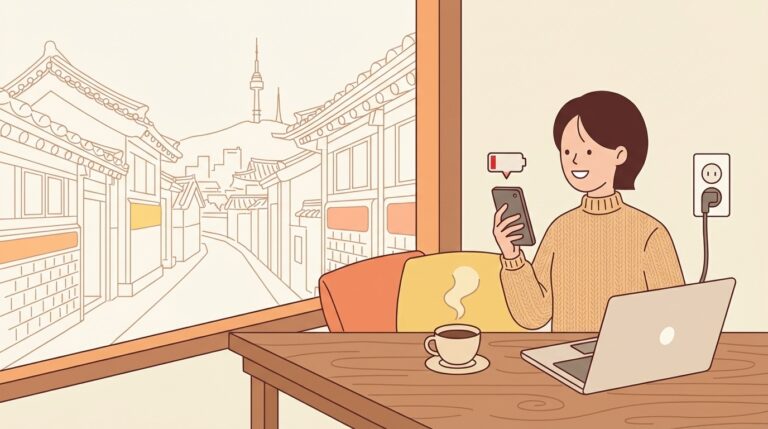
Don’t Panic in Korean Cafes! The Magic Phrases to Find a Plug Seat
Phase 1: Empathy (The K-Culture Cold Open)
Hello! It’s your Daily Hangul editor. Imagine this: You’re walking around Hongdae or Seongsu-dong. Your feet hurt, and your phone battery is at a terrifying 3%. You finally find a gorgeous, aesthetically pleasing cafe—the exact kind you see in K-Dramas. You walk in, spot an empty seat, but… wait, is there an outlet? You want to ask the barista, or maybe the person sitting next to the plug, but your mind goes blank. Does this sound familiar?
You are not alone! Knowing how to secure a ‘plug seat’ is a crucial survival skill in Korea’s bustling cafe culture. If you don’t know the right words, you might end up sipping your Iced Americano with a dead phone, unable to use your map app to find your way home. Today, I’ll teach you exactly how to ask for an outlet without feeling awkward, so you can recharge your phone and yourself like a true local. This guide is built from real questions my beginner students ask me every week!
Phase 2: Core Phrases Deep Dive
1. 콘센트 있어요?
- Pronunciation: [kon-sen-teu i-sseo-yo?] (‘eu’ sounds like the disgusted sound you make when stepping in gum)
- Meaning: Are there outlets? (Literal: Is there a concent?)
- K-Culture Moment: You enter a cafe, hold up your phone with a desperate look, and ask the barista this. They smile, nod, and point to a cozy corner seat.
- Editor’s Insight: In Korea, we don’t say ‘outlet’ or ‘socket.’ We use the Konglish (Korean-English) word ‘콘센트’ (concent). If you ask for an ‘outlet’, they might give you directions to the nearest premium shopping mall!
- Situation Spectrum:
[🚫 절대 금지] ———— [⚠️ 주의] ———— [✅ 자유롭게]
- Friends (Casual): ✅ (Just drop the ‘yo’: 콘센트 있어?)
- Cafe Staff (Semi-formal): ✅
- Formal/Elders: ⚠️ (Use ‘있습니까?’ if very formal, but ‘있어요’ is perfectly fine for cafes)
- 🤔 Think About It: Why do you think Korea adopted English words but changed their meanings (like Concent, or ‘Notebook’ for laptop)? Does your native language do this too?
2. 여기 앉아도 돼요?
- Pronunciation: [yeo-gi an-ja-do dwae-yo?] (‘an-ja’ sounds like the name ‘Anya’ but with a ‘j’)
- Meaning: Can I sit here? (Literal: Is it okay even if I sit here?)
- K-Culture Moment: In a K-Drama, the male lead approaches the only empty seat at a communal table right next to the female lead and asks this. Sparks fly!
- Editor’s Insight: Use this when you find a plug, but someone’s bag is nearby, or you want to share a large communal table. It’s polite and shows good manners.
- Situation Spectrum:
[🚫 절대 금지] ———— [⚠️ 주의] ———— [✅ 자유롭게]
- Friends (Casual): ✅ (여기 앉아도 돼?)
- Strangers/Staff (Semi-formal): ✅
- Formal/Elders: 🚫 (Use ‘여기 앉아도 될까요?’ to be more respectful)
- 🤔 Think About It: Koreans highly value asking for permission before invading personal space, even in public cafes.
3. 충전할 수 있어요?
- Pronunciation: [chung-jeon-hal su i-sseo-yo?] (‘chung’ rhymes with ‘lung’)
- Meaning: Can I charge my phone? (Literal: Is there the ability to charge?)
- K-Culture Moment: When your battery is dead, you can hand your phone to a convenience store clerk or restaurant owner and ask this. Many places in Korea will kindly charge it for you behind the counter!
- Editor’s Insight: ‘충전’ (chung-jeon) means ‘charge.’ This is a true lifesaver phrase.
- Situation Spectrum:
[🚫 절대 금지] ———— [⚠️ 주의] ———— [✅ 자유롭게]
- Friends (Casual): ✅ (충전할 수 있어?)
- Cafe Staff (Semi-formal): ✅
- Formal/Elders: ⚠️
Phase 3: Textbook vs. Real Korean
| Situation | 📖 Textbook Korean | 🗣️ Real Korean | 💡 Why is it different? |
|---|---|---|---|
| Looking for a plug | 전원 소켓이 어디에 있습니까? | 콘센트 자리 있어요? | ‘콘센트’ is the everyday Konglish word. No one says ‘전원 소켓’ (power socket) in real life. |
| Asking to charge | 제 휴대폰을 충전해 주시겠습니까? | 핸드폰 충전 돼요? | Koreans love efficiency. Dropping the subject (‘my’) and shortening the verb makes it fast and natural! |
| Asking to sit | 이 자리에 앉아도 괜찮습니까? | 여기 앉아도 돼요? | ‘돼요?’ (Is it okay?) is the most common and friendly way to ask for permission. |
Phase 4: Cultural Context — K-Culture Deep Dive
4-1. Non-verbal Cues: The Art of ‘Nunchi’ (눈치)
When asking to share a table or use a plug near someone, a slight bow of the head is essential. Don’t just aggressively reach over someone’s laptop to plug in your charger! Make eye contact, smile slightly, and use your Nunchi (social sense) to see if they are deep in concentration before interrupting.
4-2. K-Travel & K-Drama Connection: The ‘Unattended Laptop’ Trust
If you watch K-Dramas or travel vlogs, you’ve probably noticed something wild: Koreans leave their laptops, phones, and wallets on cafe tables while they go to the restroom! This is the ultimate ‘K-Trust.’ It is perfectly safe to leave your things to reserve a ‘콘센트 자리’ (plug seat). However, if someone is away from their desk, never unplug their charger to use the outlet. That is a huge breach of cafe etiquette!
Phase 5: Real Roleplay Scenario
Setting: A trendy, minimalist cafe in Seongsu-dong. It’s 2 PM on a Saturday. Every seat is full, except one spot at a large communal table. There is a plug, but a Korean student (Min-ji, 22, wearing AirPods and typing on her laptop) has her coffee near it. You have 5% battery left.
Characters:
– YOU: A traveler exploring Seoul.
– Min-ji: A local college student studying at the cafe.
Dialogue:
YOU: 저기요…
(jeo-gi-yo…)
[Excuse me…]
(🎭 Stage Direction: You wave your hand slightly to get her attention)
Min-ji: (Takes out one AirPod) 네?
(ne?)
[Yes?]
YOU: 혹시, 여기 앉아도 돼요?
(hok-si, yeo-gi an-ja-do dwae-yo?)
[By any chance, can I sit here?]
Min-ji: 아, 네. 앉으세요.
(a, ne. an-jeu-se-yo.)
[Ah, yes. Please sit.]
YOU: 감사합니다.
(gam-sa-ham-ni-da.)
[Thank you.]
(🎭 Stage Direction: You sit down and take out your phone charger, looking at the outlet)
Min-ji: 혹시 핸드폰 충전하실 거예요?
(hok-si haen-deu-pon chung-jeon-ha-sil geo-ye-yo?)
[By any chance, are you going to charge your phone?]
YOU: 네, 배터리가 없어서요.
(ne, bae-teo-ri-ga eop-seo-seo-yo.)
[Yes, because I have no battery.]
Min-ji: 여기 콘센트 쓰세요. 저는 다 했어요.
(yeo-gi kon-sen-teu sseu-se-yo. jeo-neun da hae-sseo-yo.)
[Use the outlet here. I am all done.]
YOU: 우와, 진짜 감사합니다!
(u-wa, jin-jja gam-sa-ham-ni-da!)
[Wow, thank you so much!]
Min-ji: 아니에요. 편하게 쓰세요.
(a-ni-e-yo. pyeon-ha-ge sseu-se-yo.)
[No problem. Use it comfortably.]
🔀 Your Turn! What if Min-ji was STILL using the outlet, but you desperately needed it? What should you do?
– A) Unplug her laptop and plug yours in. (Survival of the fittest!)
– B) “혹시… 충전 다 하셨어요?” (By any chance… are you done charging?)
– C) Sigh loudly until she notices your pain.✅ Best Choice: B — It’s polite, uses Nunchi, and gently asks about her status. She will likely let you use it soon!
⚠️ Choice A Analysis: Absolutely 🚫! Touching someone else’s belongings is the quickest way to ruin the peaceful K-Cafe vibe.
Phase 6: 10-Second Shadowing Drill
Let’s practice! Speak out loud focusing on the pauses (/) and the emotion tags.
😊 저기요, / 콘센트 자리 / 있어요?
(jeo-gi-yo, / kon-sen-teu ja-ri / i-sseo-yo?)
🥺 혹시 / 여기 / 앉아도 돼요?
(hok-si / yeo-gi / an-ja-do dwae-yo?)
🙏 제 핸드폰 / 충전할 수 / 있어요?
(je haen-deu-pon / chung-jeon-hal su / i-sseo-yo?)
Phase 7: K-Culture Mini Dictionary
| 한국어 | Romanization | English | Context |
|---|---|---|---|
| 카공 | ka-gong | Cafe studying | Short for ‘카페 공부’. A massive culture in Korea where students study in cafes. |
| 콘센트 | kon-sen-teu | Electrical outlet/plug | Essential Konglish word. Don’t say ‘outlet’! |
| 눈치 | nun-chi | Social sense | The ability to read the room and understand someone’s mood. |
| 아아 | a-a | Iced Americano | The unofficial national drink of Korea. Short for 아이스 아메리카노. |
Phase 8: Traveler Survival Kit
🆘 Survival Phrases for Korean Cafes
– 🇰🇷 “와이파이 비밀번호 뭐예요?” (wa-i-pa-i bi-mil-beon-ho mwo-ye-yo?)
– 🗣️ Meaning: What is the Wi-Fi password?
– 🇰🇷 “화장실 어디에 있어요?” (hwa-jang-sil eo-di-e i-sseo-yo?)
– 🗣️ Meaning: Where is the restroom?
– 🇰🇷 “영수증 버려주세요.” (yeong-su-jeung beo-ryeo-ju-se-yo.)
– 🗣️ Meaning: Please throw away the receipt.📌 Editor’s Travel Note
– Wi-Fi & Restrooms: In Korea, the Wi-Fi password and restroom door code are almost ALWAYS printed at the bottom of your receipt! Don’t throw it away immediately if you need to connect.
– Adapter: Korea uses Type F (220V, round pins). Make sure you have the right adapter for the ‘콘센트’!
Phase 9: Critical Thinking — “One Step Deeper”
🧠 Think Deeper: Media vs Reality — The ‘Unattended Laptop’ Phenomenon
You’ve probably seen TikToks or YouTube videos praising Korea because people leave their expensive laptops on cafe tables unattended. Is this true? Yes! Korea is generally a high-trust society, heavily supported by an extensive network of CCTVs everywhere. However, it’s also about an unspoken social contract among “카공족” (cafe studiers) to watch each other’s backs. But here is the funny reality: while your $2,000 laptop is completely safe, if you leave a $3 umbrella in the umbrella stand on a rainy day, it will magically disappear in 5 minutes!
💬 Your Turn: Would you feel safe leaving your phone or laptop on a cafe table in your home country to go to the restroom? Share your thoughts in the comments!
Phase 10: FAQ & Avoiding Misunderstandings
- Q: Can I sit at a cafe for 4 hours with just one drink?
- A: For large franchise cafes (like Starbucks), it’s generally okay. However, for small, independent cafes, staying too long without ordering more is considered bad manners (we call this 진상 – jin-sang). A polite rule of thumb is 1 drink per 2 hours!
- Q: Is it okay to use formal language (있습니까?) to the cafe staff?
- A: You can, but it sounds a bit like a soldier or a news anchor. Ending your sentences with ‘~요’ (yo) is polite, natural, and perfect for customer service interactions.
❌ Common Mistake #1: Asking for an “아울렛” (Outlet) instead of a “콘센트” (Concent). The staff will think you want to go shopping for discounted clothes!
✅ Do this instead: Always say “콘센트 있어요?”
Phase 11: Summary & Action Items
✨ One-Liner Summary: To survive in a Korean cafe and save your dying phone, always ask for a “콘센트” (concent), not an outlet!
🎯 Action Mission 3-Steps:
– 🥉 Bronze (Solo): Stand in front of a mirror and ask “콘센트 있어요?” out loud 3 times.
– 🥈 Silver (Online): Look up a cafe in Seoul on Google Maps (like Cafe Onion) and look at the photos. Can you spot the ‘콘센트’?
– 🥇 Gold (Real Life): Next time you visit a Korean cafe, restaurant, or convenience store, ask the staff “충전할 수 있어요?” to charge your phone!
☕ K-Culture Mission: Watch a K-Drama this week and count how many times you see the characters drinking an “아아” (Iced Americano) in a cafe.
Engagement: Are you an “Iced Americano even in freezing winter” person like most Koreans, or do you prefer warm drinks? Let me know below!
Phase 12: Interactive Quiz
1. Situational Judgment: You are at a cafe, and your phone is dead. You want to hand your phone to the staff behind the counter to ask for a charge. What is the most natural thing to say?
– A) 전원 소켓 어디입니까? (Where is the power socket?)
– B) 핸드폰 충전할 수 있어요? (Can I charge my phone?)
– C) 배터리 주세요. (Give me a battery.)
2. True or False — K-Culture Edition:
It is perfectly acceptable to unplug someone’s laptop in a cafe if they went to the restroom and you really need to charge your phone. (T/F)
3. Fill in the Blank:
Excuse me, can I sit here? -> 저기요, 여기 ( ______ ) 돼요?
(Check your answers below!)
Click here for answers
1. B (A is too robotic, and C literally means “give me a battery”.)
2. False! Touching someone else’s charger or belongings is a big no-no. Wait until they return and ask politely.
3. 앉아도 (an-ja-do)
Frequently Asked Questions (FAQ)
Q: What does "콘센트 있어요?" mean in Korean and how do you pronounce it?
A: In Korean, "콘센트 있어요?" is pronounced [kon-sen-teu i-sseo-yo?] and means: Are there outlets? (Literal: Is there a concent?)
Q: What does "여기 앉아도 돼요?" mean in Korean and how do you pronounce it?
A: In Korean, "여기 앉아도 돼요?" is pronounced [yeo-gi an-ja-do dwae-yo?] and means: Can I sit here? (Literal: Is it okay even if I sit here?)
Q: What does "충전할 수 있어요?" mean in Korean and how do you pronounce it?
A: In Korean, "충전할 수 있어요?" is pronounced [chung-jeon-hal su i-sseo-yo?] and means: Can I charge my phone? (Literal: Is there the ability to charge?)







