

Hello! It’s your Daily Hangul Editor.
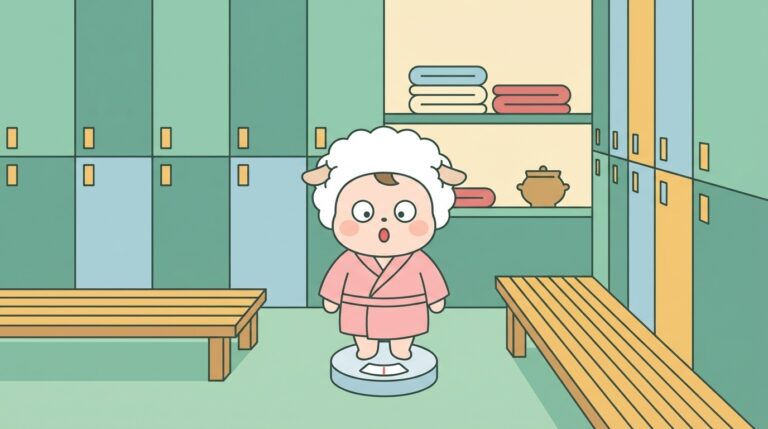
Picture this: You are watching your favorite K-Drama. The main characters are relaxing at a Jjimjilbang (Korean sauna), wearing cute ‘sheep-head’ towels, cracking baked eggs on each other’s foreheads, and sipping sweet rice punch.
Suddenly, one of them steps on a scale in the corner of the locker room, looks at the number, and screams in frustration!
Have you ever wondered what happens in a real Korean sauna? If you travel to Korea, visiting a sauna is an absolute must-do experience. But navigating the locker room and dealing with the infamous scale (which is always out in the open!) can be a bit intimidating. Plus, in Korea, we measure weight in kilograms (kg), not pounds (lbs)!
Today, as your local culture navigator, I’ll teach you exactly how to talk about weighing yourself in Korean. This guide is based on real questions from my beginner students who panicked when they couldn’t find the scale or understand the numbers. Let’s dive in!
Phase 2: Core Expressions Deep Dive
Here are the most important phrases you need when dealing with scales and weight in Korea.
1. 저울 어디 있어요? (Where is the scale?)
- Pronunciation: jeoul eodi isseoyo? [juh-ool uh-dee ee-suh-yo?]
(Tip: ‘eo’ sounds like the ‘u’ in ‘up’. Say it smoothly!)- Meaning: Literal: Where is the scale? / Real nuance: I’m looking for the weighing scale.
- K-Culture Moment: You are in the busy Jjimjilbang locker room. You just sweated out all your stress in the 80°C salt room, and you want to see if you lost any water weight. You politely ask the friendly auntie (Imo-nim) cleaning the floor.
- Editor’s Insight: This is a pure survival phrase! ‘저울’ (jeoul) means scale, and ‘어디 있어요?’ (Where is…?) is a magic phrase you can use for anything (restrooms, exits, food).
- Situation Spectrum:
[🚫 Never] ———— [⚠️ Be Careful] ———— [✅ Freely]
- Close friends (Casual): ✅ (Drop the ‘yo’: 저울 어디 있어?)
- Strangers/Staff (Semi-formal): ✅
- Boss/Elders (Formal): ⚠️ (Use with caution, as asking about scales during business is weird!)
- 🤔 Think About It: Why are public baths in Korea designed with scales right in the middle of the locker room, where everyone can see? What does this say about privacy in Korean bathhouse culture?
2. 몸무게 좀 잴게요. (I’ll just weigh myself.)
- Pronunciation: mommuge jom jaelgeyo. [mom-moo-geh jom jel-ggeh-yo]
(Tip: ‘jael’ sounds like the English word ‘gel’ but with a sharp ‘j’.)- Meaning: Literal: I will measure body weight a little. / Real nuance: Excuse me, I’m going to use the scale now.
- K-Culture Moment: Someone is standing right next to the scale, drying their hair. You need to politely let them know you want to step on the machine.
- Editor’s Insight: The word ‘좀’ (jom) literally means ‘a little’, but Koreans use it all the time to soften their sentences and sound more polite.
- Situation Spectrum:
[🚫 Never] ———— [⚠️ Be Careful] ———— [✅ Freely]
- Close friends (Casual): ✅ (몸무게 좀 잴게)
- Strangers (Semi-formal): ✅
- 🤔 Think About It: Koreans love adding ‘좀’ (a little) to requests. Do you have a word in your native language that makes sentences sound softer?
3. 살 빠졌어요! / 살 쪘어요. (I lost weight! / I gained weight.)
- Pronunciation: sal ppajyeosseoyo! / sal jjyeosseoyo. [sal ppah-jyuh-suh-yo! / sal jjyuh-suh-yo]
(Tip: The double consonants ‘pp’ and ‘jj’ require a strong, tight sound. Imagine you are slightly annoyed when saying them!)- Meaning: Literal: Flesh fell out! / Flesh got fat. / Real nuance: I lost/gained weight.
- K-Culture Moment: You step off the scale after a weekend of eating Korean BBQ and fried chicken. You look at your friend with wide eyes and confess that you gained weight.
- Editor’s Insight: Koreans are very open about discussing weight with friends. Hearing “Oh! You lost weight!” (살 빠졌어!) is often used as a warm compliment in Korea.
- Situation Spectrum:
[🚫 Never] ———— [⚠️ Be Careful] ———— [✅ Freely]
- Close friends (Casual): ✅
- Colleagues (Semi-formal): ⚠️ (Only if you are close)
- Boss/Elders (Formal): 🚫 (Do not comment on your boss’s weight!)
Phase 3: Textbook vs. Real Korean
Let’s see how standard Korean differs from what you’ll actually hear in the sauna locker room.
| Situation | 📖 Textbook Korean | 🗣️ Real Korean | 💡 Why is it different? |
|---|---|---|---|
| Looking for the scale | 체중계가 어디에 있습니까? (Where is the body weight measuring device?) | 저울 어디 있어요? (Where’s the scale?) | ‘체중계’ is the official word, but people just say ‘저울’ (scale) in daily life. |
| Checking the result | 제 체중은 60킬로그램입니다. (My body weight is 60 kilograms.) | 나 60킬로야. (I’m 60 kilos.) | We drop the “gram” and just say “kilo” for efficiency! |
| Reacting to the number | 체중이 증가했습니다. (Body weight has increased.) | 아, 살 쪘어! (Ah, I gained weight!) | Textbook Korean is for news reports; real Korean expresses raw emotion. |
Bottom Note for A2 Learners: Stick to the “Real Korean” phrases with “~요” (yo) at the end. It’s the safest, most natural way to sound polite but conversational.
Phase 4: Cultural Context — K-Culture Deep Dive
4-1. Non-verbal Elements: Sauna Nunchi (눈치)
When you are at a Jjimjilbang, scales are usually placed in the open locker area where everyone is changing.
– The Rule of Nunchi: Even though the scale is public, do not stare when someone else is on it!
– Also, always dry your feet before stepping on the electronic scale. Wet feet on the machine is a big no-no!
4-2. K-Drama & K-Travel Connection
Have you seen the drama trope where the heroine eats three bowls of ramen, goes to the Jjimjilbang, steps on the scale, and gasps?
In reality, going to a sauna is a massive part of Korean travel culture. You pay at the front desk, get a wristband (which acts as your locker key and a credit card for buying snacks), and change into the sauna uniform (찜질복). The scale is usually located right next to the giant mirrors and hairdryers.
Critical View: While dramas make it seem like everyone is obsessed with checking their weight at the sauna, for most locals, it’s just a casual habit after a good sweat session. Don’t feel pressured to use it if you don’t want to!
Phase 5: Real-Life Roleplay Scenario
Scenario A: The Moment of Truth
- Setting: Friday night, 9 PM. A massive, luxury Jjimjilbang in Seoul. You and your Korean friend just finished eating baked eggs and drinking Sikhye (sweet rice punch). You head back to the locker room.
- Characters:
- YOU: A traveler enjoying your first Korean sauna experience.
- Mina (28): Your energetic Korean friend who loves Jjimjilbangs.
Mina: 아, 배불러! 찜질방 계란은 진짜 맛있어.
(a, baebulleo! jjimjilbang gyeraneun jinjja masisseo.)
[Ah, I’m full! Sauna eggs are really delicious.]
(🎭 Stage Direction: Mina rubs her stomach happily)
YOU: 맞아요. 우리 너무 많이 먹었어요!
(majayo. uri neomu mani meogeosseoyo!)
[Right. We ate too much!]
Mina: 나 저기서 몸무게 좀 잴게.
(na jeogiseo mommuge jom jaelge.)
[I’m going to weigh myself over there.]
(🎭 Stage Direction: Mina steps on the scale, looks down, and her eyes widen)
Mina: 헐! 대박. 나 살 쪘어!
(heol! daebak. na sal jjyeosseo!)
[OMG! Crazy. I gained weight!]
YOU: 진짜요? 땀 많이 흘렸잖아요.
(jinjjayo? ttam mani heullyeotjanayo.)
[Really? But you sweat a lot.]
🔀 Your Turn! How should you respond next?
– A) “몇 킬로예요?” (How many kilos are you?)
– B) “숫자는 중요하지 않아요.” (Numbers aren’t important.)
– C) “저도 몸무게 좀 잴게요.” (I’ll weigh myself too.)✅ Best Choice: C — Reason: It shifts the focus away from her weight and keeps the mood light and fun.
⚠️ Choice A Analysis: Even in Korea, asking for the exact number can be too direct unless you are absolute best friends!
Scenario B: Bonus K-Travel Situation
You are at the sauna snack bar, and you want to buy something, but you don’t have your wallet.
Staff: 식혜 하나, 계란 세 개. 육천 원입니다.
(sikhye hana, gyeran se gae. yukcheon wonimnida.)
[One Sikhye, three eggs. It’s 6,000 won.]
YOU: 이거 팔찌로 계산할게요.
(igeo paljjiro gyesanhalgeyo.)
[I will pay with this wristband.]
(🎭 Stage Direction: You tap your locker wristband on the scanner)
Staff: 네, 결제되었습니다.
(ne, gyeoljedeo-eotseumnida.)
[Yes, the payment is complete.]
Phase 6: 10-Second Shadowing Drill
Let’s practice the most common reaction on a scale!
Pay attention to the pauses / and the emotion.
😢 아, / 계란을 너무 많이 먹어서 / 살 쪘어요!
(a, / gyeraneul neomu mani meogeoseo / sal jjyeosseoyo!)
[Ah, / because I ate too many eggs / I gained weight!]
Phase 7: K-Culture Mini Dictionary
| 한국어 (Korean) | Romanization | English | Context |
|---|---|---|---|
| 찜질방 | jjimjilbang | Korean sauna | A large public bathhouse with hot rooms, snack bars, and sleeping areas. |
| 식혜 | sikhye | Sweet rice punch | The traditional sweet drink everyone buys at the sauna. |
| 양머리 | yangmeori | Sheep head | Folding a towel to look like sheep horns to wear on your head in the sauna. |
| 킬로 | killo | Kilogram (kg) | The standard weight measurement unit in Korea. |
| 눈치 | nunchi | Nunchi | The subtle art of reading the room and other people’s feelings. |
Phase 8: Traveler’s Survival Kit
If you visit a Jjimjilbang, these phrases will save your life!
🆘 Survival Phrases for the Sauna
– 🇰🇷 “수건 한 장 더 주세요.” (sugeon han jang deo juseyo.)
– 🗣️ English pronunciation: soo-geon han jang duh joo-seh-yo.
– 📍 Where to use: At the front desk or locker room counter.
– 💡 Meaning: Please give me one more towel.
- 🇰🇷 “여탕/남탕 어디예요?” (yeotang/namtang eodiyeyo?)
- 🗣️ English pronunciation: yuh-tang / nam-tang uh-dee-yeh-yo?
- 📍 Where to use: Trying to find the baths.
- 💡 Meaning: Where is the women’s bath (yeotang) / men’s bath (namtang)?
📌 Editor’s Travel Note
– Numbers: Weight is always in Kilograms (kg). 1 kg is about 2.2 lbs. Do the math before you panic on the scale!
– Payment: Most modern saunas use a “smart key” wristband. You tap it to buy food or use massage chairs, and you pay the total bill when you leave the building.
Phase 9: Critical Thinking Corner — “A Step Deeper”
Language & Power: Directness in Korean Culture
Have you noticed how freely Koreans talk about weight? In many Western cultures, saying “You gained weight” or “You lost weight” is considered rude or overly personal.
However, in Korea, commenting on someone’s physical appearance is historically rooted in Jeong (정 – deep affection and connection). An older person telling you “You lost weight! Eat more!” is often their way of saying, “I care about your health, and I’m worried you are working too hard.” As Korea becomes more globalized, younger generations are becoming more sensitive to weight comments, but the cultural habit remains strong in daily life.
💬 Your Turn: In your culture, how do people react if someone comments on their weight? Is it a compliment, an insult, or just completely forbidden? Let me know in the comments!
Phase 10: FAQ & Avoiding Misunderstandings
Q: Can I ask a stranger how much they weigh?
A: 🚫 NO! Even though weight is an open topic among family and close friends, asking a stranger or a distant colleague for their exact weight is rude.
Q: Should I bring my shoes into the locker room?
A: 🚫 NO! You must leave your shoes in the small shoe lockers at the very entrance before you even walk into the main locker room.
❌ Common Mistake #1: Saying your weight in pounds (lbs).
✅ Do this instead: Memorize your weight in Kilograms (kg). If you say “I am 130!” Koreans will think you weigh 130 kg (which is 286 lbs) and will be very confused!
Phase 11: Summary & Action Items
One-Liner Summary: When at a Korean sauna, use “몸무게 좀 잴게요” to use the scale, but remember that the numbers are in kilograms!
Action Mission:
– 🥉 Bronze (Solo): Stand in front of your bathroom mirror and say “아, 살 빠졌어요!” (Ah, I lost weight!) with a happy face.
– 🥈 Silver (Online): Convert your weight from pounds to kilograms right now on your phone.
– 🥇 Gold (Real Life): Next time you visit Korea, go to a Jjimjilbang, wear the Yangmeori (sheep head) towel, and take a picture near the scale!
K-Culture Mission:
Go to YouTube and search “K-Drama Jjimjilbang scenes.” Try to spot the scales, the boiled eggs, and the Sikhye!
Did you enjoy today’s lesson? Have you ever been to a Korean sauna? Share your experience in the comments below! 👇
Phase 12: Quiz — Interactive Challenge
1. Fill in the Blank:
You are looking for the scale in the locker room.
“_____ 어디 있어요?”
A) 수건 (Towel)
B) 저울 (Scale)
C) 식혜 (Rice punch)
2. True or False – K-Culture Edition:
“In a Korean sauna, you pay for your snacks with cash at the snack bar.”
– True or False?
3. Situational Judgment:
Your Korean friend steps on the scale and happily says “살 빠졌어요!” What is the best reaction?
A) “병원에 가요!” (Go to the hospital!)
B) “축하해요!” (Congratulations!)
C) “맛없어요.” (It doesn’t taste good.)
(Answers: 1: B, 2: False – you use your wristband, 3: B)
Frequently Asked Questions (FAQ)
Q: What does "저울 어디 있어요? (Where is the scale?)" mean in Korean and how do you pronounce it?
A: In Korean, "저울 어디 있어요? (Where is the scale?)" is pronounced [jeoul eodi isseoyo? [juh-ool uh-dee ee-suh-yo?] and means: Literal: Where is the scale? / Real nuance: I'm looking for the weighing scale.
Q: What does "몸무게 좀 잴게요. (I'll just weigh myself.)" mean in Korean and how do you pronounce it?
A: In Korean, "몸무게 좀 잴게요. (I'll just weigh myself.)" is pronounced [mommuge jom jaelgeyo. [mom-moo-geh jom jel-ggeh-yo] and means: Literal: I will measure body weight a little. / Real nuance: Excuse me, I'm going to use the scale now.
Q: What does "살 빠졌어요! / 살 쪘어요. (I lost weight! / I gained weight.)" mean in Korean and how do you pronounce it?
A: In Korean, "살 빠졌어요! / 살 쪘어요. (I lost weight! / I gained weight.)" is pronounced [sal ppajyeosseoyo! / sal jjyeosseoyo. [sal ppah-jyuh-suh-yo! / sal jjyuh-suh-yo] and means: Literal: Flesh fell out! / Flesh got fat. / Real nuance: I lost/gained weight.







