

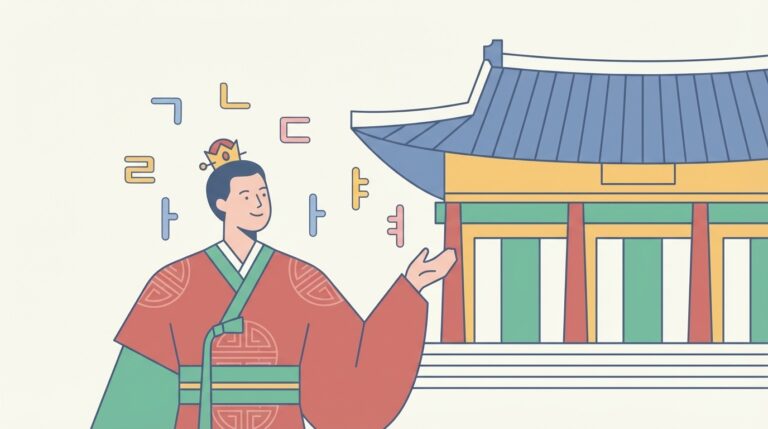
Phase 1: Empathy (Immersive Open)
Hello! I’m your Daily Hangul editor.
Picture this: You are standing in the middle of Gwanghwamun Square in Seoul. Tourists are snapping photos, city buses are zooming by, and right in the center sits a majestic, golden statue of a king holding a book. Or perhaps you’ve been watching a historical K-Drama (sageuk), and you see the King staying up late, secretly drawing strange shapes while his ministers plot against him.
Have you ever wondered why this specific King is treated like a rockstar in Korea?
For a B1 learner like you, you already know how to read Hangul (한글). You know it’s logical and easy to learn. But learning why it was made will completely change how you feel about the Korean language. It wasn’t just a linguistic project; it was a revolution fueled by a leader’s profound love for his people.
Let’s travel back to the Joseon Dynasty and uncover the story of King Sejong the Great, and learn how to talk about this proud cultural heritage like a true local!
Phase 2: Core Expressions Deep Dive
1. 세종대왕 (King Sejong the Great)
- Pronunciation: [Se-jong Dae-wang]
- Sound-alike guide: ‘Se’ like in sell, ‘jong’ like ping-pong, ‘Dae’ like dad, ‘wang’ like wand (but with an ng).
- Meaning: King Sejong (Literal) / The ultimate hero of Korean history (Real nuance)
- K-Culture Moment: In dramas like Tree With Deep Roots, King Sejong is often portrayed as a genius but stressed-out leader who fights against the elite class to give power back to ordinary citizens.
- Editor’s Insight: Notice the ‘대왕’ (Daewang) part. It means ‘The Great King.’ Koreans rarely just call him ‘Sejong.’ Leaving out ‘Daewang’ feels almost disrespectful, like calling a knight without ‘Sir.’
- Situation Spectrum:
[🚫 절대 금지] ———— [⚠️ 주의] ———— [✅ 자유롭게]
- Casual with friends: ✅ (Always use ‘대왕’)
- Semi-formal: ✅
- Formal: ✅
- 🤔 Think About It: Why do you think modern Koreans still attach such a grand title to a king from 600 years ago? Does your country have a historical figure whose title is never dropped?
2. 백성 (The People / Subjects)
- Pronunciation: [Baek-seong]
- Sound-alike guide: ‘Baek’ sounds like the word back, ‘seong’ sounds like sung.
- Meaning: Subjects of a kingdom (Literal) / The ordinary citizens that the King loved like his own children (Real nuance)
- K-Culture Moment: In any historical K-Drama, the good King will angrily shout at corrupt officials: “Are you not afraid of the baekseong?!”
- Editor’s Insight: You won’t use this word to describe modern citizens (we use 시민 – shimin). But understanding baekseong is crucial for Korean history. King Sejong invented Hangul because he pitied the baekseong who couldn’t read complex Chinese characters.
- Situation Spectrum:
[🚫 절대 금지] ———— [⚠️ 주의] ———— [✅ 자유롭게]
- Everyday modern conversation: 🚫 (Sounds like you are doing a historical drama cosplay!)
- Discussing history/dramas: ✅
- 🤔 Think About It: King Sejong viewed the baekseong not as taxpayers, but as family. How does this concept of ‘benevolent leadership’ show up in modern Korean corporate or family culture?
3. 훈민정음 (Hunminjeongeum)
- Pronunciation: [Hun-min-jeong-eum]
- Sound-alike guide: ‘Hun-min’ (Hoon-meen), ‘jeong-eum’ (jung-um: um like the sound of hesitation).
- Meaning: The correct sounds for the instruction of the people (Literal) / The original official name of the Hangul alphabet (Real nuance)
- K-Culture Moment: If you visit the National Museum of Korea or the Hangul Museum, you will see the original document called Hunminjeongeum Haeryebon. It’s a UNESCO Memory of the World!
- Editor’s Insight: Hangul was a nickname that became popular much later. When King Sejong first released his masterpiece in 1446, he called it Hunminjeongeum.
- Situation Spectrum:
[🚫 절대 금지] ———— [⚠️ 주의] ———— [✅ 자유롭게]
- Casual daily chat: ⚠️ (A bit too academic)
- Visiting museums / talking about history: ✅
- 🤔 Think About It: Naming a writing system “Correct sounds to teach the people” is very direct. How does the name itself explain the purpose of the alphabet?
Phase 3: Textbook vs. Real Korean
| Situation | 📖 Textbook Korean | 🗣️ Real Korean | 💡 Why is it different? |
|---|---|---|---|
| Calling the alphabet | 한글 (Hangul) | 한글 (Hangul) | ‘Hangul’ means ‘Great script’ and was coined in the 1910s by a linguist. |
| The language itself | 한국어 (Hangugeo) | 한국말 (Hangungmal) | In daily life, Koreans prefer ‘말’ (speech/words) over the academic ‘어’ (language). |
| Celebrating the alphabet | 10월 9일은 한글이 창제된 날입니다. (Oct 9 is when Hangul was created.) | 한글날엔 순우리말 쓰자! (Let’s use pure Korean words on Hangul Day!) | Young Koreans celebrate by trying not to use English loanwords on Hangul Day. |
Bottom Note: On Hangul Day (October 9th, a national holiday!), many brands change their English logos into Hangul. It’s a fun cultural event!
Phase 4: Cultural Context — K-Culture Deep Dive
4-1. Non-verbal Elements: Respecting the Script
Koreans have a deep emotional attachment to their alphabet. When you visit Gwanghwamun Square, you’ll see people taking photos with the King Sejong statue, but rarely acting silly or disrespectful. The alphabet itself is viewed as a symbol of national pride and independence, especially since it survived attempts to erase it during the Japanese colonial period.
4-2. K-Travel Connection: The King’s Footsteps
If you travel to Seoul, Gwanghwamun Square (광화문광장) is a must-visit. But here is a local secret: right beneath the golden statue of King Sejong, there is a hidden underground museum called “The Story of King Sejong” (세종이야기). It’s free!
Also, a K-Drama trope check! Dramas often show King Sejong secretly sneaking out of the palace in disguise to see how the ordinary baekseong live. While dramatized, history records do show he held a nationwide poll (yes, a poll in the 15th century!) to ask farmers about a new tax law. This is the ultimate Korean Nunchi (눈치 – reading the room) applied at a royal scale!
Phase 5: Real-Life Roleplay Scenario
Setting: A sunny Saturday afternoon. You and your Korean friend, Min-su, are walking around Gwanghwamun Square in Seoul. The giant golden statue of King Sejong towers in front of you.
Characters:
– YOU: A B1 Korean learner who knows the basics of Korean history.
– Min-su (30): Your energetic local friend who loves acting as a tour guide.
Dialogue:
Min-su: 우와, 오늘 날씨 진짜 좋다! 저기 동상 앞에서 사진 찍을래? 📸
(Uwa, oneul nalssi jinjja jota! Jeogi dongsang apeseo sajin jjigeullae?)
[Wow, the weather is so good today! Wanna take a picture in front of the statue over there?]
(🎭 Stage Direction: Min-su points at the golden King Sejong statue)
YOU: 좋아! 그런데 민수야, 저 분이 세종대왕 맞지?
(Joa! Geureonde Minsu-ya, jeo buni Sejong-daewang matji?)
[Sure! But Min-su, that is King Sejong the Great, right?]
Min-su: 어? 맞아. 외국인들은 보통 잘 모르는데, 어떻게 알았어?
(Eo? Maja. Oegugindeureun botong jal moreuneunde, eotteoke arasseo?)
[Huh? That’s right. Foreigners usually don’t know, how did you know?]
YOU: 내가 한국어 공부하잖아! 한글을 만드신 분이잖아.
(Naega hangugeo gongbuhajana! Hangeureul mandeusin bunijana.)
[I study Korean, you know! He’s the one who created Hangul.]
Min-su: 오~ 대박인데! 그럼 원래 한글 이름이 뭐였는지도 알아?
(O~ daebaginde! Geureom wollae hangeul ireumi mwoyeonneumjido ara?)
[Oh~ Awesome! Then do you also know what Hangul’s original name was?]
🔀 Your Turn! How do you answer?
– A) “몰라. 너무 어려워.” (I don’t know. Too hard.)
– B) “당연하지! 훈민정음이잖아.” (Of course! It’s Hunminjeongeum.)
– C) “백성?” (Baekseong?)✅ Best Choice: B — Reason: Dropping the historical term Hunminjeongeum will make any Korean instantly respect your language skills!
⚠️ Choice A Analysis: It’s honest, but misses a great chance to show off your cultural knowledge.
YOU: 당연하지! 훈민정음이잖아. 백성들을 위해서 만드셨대며?
(Dangyeonhaji! Hunminjeongeumijana. Baekseongdeureul wihaeseo mandeusyeotdaemyeo?)
[Of course! It’s Hunminjeongeum. I heard he made it for the people?]
Min-su: 와… 너 진짜 한국인 다 됐다. 인정! (Thumbs up) 👍
(Wa… neo jinjja hangugin da dwaetda. Injeong!)
[Wow… you are basically Korean now. I admit it!]
(🎭 Stage Direction: Min-su takes out his camera with a proud smile)
Phase 6: 10-Second Shadowing Drill
Listen to the rhythm and repeat! Let’s express your admiration for the King.
😲 우와! / 세종대왕이 / 백성을 위해서 / 한글을 / 만드셨어요!
(Uwa! / Sejong-daewangi / baekseongeul wihaeseo / hangeureul / mandeusyeosseoyo!)
- Intonation & Pacing: Pause at the slashes (
/). Emphasize ‘백성을 위해서’ (for the people) to show you understand the emotional context. - Emotion Tag: 😲 With amazement and deep respect.
Phase 7: K-Culture Mini Dictionary
| Korean | Romanization | English | Context |
|---|---|---|---|
| 사극 | sageuk | Historical Drama | K-dramas set in the past, heavily featuring kings, queens, and Hanboks. |
| 한글날 | Hangeullal | Hangul Day | Oct 9th. A national holiday in Korea celebrating the invention of the alphabet. |
| 광화문 | Gwanghwamun | Gwanghwamun | The main gate of Gyeongbokgung Palace, and the square where the King Sejong statue is located. |
| 순우리말 | sunurimal | Pure Korean words | Native Korean words that are not derived from Chinese characters or English. |
Phase 8: Traveler Survival Kit
If you visit the National Hangeul Museum or the King Sejong Story exhibition, you will need these phrases!
🆘 Survival Phrases for the Museum
– 🇰🇷 “영어 오디오 가이드 있어요?” (Yeong-eo odio gaideu isseoyo?)
– 🗣️ English: Do you have an English audio guide?
– 📍 Where to use: Information desk at palaces or museums.
– 🇰🇷 “입구가 어디예요?” (Ipguga eodiyeyo?)
– 🗣️ English: Where is the entrance?
– 📍 Where to use: Gwanghwamun square is huge; you might need to ask this to find the underground museum.
– 🇰🇷 “사진 찍어도 돼요?” (Sajin jjigeodo dwaeyo?)
– 🗣️ English: Can I take pictures here?
– 📍 Where to use: Inside exhibition halls. (Some ancient artifacts cannot be photographed!)📌 Editor’s Travel Note
– Best App: Naver Map or KakaoMap. Google Maps doesn’t provide walking directions in Korea!
– Free Entry: The King Sejong Story exhibition under the statue is completely free. It’s a great place to escape the summer heat or winter cold!
Phase 9: Critical Thinking — “One Step Deeper”
🧠 Think Deeper: Language & Power
Before Hangul, Koreans spoke Korean but wrote in traditional Chinese characters (Hanja). Learning Hanja took years of intensive study, meaning only the wealthy and powerful noble class (Yangban) could read and write. By inventing a phonetic alphabet that anyone could learn in a few days, King Sejong essentially democratized knowledge. He broke the monopoly on information. The nobles hated it and called it “cheap letters,” but it ultimately empowered the entire nation. It proves that language isn’t just a tool for communication; it’s an instrument of social power.
💬 Your Turn:
Has your native language ever undergone a revolution or major spelling reform to make it easier for the general public? Share it in the comments!
Phase 10: FAQ & Avoiding Misunderstandings
Q: Can I just call him “Sejong” instead of “Sejong Daewang”?
A: Technically yes, but culturally no. It sounds very dry and detached. Unless you are writing an objective academic paper, always attach ‘대왕’ (Daewang – The Great) to show natural cultural respect.
Q: Are “Hangul” and “Korean” the same thing?
A: No! This is the most common mistake foreigners make.
❌ Common Mistake #1: Confusing the alphabet with the language.
“저는 한글을 말할 수 있어요.” (I can speak Hangul.) -> ❌ WRONG! You cannot speak an alphabet.
✅ Do this instead:
“저는 한국어를 말할 수 있어요.” (I can speak Korean.)
“저는 한글을 읽을 수 있어요.” (I can read Hangul.)
Phase 11: Summary & Action Items
One-Liner Summary: King Sejong the Great (세종대왕) created Hunminjeongeum (훈민정음) out of deep love for his people (백성)!
Action Mission:
– 🥉 Bronze (Solo): Stand in front of a mirror and say “세종대왕님 감사합니다!” (Thank you, King Sejong!) 3 times.
– 🥈 Silver (Online): Write a comment on a Korean study forum explaining what Hunminjeongeum means.
– 🥇 Gold (Real-world): Visit Gwanghwamun Square, take a selfie with the statue, and post it using the hashtag #세종대왕 #한글.
K-Culture Mission:
Next time you watch a historical K-Drama (sageuk), keep your ears open. Every time you hear the king say “Baek-seong” (백성), take a sip of your drink!
Phase 12: Quiz — Interactive Challenge
1. Situational Judgment: You are talking to a Korean friend about your Korean studies. Which sentence is the most natural?
– A) 한글을 말하는 건 어려워요. (Speaking Hangul is hard.)
– B) 세종대왕이 한글을 만드셨어요. (King Sejong the Great made Hangul.)
– C) 훈민정음으로 이야기합시다. (Let’s converse in Hunminjeongeum.)
2. True or False — K-Culture Edition:
In modern Korea, citizens refer to themselves as “백성” (Baekseong) when talking to the President. (T/F)
(Answers below)
Click to reveal answers
1. B is correct! A is wrong because you cannot ‘speak’ an alphabet (use 한국어 instead). C is wrong because Hunminjeongeum is the historical name of the alphabet, not the spoken language.
2. False! Baekseong is only used in historical contexts (kings and subjects). Today, Koreans use 시민 (shimin – citizen) or 국민 (gukmin – national citizen).
Frequently Asked Questions (FAQ)
Q: What does "세종대왕 (King Sejong the Great)" mean in Korean and how do you pronounce it?
A: In Korean, "세종대왕 (King Sejong the Great)" is pronounced [Se-jong Dae-wang] and means: a key conversational Korean expression covered in this lesson.
Q: What does "백성 (The People / Subjects)" mean in Korean and how do you pronounce it?
A: In Korean, "백성 (The People / Subjects)" is pronounced [Baek-seong] and means: a key conversational Korean expression covered in this lesson.
Q: What does "훈민정음 (Hunminjeongeum)" mean in Korean and how do you pronounce it?
A: In Korean, "훈민정음 (Hunminjeongeum)" is pronounced [Hun-min-jeong-eum] and means: a key conversational Korean expression covered in this lesson.







