

Phase 1: The Empathy Open
Hello! I’m the Lead Editor at Daily Hangul.
Picture this: You’ve just binge-watched 200 hours of K-dramas. You’ve seen gangsters in The Outlaws dropping the infamous “S-word” every five seconds, and high schoolers in The Glory tossing around colorful insults. You think to yourself, “Ah, so this is how real Koreans talk! I should use this to sound like a native.”
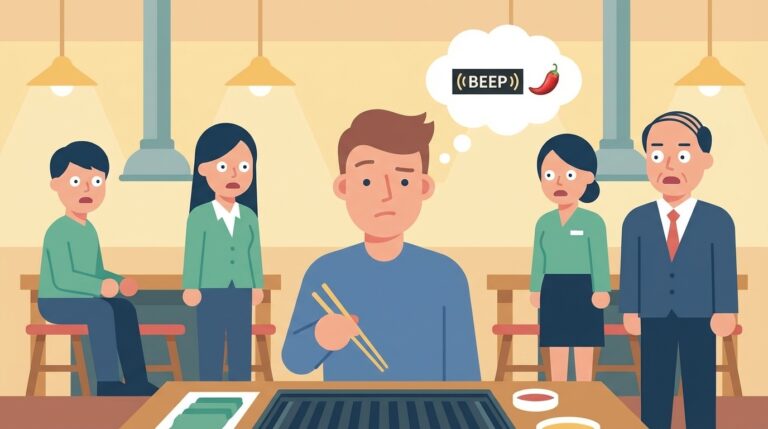
So, you go to a bustling Korean BBQ restaurant in Seoul. The 60-year-old owner brings out a sizzling plate of pork belly. Wanting to express your extreme excitement, you drop a casual, “Wow, jonna massisseo!” (It’s f***ing delicious!)
Suddenly… dead silence. The owner looks shocked, your Korean friends freeze, and you’re left holding your chopsticks in pure confusion. 🥶
What went wrong? The subtitles translated it simply as “very” or “super.” But in Korean, knowing how to swear or use slang is only 10% of the battle. The other 90% is knowing when, where, and with whom you can use it.
At the B2 level, your goal isn’t just to speak Korean; it’s to master the social air—the Nunchi (눈치). Today, we’re diving deep into the unwritten rules of Korean slang and intensifiers. Note: This guide is based on real embarrassing mistakes made by my actual tutoring students, so you don’t have to make them!
Phase 2: Core Expressions Deep Dive
Let’s look at the most common “spicy” intensifiers and slang words you hear in media, and decode their actual social weight.
1. 개- (Gae-) / 존나 (Jonna)
- Pronunciation: [gae] (Sounds like the “ga” in “gap” but with an ‘e’ at the end) / [jon-na] (Sounds like “Joan-nah” said quickly)
- Meaning: Literal: “Dog” / “[Censored genitalia]”. Real nuance: “Freaking / Insanely / F***ing”.
- K-Culture Moment: You’re at a loud PC Bang (Internet Cafe). A gamer next to you lands a crazy headshot and screams, “Ah, gae-jalhae!” (I’m freaking good!). Or, high schoolers drinking iced Americanos in winter shivering and saying, “Jonna chuwo!” (It’s freaking cold!).
- Editor’s Insight: These are ultimate intensifiers.
개-is slightly milder and often used as a prefix (like 개맛있어 – freaking delicious), while존나is an adverb. Both are strictly casual.- Situation Spectrum:
[🚫 절대 금지] ———— [⚠️ 주의] ———— [✅ 자유롭게]
- 친구 사이 (Casual with close friends): ✅
- 직장 동료 (Semi-formal / Acquaintances): ⚠️ (Only if you are same-age and very close)
- 직장 상사·어른 (Formal / Older people): 🚫 (Instant Nunchi death)
- 🤔 Think About It: Why do languages often take taboo or negative words (like “dog” or curse words) and turn them into extreme compliments? Does your mother tongue have a word like “sick” or “badass” that functions the same way?
2. 미친 (Michin)
- Pronunciation: [mi-chin] (Sounds like “me-chin”, like touching your chin)
- Meaning: Literal: “Crazy”. Real nuance: “Unbelievable / Insane” (Can be highly positive or negative).
- K-Culture Moment: A K-Pop fan is watching their bias’s new music video. The idol looks stunning. The fan covers their mouth and types frantically on Twitter: “미친 미모…” (Crazy beauty…).
- Editor’s Insight: In textbooks, “michin” is a bad word. But in modern youth culture, it’s the highest form of praise for aesthetics or skills. However, saying “미쳤어요?” (Are you crazy?) to a stranger in a traffic dispute is a declaration of war.
- Situation Spectrum:
[🚫 절대 금지] ———— [⚠️ 주의] ———— [✅ 자유롭게]
- 친구 사이 (Casual): ✅
- 직장 동료 (Semi-formal): ⚠️
- 직장 상사·어른 (Formal): 🚫
- 🤔 Think About It: “Crazy” is used globally as slang. But in Korean, adding the honorific “요” (yo) to a slang word (like 미쳤어요) doesn’t make it polite—it just makes it formal disrespect. Why is the combination of slang + polite particles so jarring in Korean?
3. 찢었다 (Jjijeotda)
- Pronunciation: [jji-jeot-da] (The ‘jj’ is a tense, squeezed ‘j’ sound. Sounds like “jee-jut-dah”)
- Meaning: Literal: “Tore it”. Real nuance: “Killed it / Nailed it / Crushed it”.
- K-Culture Moment: You’re watching a dance survival show like Street Woman Fighter. A dancer finishes an explosive solo routine, and the judges stand up clapping, yelling, “와, 무대 완전히 찢었다!” (Wow, she totally tore up the stage!).
- Editor’s Insight: This is a trendy, slightly aggressive but highly positive slang. It’s much safer than swear words but still gives off that raw, “insider” energy.
- Situation Spectrum:
[🚫 절대 금지] ———— [⚠️ 주의] ———— [✅ 자유롭게]
- 친구 사이 (Casual): ✅
- 직장 동료 (Semi-formal): ✅ (Safe in a celebratory context)
- 직장 상사·어른 (Formal): ⚠️ (Too casual for a boardroom, but okay at a company party if used playfully)
- 🤔 Think About It: Violence-related verbs (kill, tear, smash) often represent absolute success in modern slang globally. How does this reflect our highly competitive modern society?
Phase 3: Textbook vs. Real Korean
Let’s see how you can upgrade (or downgrade) your Korean depending on the room.
| 상황 (Situation) | 📖 교과서 한국어 (Textbook) | 🗣️ 진짜 한국어 (Real Korean + Slang) | 💡 왜 다를까? (Why the difference?) |
|---|---|---|---|
| Reacting to amazing food | 정말 맛있습니다. (Very delicious.) | 와, 존맛탱! / 개맛있어! (Wow, JMT! / Freaking good!) | Younger generations prefer abbreviated slang (JMT = Jon-mat-taeng) for dramatic impact online and offline. |
| Praising a great performance | 아주 잘하네요. (They do it very well.) | 와, 완전 찢었다. (Wow, totally killed it.) | Textbook Korean feels too passive. Slang adds emotional, visceral energy to the reaction. |
| Expressing shock | 정말 놀랐어요. (I am very surprised.) | 헐… 대박. 미쳤다. (Heol… Daebak. Crazy.) | “Heol” is an onomatopoeia for dropping your jaw. It’s an instant reflex, unlike forming a full sentence. |
Bottom Note for B2 Learners: You don’t need to use 존나 to sound fluent. Using 완전 (completely) or 진짜 (really) mixed with trendy words like 대박 (Daebak) or 찢었다 (Jjijeotda) makes you sound incredibly natural without risking any disrespect.
Phase 4: Cultural Context — K-Culture Deep Dive
4-1. The Non-verbal “Nunchi” of Slang
Language isn’t just audio; it’s visual. In Korea, if you are going to use casual slang in a semi-formal environment (like joking with older colleagues), you must soften it visually.
* The Gesture: Slightly cover your mouth while laughing, or tilt your head.
* The Vibe: If you say “미쳤다~” (Crazy~) with a harsh, loud voice, it sounds like swearing. If you say it with a soft, melodic sigh while smiling, it becomes a playful compliment.
4-2. The K-Drama Illusion vs. Reality
If you watch K-dramas, you’ll notice a classic trope: The male lead is a young, rich CEO who speaks in harsh Banmal (casual/slang) to everyone, while everyone else uses strict honorifics.
The Reality Check: This is pure fantasy. In a real Korean corporate environment, even the CEO uses Jondaetmal (honorifics) to lower-ranking employees in public to maintain professionalism. Dramas use slang and Banmal to artificially amplify the “bad boy” persona or the intimacy between characters. If you mimic K-drama protagonists in a real Korean office, you won’t look cool—you’ll end up in an HR meeting!
Always remember: Media language exaggerates reality for dramatic effect.
Phase 5: Real-world Roleplay Scenario
Setting: Friday evening, 7 PM. A smoky, bustling pork belly (Samgyeopsal) restaurant near Gangnam Station. Green Soju bottles line the tables. You are at a Hoesik (team dinner).
Characters:
* YOU: A foreign employee on a 3-month dispatch to the Seoul office. You want to bond with the team.
* Minsu (32): Your friendly, same-age Korean coworker. He taught you some slang yesterday.
* Team Leader Park (45): Your strict but caring boss. He is currently grilling the meat (a sign of taking care of the team).
Dialogue:
Team Leader Park: 자, 다들 이번 주 수고 많았어요. 고기 먹읍시다! 🥩
(Ja, dadeul ibeon ju sugo manasseoyo. Gogi meogeupsida!)
[Alright, great work this week everyone. Let’s eat!]
(🎭 Stage Direction: Park flips a perfectly golden piece of pork belly and puts it on your plate.)
YOU: 감사합니다, 팀장님! 잘 먹겠습니다.
(Gamsahamnida, timjangnim! Jal meokgetseumnida.)
[Thank you, Team Leader! I will eat well.]
Minsu: (Whispering to you) 야, 우리 팀장님 고기 진짜 잘 구우시지? 어때, 맛있어?
(Ya, uri timjangnim gogi jinjja jal gu-usiji? Eottae, masisseo?)
[Hey, our Team Leader grills meat really well, right? How is it, good?]
YOU: 응, 입에서 살살 녹아.
(Eung, ibeseo salsal noga.)
[Yeah, it’s melting in my mouth.]
Team Leader Park: (Overhearing, smiling broadly) 허허, 입에 맞아요? 한국 삼겹살 맛이 어때요?
(Heoheo, ibe majayo? Hanguk samgyeopsal masi eottaeyo?)
[Haha, does it suit your taste? How is the Korean pork belly?]
🔀 당신의 차례! (Your Turn!) How do you reply to your Boss?
- A) “아주 맛있습니다. 감사합니다.” (Very delicious. Thank you.)
- B) “팀장님, 진짜 개맛있어요! 존맛탱!” (Team Leader, it’s freaking delicious! JMT!)
- C) “와, 대박! 진짜 최고예요!”
✅ Best Choice: C — “대박” (Daebak) and “최고” (The best) are the perfect middle ground. They show genuine, energetic excitement (like a native) but don’t cross the line into offensive slang.
⚠️ Choice B Analysis: Using “개-” or “존맛탱” to a 45-year-old Team Leader is a massive Nunchi failure. Minsu might laugh, but Team Leader Park will be deeply confused or mildly offended.
🎬 Bonus K-Culture Roleplay: The Fan Sign Event
Imagine you are at a K-Pop fan sign event. Your favorite idol is right in front of you.
Idol: “Wow, you came from so far away! Thank you!”
You: “미친… 실물이 너무 예뻐요…” (Michin… silmuri neomu yeppeoyo… / Crazy… you look so pretty in real life…)
Idol: (Laughs brightly) “아, 진짜요? 고마워요!” (Ah, really? Thank you!)
Why it works here: In fandom culture, saying “미친” softly to express overwhelming awe about an idol’s visuals is widely accepted and considered cute, even though it’s technically slang!
Phase 6: 10-Second Shadowing Drill
Let’s practice the safe, energetic slang you can use in almost any social setting!
Read out loud, paying attention to the pauses (/) and emotions.
- 🥺 (In absolute awe): 와… / 이거 진짜 / 대~~~박이에요!
(Wa… / igeo jinjja / dae~~~bagieyo!) - 😤 (Confident & impressed): 오늘 회식 분위기 / 완전 / 찢.었.다!
(Oneul hoesik bunwigi / wanjeon / jjit.eot.da! – Emphasize each syllable at the end)
Phase 7: K-Culture Mini Dictionary
| 한국어 (Korean) | Romanization | 영어 (English) | 맥락 설명 (Context) |
|---|---|---|---|
| 눈치 | nunchi | Social awareness / Tact | The core social sense in Korea. Reading the room, knowing when to speak formally or casually. |
| 폼 미쳤다 | pom michyeotda | Form is crazy | Trendy slang meaning someone’s skill, style, or performance is currently peaking/insane. |
| 존맛탱 (JMT) | jon-mat-taeng | Freaking delicious | Internet slang abbreviation. Widely used among friends, heavily featured on Instagram food posts. |
| 킹받네 | king-banne | King-annoyed | A cute, trendy way to say you are annoyed (using the English word ‘King’ to mean ‘extremely’). |
Phase 8: Traveler Survival Kit
Even if you aren’t working in a Korean office, you need to know how to react safely while traveling without accidentally offending a taxi driver or restaurant owner!
🆘 Survival Phrases for K-Travelers
– 🇰🇷 “헐, 진짜요?” (Heol, jinjja-yo?)
– 🗣️ Meaning: “Oh my, really?” (Use when a shop owner gives you a discount or extra food—called ‘Service’).
– 🇰🇷 “아, 깜짝이야!” (Ah, kkam-jjak-i-ya!)
– 🗣️ Meaning: “Oh, you startled me!” (Use this instead of swearing if you drop something or bump into someone on the subway).
– 🇰🇷 “와, 대박 예뻐요!” (Wa, daebak yeppeo-yo!)
– 🗣️ Meaning: “Wow, amazingly pretty!” (Great for reacting to traditional Hanbok rentals or cafe interiors).
📌 Editor’s Travel Note
– Mind your English Swears: Koreans might not know all English slang, but everyone knows the “F-word” and “S-word.” Yelling them in public places like Myeongdong out of frustration will attract very negative stares.
– The “Service” Culture: If a restaurant owner gives you a free soda (Service), reacting with a bright “우와, 대박! 감사합니다!” will instantly make you their favorite customer!
Phase 9: Critical Thinking Corner — “A Step Deeper”
🧠 Think Deeper: Language & Power (언어와 권력)
Have you noticed that in Korean, you can only use slang or swear downward (to younger people) or horizontally (to friends), but never upward? In English, a CEO and an intern might jokingly use the same mild slang together to build rapport. But in Korean, the directionality of slang reveals the rigid, vertical structure of society. Swearing or using heavy slang upward isn’t just “rude”; it’s viewed as a direct challenge to the social hierarchy. It shows how the Korean language is intrinsically tied to age, status, and power dynamics.
💬 Your Turn: In your culture, does using slang with a boss make you closer, or does it get you fired? Share your workplace culture in the comments!
Phase 10: FAQ & Avoiding Mistakes
Q: Can I use “Michin” (Crazy) to an older person if I mean it as a compliment?
No! Even if you mean “Your cooking is crazy good!” (미치게 맛있어요), an older person might just hear the word “crazy” and feel disrespected. Stick to “정말 최고예요” (It’s truly the best) for elders.
Q: When writing a fan letter to an idol, can I use Banmal (casual language) and slang?
Yes and No. Idols love it when international fans use trendy slang (like “폼 미쳤다”). However, if you are writing a heartfelt letter, using polite forms (요/습니다) shows deeper respect and sincerity.
❌ Common Mistake #1: Mimicking K-Drama villains or gangsters to sound “tough” to taxi drivers or strangers.
✅ Do This Instead: Always use polite forms (요) with strangers, no matter how frustrated you are. Losing your temper and using Banmal/slang to a stranger in Korea makes you instantly lose the moral high ground in any dispute.
Phase 11: Summary & Action Items
One-Liner Summary: In Korean, the words you choose matter, but who you say them to matters a hundred times more—always read the Nunchi!
Action Mission:
* 🥉 Bronze (Solo): Stand in front of a mirror and practice saying “와, 대박!” with the most dramatic, joyful facial expression you can make.
* 🥈 Silver (Online): Go to a K-Pop music video or a K-Food Instagram reel and leave a comment using: “와… 폼 미쳤다 대박!”
* 🥇 Gold (Real World): Next time you eat at a Korean restaurant, tell the staff “진짜 대박 맛있어요!” as you pay the bill, and watch them smile.
🎬 K-Culture Mission:
Watch one episode of your favorite K-Drama today. Every time a character uses slang or swears, pause and check: Are they talking to someone older, younger, or a friend? You’ll start seeing the social matrix of Korea!
Phase 12: Quiz — Interactive Challenge
1. Situational Judgment: You accidentally spill coffee on a coworker’s desk. What is the WORST thing you could say?
– A) 아, 죄송합니다! (Ah, I’m sorry!)
– B) 헐, 어떡해! (Heol, what do I do!)
– C) 아, 존나 미안해! (Ah, f***ing sorry!)
2. True or False – K-Culture Edition:
“If a K-drama character uses ‘개-‘ (Gae-) or ‘존나’ (Jonna) to their boss, it means it’s acceptable in modern Korean start-ups.”
3. Fill in the Blank:
You are cheering for your friend who just won a singing contest.
“와, 너 오늘 무대 완전 ________!” (Wow, you totally ____ the stage today!)
(Scroll down for answers!)
(Answers: 1. C – Never use ‘Jonna’ to apologize in a professional setting! / 2. False – Dramas exaggerate for effect. Do not do this in real life! / 3. 찢었다 (Jjijeotda) – Tore it up / Nailed it!)
Frequently Asked Questions (FAQ)
Q: What does "개- (Gae-) / 존나 (Jonna)" mean in Korean and how do you pronounce it?
A: In Korean, "개- (Gae-) / 존나 (Jonna)" is pronounced [gae] and means: Literal: "Dog" / "[Censored genitalia]". Real nuance: "Freaking / Insanely / F***ing".
Q: What does "미친 (Michin)" mean in Korean and how do you pronounce it?
A: In Korean, "미친 (Michin)" is pronounced [mi-chin] and means: Literal: "Crazy". Real nuance: "Unbelievable / Insane" (Can be highly positive or negative).
Q: What does "찢었다 (Jjijeotda)" mean in Korean and how do you pronounce it?
A: In Korean, "찢었다 (Jjijeotda)" is pronounced [jji-jeot-da] and means: Literal: "Tore it". Real nuance: "Killed it / Nailed it / Crushed it".







