

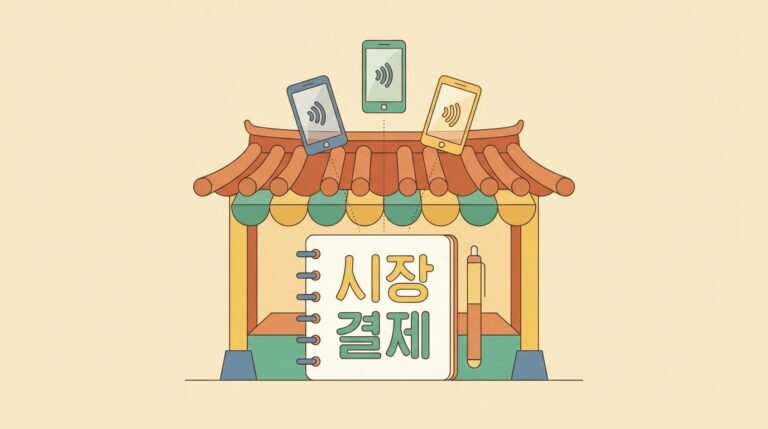
Phase 1: Empathy & Immersion (The Cold Open)
Hello! I’m your Daily Hangul Editor.
Picture this: You are watching a gritty Korean crime thriller, or maybe a realistic slice-of-life K-Drama like My Liberation Notes. The characters are sitting in a worn-down mom-and-pop restaurant outside of Seoul. The news is playing in the background, and the anchor is talking passionately about something called “Jiyeok Hwapye” (Local Currency). Suddenly, a heated argument breaks out between the restaurant owner and a customer over whether this system is actually saving their town or just wasting national taxes. The subtitles simply say, “They are arguing about local economy subsidies.”
But as a C2-level Korean learner, you know there is a much deeper socio-economic tension brewing here.
If you’ve traveled outside of Seoul, you’ve probably seen colorful stickers on cafe doors saying “OO Pay Accepted Here.” Local currency and the controversy surrounding its state funding (국비 지원) isn’t just dry economic news—it is a hot-button dinner table topic that touches on local pride, political divides, and the survival of rural Korea. Mastering this topic won’t just help you read the Chosun Ilbo; it will earn you immense respect from native speakers when you casually drop your insights over a plate of samgyeopsal in Busan.
Let’s dive into the real Korean behind the local economy. This guide is built from the actual questions my advanced students ask when they want to transcend small talk and dive into real Korean societal debates.
Phase 2: Core Expressions Deep Dive
Let’s unpack the high-level vocabulary you need to navigate this socio-economic minefield.
1. 지역 화폐 (Local Currency)
- Pronunciation: [jiyeok hwapye] → jee-yuck hwa-pyeh (The ‘yeok’ sounds like the ‘yuck’ in yucky, but shorter).
- Meaning: Literal: Regional Currency. Real nuance: A local government-issued voucher or digital currency (like Suwon Pay or Jeju’s Tamna-jeon) that can only be spent within that specific region to boost the local economy.
- K-Culture Moment: You’re watching a K-Vlog of someone traveling to Jeju Island. They brag about getting a 10% cashback on their black pork BBQ because they cleverly downloaded the local currency app before their trip.
- Editor’s Insight: This isn’t just money; it’s a political statement. Using it shows you are a savvy consumer supporting the underdogs (local merchants).
- Situation Spectrum:
[🚫 Absolute Ban] ———— [⚠️ Use with Caution] ———— [✅ Freely Use]
- Casual with friends: ✅
- Debating with colleagues: ✅
- Professional News Context: ✅
- 🤔 Think About It: Why does almost every city in Korea have its own “Pay” system? What does this fragmentation say about local identity versus national unity?
2. 골목 상권 (Alleyway Commercial Districts)
- Pronunciation: [golmok sanggwon] → gohl-mohk sang-gwon
- Meaning: Literal: Alleyway business rights. Real nuance: The ecosystem of local, independent mom-and-pop shops (as opposed to massive conglomerates/chaebols or giant hypermarkets).
- K-Culture Moment: In dramas like Itaewon Class, the entire plot revolves around protecting the golmok sang-gwon from ruthless corporate giants.
- Editor’s Insight: This word carries immense emotional weight in Korea. If a politician says they will “revive the golmok sang-gwon,” they are appealing to the working-class nostalgia and the Korean sentiment of Jeong (정, deep connection).
- Situation Spectrum:
[🚫 Absolute Ban] ———— [⚠️ Use with Caution] ———— [✅ Freely Use]
- Casual conversations: ✅
- Formal debates/Presentations: ✅
- 🤔 Think About It: How does the concept of “alleyways” differ in your home country? In Korea, alleys are historically the center of community life, not just backstreets.
3. 국비 지원 논란 (State Funding Controversy)
- Pronunciation: [gukbi jiwon nollan] → gook-bee jee-won nohl-lan
- Meaning: Literal: National expense support controversy. Real nuance: The fierce political debate over whether the central government in Seoul should subsidize the 10% discounts offered by local currencies across the country.
- K-Culture Moment: This is the headline flashing across the YTN news ticker while characters in a drama silently eat their breakfast, setting a tense mood.
- Editor’s Insight: This is a C2 powerhouse phrase. Throwing “nollan” (controversy) at the end of any noun instantly makes you sound like a socio-political commentator.
- Situation Spectrum:
[🚫 Absolute Ban] ———— [⚠️ Use with Caution] ———— [✅ Freely Use]
- Formal academic/business discussions: ✅
- Chatting at a bar (if you know their politics): ⚠️
- 🤔 Think About It: Is it fair for taxpayers in Seoul to fund the local economies of rural towns? This is the core of the Korean budget wars.
Phase 3: Textbook vs. Real Korean
How do actual Koreans talk about these macro-economic issues on the streets?
| Situation | 📖 Textbook / Formal Korean | 🗣️ Real Spoken Korean | 💡 Why is it different? |
|---|---|---|---|
| Asking if they take local currency | 지역 화폐로 결제 가능한가요? (Can I pay with local currency?) | 여기 [지역명]페이 되죠? (Do you take [City Name] Pay here?) | Koreans prefer directly naming the specific regional app (e.g., 동백전 in Busan, 탐나는전 in Jeju) for efficiency. |
| Talking about saving local shops | 지역 경제를 활성화해야 합니다. (We must revitalize the local economy.) | 골목 상권 다 죽게 생겼어요. (The mom-and-pop shops are all going to die.) | Emotional exaggeration (다 죽게 생겼다) is a common rhetorical device in Korean daily complaints. |
| Discussing government funding | 중앙 정부의 예산 지원이 삭감되었습니다. (Central government budget support has been cut.) | 이번에 국비 싹 다 잘렸대요. (I heard the state funding got completely axed this time.) | Using “잘리다” (to be cut/severed) instead of the formal “삭감되다” (to be reduced) adds visceral frustration. |
Bottom Note for C2 Learners: Notice how formal vocabulary like 삭감 (reduction) shifts to the aggressive 잘리다 (to be chopped off) in casual speech. Mastering this code-switching is the hallmark of C2 fluency.
Phase 4: Cultural Context — K-Culture Deep Dive
4-1. Non-Verbal Cues: The Art of the “Sseup” (읍)
When discussing state subsidies and taxes, Koreans often inhale sharply through their teeth, making a “Sseup” (읍) sound, followed by a slow head tilt. It means, “Well, it’s a complicated issue, and I have mixed feelings.” If you are asked about the Gukbi Jiwon controversy, do the “Sseup” before answering to instantly look like a thoughtful native.
4-2. K-Society & K-Travel: The Survival of the Provinces
Why is this topic so explosive? Because of 지방 소멸 (Provincial Extinction). As younger generations flock to Seoul for jobs and K-Pop dreams, rural Korea is hollowing out.
Local currencies (offering 10% cashbacks to users) were designed as a desperate lifeline to keep money inside these dying towns instead of flowing into mega-franchises headquartered in Seoul.
When traveling, using local currency isn’t just about saving money; it’s a form of 착한 소비 (Ethical Consumption). If you visit a traditional market in Jeonju and pull up your local pay app, the elderly vendors won’t just see a tourist; they’ll see an honorary local who respects their livelihood.
Phase 5: Real-Life Roleplay Scenario
Scenario A: The Samgyeopsal Debate
- Setting: Friday, 8:00 PM. A bustling local BBQ joint in Suwon. The table is cluttered with empty Soju bottles and lettuce leaves.
- Characters:
- YOU: A foreign expat working at a Korean tech firm. You keep up with the news.
- Min-su (34): Your friendly Korean manager. He lives in Suwon and loves taking advantage of local perks.
Min-su: 아, 오늘 회식비는 내 수원페이로 긁을게. 아직 캐시백 10% 되거든! 🧤
(A, oneul hoesikbineun nae suwonpeiro geulgeulge. Ajik kaesibaek 10% doegeodeun!)
[Ah, I’ll swipe my Suwon Pay for today’s team dinner. The 10% cashback still works!]
(🎭 Stage Direction: Min-su proudly pulls out his smartphone and opens the local app.)
YOU: 오, 과장님 완전 알뜰하신데요? 근데 내년부터는 그 혜택 줄어든다면서요?
(O, gwajangnim wanjeon altteulhasindeyo? Geunde naenyeonbuteoneun geu hyetaek jureodeundamyeonseoyo?)
[Oh, Manager, you are so frugal! But didn’t they say those benefits are shrinking starting next year?]
Min-su: 내 말이! 아니, 국비 지원을 갑자기 삭감하면 우리 동네 소상공인들은 어쩌라고?
(Nae mari! Ani, gukbi jiwoneul gapjagi sakgamhamyeon uri dongne sosanggongindeureun eojjeorago?)
[Tell me about it! I mean, if they suddenly cut the state funding, what are our neighborhood small business owners supposed to do?]
🔀 Your Turn! How do you respond to show off your C2 socio-economic fluency?
– A) “맞아요. 정부가 나빠요.” (Too simplistic, sounds like a beginner.)
– B) “그래도 국가 예산도 한계가 있으니까 효율적으로 써야 하지 않을까요?”
– C) “대박! 진짜 짜증나시겠어요.”✅ Best Choice: B — “Geuraedo gukga yesando hyangyega isseunikka hyoyuljeogeuro sseoya haji aneulkkayo?” (Still, the national budget has its limits, so shouldn’t it be used efficiently?)
Reason: At a C2 level, you can introduce a gentle counter-argument. It acknowledges the complexity of the macro-economy (efficiency vs. local support) while keeping the conversation intellectually stimulating.
⚠️ Choice C Analysis: It’s empathetic but a bit too casual (대박) to use with your manager when discussing serious economics.
Scenario B: The Market Tourist (Mini Roleplay)
You are buying twisted donuts (꽈배기) at a rural 5-day market.
Vendor: 5천 원입니다~ (5,000 won~)
YOU: 사장님, 혹시 여기 지역 화폐 QR 결제 되나요?
(Sajangnim, hoksi yeogi jiyeok hwapye QR gyeolje doenayo? / Boss, by any chance, can I pay with the local currency QR code here?)
Vendor: 아이고, 우린 그런 거 몰라. 온누리상품권은 받아요.
(Aigo, urin geureon geo molla. Onnurisangpumgwoneun badayo. / Oh my, we don’t know how to use that. But we accept Onnuri Gift Certificates.)
Cultural context: Traditional market vendors often prefer physical Onnuri certificates (a nationwide traditional market currency) over complex regional apps!
Phase 6: 10-Second Shadowing Drill
Let’s practice the rhythm of a frustrated local taxpayer. Pay attention to the pauses!
😤 국비 지원이 / 끊기면, / 골목 상권이 / 제일 먼저 / 타격을 받잖아요!
(gukbi jiwoni / kkeunkimyeon, / golmok sanggwoni / jeil meonjeo / tagyeogeul batjanayo!)
If state funding is cut off, the alleyway businesses take the hit first!
Intonation Guide: Raise your voice slightly on 끊기면 (cut off) to show consequence, and stress 제일 먼저 (first) to emphasize the urgency.
Phase 7: K-Culture Mini Dictionary
| Korean | Romanization | English | Contextual Explanation |
|---|---|---|---|
| 소상공인 | sosanggong-in | Small business owners | The backbone of the Korean local economy. Often used in news to evoke sympathy and policy protection. |
| 예산 삭감 | yesan sakgam | Budget cuts | A frequent headline. In Korea, budget cuts are often viewed as the central government abandoning the provinces. |
| 가맹점 | gamaengjeom | Affiliated store | You will see “지역화폐 가맹점” (Local currency accepted) stickers everywhere outside of Seoul. |
| 온누리상품권 | onnuri sangpumgwon | Onnuri Gift Certificate | A special currency backed by the government specifically to revive traditional markets nationwide. |
Phase 8: Traveler’s Survival Kit (Local Economy Edition)
Are you traveling outside Seoul? Don’t just rely on your international credit card. Here is how you navigate the local payment scene like a pro.
🆘 Survival Phrase #1
– 🇰🇷 “여기 [지역명]페이 되나요?” (yeogi [Region Name] pe-i doenayo?)
– 🗣️ English guide: “Do you accept [Region] Pay here?”
– 📍 Where to use: Cafes, taxis, and restaurants in places like Busan, Jeju, or Suwon.
– 💡 Pro Tip: Search for the “착 (Chak)” app. It’s the centralized app for many regional digital currencies. You can link your Korean bank account and enjoy a 5~10% discount on your travels!📌 Editor’s Travel Note
– Cash vs. Local Apps: Korea is practically a cashless society. However, elderly vendors in rural 5-day markets might still prefer cash or physical Onnuri vouchers because QR codes confuse them.
– The Seoul Exception: Seoul has its own “Seoul Pay,” but because Seoul is already economically dominant, the state funding controversies usually center on the provinces (지방) needing the subsidies more.
Phase 9: Critical Thinking — “One Step Deeper”
Language & Power: The Decentralization of Words
In Korean news, you will often hear the dichotomy of 중앙 (Central) versus 지방 (Local/Provincial). Centralized power in Seoul has dictated Korea’s hyper-growth for decades. But the rise of Jiyeok Hwapye is a linguistic and economic rebellion. By insisting on paying with “Incheon Pay” or “Gyeonggi Pay,” citizens are claiming a localized identity over a homogenized national one. It is a pushback against the drain of wealth and youth into the capital. When the central government cuts the Gukbi Jiwon (State funding), locals don’t just see it as an economic calculation; they perceive it as Seoul “abandoning” the provinces.
💬 Your Turn: In your country, is there a massive divide between the capital city and the rural regions? How do people in your hometown protect their local businesses? Share your thoughts in the comments using the term “골목 상권”!
Phase 10: FAQ & Avoiding Misunderstandings
Q: Can I discuss political economy issues like budget cuts with Korean friends?
Yes, but tread carefully. Politics in Korea is highly polarized. If you want to discuss it, take a curious, neutral stance: “한국 뉴스를 보니까 지역 화폐 논란이 있던데, 한국분들의 실제 생각이 궁금해요.” (I saw the local currency controversy on the news, and I’m curious what Koreans actually think about it.)
❌ Common Mistake #1: Confusing Jiyeok Hwapye (Local Currency) with Sanggong-in (Business Owner).
✅ Do this instead: Remember that the currency is the tool to help the Sanggong-in. “지역 화폐가 소상공인을 돕습니다.” (Local currency helps small business owners.)❌ Common Mistake #2: Trying to use Seoul Pay in Busan.
✅ Do this instead: Local currency is strictly geofenced! You must use the specific city’s currency within its borders, which is exactly why its economic effect is hotly debated.
Phase 11: Summary & Action Items
One-Liner Summary: The debate over “Jiyeok Hwapye” (Local Currency) and its “Gukbi Jiwon” (State Funding) is the ultimate proxy war between saving Korea’s “Golmok Sang-gwon” (Alleyway economies) and managing the national budget efficiently.
Action Mission 3-Steps:
– 🥉 Bronze (Solo): Read a Korean news headline about the economy and try to spot the words 예산 (budget) or 삭감 (cut).
– 🥈 Silver (Online): Go to Naver Maps, search a restaurant in a rural Korean town, and look for the tag “지역화폐(지류,모바일,카드)” in their info section.
– 🥇 Gold (Real-world): Next time you travel outside Seoul, ask the cashier: “여기 지역 화폐 결제 가능한가요?”
K-Culture Mission:
Watch an episode of Our Blues or Hometown Cha-Cha-Cha and observe the traditional market scenes. Imagine how the introduction of a digital local currency app would change the dynamics of those elderly market characters!
Phase 12: Interactive Quiz — C2 Challenge
1. Situational Judgment: You are watching the news with your Korean in-laws. The anchor says state subsidies for local currency will be cut by 50%. Your father-in-law sighs. What is the most culturally sophisticated comment you can make?
– A) “아싸! 세금 덜 내겠네요.” (Yay! We’ll pay less taxes.)
– B) “지방 소상공인분들이 많이 힘들어지시겠네요.” (It’s going to become very difficult for provincial small business owners.)
– C) “지역 화폐는 너무 구식이에요.” (Local currency is too old-fashioned.)
2. Fill in the Blank:
“대기업 마트보다 우리 동네 ______을/를 살려야 합니다.”
(We need to save our neighborhood ________ rather than giant corporate hypermarkets.)
3. True or False — K-Economy Edition:
You can use “Suwon Pay” in Seoul if the merchant is a small business owner. (T/F)
(Answers: 1. B – Shows empathy and deep understanding of the local economy. / 2. 골목 상권 / 3. False – Local currencies are strictly bound to their specific municipal jurisdictions.)
Frequently Asked Questions (FAQ)
Q: What does "지역 화폐 (Local Currency)" mean in Korean and how do you pronounce it?
A: In Korean, "지역 화폐 (Local Currency)" is pronounced [jiyeok hwapye] and means: Literal: Regional Currency. Real nuance: A local government-issued voucher or digital currency (like Suwon Pay or Jeju's Tamna-jeon) that can only be spent within that specific region to boost the local economy.
Q: What does "골목 상권 (Alleyway Commercial Districts)" mean in Korean and how do you pronounce it?
A: In Korean, "골목 상권 (Alleyway Commercial Districts)" is pronounced [golmok sanggwon] and means: Literal: Alleyway business rights. Real nuance: The ecosystem of local, independent mom-and-pop shops (as opposed to massive conglomerates/chaebols or giant hypermarkets).
Q: What does "국비 지원 논란 (State Funding Controversy)" mean in Korean and how do you pronounce it?
A: In Korean, "국비 지원 논란 (State Funding Controversy)" is pronounced [gukbi jiwon nollan] and means: Literal: National expense support controversy. Real nuance: The fierce political debate over whether the central government in Seoul should subsidize the 10% discounts offered by local currencies across the country.






