

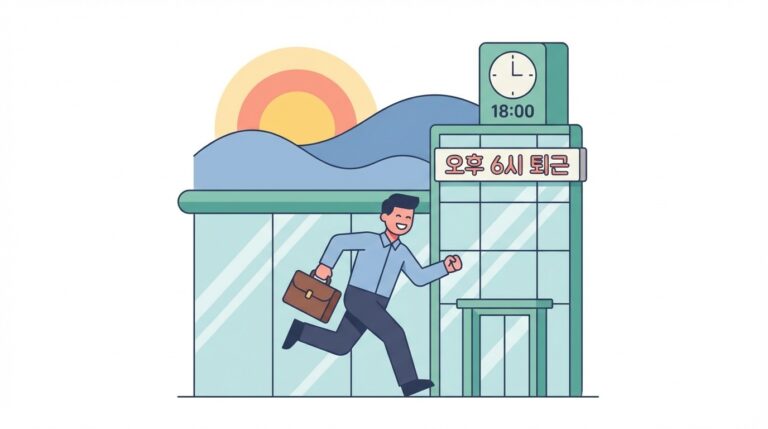
Phase 1: The 5:59 PM K-Drama Moment
Hello! I’m the Lead Editor of Daily Hangul.
Imagine this: You are watching a K-Drama. The clock on the office wall clicks to 6:00 PM. The main character stealthily grabs their bag, looks around the room, bows slightly to their boss, and says something that sounds like a magic spell before disappearing into the night. Subtitles just say, “See you tomorrow.”
But wait… they didn’t say “Goodbye” (안녕히 계세요). They used entirely different words!
In your home country, leaving work or school might be as simple as shouting “Bye guys!” and walking out the door. In Korea, however, leaving work (퇴근) is an art form. It involves a beautiful mix of Nunchi (reading the room), respect, and acknowledging everyone’s hard work.
I’ve seen so many of my A1 students freeze at the office door, awkwardly waving goodbye while their Korean coworkers stare at them. Don’t worry! Everything in this guide is based on real struggles from expats like you. Let’s learn how to leave the office or school like a true insider!
Phase 2: Core Expressions Deep Dive
Let’s break down the magic words of freedom.
1. 퇴근해요 (I am getting off work)
- Pronunciation: toe-geun-hae-yo [tway-gun-heh-yo]
- Sound-alike guide for English speakers: Sounds a bit like “toy-gun” but with an ‘eh-yo’ at the end!
- Meaning: (Literal) I am leaving the workplace. / (Real nuance) I’m done for the day! Freedom!
- K-Culture Moment: You will hear this in almost every K-Drama office scene. Or, you’ll see idols on V-Live happily shouting “저희 이제 퇴근해요!” (We are getting off work now!) after a long music show recording.
- Editor’s Insight: This is a statement of fact, not a greeting. You use it to tell a coworker you are leaving, or when texting a friend to say you are finally free. Do NOT use this as a goodbye to your boss!
- Situation Spectrum:
[🚫 절대 금지] ———— [⚠️ 주의] ———— [✅ 자유롭게]- Friends (Casual): ✅ (퇴근해!)
- Coworkers (Semi-formal): ⚠️ (퇴근해요?)
- Boss/Elders (Formal): 🚫 (Too direct!)
- 🤔 Think About It: Why is there a specific, highly used verb just for “leaving work” in Korean? How does this reflect Korea’s intense work culture?
2. 먼저 가보겠습니다 (I will leave first)
- Pronunciation: meon-jeo ga-bo-get-seum-ni-da [mon-jaw ga-bo-get-sum-nee-da]
- Sound-alike guide: “mon-jaw” means ‘first’. Think of it as politely asking for permission to escape.
- Meaning: (Literal) I will go first. / (Real nuance) I am leaving now, please excuse me.
- K-Culture Moment: The clock strikes 6:15 PM. You finally make eye contact with your manager. You bow slightly and drop this phrase. It’s the ultimate polite exit!
- Editor’s Insight: In Korea, leaving before your seniors can feel a bit awkward. Adding “first” (먼저) softens the blow. It shows you respect that they are still working.
- Situation Spectrum:
[🚫 절대 금지] ———— [⚠️ 주의] ———— [✅ 자유롭게]- Friends (Casual): 🚫 (Too stiff!)
- Coworkers (Semi-formal): ✅ (먼저 가볼게요)
- Boss/Elders (Formal): ✅ (먼저 가보겠습니다)
- 🤔 Think About It: Does your culture require you to apologize or justify leaving exactly when your shift ends?
3. 수고하셨습니다 (Thank you for your hard work)
- Pronunciation: su-go-ha-syeot-seum-ni-da [soo-go-ha-shot-sum-nee-da]
- Sound-alike guide: “Soo-go” sounds like “Sue, go!”. This is the golden phrase of Korean society.
- Meaning: (Literal) You have worked hard. / (Real nuance) Great job today, see you tomorrow!
- K-Culture Moment: The director yells “Cut!” on a drama set. Immediately, all the actors and staff bow to each other shouting “수고하셨습니다!” over and over.
- Editor’s Insight: THIS is your real goodbye at work. Instead of saying “Bye,” Koreans acknowledge the effort of the people they work with. It builds incredible team bonding.
- Situation Spectrum:
[🚫 절대 금지] ———— [⚠️ 주의] ———— [✅ 자유롭게]- Friends (Casual): ✅ (수고했어!)
- Coworkers (Semi-formal): ✅ (수고하셨습니다)
- Boss/Elders (Formal): ✅ (수고하셨습니다)
- 🤔 Think About It: Acknowledging someone’s hard work is the default greeting and farewell in Korea. What does this tell you about Korean values?
4. 학교 끝났어요 (School is over)
- Pronunciation: hak-gyo kkeut-nat-seo-yo [hak-gyo kkoot-nat-so-yo]
- Sound-alike guide: “hak-gyo” (school) + “kkoot” (like ‘cut’) + “nat-so-yo”.
- Meaning: (Literal) School ended. / (Real nuance) I’m done with classes!
- K-Culture Moment: Texting your Korean language exchange partner to let them know you are free to meet up in Hongdae!
- Editor’s Insight: Textbooks will teach you “하교하다” (to leave school), but NO ONE uses this in daily speech. It sounds like a police report. Just say “학교 끝났어요” (School ended)!
- Situation Spectrum:
[🚫 절대 금지] ———— [⚠️ 주의] ———— [✅ 자유롭게]- Friends (Casual): ✅ (학교 끝났어!)
- Acquaintances (Semi-formal): ✅ (학교 끝났어요)
- Boss/Elders (Formal): ⚠️ (Use 학교 마쳤습니다 if very formal)
- 🤔 Think About It: Why do Koreans separate the concept of “leaving work” (퇴근) and “leaving school” (하교) with entirely different words, unlike English where we just say “I’m done”?
Phase 3: Textbook vs. Real Korean
| Situation | 📖 Textbook Korean | 🗣️ Real Korean | 💡 Why is it different? |
|---|---|---|---|
| Telling boss you are leaving | 안녕히 계십시오. (Goodbye.) | 먼저 가보겠습니다. 내일 봬요! (I’ll go first. See you tomorrow!) | Saying “Goodbye” implies a final separation; “I’ll go first” implies ongoing teamwork. |
| Coworkers saying bye to you | 안녕히 가세요. (Go in peace.) | 수고하셨습니다! (You worked hard!) | Acknowledging shared suffering/hard work is the highest form of respect in the workplace. |
| Telling a friend school is over | 저는 지금 하교합니다. (I am departing school now.) | 나 학교 끝났어! 놀자! (School is over! Let’s play!) | “하교하다” is a formal written word (Hanja-based). Everyday speech prefers pure Korean verbs like “끝나다” (to end). |
Phase 4: Cultural Context — K-Culture Deep Dive
4-1. The Non-Verbal Secret: The “Bow-and-Shuffle”
When leaving work in Korea, you don’t just yell across the room. You do what I call the “Bow-and-Shuffle.”
1. Stand up and gather your things quietly (Nunchi!).
2. Walk slightly toward your manager’s desk.
3. Do a 30-degree bow while saying “먼저 가보겠습니다.”
4. As you walk toward the door, give smaller nods to other coworkers and say “수고하셨습니다!”
4-2. The K-Drama Trope: “Kal-Toe” (칼퇴)
Have you noticed in dramas how characters sometimes stare intensely at their watches, waiting for 6:00:00 PM to sprint out the door? This is called 칼퇴 (Kal-toe).
– 칼 (Kal) = Knife
– 퇴 (Toe) = Short for 퇴근 (leaving work)
It means leaving work cutting exactly on time. For a long time, doing “Kal-toe” was frowned upon by older generations who valued staying late (야근 – overtime). But younger MZ generation workers in Korea are reclaiming “Kal-toe” as their right! If you see a K-Drama where the young rookie leaves exactly at 6 PM while the older boss glares at them—that’s the “Kal-toe” cultural clash in action!
Phase 5: Real-World Roleplay Scenario
Setting: Friday, 6:00 PM. A marketing office near Gangnam Station. The sky is getting dark, and you can smell the distant scent of Korean BBQ from the streets below. You are packing your bag.
Characters:
– YOU: An expat in your first month of working in Korea.
– Min-su (32): Your friendly Korean coworker who sits next to you.
– Manager Kim (45): Your strict but caring boss.
(Dialogue starts)
Min-su:
퇴근할 준비 해요? 🎒
(toe-geun-hal jun-bi hae-yo?)
Are you getting ready to leave work?
YOU:
네, 6시 정각이잖아요!
(ne, yeo-seot-si jeong-gak-i-ja-na-yo!)
Yes, it’s exactly 6 o’clock!
Min-su:
(Whispering) 김 부장님 아직 안 가셨는데…
(gim bu-jang-nim a-jik an ga-syeot-neun-de…)
(Whispering) Manager Kim hasn’t left yet, though…
YOU:
아… 먼저 가면 안 돼요?
(a… meon-jeo ga-myeon an dwae-yo?)
Ah… am I not allowed to leave first?
Min-su:
아니요, 괜찮아요. 가서 인사만 하세요.
(a-ni-yo, gwaen-cha-na-yo. ga-seo in-sa-man ha-se-yo.)
No, it’s fine. Just go and say goodbye to him.
(🎭 Stage Direction: You walk up to Manager Kim’s desk. He looks up from his computer.)
Manager Kim:
어, OOO 씨. 퇴근하게?
(eo, OOO ssi. toe-geun-ha-ge?)
Oh, [Your Name]. Are you getting off work?
🔀 Your Turn! How should you respond?
– A) “네! 안녕히 계세요!” (Yes! Goodbye!)
– B) “네, 수고하세요!” (Yes, keep working hard!)
– C) “네, 먼저 가보겠습니다. 수고하셨습니다!” (Yes, I will leave first. Thank you for your hard work today!)✅ Best Choice: C — This perfectly combines permission to leave (먼저 가보겠습니다) with respect for the team’s effort (수고하셨습니다).
⚠️ Choice A Analysis: Safe, but sounds a bit like a child leaving school, not a professional.
🚫 Choice B Analysis: FATAL MISTAKE! Saying “수고하세요” to a boss means “Keep suffering/working!” It sounds incredibly rude coming from a junior.
Manager Kim:
(Smiling) 그래, 오늘 수고 많았어요. 주말 잘 보내요.
(geu-rae, o-neul su-go ma-nat-seo-yo. ju-mal jal bo-nae-yo.)
Alright, you worked hard today. Have a good weekend.
YOU:
부장님도 주말 잘 보내세요!
(bu-jang-nim-do ju-mal jal bo-nae-se-yo!)
Have a good weekend too, Manager!
(🎭 Stage Direction: You walk out feeling like a true Korean office worker!)
🎬 Bonus K-Culture Roleplay: The Post-Work Chimaek
You successfully left the office. Min-su texts you outside the building.
Min-su: 퇴근했어요? 맥주 한잔 어때요? 🍗🍺 (Got off work? How about a beer?)
YOU: 아싸! 치맥 완전 좋아요! (Assa! Chimaek sounds totally awesome!)
Min-su: 강남역 10번 출구로 오세요! (Come to Gangnam Station Exit 10!)
Phase 6: 10-Second Shadowing Drill
Practice saying this out loud. Pay attention to the pauses (/) and emotions!
🥺 (Slightly apologetic, polite tone)
부장님 / 저는 먼저 / 가보겠습니다. (bu-jang-nim / jeo-neun meon-jeo / ga-bo-get-seum-ni-da.)😊 (Bright, encouraging tone to the whole room)
모두 / 수고하셨습니다! / 내일 봬요! (mo-du / su-go-ha-syeot-seum-ni-da! / nae-il bwae-yo!)
Phase 7: K-Culture Mini Dictionary
| Korean | Romanization | English | Cultural Context |
|---|---|---|---|
| 퇴근 | toe-geun | Leaving work | The ultimate daily goal of every Korean adult. |
| 칼퇴 | kal-toe | Leaving exactly on time | A modern virtue for young workers (MZ generation). |
| 야근 | ya-geun | Overtime work | The villain of Korean office life. Working late into the night. |
| 회식 | hoe-sik | Company dinner | Going out to eat/drink with coworkers after work. Often involves Soju and BBQ. |
| 눈치 | nun-chi | Reading the room | The essential Korean social skill. E.g., not leaving work if the boss looks angry. |
Phase 8: Traveler Survival Kit
Even if you don’t work in Korea, you will hear “퇴근” and “수고하셨습니다” EVERYWHERE when you travel! Here is how to use it as a tourist.
🆘 Survival Phrases for Travelers
🇰🇷 1. “수고하셨습니다!” (su-go-ha-syeot-seum-ni-da)
– 📍 Where to use: Getting out of a taxi, leaving a restaurant, or finishing a tour.
– 💡 Meaning: Instead of “Goodbye,” say this to the driver/staff. It means “Thank you for your service/hard work.” They will LOVE you for it!🇰🇷 2. “퇴근 시간이에요?” (toe-geun si-gan-i-e-yo?)
– 📍 Where to use: Making small talk, or asking why the subway is so insanely crowded at 6:30 PM.
– 💡 Meaning: “Is it rush hour / time to get off work?”🇰🇷 3. “영업 끝났어요?” (yeong-eop kkeut-nat-seo-yo?)
– 📍 Where to use: Entering a cafe/restaurant late at night.
– 💡 Meaning: “Are you closed?” (Since you can’t use 퇴근 for stores).📌 Editor’s Travel Note: The “Hell-cheol” (지옥철)
Do NOT take the Seoul subway between 6:00 PM and 7:30 PM if you have heavy luggage. This is the sacred Toe-geun time. The subway becomes “Ji-ok-cheol” (Hell Subway). Plan your cafe breaks around this time!
Phase 9: Critical Thinking Corner — “One Step Deeper”
🧠 Think Deeper: Language & Power (The Hierarchy of Greetings)
Have you ever wondered why Korean has different phrases depending on who you are talking to? When you leave work, you tell your equal “수고하셨습니다” (You worked hard), but you MUST NOT say “수고하세요” (Keep working hard) to your boss.
This reflects traditional Korean Confucian values, where evaluating or commanding someone older or higher in status is considered rude. Telling a boss “Keep working hard” sounds like you are giving them an order! Therefore, juniors must lower themselves by saying “먼저 가보겠습니다” (I will take my leave first), focusing on their own action rather than the boss’s.
💬 Your Turn:
Does your native language change depending on the age or rank of the person you are talking to? How do you say goodbye to your boss compared to your best friend? Let us know in the comments!
Phase 10: FAQ & Avoiding Common Mistakes
Q: Can I tell a store clerk “퇴근하세요!” (Please get off work!) to be nice?
A: Haha, no! While the sentiment is sweet, you can’t order them to leave. Just say, “수고하세요!” (Keep up the good work!).
Q: My Korean friend texted me “퇴근!” How do I reply?
A: You can reply with “오! 수고했어!” (Oh! Good job today!) or “고생했어!” (You worked hard!).
❌ Common Mistake #1: Saying “수고하세요” (su-go-ha-se-yo) to your boss or older people.
✅ Do this instead: Say “먼저 가보겠습니다” or “수고하셨습니다” (past tense is generally safer and more polite to superiors as an acknowledgment of completed work).❌ Common Mistake #2: Using “하교합니다” to tell friends school is over.
✅ Do this instead: Say “나 학교 끝났어!” (My school finished!).
Phase 11: Summary & Action Items
✨ One-Liner Summary:
In Korea, leaving work isn’t just about walking out; it’s about acknowledging everyone’s hard work by saying “먼저 가보겠습니다” and “수고하셨습니다!”
🔥 Action Missions:
– 🥉 Bronze (Solo): Stand in front of a mirror, pretend to grab a bag, bow slightly, and say “먼저 가보겠습니다!”
– 🥈 Silver (Online): Post on a language exchange app: “저는 지금 학교 끝났어요! (or 퇴근했어요!)” and see how Koreans reply.
– 🥇 Gold (Real-world): The next time you take a taxi or leave a Korean restaurant, loudly and brightly say “수고하셨습니다!” to the staff.
🎬 K-Culture Mission:
Watch one episode of a modern K-Drama (like Misaeng or Business Proposal). Pay attention to the office scenes around 6:00 PM. Can you catch them saying “수고하셨습니다” as they leave?
Phase 12: Interactive Quiz
1. Situational Judgment: It’s 6:00 PM. Your Korean boss is still typing away at his computer. You need to leave. What is the BEST thing to say?
– A) 안녕! 내일 봐!
– B) 수고하세요!
– C) 부장님, 먼저 가보겠습니다.
2. Fill in the blank:
Friend: “너 지금 어디야?” (Where are you now?)
You: “나 방금 학교 ________!” (I just finished school!)
– A) 퇴근했어
– B) 안녕했어
– C) 끝났어
3. True or False – K-Culture Edition:
“Kal-toe” (칼퇴) means working overtime until midnight. (T / F)
(Check your answers!)
Answers (Click to reveal)
1. C (A is too casual, B is rude to a boss. C is the perfect polite exit.)
2. C (For school, we say 끝나다(finish), not 퇴근하다.)
3. False (Kal-toe means leaving exactly on time like a knife! Ya-geun 야근 is overtime.)
Did you enjoy today’s Daily Hangul lesson? Tell us about your craziest “leaving work” story in the comments below! 수고하셨습니다! 😊
Frequently Asked Questions (FAQ)
Q: What does "퇴근해요 (I am getting off work)" mean in Korean and how do you pronounce it?
A: In Korean, "퇴근해요 (I am getting off work)" is pronounced [toe-geun-hae-yo [tway-gun-heh-yo] and means: (Literal) I am leaving the workplace. / (Real nuance) I'm done for the day! Freedom!
Q: What does "먼저 가보겠습니다 (I will leave first)" mean in Korean and how do you pronounce it?
A: In Korean, "먼저 가보겠습니다 (I will leave first)" is pronounced [meon-jeo ga-bo-get-seum-ni-da [mon-jaw ga-bo-get-sum-nee-da] and means: (Literal) I will go first. / (Real nuance) I am leaving now, please excuse me.
Q: What does "수고하셨습니다 (Thank you for your hard work)" mean in Korean and how do you pronounce it?
A: In Korean, "수고하셨습니다 (Thank you for your hard work)" is pronounced [su-go-ha-syeot-seum-ni-da [soo-go-ha-shot-sum-nee-da] and means: (Literal) You have worked hard. / (Real nuance) Great job today, see you tomorrow!
Q: What does "학교 끝났어요 (School is over)" mean in Korean and how do you pronounce it?
A: In Korean, "학교 끝났어요 (School is over)" is pronounced [hak-gyo kkeut-nat-seo-yo [hak-gyo kkoot-nat-so-yo] and means: (Literal) School ended. / (Real nuance) I'm done with classes!







