

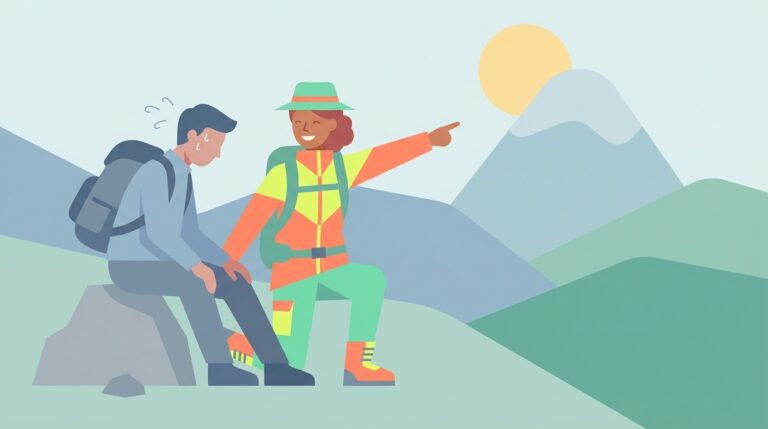
Phase 1: Empathy (The “Mountain” of Misunderstandings)
Hello! Daily Hangul Editor here.
Picture this: A Korean friend invites you for a “light morning walk” on a weekend. You show up in jeans and sneakers. Your friend shows up in full, brightly colored, professional mountaineering gear from head to toe. Before you know it, you are scaling the rocky cliffs of Mount Bukhansan.
Halfway up, you are panting, sweating, and your legs feel like jelly. Your friend smiles and says, “We are almost there!” (Spoiler alert: You are not).
If you don’t know how to stop them, you might just faint on the trail. Knowing how to say “My legs hurt” or “I need a break” is literally a survival skill in Korea. Plus, if you say it right, you might even earn some sympathy cherry tomatoes or a cup of Makgeolli from friendly older hikers passing by. Let’s learn how to politely but firmly hit the brakes!
Phase 2: Core Expressions Deep Dive
1. 다리 아파요
- Pronunciation: dari apayo [dah-ree ah-pah-yo]
(Tip: The ‘ah’ sounds like the sound you make when the doctor tells you to open your mouth, or a long sigh.)- Meaning: (Literal) Legs hurt. (Real nuance) My legs are sore / I’m tired from walking.
- K-Culture Moment: If you say this to a Korean hiker, they will almost always reply with “We’re almost at the top!” It’s the most common excuse to keep you moving.
- Editor’s Insight: This is a direct but soft way to state your condition. It’s not rude, but it clearly sends an SOS signal.
- Situation Spectrum:
[🚫 Never] ———— [⚠️ Be Careful] ———— [✅ Use Freely]
- Friends (Casual): ✅ (다리 아파 / dari apa)
- Coworkers (Semi-formal): ✅
- Boss/Elders (Formal): ⚠️ (Better to say “힘듭니다” – I’m exhausted)
- 🤔 Think About It: Why do Koreans love hiking so much that mountains are packed every weekend? How popular is hiking in your country?
2. 조금 쉬어도 돼요?
- Pronunciation: jogeum swieodo dwaeyo? [jo-geum shwee-uh-doh dway-yo]
- Meaning: (Literal) Is it okay if I rest a little? (Real nuance) Please, for the love of everything, let’s stop.
- K-Culture Moment: Essential for group activities. Koreans value group harmony (Jeong), so instead of saying “I am stopping,” asking “Can we rest?” is seen as polite and considerate of the group’s pace.
- Editor’s Insight: The magic word here is “조금” (a little). It softens the request so you don’t sound like you’re giving up completely.
- Situation Spectrum:
[🚫 Never] ———— [⚠️ Be Careful] ———— [✅ Use Freely]
- Friends (Casual): ✅ (조금 쉬어도 돼?)
- Coworkers (Semi-formal): ✅
- Boss/Elders (Formal): ✅ (조금 쉬어도 될까요?)
- 🤔 Think About It: Asking for permission to rest shows Nunchi (reading the room). Do you usually ask for permission to rest, or do you just sit down in your culture?
3. 못 걷겠어요
- Pronunciation: mot geotgesseoyo [moht gut-geh-suh-yo]
- Meaning: (Literal) I cannot walk. (Real nuance) I refuse to take another step. I am completely out of energy.
- K-Culture Moment: You’ve probably seen this in a K-Drama. The main character sits on a staircase, pouts, says “못 걷겠어요!”, and then the romantic lead gives them a piggyback ride (어바부바 – eobuba).
- Editor’s Insight: This is dramatic! Use it when you are truly exhausted. It has a slightly whining, cute nuance when used among close friends or partners.
- Situation Spectrum:
[🚫 Never] ———— [⚠️ Be Careful] ———— [✅ Use Freely]
- Friends/Partners (Casual): ✅
- Coworkers (Semi-formal): ⚠️ (Might sound a bit unprofessional)
- Boss/Elders (Formal): 🚫
- 🤔 Think About It: The suffix “-겠” implies a strong feeling or intention. It’s not just physical inability; it’s your mind saying “NOPE.”
Phase 3: Textbook vs. Real Korean
| Situation | 📖 Textbook Korean | 🗣️ Real Korean | 💡 Why is it different? |
|---|---|---|---|
| Legs are sore | 다리에 통증이 있습니다. (There is pain in my legs.) | 아, 다리 터질 것 같아요. (Ah, my legs feel like they’ll explode.) | Koreans love using dramatic verbs like “explode” (터지다) or “die” (죽다) to emphasize feelings. |
| Asking to stop | 휴식을 취합시다. (Let us take a rest.) | 잠깐만 쉴까요? (Shall we rest for just a moment?) | Using “잠깐만” (just a moment) makes the request sound less demanding and more polite. |
| Out of breath | 숨이 찹니다. (I am out of breath.) | 아, 너무 힘들어요. (Ah, it’s too hard/exhausting.) | “힘들다” is the universal word for any physical or mental hardship in Korea. |
Phase 4: Cultural Context — K-Culture Deep Dive
4-1. Non-Verbal Cues and “Nunchi”
When your legs hurt, don’t just complain loudly. A classic Korean move is to stop, put your hands on your knees, take a deep breath, and wipe your sweat. Your Korean friends will immediately read your Nunchi (body language/vibe) and suggest a break first.
4-2. K-Culture Connection: The “Almost There” Lie
If you ever hike in Korea, you will encounter middle-aged hikers (아저씨 – Ahjusshi and 아줌마 – Ajumma) in vibrant, neon outdoor clothing. If you ask them, “How much further to the top?”, 99% of the time they will answer:
“다 왔어요!” (da wasseoyo! – We’re almost there!)
Critical View: Do not trust this! In Korean hiking culture, “almost there” could mean anything from 5 minutes to a full hour. It’s not meant to deceive you; it’s meant to encourage you to not give up. It reflects a culture that pushes through hardship to achieve a goal. But realistically, just sit down and take a break!
Phase 5: Real-Life Roleplay Scenario
Setting: Saturday morning, halfway up Mount Bukhansan. The trail is mostly rocks. You are panting heavily. Your Korean friend Jihoon is wearing full professional hiking gear and looks like he hasn’t even broken a sweat.
Characters:
– YOU: A foreigner who thought this was going to be a walk in the park.
– Jihoon (30): Your energetic Korean friend. Loves hiking.
(🎭 Stage Direction: You stop walking and grab your knees, panting.)
Jihoon: 빨리 와! 경치가 진짜 좋아. ⛰️
(ppalli wa! gyeongchiga jinjja joa.)
[Hurry up! The view is really good.]
YOU: 지훈 씨, 우리 언제 도착해요?
(jihun ssi, uri eonje dochakaeyo?)
[Jihoon, when do we arrive?]
Jihoon: 거의 다 왔어요! 10분만 더 가면 돼.
(geoui da wasseoyo! sipbunman deo gamyeon dwae.)
[We are almost there! Just 10 more minutes.]
YOU: 30분 전에도 그렇게 말했잖아요…
(samsipbun jeonedo geureoke malhaetjanayo…)
[You said that 30 minutes ago…]
Jihoon: 하하, 진짜 다 왔어. 파이팅!
(haha, jinjja da wasseo. paiting!)
[Haha, we really are almost there. Fighting!]
🔀 Your Turn! How should you respond?
– A) 아, 진짜요? 그럼 빨리 가요! (Ah, really? Then let’s go fast!)
– B) 아, 다리 아파요. 조금 쉬어도 돼요? (Ah, my legs hurt. Can we rest a little?)
– C) 거짓말하지 마세요! 집에 갈래요! (Don’t lie! I want to go home!)✅ Best Choice: B — It’s honest, polite, and suggests a solution.
⚠️ Choice C Analysis: While funny, it’s a bit too aggressive for a beginner level, though close friends might laugh at it.
YOU: 아, 다리 아파요. 조금 쉬어도 돼요?
(a, dari apayo. jogeum swieodo dwaeyo?)
[Ah, my legs hurt. Can we rest a little?]
Jihoon: 그래요? 많이 힘들어요?
(geuraeyo? mani himdeureoyo?)
[Really? Are you very tired?]
YOU: 네, 너무 힘들어서 못 걷겠어요.
(ne, neomu himdeureoseo mot geotgesseoyo.)
[Yes, I’m so exhausted I can’t walk anymore.]
Jihoon: 알겠어요. 저기 바위에서 5분 쉴까요? 물 마셔요. 💧
(algesseoyo. jeogi bawieseo obun swilkkayo? mul masyeoyo.)
[Got it. Shall we rest on that rock for 5 minutes? Drink some water.]
YOU: 휴, 고마워요. 살 것 같아요.
(hyu, gomawoyo. sal geot gatayo.)
[Phew, thank you. I feel like I’m going to live.]
🌟 Bonus Roleplay: At the Bottom of the Mountain
After surviving the hike, it’s time for the true Korean hiking reward.
Ajumma (Restaurant Owner): 몇 분이세요?
(myeot buniseyo?) [How many people?]
YOU: 두 명이요. 파전 하나랑 막걸리 주세요!
(du myeongiyo. pajeon hanarang makgeolli juseyo!) [Two people. One green onion pancake and Makgeolli, please!]
Phase 6: 10-Second Shadowing Drill
Practice this until it flows naturally. It will save your life on the mountain!
🥺 아, / 다리가 / 너무 아파서 / 못 걷겠어요.
(a, / dariga / neomu apaseo / mot geotgesseoyo.)
Emotion: Pleading, out of breath, seeking sympathy.
Phase 7: K-Culture Mini Dictionary
| Korean | Romanization | English | Context |
|---|---|---|---|
| 등산 | deungsan | Hiking | Not just a hobby, but a serious weekend sport for many Koreans. |
| 파이팅 | paiting | “You can do it!” | Used to cheer someone on when they are tired. |
| 다 왔어요 | da wasseoyo | We’re almost there | The greatest lie told on Korean mountains. |
| 파전 | pajeon | Green onion pancake | The mandatory greasy food eaten after a long hike. |
| 막걸리 | makgeolli | Rice wine | The traditional drink paired with Pajeon. Sweet and refreshing! |
Phase 8: Traveler Survival Kit
If your legs are truly killing you after a long day of exploring Seoul or hiking a mountain, you’ll need this.
🆘 Survival Expression #1: Finding the Pharmacy
– 🇰🇷 “약국이 어디예요?” (yakgugi eodiyeyo?)
– 🗣️ English Pronunciation: [yahk-gook-ee uh-dee-yay-yo?]
– 📍 Where to use: Asking for directions on the street.
– 💡 Pro Tip: Korean pharmacies (약국) sell amazing muscle pain relief patches called “파스” (Paseu). If your legs hurt, just walk in, point to your leg, and say “파스 주세요” (Paseu juseyo – Please give me patches). They have hot ones and cold ones!📌 Editor’s Travel Note
– Useful Apps: Google Maps doesn’t work well for walking directions in Korea. Always use KakaoMap or Naver Map to avoid getting lost and walking extra miles!
– Public Transit: If your legs hurt, look for an escalator or elevator in subway stations. Some older stations only have endless stairs (looking at you, Dongdaemun History & Culture Park station!).
Phase 9: Critical Thinking Corner — “One Step Deeper”
🧠 Think Deeper: Language & Power – The Group Dynamic
In Korean culture, the group often takes priority over the individual. This is why Koreans usually hike in groups and prefer to stay together rather than splitting up by walking speeds. Saying “My legs hurt, I will stop here” breaks the group dynamic (Jeong). That’s why indirect phrases like “Can we rest a little?” are developed to politely request a break while maintaining harmony and showing respect to the group’s shared goal.
💬 Your Turn: In your culture, if someone is tired during a group hike, do they stop the whole group, or do they just walk slower on their own? Let us know in the comments!
Phase 10: FAQ & Avoiding Misunderstandings
Q: Can I say “다리 아파요” to my boss during a company hike?
A: Yes, it’s a factual statement. However, to sound more polite, say “조금 무리가 되는 것 같습니다” (It feels a bit too much for me) or simply “조금 쉬었다가 가면 안 될까요?” (Could we rest for a bit before going?).
Q: What is the difference between 아파요 (apayo) and 힘들어요 (himdeureoyo)?
A: This is important! 아파요 means literal physical pain (my bones ache, my muscle is torn). 힘들어요 means you are exhausted or out of breath. If you just say “아파요” on a mountain, Koreans might think you broke your ankle and try to call a helicopter. Use “다리 아파요” (specific to sore legs) or “힘들어요” (I’m exhausted).
❌ Common Mistake #1: Saying “죽겠어요!” (I’m dying!) to older strangers.
✅ Do This Instead: While “힘들어 죽겠어요” (I’m so tired I could die) is a common native expression, it can sound rude or overly dramatic to strangers. Stick to “너무 힘들어요” (I’m very tired).
Phase 11: Summary & Action Items
- One-Liner Summary: When your legs are screaming on a Korean mountain, ask “조금 쉬어도 돼요?” (Can we rest a little?) to politely pause the hike.
Action Mission 3 Steps:
– 🥉 Bronze (Solo): Stand up, touch your legs, and sigh loudly while saying “다리 아파요” 3 times.
– 🥈 Silver (Online): Find a YouTube video of someone hiking Mount Hallasan or Bukhansan, and leave a comment: “다리 아파 보여요!” (Your legs look like they hurt!)
– 🥇 Gold (Real-world): Next time you are walking a lot with a Korean friend, test out “조금 쉬어도 돼요?” and see if they guide you to a cafe!
- K-Culture Mission: Search “막걸리 파전” (Makgeolli Pajeon) on Instagram and see what your reward will look like after your next Korean hike.
Phase 12: Quiz — Interactive Challenge
1. You are halfway up the mountain and completely out of breath. What is the safest way to ask for a break?
A) 집에 갈래! (I wanna go home!)
B) 조금 쉬어도 돼요? (Can we rest a little?)
C) 다 왔어요? (Are we almost there?)
2. True or False: If an older Korean hiker tells you “다 왔어요” (We are almost there), you should believe them and sprint to the top.
3. Fill in the blank:
Ah, my legs are so sore I cannot walk!
아, 다리가 너무 아파서 ( )!
(Answers: 1. B / 2. False! It’s the biggest lie in Korean hiking. Save your energy. / 3. 못 걷겠어요 – mot geotgesseoyo)
Frequently Asked Questions (FAQ)
Q: What does "다리 아파요" mean in Korean and how do you pronounce it?
A: In Korean, "다리 아파요" is pronounced [dari apayo [dah-ree ah-pah-yo] and means: (Literal) Legs hurt. (Real nuance) My legs are sore / I'm tired from walking.
Q: What does "조금 쉬어도 돼요?" mean in Korean and how do you pronounce it?
A: In Korean, "조금 쉬어도 돼요?" is pronounced [jogeum swieodo dwaeyo? [jo-geum shwee-uh-doh dway-yo] and means: (Literal) Is it okay if I rest a little? (Real nuance) Please, for the love of everything, let's stop.
Q: What does "못 걷겠어요" mean in Korean and how do you pronounce it?
A: In Korean, "못 걷겠어요" is pronounced [mot geotgesseoyo [moht gut-geh-suh-yo] and means: (Literal) I cannot walk. (Real nuance) I refuse to take another step. I am completely out of energy.







