

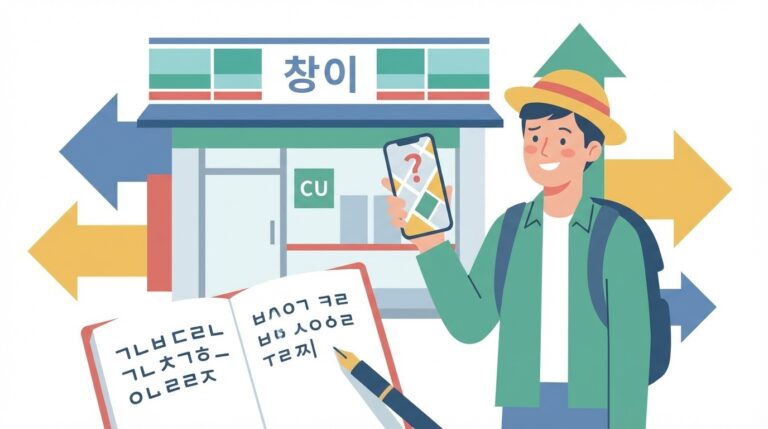
Phase 1: 공감 — 몰입형 오프닝 (Immersive Hook)
Hello! I’m your Daily Hangul Editor, your friendly local guide and Korean tutor.
Picture this: You are standing right in the middle of Myeongdong or Hongdae. Your map app proudly announces, “You have arrived!” But you look around, and… nothing. The K-BBQ restaurant you’re dying to try is nowhere to be seen. You muster up the courage to ask a passing local. They kindly point and say something like, “Ah! Convenience store yeop-e isseoyo!”
Yeop? What on earth is a yeop?
If you don’t know the holy trinity of Korean locations—Front, Back, and Side—you might end up walking in circles around the same block for 20 minutes. But don’t worry! Today, we are going to learn how to navigate like a true local. Once you master these three little words, you won’t just find your way; you’ll understand exactly where your favorite K-Drama characters are hiding!
(Transparency note: This post is based on the real-life struggles of my A1 students who got lost trying to find my tutoring center!)
Phase 2: 핵심 표현 심층 분석 (Deep Dive)
Let’s learn the 3 magical words you need to survive getting lost in Korea.
1. 앞 (Front)
- Pronunciation: [ap] (Sounds like you’re saying “Up!” but with a shorter, crisper ‘p’ sound at the end.)
- Meaning: Front / In front of
- K-Culture Moment: You’ll hear this in every K-Drama when the male lead calls the female lead at 11 PM: “나 너희 집 앞이야. 나와.” (I’m in front of your house. Come out.)
- Editor’s Insight: Just remember the word “App” on your phone. The screen is always in front of your face! To say “It’s in front of the station,” just say: 역 앞 (yeok ap).
- Situation Spectrum:
[🚫 절대 금지] ———— [⚠️ 주의] ———— [✅ 자유롭게]
- Casual / Formal: ✅ (Just a noun, completely safe to use anywhere!)
- 🤔 Think About It: In Korean, the landmark comes first, then the direction. It’s “Station Front” (역 앞), not “Front of Station.” How does your native language structure this?
2. 뒤 (Back / Behind)
- Pronunciation: [dwi] (Sounds like “twee” but with a softer ‘d’. Imagine a bird going “dwi-tweet” behind you!)
- Meaning: Back / Behind
- K-Culture Moment: Ah, the classic K-Drama “Back Hug” (백허그). The guy always sneaks up from behind (뒤). Also, the best indie cafes in Seoul are usually hidden behind (뒤) big, boring buildings.
- Editor’s Insight: If someone says “건물 뒤에 있어요” (geonmul dwie isseoyo), it means it’s behind the building.
- Situation Spectrum:
[🚫 절대 금지] ———— [⚠️ 주의] ———— [✅ 자유롭게]
- Casual / Formal: ✅
- 🤔 Think About It: Have you noticed that Koreans rarely use street names when giving directions? They prefer landmarks! “Behind the bank” is much more common than “On 3rd Street.”
3. 옆 (Side / Next to)
- Pronunciation: [yeop] (Rhymes with “yup!”)
- Meaning: Side / Next to
- K-Culture Moment: Imagine going to a K-Pop concert. You check your ticket, and guess what? Your seat is right next to (옆) the stage! “무대 옆!” (mudae yeop!)
- Editor’s Insight: This is the most frequently used direction word when looking for small shops. “편의점 옆에 있어요” (pyeonuijeom yeope isseoyo) = It is next to the convenience store.
- Situation Spectrum:
[🚫 절대 금지] ———— [⚠️ 주의] ———— [✅ 자유롭게]
- Casual / Formal: ✅
- 🤔 Think About It: In crowded cities like Seoul, shops are tightly packed. That’s why “next to” (옆) is the most helpful word you can learn!
Phase 3: 교과서 vs 진짜 한국어 (Textbook vs Real Life)
| Situation | 📖 Textbook Korean | 🗣️ Real Korean | 💡 Why is it different? |
|---|---|---|---|
| Answering “Where is the cafe?” | 은행 앞 건물에 있습니다. (It is in the building in front of the bank.) | 은행 앞이요! (In front of the bank!) | Koreans love efficiency (Ppalli-ppalli culture). Dropping unnecessary words is standard! |
| Telling a taxi driver where to stop | 저기 편의점 앞에서 세워 주시겠습니까? (Would you kindly stop in front of the convenience store over there?) | 저기 편의점 앞이요! (In front of that convenience store over there!) | Adding “~이요” (~iyo) to a noun makes it instantly polite but brief. Perfect for quick taxi rides! |
Phase 4: 문화적 맥락 — K-Culture 딥다이브 (Cultural Deep Dive)
4-1. Non-verbal Communication: The “Hand Pointing” Rule
When Koreans point to the front, back, or side, they rarely use just one index finger, especially to an older person or a stranger. It’s considered a bit rude. Instead, you’ll see them use an open hand (palm facing up) to gesture towards the direction. Also, look out for the “chin point”—a quick nod towards the location!
4-2. K-Travel Connection: Navigating the Alleys (골목)
In Seoul, main streets (큰길) are for big corporate stores. But the real magic—the trendy cafes, secret K-BBQ spots, and aesthetic boutiques—happens in the narrow alleys (골목 – golmok) behind the main streets.
When a local tells you a famous restaurant is “건물 뒤” (behind the building), they literally mean you need to walk down a tiny alleyway. Don’t be scared! Some of the best culinary adventures in Korea start by walking behind a massive cosmetic store into a quiet, hidden street.
Phase 5: 실전 롤플레이 시나리오 (Immersive Roleplay)
Scenario A: The Hongdae Cafe Hunt
Setting: Saturday afternoon, Hongdae. It’s crowded. You’ve been walking for 15 minutes looking for a cafe famous for its fluffy pancakes. The map app is failing you.
Characters:
– YOU: A hungry traveler craving sugar.
– Minji: A stylish local university student waiting for her friend.
YOU: 실례합니다… (Sillyehamnida… – Excuse me…)
Minji: 네? (Ne? – Yes?)
YOU: (Showing your phone) 혹시 카페 ‘달고나’ 아세요? (Hoksi kape ‘dalgona’ aseyo? – By any chance, do you know Cafe Dalgona?)
Minji: 아! 카페 달고나요? 저기 은행 보이시죠? (Ah! Kape dalgonayo? Jeogi eunhaeng boisijyo? – Ah! Cafe Dalgona? You see the bank over there?)
YOU: 네, 은행… (Ne, eunhaeng… – Yes, the bank…)
Minji: 은행 뒤에 있어요! 바로 옆에 편의점도 있고요. (Eunhaeng dwi-e isseoyo! Baro yeop-e pyeonuijeomdo itgoyo. – It’s behind the bank! And there is a convenience store right next to it.)
🔀 Your Turn! How should you respond?
– A) “오케이, 바이!” (Okay, bye!)
– B) “은행 앞이요?” (In front of the bank?)
– C) “아~ 은행 뒤요! 감사합니다!” (Ah~ Behind the bank! Thank you!)✅ Best Choice: C — Confirming the direction (dwi) and saying thank you is the perfect, polite way to end the interaction.
⚠️ Choice A Analysis: Too casual and a bit rude for a stranger!
Scenario B: Bonus K-Drama Moment
You’re at the airport waiting for your friend. You call them:
Friend: 어디야? (Eodiya? – Where are you?)
YOU: 나 지금 스타벅스 앞! 너는? (Na jigeum sutabeokseu ap! Neoneun? – I’m in front of Starbucks right now! And you?)
Friend: 네 뒤에 봐봐. (Ne dwi-e bwabwa. – Look behind you.)
(You turn around, and they are waving excitedly! K-Drama moment achieved!)
Phase 6: 10초 섀도잉 드릴 (Shadowing Drill)
Let’s practice! Speak out loud within 10 seconds. Follow the pauses (/) and emotions.
- 🥺 (Looking a bit lost): 저기요, / 편의점은 / 어디에 있어요?
(Jeogiyo, / pyeonuijeomeun / eodie isseoyo?)
Excuse me, where is the convenience store? -
😊 (Bright and helpful): 아! / 저기 은행 / 옆에 있어요!
(Ah! / jeogi eunhaeng / yeop-e isseoyo!)
Ah! It is next to the bank over there! -
😤 (Confident): 스타벅스 / 앞에서 / 만나요!
(Sutabeokseu / ap-eseo / mannayo!)
Let’s meet in front of Starbucks!
Phase 7: K-Culture 미니 사전 (K-Culture Glossary)
| 한국어 (Korean) | Romanization | English | Cultural Context |
|---|---|---|---|
| 앞 | ap | Front | Used heavily when setting meeting points (e.g., Station front). |
| 뒤 | dwi | Back / Behind | Often where hidden gem cafes/restaurants are located. |
| 옆 | yeop | Side / Next to | Used to describe proximity in crowded streets. |
| 골목 | golmok | Alley | The heart of vintage and hipster culture in Seoul (e.g., Ikseon-dong golmok). |
| 길치 | gilchi | Bad with directions | “길” (road) + “치” (fool). A cute slang for someone who always gets lost. Are you a gilchi? |
Phase 8: 여행자 서바이벌 키트 (Traveler’s Survival Kit)
If you memorize nothing else today, save these phrases on your phone!
🆘 Survival Phrases for the Lost Traveler
– 🇰🇷 1. “여기가 어디예요?” (Yeogiga eodiyeyo?)
– 🗣️ Meaning: Where is here? (Where am I?)
– 🇰🇷 2. “[장소] 앞이요.” ([Place] ap-iyo.)
– 🗣️ Meaning: In front of [Place], please. (Perfect for telling taxi drivers where to drop you off!)
– 🇰🇷 3. “길을 잃었어요.” (Gireul ileosseoyo.)
– 🗣️ Meaning: I am lost.📌 Editor’s Travel Note
– App Tip: Google Maps doesn’t work well in Korea for walking directions due to security laws. You MUST download Naver Map or KakaoMap. They have English settings!
– Finding Addresses: Korean addresses usually follow the format of City -> District -> Street -> Building Number. But locals still use landmarks like “Next to the Olive Young” to find things faster!
Phase 9: 비판적 사고 코너 — “한 발 더 깊이” (Think Deeper)
Space and Community in the Korean Language
🧠 Think Deeper:
In English, you might say “I am waiting at 123 Main Street.” In Korean, people almost always say “I am waiting in front of the movie theater” (영화관 앞). Why? Korean culture is highly relationship-oriented and visual. Buildings and landmarks are shared community spaces. Navigating by landmarks (like “next to the bank” or “behind the bakery”) requires a shared understanding of the neighborhood. It turns a cold, geographic map into a warm, human-centered neighborhood.💬 Your Turn: How do people give directions in your country? Do you use exact street numbers, or do you use landmarks like “Next to the big oak tree”? Tell me in the comments!
Phase 10: FAQ & 오해 방지 (Troubleshooting)
Q: Can I just say “Ap” to a taxi driver?
No! Just saying “Ap” sounds like a caveman grunt. 😅 Always add “~iyo” to make it a polite sentence. Say “스타벅스 앞이요” (Starbucks ap-iyo).
Q: What is the difference between 앞 (ap) and 안 (an)? They sound the same!
Ah! This is the most common mistake for A1 learners.
– 앞 (ap) = Front
– 안 (an) = Inside
If you tell your friend “카페 안이야” (kape an-iya), you are sitting inside drinking coffee. If you say “카페 앞이야” (kape ap-iya), you are standing outside in front of the door freezing! Listen carefully to the ending consonant: ‘p’ vs ‘n’.
❌ Common Mistake #1: Saying “역의 앞” (Front of the station) using the possessive particle ‘의’.
✅ How to fix it: Korean is simpler! Just smash the two nouns together: “역 앞” (Yeok ap – Station front).
Phase 11: 요약 및 액션 아이템 (Wrap-up)
One-Liner Summary: To survive in Korea, just remember: AP (Front), DWI (Behind), YEOP (Next to) + 에 있어요 (It is at)!
Action Mission:
– 🥉 Bronze (Solo): Look around your room right now. Say “Laptop 앞” (Laptop front), “Wall 뒤” (Wall behind), “Phone 옆” (Phone next to) out loud 3 times.
– 🥈 Silver (Online): Go to Naver Map, find your favorite K-Pop agency building, and see what is “옆” (next to) it!
– 🥇 Gold (Real Life): Next time you meet a Korean friend, text them where you are using: “[Place] 앞이야!”
K-Culture Mission: Watch any K-Drama episode today. I guarantee you will hear the word “앞” (ap) at least once when characters are meeting up. When you hear it, point at the screen and shout “AP!”
Phase 12: 퀴즈 — 인터랙티브 챌린지 (Interactive Quiz)
Let’s test your K-Direction skills!
1. You want to wait for your friend in front of the convenience store (편의점). What should you text them?
A) 편의점 뒤
B) 편의점 앞
C) 편의점 옆
2. True or False: Pointing directions with one index finger is considered highly polite in Korea.
A) True
B) False
3. Fill in the blank: The taxi driver asks where you want to get off. You want to stop next to the subway station (지하철역).
“지하철역 ( _______ )이요!”
A) 앞 (ap)
B) 뒤 (dwi)
C) 옆 (yeop)
(Answers: 1. B, 2. False – Use an open hand gesture instead!, 3. C)
Frequently Asked Questions (FAQ)
Q: What does "앞 (Front)" mean in Korean and how do you pronounce it?
A: In Korean, "앞 (Front)" is pronounced [ap] and means: Front / In front of
Q: What does "뒤 (Back / Behind)" mean in Korean and how do you pronounce it?
A: In Korean, "뒤 (Back / Behind)" is pronounced [dwi] and means: Back / Behind
Q: What does "옆 (Side / Next to)" mean in Korean and how do you pronounce it?
A: In Korean, "옆 (Side / Next to)" is pronounced [yeop] and means: Side / Next to







