

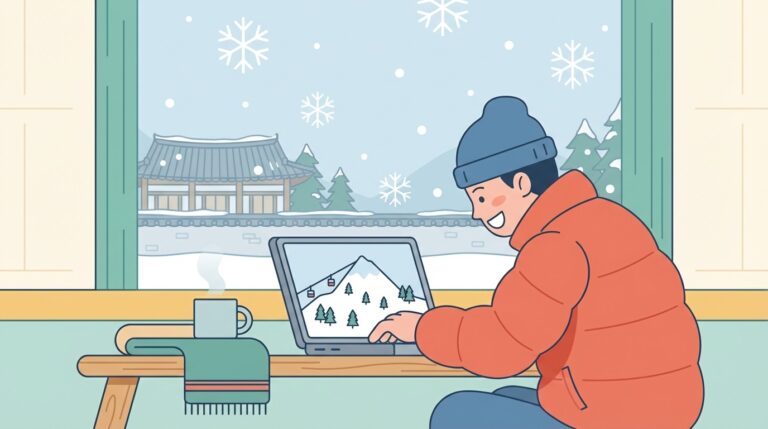
안녕하세요! I am the Lead Editor of Daily Hangul. Have you ever watched a K-Drama where the main characters go on a corporate winter workshop (워크숍) or a romantic getaway to a pristine, snow-covered mountain? The female lead is freezing, the chaebol male lead wraps his scarf around her, and they share a steaming cup of Eomuk (fish cake) soup. It looks effortlessly romantic, doesn’t it?
But behind that picture-perfect winter wonderland lies one of the most fiercely competitive sports in Korean society: Securing the Early Bird Ski Season Pass (얼리버드 시즌권).
For advanced (C2) Korean learners, merely knowing how to say “겨울” (winter) or “눈” (snow) isn’t enough. If you want to mingle with locals in Seoul, you need to understand the cultural obsession with Gaseongbi (cost-effectiveness) and the adrenaline rush of Korean internet ticketing culture.
Today, we aren’t just learning textbook words. We are diving deep into the real, fast-paced Korean winter survival language. Grab your hot cocoa, and let’s hit the slopes!
Phase 2: Core Expressions Deep Dive
Let’s break down the expressions locals actually use when the temperature drops below zero.
1. 이번 주말에 드디어 개장한대요.
- Pronunciation: Ibeon jumare deudieo gaejanghandaeyo. [ee-bun joo-mahl-eh deu-dee-uh gae-jahng-hahn-dae-yo]
- Meaning: I heard they are finally opening this weekend. (Literal: It is said they open this weekend.)
- K-Culture Moment: You’ll hear this buzzing around the office watercooler in late November. Koreans track ski resort opening dates (개장일) like they track stock prices. The weather dictates everything, and resorts race to be the first to open their slopes.
- Editor’s Insight: The magic here is the grammatical structure
-한대요(a contraction of-한다고 해요). At the C2 level, you know this is indirect quotation. Using it shows you are passing on highly anticipated insider information. It sounds much more natural and conversational than just stating a fact.- Situation Spectrum:
[🚫 절대 금지] ———— [⚠️ 주의] ———— [✅ 자유롭게]
- Casual (Friends): ✅ (Drop the ‘요’ -> 개장한대)
- Semi-formal (Co-workers): ✅
- Formal (Boss): ⚠️ (Better to use “개장한다고 합니다”)
- 🤔 Think About It: Why is indirect quotation (
-한대요) so heavily used in Korean daily conversation? It reflects a culture that values shared information and consensus. By framing it as “I heard,” you invite the listener into a shared rumor mill rather than forcefully declaring a fact.2. 얼리버드 특가로 시즌권 끊었어요?
- Pronunciation: Eollibeodeu teukgaro sijeungwon kkeunheosseoyo? [uhl-lee-buh-deu teuk-gah-ro shee-jeun-gwon kkeun-uh-suh-yo?]
- Meaning: Did you get the season pass at the early bird special price?
- K-Culture Moment: This is the ultimate flex among Korean winter sports enthusiasts. Getting a season pass at full price? Unheard of. You must get the ‘Early Bird’ (얼리버드) ‘Special Price’ (특가).
- Editor’s Insight: Pay close attention to the verb 끊다 (to cut). In English, you “buy” a ticket. In Korean, you “cut” a ticket. This is a crucial native nuance.
- Situation Spectrum:
[🚫 절대 금지] ———— [⚠️ 주의] ———— [✅ 자유롭게]
- Casual (Friends): ✅
- Semi-formal (Co-workers): ✅
- Formal (Boss): ⚠️ (Depending on how close you are)
- 🤔 Think About It: Why “cut” (끊다)? Before the digital era, paper tickets for trains and movies were literally cut or punched by staff upon entry. The language preserved this physical action even in the era of mobile QR codes! Does your native language have words that survived technological evolution?
3. 올해는 설질이 꽤 괜찮을 것 같아.
- Pronunciation: Olhaeneun seoljiri kkwae gwaenchaneul geot gata. [ohl-hae-neun suhl-jeel-ee kkwae gwaen-chahn-eul guht gah-tah]
- Meaning: Looks like the snow quality will be pretty good this year.
- K-Culture Moment: When sitting on the ski lift, true snowboard and ski maniacs don’t just look at the view; they analyze the snow.
- Editor’s Insight: 설질 (雪質 – snow quality) is an advanced Sino-Korean compound. Koreans love creating two-syllable Sino-Korean words for extreme specificity (e.g., 화질 for picture quality, 음질 for sound quality, 수질 for water quality). Throwing “설질” into a conversation immediately promotes you from “tourist” to “local enthusiast.”
- Situation Spectrum:
[🚫 절대 금지] ———— [⚠️ 주의] ———— [✅ 자유롭게]
- Casual (Friends): ✅
- Semi-formal (Co-workers): ✅
- Formal (Boss): ✅
Phase 3: Textbook vs Real Life
Let’s see how a C2 learner can upgrade their textbook knowledge into natural, native-level slang.
| Situation | 📖 Textbook Korean | 🗣️ Real Korean | 💡 Why the difference? |
|---|---|---|---|
| Buying a pass | 시즌 패스를 샀어요. | 시즌권 끊었어요. | “끊다” is deeply ingrained in Korean ticketing culture. |
| Asking about opening | 스키장이 언제 문을 여나요? | 개장일 떴어요? | “뜨다” (to float/rise) is used when news or internet notices are published. |
| Snow is great | 눈 상태가 매우 좋습니다. | 오늘 설질 미쳤어요. | “미치다” (to be crazy) is the ultimate Gen Z/Millennial slang for “amazing.” |
| Waiting for discounts | 할인을 기다립니다. | 존버 중이에요. | “존버” (slang for holding on desperately) reflects the intense waiting game for price drops. |
Phase 4: Cultural Deep Dive
4-1. Non-verbal Communication: The “Fingertip Nunchi”
When booking an early bird season pass, Nunchi (눈치) takes on a digital form. Koreans don’t just click; they prepare. They use atomic clocks (네이비즘) to sync their computer time to the server’s time. The non-verbal stance is: leaning forward, hand hovering over the mouse, refreshing the page exactly at 11:59:59. If you are sitting next to a Korean friend doing this, do not interrupt them. It’s a matter of life and death.
4-2. K-Culture Connection: The “Ticketing” DNA
Why are Koreans so intense about early bird discounts? It’s deeply connected to K-Pop Fan Culture. The phenomenon of “피켓팅” (Blood Ticketing – fighting for concert seats) has bled into everyday life. Whether it’s registering for university classes (수강신청), booking train tickets for Chuseok (명절 기차표), or buying a ski season pass, the digital warfare is the same.
In K-Dramas, you’ll often see scenes where colleagues gather around a PC bang (internet cafe) to help someone click faster. It’s a bonding experience. If you offer to help a Korean friend “click” for their season pass, you’ve instantly become their best friend.
Phase 5: Immersive Roleplay
Scenario A: The Server Crash
- Setting: A bustling Gangnam office, 1:55 PM on a Tuesday. The early bird special for Vivaldi Park Ski Resort opens at 2:00 PM. You and your coworker, Min-su, have two laptops open.
- Characters:
- YOU: An expat working in Seoul, looking forward to your first Korean ski trip.
- Min-su (32): Your fast-talking, deal-loving Korean coworker.
민수: 시간 다 돼 가요! 준비됐죠? F5(새로고침) 누를 준비 하세요! ⏰
(Sigan da dwae gayo! Junbidwaetjyo? F5 nureul junbi haseyo!)
[It’s almost time! You ready? Get ready to hit F5!]
(🎭 Stage Direction: Min-su is aggressively tapping his fingers on the desk.)
YOU: 네, 로그인해 놨어요. 근데 이거 진짜 빨리 매진돼요?
(Ne, log-inhae nwasseoyo. Geunde igeo jinjja ppalli maejindwaeyo?)
[Yes, I’m logged in. But does this really sell out that fast?]
민수: 장난 아니에요. 작년에는 3분 컷이었어요. 아, 떴다!!! 클릭!!!
(Jangnan anieyo. Jangnyeoneneun 3bun keosieosseoyo. Ah, tteotda!!! Keullik!!!)
[No joke. Last year it was gone in 3 minutes. Ah, it’s up!!! Click!!!]
YOU: 어? 화면이 하얗게 변했는데요? 안 넘어가요!
(Eo? Hwamyeoni hayake byeonhaenneundeyo? An neomeogayo!)
[Huh? The screen just went white! It’s not loading!]
민수: 아씨, 서버 또 터졌어! 🤬 제발, 제발… 오! 결제 창 넘어갔어요!
(Assi, seobeo tto teojeosseo! Jebal, jebal… Oh! Gyeolje chang neomeogasseoyo!)
[Damn it, the server crashed again! Please, please… Oh! I got to the payment page!]
민수: 제가 두 장 다 끊을게요! 나중에 돈 보내주세요.
(Jega du jang da kkeunheulgeyo! Najunge don bonaejuseyo.)
[I’ll buy both! Just send me the money later.]
🔀 Your Turn! How should you respond?
– A) “얼마예요? 지금 현금으로 줄게요.” (How much? I’ll give you cash now.)
– B) “우와, 대박! 카카오페이로 바로 엔빵 할게요!” (Wow, awesome! I’ll split it right now via KakaoPay!)
– C) “아, 제가 직접 사고 싶었는데 아쉽네요.” (Ah, I wanted to buy it myself, what a shame.)✅ Best Choice: B — 엔빵 (N-bbang) is a ubiquitous slang for splitting the bill (1/N). Using mobile payment apps like KakaoPay or Toss to send money instantly is the most “Korean” way to handle this. Offering cash (A) in a cashless society like Korea will just make things awkward!
Phase 6: 10-Second Shadowing Drill
Let’s practice the frustration of digital ticketing. Pay attention to the pauses (/) and intonation!
😤 아씨, / 서버 또 / 터졌어! (Ah-ssi, / seo-beo tto / teo-jyeot-seo!)
😢 나 진짜 / 얼리버드 아니면 / 스키장 안 갈래. (Na jin-jja / eol-ri-beo-deu a-ni-myeon / seu-ki-jang an gal-lae.)
(Translation: Damn it, the server crashed again! Seriously, if it’s not the early bird, I’m not going to the ski resort.)
Phase 7: K-Culture Glossary
| 한국어 | Romanization | English | Cultural Context |
|---|---|---|---|
| 가성비 | gaseongbi | Cost-effectiveness | A core philosophy in Korean consumer culture. Getting the best value for your money. |
| 피켓팅 | piketting | Blood-ticketing | A portmanteau of ‘피’ (blood) and ticketing. Refers to extremely competitive online booking. |
| 서버가 터지다 | seobeoga teojida | Server crashed | Literal translation: “The server exploded.” Used whenever a website crashes from high traffic. |
| 존버 | jonbeo | Holding on / HODL | Extreme slang. Enduring a difficult situation (like waiting for a price drop) with sheer willpower. |
| 엔빵 | enbbang | Splitting the bill | Dividing the cost by ‘N’ number of people. Essential for group trips and dinners! |
Phase 8: Traveler’s Survival Kit (Ski Resort Edition)
Heading to a Korean ski resort like Yongpyong, Phoenix Park, or Vivaldi? Save these cards!
🆘 Survival Expression #1: Renting Gear
– 🇰🇷 “장비 렌탈 종일권으로 할게요.” (Jangbi rental jong-il-gwoneuro halgeyo.)
– 🗣️ Meaning: I’ll take the all-day gear rental.
– 💡 Pro Tip: Resorts offer ‘Half-day’ (반일권), ‘Afternoon’ (오후권), and ‘Night’ (야간권). Night skiing is incredibly popular in Korea!🆘 Survival Expression #2: The Free Ride
– 🇰🇷 “시즌권자 무료 셔틀은 어디서 타나요?” (Sijeungwonja muryo syeoteureun eodiseo tanayo?)
– 🗣️ Meaning: Where do I take the free shuttle for season pass holders?
– 💡 Pro Tip: Most major ski resorts offer free round-trip shuttle buses from Seoul if you hold a season pass.
📌 Editor’s Travel Note:
Korean ski resorts operate like massive, self-contained cities. Don’t worry about bringing food; you’ll find everything from Domino’s Pizza to premium Korean BBQ right at the base of the slopes. Also, there is NO tipping for ski instructors or equipment rental staff. Handing them cash will just confuse them!
Phase 9: Think Deeper – “Media vs Reality”
🧠 Think Deeper: The “Gaseongbi” Paradox
If you watch K-Dramas, wealthy characters casually rent out entire ski resorts, portraying a life of lavish luxury. However, the reality of Korean culture is deeply rooted in 가성비 (Cost-effectiveness). Even affluent professionals will sit at their desks frantically refreshing a webpage to save 30% on a season pass. Why? In Korea, finding a discount isn’t just about saving money; it’s a testament to your resourcefulness, speed, and information-gathering skills. Paying “full price” (호갱 – being a sucker) is considered a failure of social awareness. The thrill of the “Early Bird” is a modern survival game.💬 Your Turn: In your culture, is bragging about getting a massive discount considered a smart move, or something people prefer to keep quiet about? Let me know in the comments!
Phase 10: FAQ & Troubleshooting
Q1. Can I use the word ‘미쳤어요’ (It’s crazy/insane) to describe good snow quality to my ski instructor?
Maybe. If your instructor is young and you’ve built a friendly rapport, saying “오늘 설질 미쳤네요!” is a great icebreaker. But if it’s an older instructor or a formal setting, stick to “눈 상태가 너무 좋네요.”
Q2. Do I need to buy a season pass if I only go 2-3 times?
Actually, no! This is a common trap. If you aren’t going every weekend, look for 카드사 할인 (Credit card discounts). Almost every Korean credit card offers 30-50% off lift tickets.
❌ Common Mistake Alert!
Foreigners often translate “I bought a ski pass” directly to “스키 패스를 샀어요.” While understandable, a true C2 speaker will say “스키장 시즌권 끊었어요.” Remember the verb ‘끊다’!
Phase 11: Wrap-up & Action Items
🎯 One-Liner Summary: Conquering the Korean winter means mastering the digital warfare of the “Early Bird Season Pass” (얼리버드 시즌권) and splitting the bill (엔빵) with your crew.
✅ Your Action Missions:
– 🥉 Bronze: Say “올해는 설질이 꽤 괜찮네” out loud 3 times, imagining you are looking at a snowy mountain.
– 🥈 Silver: Leave a comment below using the word “가성비” or “존버” in a sentence!
– 🥇 Gold (K-Culture Mission): Go to a Korean ski resort’s website (like Vivaldi Park or Yongpyong) and see if you can locate the word 얼리버드 or 특가 on their promotional banners!
Phase 12: Interactive Quiz
Q1. Your friend bought the ski tickets for the whole group. What is the most culturally appropriate response?
1) “Thank you! I will tip you 20%.”
2) “카카오페이로 엔빵 할게요!” (I’ll split it via KakaoPay!)
3) “내년에는 제가 살게요.” (I will buy them next year.)
Click for the Answer
Answer: 2! Tipping doesn’t exist, and waiting until next year is too vague. Immediate ‘N-bbang’ is the golden rule of Korean social outings.
Q2. Fill in the blank: “서버가 ____!” (The server crashed! – Literal: The server exploded!)
1) 터졌어
2) 아파요
3) 죽었어
Click for the Answer
Answer: 1 (터졌어). While “죽었어” (died) makes sense in English, Koreans specifically say the server “exploded” (터지다) when overwhelmed by traffic.
How many did you get right? Get your clicking fingers ready, and I’ll see you on the slopes! ⛷️
Frequently Asked Questions (FAQ)
Q: What does "이번 주말에 드디어 개장한대요." mean in Korean and how do you pronounce it?
A: In Korean, "이번 주말에 드디어 개장한대요." is pronounced [Ibeon jumare deudieo gaejanghandaeyo. [ee-bun joo-mahl-eh deu-dee-uh gae-jahng-hahn-dae-yo] and means: I heard they are finally opening this weekend. (Literal: It is said they open this weekend.)
Q: What does "얼리버드 특가로 시즌권 끊었어요?" mean in Korean and how do you pronounce it?
A: In Korean, "얼리버드 특가로 시즌권 끊었어요?" is pronounced [Eollibeodeu teukgaro sijeungwon kkeunheosseoyo? [uhl-lee-buh-deu teuk-gah-ro shee-jeun-gwon kkeun-uh-suh-yo?] and means: Did you get the season pass at the early bird special price?
Q: What does "올해는 설질이 꽤 괜찮을 것 같아." mean in Korean and how do you pronounce it?
A: In Korean, "올해는 설질이 꽤 괜찮을 것 같아." is pronounced [Olhaeneun seoljiri kkwae gwaenchaneul geot gata. [ohl-hae-neun suhl-jeel-ee kkwae gwaen-chahn-eul guht gah-tah] and means: Looks like the snow quality will be pretty good this year.







