

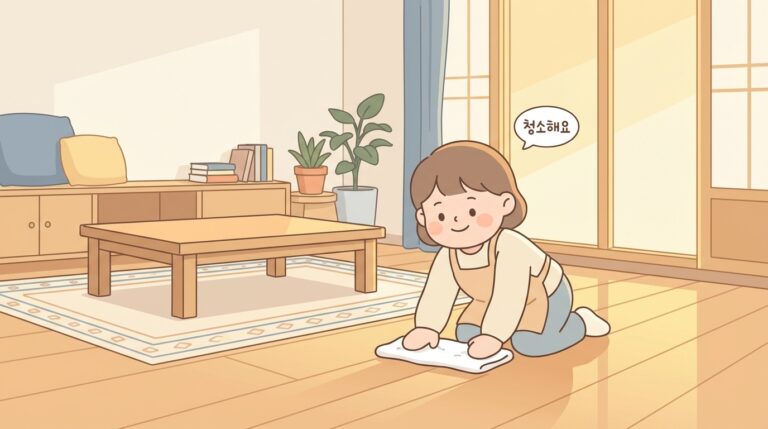
Hello! I’m your Daily Hangul Editor. Have you ever watched a K-Drama and noticed a peculiar scene? The main character just had a massive argument, or perhaps they are heavily stressed. To blow off steam, what do they do? They don’t go for a run—instead, they are on their hands and knees, aggressively scrubbing the living room floor with a wet rag, huffing and puffing.
Or maybe you’ve been to a bustling Korean BBQ restaurant, accidentally knocked over a glass of water, and heard the owner shout to the staff, “여기 좀 닦아!” (Wipe here!).
Today, we are diving into the world of 집안일 (Housework), specifically focusing on 걸레질하기 (Mopping/Wiping the floor). It might sound like a mundane chore, but in Korea, wiping the floor is a cultural ritual deeply tied to how Koreans live. Let’s learn how to sound like a local when you clean up, spill something, or just want to help out!
Phase 2: Deep Dive into Key Expressions
Let’s look at the most essential phrases you need.
1. 바닥을 닦아요 (I wipe the floor)
- Pronunciation: badageul dakkayo [Ba-da-geul dak-ka-yo]. Tip: ‘닦’ (dak) sounds a bit like the English word ‘duck’, but with a sharper, tighter ‘D’ sound.
- Meaning: I wipe/clean the floor.
- K-Culture Moment: You’ll hear this a lot in guest houses or when helping a Korean friend clean their apartment. Since Koreans sit and sleep on the floor, wiping it is taken very seriously!
- Editor’s Insight: The verb 닦다 (dakda) is super versatile. You use it for wiping floors, wiping tables, and even brushing your teeth (이를 닦다).
- Situation Spectrum:
[🚫 0%] ———— [⚠️ 50%] ———— [✅ 100%]
- Casual (to friends): 바닥 닦아 (badak dakka) ✅
- Semi-formal: 바닥을 닦아요 ✅
- Formal: 바닥을 닦습니다 ✅
- 🤔 Think About It: In English, we “mop” a floor, implying the use of a tool with a long handle. In Korean, we “wipe” (닦다) it, often implying getting down on our hands and knees. How does your culture clean floors?
2. 걸레질할게요 (I will do the mopping)
- Pronunciation: geollejil-halgeyo [Geol-le-jil hal-gge-yo]. Tip: ‘걸’ sounds like ‘gull’ (seagull).
- Meaning: I’ll mop/wipe with a rag.
- K-Culture Moment: If you are staying at a homestay (하숙집) and want to win over the host mother (아줌마), just say this! She will instantly think you are the most polite guest ever.
- Editor’s Insight: 걸레 (geolle) means a cleaning rag, and ~질 (~jil) is a suffix meaning “the act of doing something.” So, it literally translates to “ragging.”
- Situation Spectrum:
[🚫 0%] ———— [⚠️ 50%] ———— [✅ 100%]
- Casual: 내가 걸레질할게 ✅
- Semi-formal: 제가 걸레질할게요 ✅
- 🤔 Think About It: The suffix ‘~질’ can sometimes have a negative nuance in other words, but for chores like ‘걸레질’ (mopping) or ‘비질’ (sweeping), it simply denotes labor.
3. 물 좀 엎질렀어요 (I spilled some water)
- Pronunciation: mul jom eopjilleosseoyo [Mool jom up-jil-lus-suh-yo]
- Meaning: I accidentally spilled some water.
- K-Culture Moment: You are at a cafe in Hongdae, and oops! Your iced Americano tips over. This is the exact phrase you need to confess your tiny accident to the staff.
- Editor’s Insight: 엎지르다 (eopjireuda) specifically means to spill liquid. By adding “좀” (a little), you soften the blow of the mistake. It makes you sound sorry and polite.
- Situation Spectrum:
- Casual: 물 엎질렀어 ✅
- Semi-formal: 물 좀 엎질렀어요 ✅
Phase 3: Textbook vs Real Life
| Situation | 📖 Textbook Korean | 🗣️ Real Korean | 💡 Why the difference? |
|---|---|---|---|
| Telling a friend to wipe the table | 탁자를 청소하세요. (Clean the table) | 여기 좀 닦아. (Wipe here) | Koreans use ‘닦다’ (wipe) for surfaces, rather than the broad word for ‘clean’ (청소하다). |
| Volunteering to mop | 저는 걸레질을 하겠습니다. (I shall do the mopping) | 제가 닦을게요! (I’ll wipe it!) | Dropping the object and using ‘~ㄹ게요’ makes it sound proactive and natural. |
| Need something to clean a spill | 수건이 있습니까? (Do you have a towel?) | 행주/물티슈 있어요? (Do you have a dishcloth/wet wipes?) | Towels (수건) are for bodies. For tables, it’s 행주 (haengju). Modern Koreans just ask for wet wipes (물티슈)! |
Phase 4: Cultural Deep Dive
4-1. Non-verbal Communication
When wiping a table or floor in Korea, especially to help someone older, do not just lazily swipe at it with one hand while looking at your phone. It’s polite to use both hands or put some visible effort into it. If you spill something in a restaurant, 눈치 (Nunchi – reading the room) is key. Quickly grab some napkins and start wiping your own area before the staff arrives to show you are taking responsibility!
4-2. K-Culture Connection: The Mighty “Ondol” and the “Mool-tissue”
Why do K-Drama characters aggressively scrub floors on their hands and knees? It’s all because of 온돌 (Ondol), the traditional Korean floor heating system. Because the floor is warm, Koreans traditionally sleep, eat, and sit directly on the floor. Therefore, the floor isn’t just a surface to walk on; it’s practically a piece of furniture! It must be impeccably clean.
These days, young Koreans love a shortcut: 물티슈 (Multisyu – Wet wipes). It is the ultimate modern K-Housework hack. Spilled something? 물티슈. Dusty floor? 물티슈. You will find a pack in almost every Korean household and car.
Phase 5: Immersive Roleplay
Main Scenario: The K-BBQ Mishap
Setting: Friday night, 7 PM. A bustling Korean BBQ restaurant near Gangnam Station. The air is thick with the smell of roasted pork belly, and soju bottles line the tables. You are having dinner with your Korean coworkers.
Characters:
– YOU: An expat working in Seoul, trying to impress your team.
– Minsu (32): Your friendly Korean coworker who is currently grilling the meat.
Minsu: 앗, 뜨거! 기름이 좀 튀었네요.
(At, tteugeo! Gireumi jom twieonneyo.)
[Ouch, hot! Some oil splattered.]
(🎭 Stage Direction: Minsu flinches as pork fat splatters onto the table near your glass. Startled, you accidentally knock over your half-full glass of water!)
YOU: 헉! 어떡해…
(Heok! Eotteokhae…)
[Gasp! What should I do…]
Minsu: 괜찮아요? 옷 안 젖었어요?
(Gwaenchanayo? Ot an jeojeosseoyo?)
[Are you okay? Did your clothes get wet?]
🔀 Your Turn! How will you respond to fix the situation?
– A) “네, 괜찮아요. 사장님! 여기 청소하세요!” (Yes, I’m fine. Boss! Clean here!)
– B) “아, 죄송해요. 물티슈 있어요? 제가 닦을게요.” (Ah, I’m sorry. Do you have wet wipes? I’ll wipe it.)
– C) “물 엎질렀어요. 도망갈까요?” (I spilled water. Shall we run away?)✅ Best Choice: B — It shows politeness, uses the magic word ‘물티슈’ (wet wipes), and offers to take action (‘제가 닦을게요’).
⚠️ Choice A Analysis: Telling the restaurant owner “청소하세요” (Clean) sounds like a direct command and is extremely rude. Always use “닦아 주세요” (Please wipe) if asking for help, but offering to do it yourself first is best!
Bonus K-Culture Scenario: The Guest House
(You are staying at a traditional Hanok guest house. The host is sweeping the courtyard.)
Host: 일어났어요? 방바닥은 따뜻했어요?
(Ireonasseoyo? Bangbadageun ttatteutaesseoyo?)
[Did you wake up? Was the floor warm?]
YOU: 네, 너무 좋았어요! 제가 방바닥 닦을까요?
(Ne, neomu joasseoyo! Jega bangbadak dakgeulkkayo?)
[Yes, it was so good! Should I wipe the room floor?]
Host: 아이고, 외국인 손님이 한국식 걸레질을 아네요! (Wow, our foreign guest knows Korean-style mopping!)
Phase 6: 10-Second Shadowing Drill
Practice this phrase so you are ready when an accident happens!
🥺 아, / 죄송해요. / 제가 / 닦을게요!
(Ah, / joesonghaeyo. / jega / dakgeulgeyo!)
Meaning: Ah, I’m sorry. I will wipe it!
Vibe: Look slightly apologetic, reach for a napkin, and say this with a soft, willing tone.
Phase 7: K-Culture Glossary
| Korean | Romanization | English | Context |
|---|---|---|---|
| 물티슈 | multisyu | Wet wipes | The holy grail of quick Korean cleaning. |
| 온돌 | ondol | Floor heating | The reason Koreans take off their shoes and keep floors spotless. |
| 방바닥 | bangbadak | Room floor | The floor inside a house (as opposed to the street). |
| 행주 | haengju | Dishcloth | Used strictly for wiping dining tables and kitchen counters, NEVER the floor! |
| 눈치 | nunchi | Reading the room | Knowing to grab a napkin when a spill happens before anyone asks. |
Phase 8: Traveler’s Survival Kit
Even if you aren’t doing heavy chores, spilling things happens to the best travelers!
🆘 Survival Expression: Asking for cleaning supplies
– 🇰🇷 “저기요, 테이블 좀 닦아 주시겠어요?”
– 🗣️ Pronunciation: Jeogiyo, teibeul jom dakka jusigesseoyo?
– 🇬🇧 Meaning: Excuse me, could you please wipe the table?
– 📍 Where to use: Food courts, cafes, street food stalls.
– 💡 Pro Tip: In fast-food chains or self-service cafes in Korea, you are expected to wipe your own table and return your tray. Look for a station with ‘물티슈’ (wet wipes) or ‘휴지’ (tissues).
📌 Editor’s Travel Note:
If you drop glass or make a huge mess in an Airbnb or restaurant, don’t just use paper towels! Tell the staff immediately: “유리컵을 깼어요. 다칠까 봐요.” (I broke a glass. I’m worried someone might get hurt.) Koreans appreciate honesty and will rush to help with proper tools.
Phase 9: Think Deeper — “A Step Further”
Space and Identity: Why is the Floor So Sacred?
🧠 Think Deeper:
Have you ever wondered why Koreans are so strict about taking off their shoes indoors? It all traces back to the traditional Ondol (underfloor heating) culture. Because the floor is where families sit to eat, play games, and sleep, walking inside with shoes is culturally equivalent to walking on someone’s dining table with muddy boots! This is why 걸레질 (wiping the floor on hands and knees) was traditionally seen as a sign of true care for the family’s living space.💬 Your Turn: Do you take off your shoes inside your house in your culture? Who usually does the floor cleaning? Share in the comments!
Phase 10: FAQ & Troubleshooting
Q: Can I use the word “닦다” (wipe) to ask someone to wash the dishes?
No! This is a common mistake. For dishes, you must use 설거지하다 (seolgeojihada). If you say “그릇을 닦아주세요” (Wipe the dishes), they might just dry them with a towel instead of washing them with soap!
Q: Is it okay to use my foot to push a rag around the floor?
In your own home? Sure, everyone does the “lazy mop” sometimes! But if you are in front of Korean elders or guests, using your foot to clean is considered rude and lazy. Get down on your knees, or use a proper standing mop (밀대).
❌ Common Mistake #1: Saying “방바닥을 씻어요” (I wash the floor).
✅ Do this instead: 씻다 (ssitda) is for washing your body or fruit. For floors, always use 닦다 (dakda – to wipe).
Phase 11: Wrap-up & Action Items
One-Liner Summary: When it comes to cleaning surfaces and floors in Korea, forget ‘cleaning’ and remember the magic word: 닦다 (Wipe)!
Action Mission:
– 🥉 Bronze: Say “제가 닦을게요!” (I’ll wipe it!) out loud 3 times while wiping your own desk today.
– 🥈 Silver: Write a comment below: “저는 오늘 [your room/desk]을/를 닦았어요!”
– 🥇 Gold: Next time you are at a Korean restaurant or cafe and spill a drop of water, proactively ask the staff: “물티슈 있어요?”
🎬 K-Culture Mission:
Watch an episode of any K-Drama featuring a family home. Spot the moment someone is sitting on the floor folding laundry or wiping the floor. Notice how close they are to the bangbadak (floor)!
Phase 12: Interactive Challenge (Quiz)
1. You spilled coffee on the cafe table. What is the most natural thing to ask the barista for?
A) 수건 (Towel)
B) 물티슈 (Wet wipes)
C) 걸레 (Rag)
2. Fill in the blank: Ah, I’m sorry. I will wipe it!
“아, 죄송해요. 제가 _______!”
A) 씻을게요
B) 닦을게요
C) 청소할게요
3. True or False – K-Culture Edition:
It is perfectly acceptable to wear shoes inside a Korean home if you are only staying for 5 minutes.
(Answers: 1. B – Wet wipes are the go-to! C is for dirty floor rags, not tables! / 2. B – 닦을게요 is the correct verb for wiping. / 3. False – Never wear shoes past the entryway (현관) in a Korean home, not even for 10 seconds!)
Frequently Asked Questions (FAQ)
Q: What does "바닥을 닦아요 (I wipe the floor)" mean in Korean and how do you pronounce it?
A: In Korean, "바닥을 닦아요 (I wipe the floor)" is pronounced [badageul dakkayo [Ba-da-geul dak-ka-yo] and means: I wipe/clean the floor.
Q: What does "걸레질할게요 (I will do the mopping)" mean in Korean and how do you pronounce it?
A: In Korean, "걸레질할게요 (I will do the mopping)" is pronounced [geollejil-halgeyo [Geol-le-jil hal-gge-yo] and means: I'll mop/wipe with a rag.
Q: What does "물 좀 엎질렀어요 (I spilled some water)" mean in Korean and how do you pronounce it?
A: In Korean, "물 좀 엎질렀어요 (I spilled some water)" is pronounced [mul jom eopjilleosseoyo [Mool jom up-jil-lus-suh-yo] and means: I accidentally spilled some water.







