

Phase 1: Empathy — Immersive Hook
Hello there! I’m the Lead Editor at Daily Hangul.
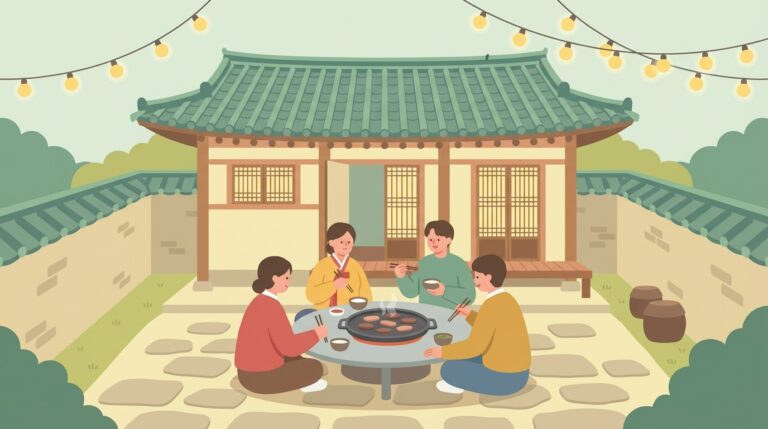
Picture this: It’s a breezy Friday evening. You’re watching your favorite K-Drama, and the main characters are sitting in the cozy yard of a traditional Korean house (Madang), or maybe on a rooftop (Oktapbang). Sizzling sounds fill the air as thick slices of Samgyeopsal (pork belly) hit the grill. Someone shouts, “빨리 뒤집어! (Flip it quickly!)”, hands a lettuce wrap to their crush, and everyone clinks their Soju glasses.
Have you ever wondered what exactly they are saying over that grill?
If you ever get invited to a Korean friend’s house—or even just go to a local K-BBQ restaurant—knowing how to navigate the “grill talk” will instantly upgrade your status from a ‘foreign guest’ to an absolute Insider (인싸). Because in Korea, grilling meat isn’t just cooking; it’s a social ritual, a bonding experience, and sometimes, a true test of friendship!
Transparency Note: This guide is crafted from real questions and epic, sometimes hilarious, experiences of my students who tried to master the art of K-BBQ!
Phase 2: Deep Dive into Core Expressions
Let’s look at the absolute must-know phrases when you’re around a Korean grill.
1. 제가 구울게요. (I will grill it.)
- Pronunciation: [jega gu-ulgeyo]
Sound-alike guide: ‘je’ like in jelly, ‘ga’ like in Lady Gaga. ‘gu’ sounds like goo.- Meaning: (Literal) I will grill. / (Real nuance) Let me take charge of the grill so you can relax.
- K-Culture Moment: In Korean culture, taking charge of the tongs and scissors is an act of service. At a company dinner (Hoesik), the youngest employee usually says this. But in a friend group, the one who takes the most pride in their grilling skills (the “Grill Master”) will snatch the tongs away!
- Editor’s Insight: Saying this shows you are considerate and proactive. It’s a massive green flag in Korean social settings!
- Situation Spectrum:
[🚫 Never] ———— [⚠️ Be Careful] ———— [✅ Freely]
- Close Friends (Casual): ✅ (Say: 내가 구울게!)
- Co-workers (Semi-formal): ✅ (제가 구울게요.)
- Boss/Elders (Formal): ✅ (제가 굽겠습니다!)
- 🤔 Think About It: Why is it considered polite to cook for others at the table in Korea? Does your culture have a similar “designated cook” role during a shared meal?
2. 빨리 뒤집어요! 타잖아요! (Flip it quickly! It’s burning!)
- Pronunciation: [ppalli dwijibeoyo! tajaneoyo!]
Sound-alike guide: ‘ppalli’ requires a tense, strong ‘P’ sound. ‘dwijibeo’ sounds like dwee-jee-buh.- Meaning: (Literal) Flip quickly! It is burning! / (Real nuance) Emergency! Save the precious meat!
- K-Culture Moment: Koreans take their meat very seriously. Overcooking a premium cut of Hanwoo (Korean beef) or pork belly is a minor tragedy. You’ll hear this shouted in a panic at K-BBQ places everywhere.
- Editor’s Insight: The ending ‘-잖아요’ (you know / as you can see) implies “Look! It’s burning, do something!” It adds a sense of urgent camaraderie.
- Situation Spectrum:
[🚫 Never] ———— [⚠️ Be Careful] ———— [✅ Freely]
- Close Friends (Casual): ✅ (빨리 뒤집어! 타잖아!)
- Co-workers (Semi-formal): ⚠️ (Only if you are close)
- Boss/Elders (Formal): 🚫 (Instead, gently say: “고기가 다 익은 것 같습니다” – The meat seems to be fully cooked.)
- 🤔 Think About It: Koreans love the word “빨리빨리 (Hurry hurry)”. How does this fast-paced culture show up in their dining habits?
3. 쌈 하나 싸 줄까요? (Shall I make a wrap for you?)
- Pronunciation: [ssam hana ssa julkkayo?]
Sound-alike guide: ‘ss’ is a sharp, hissing ‘S’. ‘ssam’ rhymes with mom, but tighter.- Meaning: (Literal) Shall I pack one wrap for you? / (Real nuance) I care about you, let me feed you a delicious bite.
- K-Culture Moment: You’ve seen this in K-Dramas! Making a Ssam (meat, garlic, ssamjang wrapped in lettuce) and feeding it to someone is a gesture of extreme affection. Friends do it to show loyalty, and couples do it to show love.
- Editor’s Insight: Beware! If you make a Ssam for someone else’s partner, it might start a drama (just like the famous “Perilla Leaf Debate” in Korea!).
- Situation Spectrum:
[🚫 Never] ———— [⚠️ Be Careful] ———— [✅ Freely]
- Close Friends (Casual): ✅
- Romantic Interest (Flirting): ✅
- Boss/Elders (Formal): 🚫 (Too intimate!)
- 🤔 Think About It: Feeding someone with your own hands is deeply intimate in many Western cultures, but relatively common among friends in Korea. Why is sharing food so central to Korean affection?
Phase 3: Textbook vs Real Life Korean
| Situation | 📖 Textbook Korean | 🗣️ Real-Life Korean | 💡 Why the difference? |
|---|---|---|---|
| Offering to grill | 제가 고기를 굽겠습니다. (I will grill the meat.) | 집게 주세요. (Give me the tongs.) | Action speaks louder! Asking for the tongs implies you’ll do the grilling. |
| Telling someone to eat | 고기가 다 익었습니다. 드십시오. (The meat is fully cooked. Please eat.) | 다 익었어요. 드세요! (It’s done. Eat up!) | Shorter and warmer. Drops the overly formal ‘-ㅂ니다’ for a friendly ‘-요’. |
| Complimenting the taste | 고기 맛이 정말 훌륭합니다. (The taste of the meat is excellent.) | 와, 육즙 대박! (Wow, the meat juice is crazy!) | ‘대박’ (daebak) is the ultimate everyday slang for something awesome. |
Bottom Note for B1 Learners: You don’t need to memorize difficult textbook vocabulary for K-BBQ. Mastering essential props like 집게 (tongs) and 가위 (scissors) will make you sound incredibly natural!
Phase 4: Cultural Deep Dive
4-1. Non-verbal Communication: The Art of Tongs and Scissors
At a Korean BBQ, you don’t cut the meat with a knife and fork. You use 가위 (scissors)! When you hand the scissors or tongs to an older person or someone you just met, always use two hands. Also, Nunchi (눈치) is crucial here. If the grill is empty, nunchi tells you to put more meat on it. If someone’s glass is empty, nunchi tells you to pour them a drink.
4-2. K-Culture Connection: Why the “Yard” (Madang)?
Let’s connect this to Korean Residential Types (한국의 주거 형태). Over 60% of Koreans live in apartments (아파트). Because apartments are closed spaces, you cannot grill meat with charcoal inside due to smoke and fire hazards.
Therefore, grilling meat in a private yard (마당, Madang) or a rooftop (옥탑방, Oktapbang) is seen as a romanticized, special event. When you see K-pop idols in reality shows (like BTS’s In the Soop) going to a country house and grilling thick pork belly over a wood fire, it represents the ultimate “healing” escape from crowded city life. If a Korean friend invites you to a “yard BBQ” at their parents’ country house, consider yourself deeply trusted and honored!
Phase 5: Immersive Roleplay Scenario
Scenario A: The Rooftop BBQ Invitation
Setting: Saturday, 6 PM. You are at your Korean friend Minho’s family house. They have a rare private yard in Seoul. String lights are glowing, a gentle breeze is blowing, and the charcoal grill is blazing hot.
Characters:
– YOU: An exchange student who loves K-Food.
– Minho (25): Your energetic Korean friend, self-proclaimed “Grill Master.”
Dialogue:
Minho: 와, 오늘 날씨 진짜 좋다. 마당에서 고기 먹기 딱 좋은 날씨야!
(Wa, oneul nalssi jinjja jota. Madangeseo gogi meokgi ttak joeun nalssiya!)
[Wow, the weather is so good today. Perfect weather for eating meat in the yard!]
YOU: 맞아요! 초대해 줘서 고마워요.
(Majayo! Chodaehae jwoseo gomawoyo.)
[Right! Thanks for inviting me.]
Minho: 삼겹살 엄청 두꺼운 걸로 사 왔어.
(Samgyeopsal eomcheong duggeoun geollo sa wasseo.)
[I bought super thick pork belly.]
YOU: 오 대박! 제가 구울까요? 집게 주세요.
(O daebak! Jega gu-ulkkayo? Jipge juseyo.)
[Oh awesome! Shall I grill? Give me the tongs.]
Minho: 에이, 넌 손님인데 앉아 있어. 내가 고기 굽기 장인이잖아.
(Ei, neon sonnim-inde anja isseo. Naega gogi gupgi jang-in-ijana.)
[Hey, you’re the guest, so sit down. I’m the meat grilling master, you know.]
YOU: 알겠어요. 그럼 저는 상추랑 마늘을 준비할게요.
(Algesseoyo. Geureom jeoneun sangchurang maneureul junbihalgeyo.)
[Got it. Then I’ll prepare the lettuce and garlic.]
(🎭 Stage Direction: Minho places the meat on the grill. Sizzle!)
Minho: 앗! 불이 너무 세다. 빨리 뒤집어!
(At! Buri neomu seda. Ppalli dwijibeo!)
[Ah! The fire is too strong. Flip it quickly!]
YOU: (Using chopsticks to help) 뒤집었어요! 휴, 다행이다.
(Dwijibeosseoyo! Hyu, dahaeng-ida.)
[Flipped it! Phew, what a relief.]
Minho: 다 익었다! 자, 첫 고기는 너 먼저.
(Da igeotda! Ja, cheot gogineun neo meonjeo.)
[It’s all cooked! Here, the first piece goes to you.]
(🎭 Stage Direction: Minho places the best, crispiest piece of pork belly on your plate.)
🔀 Your Turn! How should you respond?
– A) “아니에요, 민호 씨 먼저 드세요!” (No, Minho, you eat first!)
– B) “감사합니다! 진짜 맛있어 보여요.” (Thank you! It looks really delicious.)
– C) “저 고기 안 좋아해요.” (I don’t like meat.)✅ Best Choice: B — Reason: While politely declining once (A) is very Korean, when a friend cooks for you and gives you the first piece, accepting it cheerfully with a big “Thank you” (B) makes the cook the happiest! Choice C would ruin the mood instantly.
YOU: (Choosing B) 감사합니다! 잘 먹겠습니다!
(Gamsahamnida! Jal meokgetseumnida!)
[Thank you! I will eat well!]
Bonus Scenario B: K-Culture Survival – Ordering at the Restaurant
If you don’t have a friend with a yard, you’ll be at a K-BBQ restaurant!
Staff: 주문하시겠어요? (Would you like to order?)
YOU: 삼겹살 2인분 주세요. (Two portions of pork belly, please.)
Staff: 네, 불판 바로 넣어 드릴게요. (Yes, I’ll put the grill in right away.)
YOU: 아! 그리고 여기 앞치마 좀 주시겠어요? (Ah! And could you give me an apron, please?)
Phase 6: 10-Second Shadowing Drill
Practice speaking like a true Korean! Follow the intonation (/) and emotion tags.
😊 우와~ / 고기 냄새 / 장난 아니네요! (Uwa~ / gogi naemsae / jangnan anineyo!)
Wow~ the smell of the meat is no joke!
😤 타기 전에 / 빨리 / 뒤집어요! (Tagi jeone / ppalli / dwijibeoyo!)
Before it burns, flip it quickly!
🥺 저 / 쌈 하나만 / 싸 주시면 안 돼요? (Jeo / ssam hanaman / ssa jusimyeon an dwaeyo?)
Could you please make just one wrap for me?
Phase 7: K-Culture Glossary (Mini Dictionary)
| Korean | Romanization | English | Cultural Context |
|---|---|---|---|
| 눈치 | nunchi | Social sense | The ability to “read the room” (e.g., knowing when to flip the meat without being told). |
| 집게 | jipge | Tongs | The symbol of power and service at a Korean table. Who holds the tongs controls the pace of the meal. |
| 가위 | gawi | Scissors | Used globally for paper, but used in Korea to cut meat, noodles, and kimchi perfectly! |
| 회식 | hoesik | Company dinner | Bonding time for colleagues, usually involving K-BBQ and alcohol. |
| 첫 입 | cheot ip | First bite | Giving the first bite to someone is a sign of immense respect or affection. |
Phase 8: Traveler’s Survival Kit
Whether you are renting a countryside pension with a BBQ grill or navigating a bustling Seoul restaurant, keep these expressions in your back pocket!
🆘 Survival Phrases TOP 3
1. 🇰🇷 “불판 좀 갈아주세요.” (Bulpan jom garajuseyo.)
– 🗣️ Meaning: Please change the grill pan.
– 📍 When to use: When the grill gets black and charred. Staff will bring a fresh one!
- 🇰🇷 “삼겹살 2인분 추가요!” (Samgyeopsal i-inbun chugayo!)
- 🗣️ Meaning: One more order (2 portions) of pork belly, please!
- 📍 When to use: When you run out of meat. Note: Meat is usually ordered by “인분” (portions per person).
- 🇰🇷 “이거 다 익은 건가요?” (Igeo da igeun geongayo?)
- 🗣️ Meaning: Is this fully cooked?
- 📍 When to use: When you are terrified of eating raw pork. Just ask the staff or your Korean friend!
📌 Editor’s Travel Note
– No Tipping! Excellent grilling service is often provided by restaurant staff, but handing them a tip will only confuse them. It’s not part of the culture.
– App to use: Search for ‘정육점’ (Butcher) on Naver Map or KakaoMap if you are buying meat for a yard BBQ.
Phase 9: Think Deeper — “A Step Further”
Food & Identity: The Shared Destiny of the One Grill
Have you ever noticed that in Western dining, everyone gets their own plate, their own steak, and their own sides? In Korea, everything centers around one communal fire. Everyone dips their chopsticks into the same stew, shares the same side dishes (Banchan), and eats meat from the exact same grill. This isn’t just about saving dishwashing time; it stems from the concept of Jeong (정) and community. Sharing food from the same pot means “we are family” or “we share the same fate.” It breaks down individual boundaries and builds deep collective solidarity.
💬 Your Turn:
Does your culture have a tradition of sharing food from a central pot or grill? How do you feel about sharing a single grill with co-workers? Share in the comments!
Phase 10: FAQ & Troubleshooting
Q: Can I use “야, 고기 다 탔어! (Hey, the meat is all burnt!)” to my boss?
A: NO! 🚫 ‘야’ (Hey) and dropping the ‘-요’ ending is strictly for close friends. Even if the meat is burning, politely say, “부장님, 고기가 타는 것 같습니다!” (Boss, I think the meat is burning!)
Q: Is it rude to ask for more side dishes (Banchan) at a restaurant?
A: Not at all! Side dishes are mostly unlimited and free. Just politely say, “이모님, 상추 좀 더 주세요” (Auntie, more lettuce please).
❌ Common Mistake #1:
Using your personal chopsticks to flip the raw meat on the grill.
✅ Do this instead:
ALWAYS use the tongs (집게) for raw meat to prevent cross-contamination. Save your chopsticks for eating!
Phase 11: Wrap-up & Action Items
One-Liner Summary: Mastering the K-BBQ grill isn’t just about cooking meat; it’s about showing care with your tongs and bonding over shared food!
Action Mission:
– 🥉 Bronze (Solo): Stand in front of a mirror and urgently say, “빨리 뒤집어요! 타잖아요!” three times.
– 🥈 Silver (Online): Comment below your favorite Korean meat (Samgyeopsal, Hanwoo, Bulgogi) using the phrase: “저는 [Meat name]을/를 제일 좋아해요!”
– 🥇 Gold (Real Life): Next time you go to a Korean restaurant, ask the staff “불판 좀 갈아주세요” (Please change the grill).
🎬 K-Culture Mission:
Watch an episode of Hospital Playlist or Weightlifting Fairy Kim Bok-joo. Find a scene where they eat K-BBQ and watch who holds the tongs and who feeds whom!
Phase 12: Interactive Quiz
1. You are at a company dinner. The grill is empty, and your boss is looking around. What is the BEST thing to do?
A) Wait for the boss to order more meat.
B) Say, “제가 굽겠습니다. 집게 주세요!” (I will grill. Give me the tongs!)
C) Look at your phone to avoid eye contact.
(Answer: B! Stepping up to grill at a company dinner makes you look incredibly proactive and polite.)
2. Fill in the blank:
You want to wrap some meat and garlic in lettuce for your date. You ask:
“[________] 하나 싸 줄까요?”
(Answer: 쌈 – Ssam)
3. True or False (K-Culture Edition):
“Since most Koreans live in apartments, grilling meat in a private yard with charcoal is a very common everyday activity.”
(Answer: False. It is actually quite rare and considered a special event or luxury getaway, which is why it’s so romanticized in K-Dramas!)
Frequently Asked Questions (FAQ)
Q: What does "제가 구울게요. (I will grill it.)" mean in Korean and how do you pronounce it?
A: In Korean, "제가 구울게요. (I will grill it.)" is pronounced [jega gu-ulgeyo] and means: (Literal) I will grill. / (Real nuance) Let me take charge of the grill so you can relax.
Q: What does "빨리 뒤집어요! 타잖아요! (Flip it quickly! It's burning!)" mean in Korean and how do you pronounce it?
A: In Korean, "빨리 뒤집어요! 타잖아요! (Flip it quickly! It's burning!)" is pronounced [ppalli dwijibeoyo! tajaneoyo!] and means: (Literal) Flip quickly! It is burning! / (Real nuance) Emergency! Save the precious meat!
Q: What does "쌈 하나 싸 줄까요? (Shall I make a wrap for you?)" mean in Korean and how do you pronounce it?
A: In Korean, "쌈 하나 싸 줄까요? (Shall I make a wrap for you?)" is pronounced [ssam hana ssa julkkayo?] and means: (Literal) Shall I pack one wrap for you? / (Real nuance) I care about you, let me feed you a delicious bite.







