

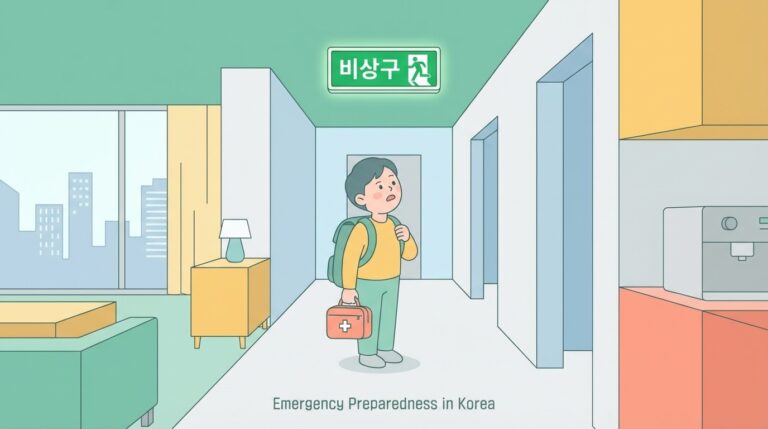
Don’t Panic! The Ultimate Korean Survival Guide for When the Fire Alarm Goes Off
Phase 1: Immersive Hook
Hello there! I’m your Daily Hangul Editor. Imagine this: It’s a chilly Friday night in Seoul. You’re chilling in your cozy Hongdae Airbnb, munching on some crispy Korean fried chicken you just ordered from a delivery app. Suddenly, out of nowhere… WEE-WOO-WEE-WOO!
A loud voice starts blaring from the ceiling speaker in rapid-fire Korean. In a K-Drama, this is the exact moment the handsome male lead would grab your wrist, shield you from falling debris, and run you out to safety. But in reality? You’re standing there in your pajamas, holding a drumstick, wondering, “Wait… is this real? Did someone just burn their Samgyeopsal (pork belly)? Should I run?”
If you don’t know what the announcements are saying, a simple false alarm can turn into a panicked nightmare. But if you know these key expressions, you’ll handle the situation with the cool composure of a seasoned local. This guide is based on real panicked text messages I’ve received from my expat students over the years. Let’s make sure you never have to panic!
Phase 2: Deep Dive
Let’s break down the 3 most critical phrases you need to know when that siren howls.
1. 화재 경보기가 울려요! (The fire alarm is ringing!)
- Pronunciation: [hwajae gyeongbogiga ullyeoyo]
(Tip: The ‘hwa’ sounds like you’re blowing out a candle: HWA! The ‘ullyeoyo’ rolls off the tongue like a soft lullaby, which is ironic for an alarm.)- Meaning: The fire alarm is going off.
- K-Culture Moment: You’re in a study cafe (스터디카페) where it’s so quiet you can hear a pin drop. Suddenly the alarm blares. You can whisper this to the manager to ask what’s going on.
- Editor’s Insight: The verb “울리다” literally means “to make something cry” or “to ring.” Koreans use this for alarms, cell phones, and bells.
- Situation Spectrum:
[🚫 100% Forbidden] ———— [⚠️ Caution] ———— [✅ Freely Use]
- Close Friends (Casual): ✅ (Drop the ‘요’ -> 화재 경보기 울려!)
- Coworkers/Strangers (Semi-formal): ✅
- Boss/Elders (Formal): ✅
- 🤔 Think About It: Why does Korean use the same word for a baby “crying” (울다) and an alarm “ringing” (울리다)? It reflects how Korean language personifies objects that make loud, emotional noises!
2. 이거 오작동인가요? (Is this a false alarm?)
- Pronunciation: [igeo ojakdong-ingayo?]
(Tip: ‘O’ like “oh”, ‘jak’ sounds like the name “Jack”.)- Meaning: Literal: Is this a malfunction? / Real Nuance: Is this a false alarm?
- K-Culture Moment: Korean apartment complexes (아파트) have highly sensitive fire detection systems. It’s very common for alarms to go off because someone left their door open while grilling fish or meat. This is the #1 question neighbors ask each other in the hallway.
- Editor’s Insight: Instead of saying “false alarm,” Koreans focus on the mechanical aspect: “malfunction” (오작동).
- Situation Spectrum:
- Close Friends (Casual): ✅ (이거 오작동이야?)
- Coworkers/Strangers (Semi-formal): ✅
- Boss/Elders (Formal): ✅
- 🤔 Think About It: Does your culture assume an alarm is real until proven false, or false until proven real? In Korea, because of high-density housing, people often default to hoping it’s an “ojakdong.”
3. 밖으로 대피해야 돼요! (We must evacuate outside!)
- Pronunciation: [bakkeuro daepihaeya dwaeyo!]
(Tip: The ‘eu’ in ‘bakkeuro’ sounds like the disgusted noise you make when you step in gum: “Ugh!” The ‘dae-pi’ sounds like “day-pee”.)- Meaning: We need to evacuate outside immediately!
- K-Culture Moment: The moment the broadcasting system (안내방송) confirms it’s a real fire, this is what the building security guard (경비 아저씨) will shout while waving a glowing baton.
- Editor’s Insight: “대피하다” is the formal word for “evacuate.” In an extreme rush, people will just scream “나가요!” (Get out!).
- Situation Spectrum:
- Close Friends (Casual): ✅ (대피해야 돼!)
- Coworkers/Strangers (Semi-formal): ✅
- Boss/Elders (Formal): ✅
Phase 3: Textbook vs Real Life
When the sirens are wailing, nobody has time for complex grammar.
| Situation | 📖 Textbook Korean | 🗣️ Real Life Korean | 💡 Why the difference? |
|---|---|---|---|
| Spotting a fire | 화재가 발생했습니다. (A fire has occurred.) | 불이야! (Fire!) | Urgency strips away all polite suffixes. Shouting “불이야” is the universal distress signal. |
| Telling someone to run | 밖으로 대피하십시오. (Please evacuate outside.) | 빨리 나와! / 대피해! (Come out fast! / Evacuate!) | The famous Korean “Ppalli Ppalli” (hurry hurry) culture kicks into high gear during emergencies. |
| Calling for help | 구조대를 부르겠습니다. (I will call the rescue team.) | 119 불러! (Call 119!) | Nobody says “rescue team.” They just yell the emergency number. |
(Bottom Note: As a B1 learner, knowing “불이야!” is your most crucial survival tool. Don’t worry about being polite when your life is in danger!)
Phase 4: Cultural Deep Dive
4-1. Non-verbal Communication: The Art of ‘Nunchi’ in an Emergency
In Korea, Nunchi (눈치)—the ability to gauge the mood and read the room—can literally save your life. If the alarm goes off in a café and nobody moves, it might be a known drill. But if you see Koreans leaving their laptops on the table and briskly walking out, follow them immediately! (Yes, in Korea, people leave their expensive laptops behind during a fire. Nobody will steal them.)
4-2. K-Travel & K-Food Connection
Why do fire alarms go off so often in Korea? It’s often related to K-Food! Korean dining involves a lot of table-top grilling (like K-BBQ) and heavy smoke. If an exhaust fan breaks in a restaurant, the smoke quickly triggers the building’s sensors.
Also, if you’re traveling, you must know this: The emergency number in Korea is 119, NOT 911. If you dial 911 on a Korean network, it might redirect, but 119 is the direct line for Fire and Medical emergencies (112 is for Police).
Phase 5: Immersive Roleplay
Scenario A: The Hongdae Guesthouse
Setting: A Friday night, 10 PM. You and your Korean friend, Minsu, are hanging out in the common area of a guesthouse. Suddenly, a loud siren goes off.
Characters:
– YOU: An expat traveler trying to stay calm.
– Minsu (28): Your Korean friend. Usually laid-back, but currently sniffing the air.
Minsu: 야, 무슨 냄새 안 나? 뭔가 타는 냄새 나는데?
(Ya, museun naemsae an na? mwonga taneun naemsae naneunde?)
[Hey, do you smell that? Smells like something is burning.]
(🎭 Stage Direction: Minsu looks towards the kitchen area)
YOU: 어? 화재 경보기가 울려요! 이거 실제 상황인가요?
(Eo? Hwajae gyeongbogiga ullyeoyo! Igeo silje sanghwang-ingayo?)
[Huh? The fire alarm is ringing! Is this a real situation?]
Minsu: 잠깐만, 복도 좀 볼게. 헉… 밖에서 연기가 들어오고 있어!
(Jamkkanman, bokdo jom bolge. Heok… bakkeseo yeongiga deureoogo isseo!)
[Wait, let me check the hallway. Gasp… smoke is coming in from outside!]
🔀 YOUR TURN! How do you respond?
– A) “엘리베이터 타고 내려가자!” (Let’s take the elevator down!)
– B) “내 여권이랑 짐 좀 챙길게!” (Let me pack my passport and luggage!)
– C) “빨리 계단으로 대피해야 돼! 불이야!”✅ Best Choice: C — “We need to evacuate via the stairs quickly! Fire!”
⚠️ Why A & B are wrong: Never use the elevator during a fire, and never waste time packing! In Korea, using the stairs (계단) and finding the green exit sign is rule #1.
Minsu: 맞아, 엘리베이터는 절대 안 돼. 수건에 물 적셔서 입 막고 나가자!
(Maja, ellibeiteoneun jeoldae an dwae. Sugeone mul jeoksyeoseo ip makgo nagaja!)
[Right, elevators are an absolute no. Let’s wet a towel, cover our mouths, and go!]
Scenario B: The K-Drama False Alarm (Bonus)
Setting: Your office building. The alarm blares. You run outside, heart pounding, only to see your coworkers casually drinking iced americanos.
Coworker: 아, 놀라셨어요? 오늘 소방 훈련이에요. (Ah, were you startled? Today is a fire drill.)
YOU: 아… 오작동인 줄 알았어요. 다행이네요. (Ah… I thought it was a false alarm. What a relief.)
Phase 6: 10-Second Shadowing Drill
Read this out loud. Pay attention to the pauses (/) and the emotion!
😤 밖으로 / 대피해야 돼요! / 불이야! / 빨리 / 나가요!
(bakkeuro / daepihaeya dwaeyo! / buriya! / ppalli / nagayo!)
(Vibe: Urgent, loud, and commanding!)
Phase 7: K-Culture Glossary
| Korean | Romanization | English | Context |
|---|---|---|---|
| 비상구 | bi-sang-gu | Emergency Exit | Look for the green sign with the running man. |
| 소화기 | so-hwa-gi | Fire Extinguisher | Usually red, placed in every hallway by law. |
| 대피 | dae-pi | Evacuation | Often heard over the PA system during emergencies. |
| 눈치 | nunchi | Social Awareness | Reading the room to see if others are panicking. |
| 오작동 | o-jak-dong | False Alarm/Malfunction | What everyone prays it is when the alarm rings. |
Phase 8: Traveler’s Survival Kit
If you remember nothing else from this post, screenshot this section for your trip to Korea!
🆘 Survival Phrases TOP 3
– 🇰🇷 “119에 신고해 주세요!” (il-il-gu-e singohae juseyo!) -> “Please call 119!”
– 🇰🇷 “불이 났어요!” (buri nasseoyo!) -> “There’s a fire!”
– 🇰🇷 “비상구가 어디예요?” (bisangguga eodiyeyo?) -> “Where is the emergency exit?”📌 Editor’s Travel Note
– 119 App: You can actually download the ‘119 신고’ app. It tracks your GPS location automatically, which is a lifesaver if you don’t know your exact Korean address.
– Language Barrier: Don’t hesitate to call 119. They have a 3-way translation system available for foreigners!
– Navigating Inside: Apps like KakaoMap won’t help you inside a burning building. Always locate the 비상구 (Emergency Exit) when you check into a hotel.
Phase 9: Think Deeper
🧠 Media vs Reality: The K-Drama Fire Myth
In Korean media, a fire alarm usually means two things: a villain is trying to destroy evidence, or it’s an excuse for the lead couple to hold hands and dramatically escape in slow motion.
However, the reality of Korean fire safety is strictly regulated. After several historical tragedies, Korea implemented some of the fastest response systems in the world. Elevators automatically ground themselves, heavy fire doors (방화문) shut automatically, and the 119 dispatch response time is incredibly fast. The “Ppalli Ppalli” culture, often criticized for causing stress, is exactly what makes Korea’s emergency services so efficient.
💬 Your Turn: Have you ever experienced a fire alarm or emergency drill in a foreign country? How did the local response differ from your home country? Share your story in the comments!
Phase 10: FAQ & Troubleshooting
Q: In an emergency, is it rude to drop formalities and use ‘banmal’ (casual language) to older people?
A: Absolutely not! When shouting “불이야!” (Fire!) or “비켜요!” (Move!), safety overrides social hierarchy. No one will scold you for bad manners when the building is on fire.
Q: Can I just call 911 like in K-Movies that are set in the US?
A: No. While some modern smartphones auto-reroute 911 to local emergency services, always manually dial 119 for fire/medical and 112 for police in Korea.
❌ Common Mistake #1: Asking “불이에요?” (Is it a fire?)
✅ Do this instead: Ask “실제 상황인가요?” (Is this a real situation?). “불이에요” sounds a bit awkward, like you are asking if an object is made of fire.
Phase 11: Wrap-up & Missions
🔥 One-Liner Summary: When the siren wails, don’t wait for a K-Drama hero—shout “불이야!”, look for the “비상구”, and evacuate immediately!
🎯 Action Mission:
– 🥉 Bronze: Stand up and confidently shout “불이야! 빨리 나가요!” to your empty room 3 times.
– 🥈 Silver: Next time you visit a Korean restaurant in your city, look around and identify where the emergency exit is in your mind.
– 🥇 Gold: If you’re in Korea, locate the “소화기” (fire extinguisher) in your hallway today!
🎬 K-Culture Mission:
Watch one episode of your favorite K-Drama today. I guarantee you’ll spot a green “비상구” (Emergency Exit) sign in the background of a hospital, office, or restaurant scene. Snap a photo of your screen when you find it!
Phase 12: Interactive Quiz
1. You’re in a Korean hotel and smell heavy smoke. People look confused. What is the BEST thing to shout?
A) 저기요! (Excuse me!)
B) 화장실이 어디예요? (Where is the bathroom?)
C) 불이야! 대피해요! (Fire! Evacuate!)
2. Fill in the blank: “Oh no, the alarm is ringing! I hope it’s just a _______.”
A) 오작동 (Ojakdong)
B) 비상구 (Bisanggu)
C) 소화기 (Sohwagi)
3. True or False: If the fire alarm rings in Korea, you should immediately call 911.
4. Roleplay Check: Minsu tells you to wet a towel and cover your mouth. Why?
A) To hide your face from K-Pop paparazzi.
B) To filter out toxic smoke while evacuating.
C) Because it’s a K-Beauty skincare routine.
(Answers: 1: C, 2: A, 3: False – call 119, 4: B)
Frequently Asked Questions (FAQ)
Q: What does "화재 경보기가 울려요! (The fire alarm is ringing!)" mean in Korean and how do you pronounce it?
A: In Korean, "화재 경보기가 울려요! (The fire alarm is ringing!)" is pronounced [hwajae gyeongbogiga ullyeoyo] and means: The fire alarm is going off.
Q: What does "이거 오작동인가요? (Is this a false alarm?)" mean in Korean and how do you pronounce it?
A: In Korean, "이거 오작동인가요? (Is this a false alarm?)" is pronounced [igeo ojakdong-ingayo?] and means: Literal: Is this a malfunction? / Real Nuance: Is this a false alarm?
Q: What does "밖으로 대피해야 돼요! (We must evacuate outside!)" mean in Korean and how do you pronounce it?
A: In Korean, "밖으로 대피해야 돼요! (We must evacuate outside!)" is pronounced [bakkeuro daepihaeya dwaeyo!] and means: We need to evacuate outside immediately!







