

Phase 1: Immersive Hook — The Naked Truth About K-Saunas
Hello! I’m the lead editor at Daily Hangul.
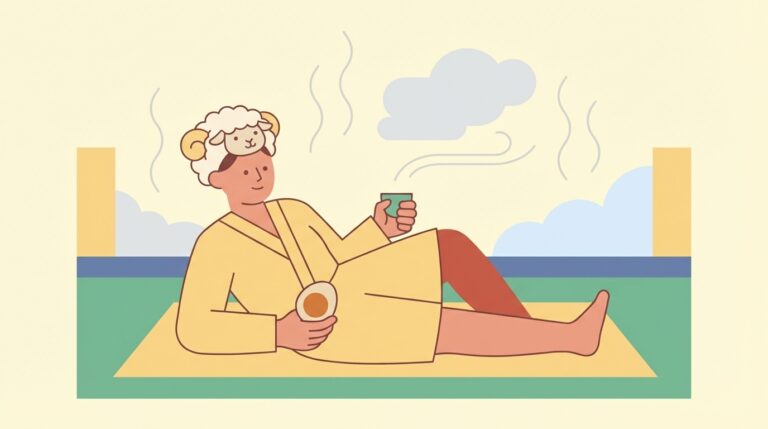
Picture this: You’re watching a classic K-Drama. The main characters are sitting in a warm room, wearing matching oversized t-shirts, sporting towels rolled up like sheep horns (양머리, Yangmeori) on their heads, and cracking roasted eggs on each other’s foreheads. It looks so cozy, right?
But then, the scene shifts to the wet bath area. Someone is lying on a vinyl table while a person in black waterproof underwear aggressively scrubs their body with a brightly colored towel. The characters wince, but afterward, they look like glowing, newborn babies saying, “Ah, so refreshing!”
Welcome to the intense, vulnerable, and ultimately cathartic world of 세신 (Seshin)—the Korean body scrub culture.
I know what you’re thinking. “Taking off all my clothes and letting a stranger scrub off my dead skin? No way.” I hear you! As a B2 learner, you probably already know how to order coffee, but navigating a Jjimjilbang (찜질방, Korean sauna) requires a whole different set of vocabulary and cultural courage. This guide is based on real panic moments from my expat students who walked into a sauna completely unprepared. Let’s strip away the confusion and dive in!
Phase 2: Core Expressions Deep Dive
Let’s learn the essential survival phrases for the wet room.
1. 세신 예약할게요. (I’d like to book a body scrub.)
- Pronunciation: Seshin yeyakalgeyo. [Se-shin ye-yak-hal-ge-yo]
- Meaning: Literal: “I will reserve a Seshin.” / Real nuance: “I want to put my name on the list for a scrub.”
- K-Culture Moment: Seshin isn’t something you just walk up and get. You have to find the scrub master (usually wearing black undergarments) and book your spot. They will tell you to soak in the hot tub for 15-20 minutes first.
- Editor’s Insight: “예약하다” (to reserve) isn’t just for fancy restaurants. In the chaotic, steamy bathhouse, saying this clearly secures your spot.
- Situation Spectrum:
[🚫 절대 금지] ———— [⚠️ 주의] ———— [✅ 자유롭게]
- To the Scrub Master (Seshinsa): ✅
- 🤔 Think About It: Why do Koreans call dead skin cells “때” (dirt/grime)? Scrubbing isn’t just about hygiene; it’s almost a ritual of shedding the past week’s stress and fatigue. Does your culture have a similar physical ritual for mental cleansing?
2. 살살 해주세요. (Please do it gently.)
- Pronunciation: Salsal hae-ju-se-yo. [Sal-sal he-joo-se-yo]
- Meaning: Literal: “Please do it softly.” / Real nuance: “Please, have mercy on my skin!”
- K-Culture Moment: You’re on the table. The “Italy Towel” (이태리타월, the abrasive scrub mitt) feels like sandpaper. You need to speak up before you lose a layer of skin!
- Editor’s Insight: “살살” is a fantastic mimetic word (의태어) that mimics a gentle, soft motion. If you want it stronger, you’d say “세게 해주세요” (Se-ge hae-ju-se-yo), but trust me, you probably won’t need to!
- Situation Spectrum:
[🚫 절대 금지] ———— [⚠️ 주의] ———— [✅ 자유롭게]
- To a Seshinsa, hairdresser, or masseuse: ✅
- To a friend applying medicine: ✅
3. 아, 시원하다! (Ah, that hits the spot!)
- Pronunciation: Ah, si-won-ha-da! [Ah, shee-won-ha-da!]
- Meaning: Literal: “It’s cool/cold.” / Real nuance: “That feels incredibly refreshing/relieving.”
- K-Culture Moment: You step out of the scorching hot bath, or the Seshinsa pours a bucket of warm water over your freshly scrubbed back. An involuntary “Ah, siwonhada!” escapes your lips.
- Editor’s Insight: This is the most confusing word for foreigners! Koreans say “siwonhada” when eating boiling hot soup, getting a deep tissue massage, or stepping into an air-conditioned room. It means “relieving built-up tension.”
- Situation Spectrum:
[🚫 절대 금지] ———— [⚠️ 주의] ———— [✅ 자유롭게]
- Muttering to yourself in the sauna: ✅
- Agreeing with an older person in the hot tub: ✅
Phase 3: Textbook vs Real Life
| Situation | 📖 Textbook Korean | 🗣️ Real Korean | 💡 Why is it different? |
|---|---|---|---|
| Calling the Seshinsa | 저기요, 세신사님. (Excuse me, Scrub Master.) | 이모님! (Auntie!) | 이모님 is an affectionate, respectful term used for middle-aged women providing a service, building an instant bond. |
| Asking the price | 세신 요금은 얼마입니까? (How much is the scrub fee?) | 세신 얼마예요? | Efficiency. In a loud, echoing bathhouse, shorter is better. |
| Expressing pain | 아픕니다. (It hurts.) | 아! 너무 아파요! | You need to express immediate discomfort, so adding 너무 (too much) with a sharp intake of breath works best. |
Phase 4: Cultural Deep Dive
4-1. Non-verbal Communication: The Art of Surrender
When you are on the Seshin table, you must turn off your Nunchi (눈치, reading the room). The Seshinsa will flip you over like a pancake, slap your leg when it’s time to turn, and pour water over your face. Do not try to help them. Let your body go completely limp. If you tense up or try to lift your own arm, it makes their job harder. Complete surrender is the ultimate Korean bathhouse etiquette.
4-2. K-Culture Connection: Post-Sauna Comfort Food (K-Food)
You survived the scrub! You are now baby-soft and dressed in the provided Jjimjilbang uniform. What’s next? You must head straight to the snack bar (매점, Maejeom).
In K-Dramas, you always see characters drinking 식혜 (Sikhye), a sweet, icy traditional rice beverage, alongside 구운 계란 (Gu-un Gyeran), brown roasted eggs slow-cooked in the sauna’s heat. The combination of the icy, sweet drink and the dense protein of the egg perfectly replenishes the energy you lost sweating and being scrubbed. If you don’t do this, did you even go to a Korean sauna?
Phase 5: Immersive Roleplay
Scenario A: The Seshin Booking
Setting: A grand Jjimjilbang in Busan. You’ve braved the naked wet area. The air is thick with steam. You spot the Seshin corner: a few vinyl tables and a middle-aged woman in a black bikini rapidly scrubbing someone.
Characters:
– YOU: An adventurous expat wanting the full experience.
– Seshinsa (Imo-nim): The veteran scrub master. Busy, tough exterior, but a heart of gold.
YOU: (Approaching cautiously) 저기요…
(Jeo-gi-yo…)
[Excuse me…]
Imo-nim: (Without looking up, scrubbing vigorously) 네, 무슨 일이에요?
(Ne, mu-seun ir-i-e-yo?)
[Yes, what is it?]
YOU: 세신 예약할게요.
(Se-shin ye-yak-hal-ge-yo.)
[I’d like to book a scrub.]
Imo-nim: 지금 앞에 세 명 있어요. 30분 걸려요. 탕에 들어가서 때 불리고 오세요.
(Ji-geum ap-e se myeong is-seo-yo. Sam-ship-bun geol-lyeo-yo. Tang-e deu-reo-ga-seo ttae bul-li-go o-se-yo.)
[There are three people ahead of you. It’ll take 30 minutes. Go into the bath, soak, and soften your dead skin, then come back.]
🔀 Your Turn! How do you respond?
– A) “때가 뭐예요?” (What is dead skin?)
– B) “네, 온탕에 있을게요. 이따 봐요!” (Okay, I’ll be in the hot tub. See you later!)
– C) “알겠습니다. 번호키 여기 있습니다.” (Understood. Here is my locker key.)✅ Best Choice: C — Reason: Seshin is usually paid for by tapping your electronic locker key (번호키) to their machine, which adds it to your final bill at checkout.
⚠️ Choice B Analysis: Saying “이따 봐요” (See you later) is way too casual for someone providing a service, even if you call them Imo-nim!
Scenario B: The Snack Bar Reward
Setting: The dry Jjimjilbang area. You are wearing your uniform and your Yangmeori towel.
Cashier: 주문하시겠어요? (May I take your order?)
YOU: 식혜 하나랑 구운 계란 세 개 주세요. (One Sikhye and three roasted eggs, please.)
Cashier: 5천 원입니다. 팔찌 찍어주세요. (That’s 5,000 won. Please tap your wristband.)
YOU: (Taps wristband) 감사합니다! 아, 진짜 시원하다! (Thank you! Ah, so refreshing!)
Phase 6: 10-Second Shadowing Drill
Practice this until it flows naturally. Pay attention to the pauses (/) and the emotion tags!
🥺 (Slightly nervous but polite)
이모님, / 저 / 세신 예약할게요.
(I-mo-nim, / jeo / se-shin ye-yak-hal-ge-yo.)
😤 (Firmly but gently, when it hurts)
아! / 이모님, / 조금만 / 살살 해주세요~
(Ah! / I-mo-nim, / jo-geum-man / sal-sal hae-ju-se-yo~)
Phase 7: K-Culture Glossary (Sauna Edition)
| 한국어 | Romanization | English | Cultural Context |
|---|---|---|---|
| 찜질방 | jjimjilbang | Korean Sauna | 24/7 bathhouses featuring hot/cold pools, dry saunas, and sleeping areas. |
| 세신사 | seshinsa | Scrub Master | Licensed professionals who perform full-body exfoliation in the wet baths. |
| 양머리 | yangmeori | Sheep Head | A fun way of folding a towel to wear on your head, popularized by K-Dramas. |
| 이태리타월 | itaeri-tawol | Italy Towel | A rough, colorful viscose mitt used for scrubbing. Ironically, invented in Korea using Italian fabric. |
| 때 | ttae | Dead skin / Grime | In Korea, scrubbing off ‘ttae’ is seen as essential for health and hygiene. |
Phase 8: Traveler’s Survival Kit
🆘 Survival Phrases for the Jjimjilbang
– 🇰🇷 “결제는 팔찌로 하나요?” (Gyeol-je-neun pal-jji-ro ha-na-yo?)
– 🗣️ Pronunciation: [Gyul-je-neun pal-jji-ro ha-na-yo?]
– 🇬🇧 Meaning: Do I pay with this wristband?
– 📍 Where to use: Seshin corner, snack bar, massage chairs.
– 💡 Pro Tip: Almost all modern Korean saunas use a cashless wristband system. You tap it for everything inside and pay the total bill at the front desk when you leave.
📌 Editor’s Travel Note
– Tattoos: Unlike Japan (Onsens), most Korean Jjimjilbangs do not ban tattoos. However, if you have very large, full-body tattoos, older guests might stare out of curiosity. Just ignore it and enjoy the bath!
– Nudity: The wet baths are strictly separated by gender, and you must be 100% naked. No swimsuits allowed. It feels weird for 30 seconds, and then you realize literally no one is looking at you.
– Pre-shower: You MUST take a quick shower using soap before entering the hot tubs. Entering the pristine tubs without showering is considered incredibly rude.
Phase 9: Think Deeper — “A Step Further”
🧠 Think Deeper: Body & Bonding in Korea (Language & Power / Identity)
In many Western cultures, the physical body is fiercely private, and communal bathing might seem like an invasion of personal space. However, in Korea, scrubbing each other’s backs (등 밀어주기) is one of the deepest forms of bonding. Fathers and sons, mothers and daughters, or close friends go to the bathhouse to literally strip away their societal armor, titles, and makeup. When you are entirely naked, there is no CEO or intern—everyone is equal. Trusting someone to scrub your back, where you cannot reach, is a physical manifestation of Jeong (정, deep connection/affection). The Seshin culture is an extension of this community intimacy, outsourced to a professional.
💬 Your Turn: Does your culture have a space where people gather to shed their societal roles and just be vulnerable? Let me know in the comments!
Phase 10: FAQ & Troubleshooting
Q: “Can I ask the Seshinsa personal questions?”
A: Maybe, but read the room. Usually, the scrubbing is so intense you won’t want to talk. However, friendly Imo-nims might ask you where you’re from. Keep answers short and polite (use “요” endings).
Q: “Do I need to tip the Seshinsa?”
A: No. Korea has a strict no-tipping culture. The fee you pay (usually around 20,000 to 35,000 KRW) goes to them. Handing them cash might confuse them or be politely refused.
❌ Common Mistake #1: Booking a scrub and immediately getting on the table.
✅ Do this instead: You MUST soak in the warm tubs (온탕) for at least 15-20 minutes before your scrub. If your skin isn’t softened, the Seshinsa will literally scold you and tell you to go back in the water. They can’t scrub un-soaked skin!❌ Common Mistake #2: Wearing a towel into the hot tub water.
✅ Do this instead: Keep your towel on your head or leave it on the racks. Towels belong outside the water to keep the bath sanitary.
Phase 11: Wrap-up & Action Items
One-Liner Summary: Surviving the Seshin means soaking first, surrendering your body to the Imo-nim, and celebrating your baby-soft skin with Sikhye and roasted eggs!
Action Mission:
– 🥉 Bronze (Solo): Stand in your bathroom, mimic scrubbing your arm, and say out loud: “아~ 시원하다!” (Feel the vibe!)
– 🥈 Silver (Online): Go to YouTube, search “Korean Jjimjilbang Seshin Vlog,” and spot the black-clad Seshinsa.
– 🥇 Gold (Real Life): Next time you visit Korea, add a Jjimjilbang to your itinerary, book a Seshin, and tell the Imo-nim: “살살 해주세요!”
K-Culture Mission: Watch any classic K-Drama (like Crash Landing on You or Secret Garden) and try to spot the iconic ‘Yangmeori’ (Sheep Head) towel scene!
What are you most afraid of when visiting a Korean bathhouse? Drop your worries in the comments, and I’ll give you a pep talk!
Phase 12: Interactive Quiz
1. Situational Judgment:
You finally get on the Seshin table. The scrub master starts, and it feels like your skin is being grated like cheese. What is the most natural thing to say?
– A) 안 좋아요. (It’s not good.)
– B) 살살 해주세요. (Please do it gently.)
– C) 아픕니다, 그만하세요. (It hurts, stop.)
2. True or False – K-Culture Edition:
– You can wear a swimsuit in the wet bath area to hide your modesty. (T/F)
– After a scrub, it is customary to tip the Seshinsa 10%. (T/F)
(Answers below!)
Click to reveal answers!
1. B – “살살 해주세요” is polite and perfectly communicates that they need to reduce the pressure. A is unnatural, and C is too aggressive and formal.
2. False – 100% naked only! Swimsuits bring outside dirt into the water.
3. False – No tipping in Korea! The price you tap on your wristband is the final price.
Frequently Asked Questions (FAQ)
Q: What does "세신 예약할게요. (I'd like to book a body scrub.)" mean in Korean and how do you pronounce it?
A: In Korean, "세신 예약할게요. (I'd like to book a body scrub.)" is pronounced [Seshin yeyakalgeyo. [Se-shin ye-yak-hal-ge-yo] and means: Literal: "I will reserve a Seshin." / Real nuance: "I want to put my name on the list for a scrub."
Q: What does "살살 해주세요. (Please do it gently.)" mean in Korean and how do you pronounce it?
A: In Korean, "살살 해주세요. (Please do it gently.)" is pronounced [Salsal hae-ju-se-yo. [Sal-sal he-joo-se-yo] and means: Literal: "Please do it softly." / Real nuance: "Please, have mercy on my skin!"
Q: What does "아, 시원하다! (Ah, that hits the spot!)" mean in Korean and how do you pronounce it?
A: In Korean, "아, 시원하다! (Ah, that hits the spot!)" is pronounced [Ah, si-won-ha-da! [Ah, shee-won-ha-da!] and means: Literal: "It's cool/cold." / Real nuance: "That feels incredibly refreshing/relieving."







