

Phase 1: Empathy — Immersive Hook
Hello there! I’m the Chief Editor of Daily Hangul, your veteran tutor and local Seoulite friend.
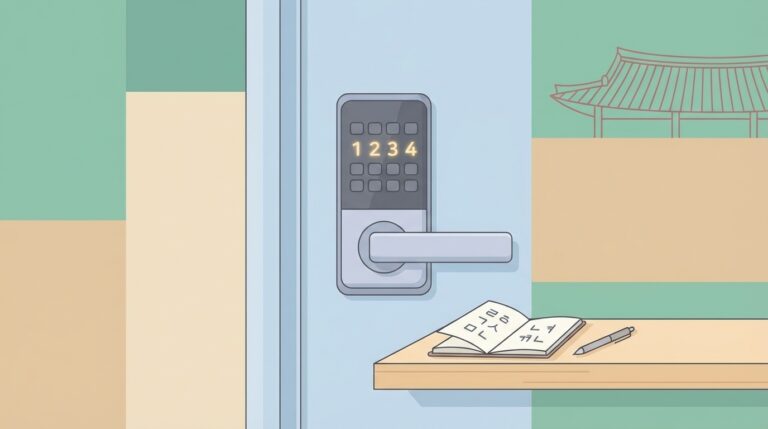
If you’ve watched more than three K-Dramas, you’ve definitely seen this scene: The main character comes home after a long day, tired or maybe a little drunk after some Soju. Instead of fumbling for a key, they reach out to their door. A sleek screen lights up. Beep-beep-beep-beep-trrrring! The door magically unlocks.
Welcome to modern Korea! Here, physical keys are almost extinct. From luxury apartments to cozy Airbnbs, everything runs on digital door locks (도어락). But what happens when you book an Airbnb in Seoul, arrive with your heavy luggage, and realize you don’t know how to ask for the passcode? Or worse, you’re standing at the building’s main entrance, and you can’t even get inside to reach your door?
Don’t worry! Today, we are going to learn exactly how to navigate Korean apartments and door locks. This guide is based on real panicked messages I’ve received from my beginner students visiting Korea. Let’s unlock this culture together!
Phase 2: Deep Dive into Core Expressions
Let’s master the most important survival words for this situation. Since you are at the A1 (Beginner) level, we will keep it super simple and useful!
1. 비밀번호 (Password / Passcode)
- Pronunciation: bi-mil-beon-ho [Sounds like: bee-meal-bun-ho]
- Meaning: Secret number (Literal) -> Password / Passcode (Real nuance)
- K-Culture Moment: You’ll see this everywhere! Not just for doors, but also for Wi-Fi at every Korean cafe. When you check into an Airbnb, the host will message you: “Door 비밀번호 is 1234.”
- Editor’s Insight: This word is the holy grail of Korean travel. Without it, you can’t enter your room, and you can’t post your travel photos on Instagram!
- Situation Spectrum:
[🚫 Absolute Ban] ———— [⚠️ Caution] ———— [✅ Freely]
- Casual (Friends): ✅
- Semi-formal (Staff/Airbnb Host): ✅
- Formal (Elders/Boss): ✅ (It’s a standard noun!)
- 🤔 Think About It: Why do Koreans prefer “secret numbers” over physical keys? Does your home country use digital locks or physical keys more often?
2. 뭐예요? (What is it?)
- Pronunciation: mwo-ye-yo? [Sounds like: mwo-yeh-yo?]
- Meaning: What is it?
- K-Culture Moment: This is the most versatile question in Korean. Point at a street food? “이거 뭐예요?” (What is this?). Want the passcode? “비밀번호 뭐예요?”
- Editor’s Insight: It’s polite but natural. It’s the perfect magic wand for A1 learners.
- Situation Spectrum:
[🚫 Absolute Ban] ———— [⚠️ Caution] ———— [✅ Freely]
- Casual (Friends): ⚠️ (For close friends, just drop ‘yo’ and say “뭐야?” mwo-ya?)
- Semi-formal (Staff/Strangers): ✅
- Formal (Strict Boss): ⚠️
Phase 3: Textbook vs Real Life
How do real Koreans ask for the password compared to your textbook?
| Situation | 📖 Textbook Korean | 🗣️ Real Korean | 💡 Why the difference? |
|---|---|---|---|
| Asking a host/staff | 비밀번호가 무엇입니까? (bi-mil-beon-ho-ga mu-eo-sim-ni-kka?) | 비밀번호 뭐예요? (bi-mil-beon-ho mwo-ye-yo?) | The textbook is too robotic. “뭐예요?” is much softer and more natural for everyday life! |
| Asking a close friend | 비밀번호가 뭐야? (bi-mil-beon-ho-ga mwo-ya?) | 비번 뭐야? (bi-beon mwo-ya?) | Koreans love abbreviating! 비밀번호 becomes 비번 (bi-beon). Fast and efficient! |
Bottom Note: As a beginner, stick to “비밀번호 뭐예요?” It’s polite, safe, and guarantees a smile!
Phase 4: Cultural Deep Dive — K-Culture Connection
4-1. Non-verbal Communication: The Password “Nunchi” (눈치)
In Korea, Nunchi (the subtle art of reading the room) is everything. When your Korean friend is typing their apartment passcode, what should you do? Do NOT stare at their fingers!
It is an unspoken cultural rule to look away, stare at the ceiling, or turn your back slightly while they press the numbers. It shows respect for their privacy and safety.
4-2. K-Drama Connection: The Breakup Trope
If you love K-Dramas, you know the ultimate sign of a breakup. It’s not deleting photos; it’s changing the apartment passcode!
There’s always that dramatic scene where the ex-boyfriend shows up, drunkenly types the old anniversary date on the glowing keypad, and gets the dreaded “Beep-beep-beep! Error!” sound. In Korea, your door lock passcode is deeply tied to your trust circle.
Phase 5: Immersive Roleplay — Be the Star!
Main Scenario: Friday Night Chicken Delivery
- Setting: Friday night, 8 PM. You just arrived at your Korean friend Min-su’s apartment in Hongdae. You are carrying a warm, delicious-smelling bag of Korean fried chicken (치킨). Min-su is carrying heavy drinks.
- Characters:
- YOU: An A1 Korean learner, excited for chicken and beer (Chi-maek).
- Min-su (30): Your friendly local buddy.
Min-su: 아, 손이 없네. 문 좀 열어줄래?
(a, son-i eom-ne. mun jom yeo-reo-jul-lae?)
[Ah, my hands are full. Can you open the door?]
(Wait, “I don’t have hands?” No, it’s a Korean idiom meaning “My hands are full”!)
YOU: 물론이지! 근데…
(mul-lo-ni-ji! geun-de…)
[Of course! But…]
🔀 YOUR TURN! What should you say next?
– A) 비밀번호가 무엇입니까? (bi-mil-beon-ho-ga mu-eo-sim-ni-kka?)
– B) 비번 뭐야? (bi-beon mwo-ya?)
– C) 와이파이 뭐야? (wa-i-pa-i mwo-ya?)✅ Best Choice: B — Since Min-su is a close friend, you can use the casual, shortened slang “비번 뭐야?” (What’s the passcode?).
⚠️ Choice A Analysis: Too formal! You sound like an AI robot.
⚠️ Choice C Analysis: You asked for the Wi-Fi! You can’t open a door with Wi-Fi!
Min-su: 천사!
(cheon-sa!)
[Angel!]
YOU: 뭐라고? 내가 천사라고?
(mwo-ra-go? nae-ga cheon-sa-ra-go?)
[What? I’m an angel?]
(Min-su laughs loudly)
Min-su: 아니, 비밀번호 1004!
(a-ni, bi-mil-beon-ho cheon-sa!)
[No, the passcode is 1004!]
(In Korean, the number 1004 is pronounced “cheon-sa”, which sounds exactly like the word for “Angel”. It’s a very common, cute passcode!)
Phase 6: 10-Second Shadowing Drill
Let’s practice your pronunciation! Pay attention to the slash (/) for pausing.
😊 실례지만 / 비밀번호가 / 뭐예요?
(sil-lye-ji-man / bi-mil-beon-ho-ga / mwo-ye-yo?)
“Excuse me, but what is the passcode?”
🤔 공동현관 / 비번 / 알려주세요.
(gong-dong-hyeon-gwan / bi-beon / al-lyeo-ju-se-yo.)
“Please let me know the common entrance passcode.”
Phase 7: K-Culture Mini Glossary
| Korean | Romanization | English | Context |
|---|---|---|---|
| 도어락 | do-eo-rak | Digital door lock | The electronic lock on every Korean door. Keys are rare! |
| 비밀번호 | bi-mil-beon-ho | Password | Used for doors, Wi-Fi, bank accounts. |
| 비번 | bi-beon | Password (Slang) | Shortened version, used mostly among friends. |
| 공동현관 | gong-dong-hyeon-gwan | Common entrance | The main glass door of an apartment building. You need a code for this too! |
| 별표 | byeol-pyo | Star key (*) | Most Korean locks require you to press the * key after entering numbers! |
Phase 8: Traveler’s Survival Kit
If you are staying at an Airbnb in Korea, you absolutely need this survival kit!
🆘 Survival Phrase #1: Finding the Code
– 🇰🇷 “공동현관 비밀번호 뭐예요?” (gong-dong-hyeon-gwan bi-mil-beon-ho mwo-ye-yo?)
– 🗣️ Sounds like: [gong-dong-hyun-gwan bee-meal-bun-ho mwo-yeh-yo?]
– 📍 Where to use: Texting your Airbnb host when you are stuck outside the main building.
– 💡 Pro Tip: Many delivery drivers know the building codes, but it’s best to ask your host directly!📌 Editor’s Travel Note: The Dead Battery Panic!
Imagine coming home at 2 AM, and the door lock doesn’t light up. The battery is dead! Don’t panic. Run to the nearest convenience store (CU, GS25) and buy a 9V battery (9볼트 건전지). Touch the battery to the two silver emergency nodes on the outside of the door lock. It gives it enough juice to turn on so you can enter your code!
Phase 9: Think Deeper — “A Step Further”
🫠 Think Deeper: Trust and the “Palli-Palli” Culture
Why did South Korea abandon physical keys so quickly? It comes down to two things: High social trust and the famous 빨리빨리 (Palli-Palli / Hurry-Hurry) culture. Carrying a bulky keychain, searching your bag for keys, and manually turning a lock is simply too slow for Koreans! Plus, with low crime rates, people trust digital security. It’s a perfect reflection of a fast-paced, highly digitized society.
💬 Your Turn: Does your culture prefer the convenience of digital locks, or the tangible security of heavy metal keys? Tell me in the comments!
Phase 10: FAQ & Troubleshooting
Q: Is it rude to ask for the passcode to my friend’s apartment?
A: Maybe. If they invite you to enter first, it’s fine. But Koreans usually don’t share their personal apartment code unless you are a close partner or family member. Let them open it!
Q: The host gave me the code, but the door isn’t opening!
A: Remember the 별표 (*)! On 90% of Korean door locks, you must press the numbers and then press the star key (*) to confirm. Sometimes, you have to touch the screen with your whole palm to wake it up first.
❌ Common Mistake #1: Confusing ‘비밀번호’ for only Wi-Fi.
✅ Do this: Remember that 비밀번호 applies to EVERYTHING. Doors, phones, internet, and luggage locks. It’s the universal word for “password”.
Phase 11: Wrap-up & Action Missions
📌 One-Liner Summary: When you need a passcode in Korea, just politely ask, “비밀번호 뭐예요?” (bi-mil-beon-ho mwo-ye-yo?).
Your Missions:
– 🥉 Bronze (Solo): Stand in front of your own door at home, pretend it’s a digital lock, and say “비밀번호 뭐예요?” out loud 3 times.
– 🥈 Silver (Online): Find a K-Drama scene with a door lock and comment on our blog which drama it was!
– 🥇 Gold (Real Life): Next time you enter a Korean cafe or Airbnb, ask the staff/host “비밀번호 뭐예요?” entirely in Korean!
Phase 12: Interactive Quiz!
Let’s test your new K-Culture knowledge!
1. You are at a cafe and want the Wi-Fi password. What is the most natural thing to say to the barista?
A) 비밀번호가 무엇입니까?
B) 비번 뭐야?
C) 비밀번호 뭐예요?
2. True or False: When your Korean friend is typing their door lock passcode, it’s polite to watch closely so you can learn it and help them next time.
3. Which button must you usually press AFTER typing your numbers on a Korean door lock?
A) The # (Pound) key
B) The * (Star) key
C) You just wait 5 seconds
(Answers: 1. C – It’s polite and natural. 2. False! Practice your Nunchi and look away! 3. B – Press the star key!)
Frequently Asked Questions (FAQ)
Q: What does "비밀번호 (Password / Passcode)" mean in Korean and how do you pronounce it?
A: In Korean, "비밀번호 (Password / Passcode)" is pronounced [bi-mil-beon-ho [Sounds like: bee-meal-bun-ho] and means: Secret number (Literal) -> Password / Passcode (Real nuance)
Q: What does "뭐예요? (What is it?)" mean in Korean and how do you pronounce it?
A: In Korean, "뭐예요? (What is it?)" is pronounced [mwo-ye-yo? [Sounds like: mwo-yeh-yo?] and means: What is it?






