

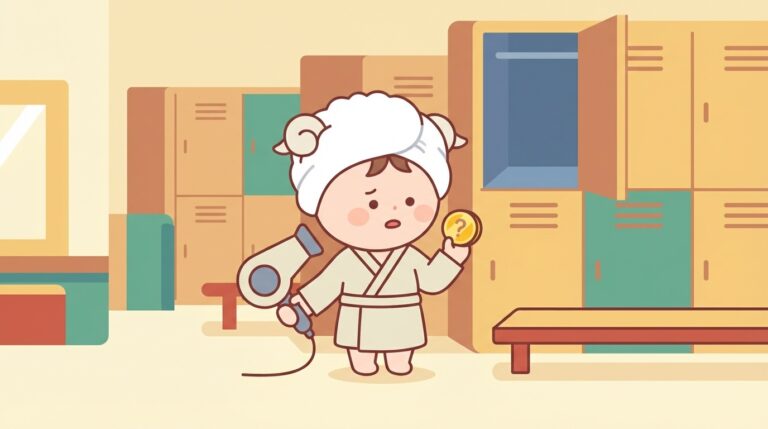
Hello! It is your Daily Hangul Editor. Grab your sweet sikhye (rice punch) and your favorite towel, because today we are heading to the Jjimjilbang (Korean sauna)!
Imagine this: You are starring in your very own K-Drama moment. You have successfully navigated the hot baths, your skin is glowing like your favorite K-Pop idol’s, and you have even mastered the yangmeori (sheep head towel). Now, it is time to dry your hair before you head out into the cold Seoul night. You grab the hairdryer, press the button, and… nothing happens. Wait, is that a coin slot? And why is the person behind you staring at you with that intense look?
Welcome to the true test of Korean local life: The Sauna Locker Room.
If you do not know what to say here, you might end up walking back to your hotel with freezing, wet hair. But do not worry! This guide is based on real struggles my foreign students have faced. Let’s turn you into a locker room insider!
Phase 2: Deep Dive into Essential Expressions
Here are the top 3 lifesaver phrases you need when holding that hairdryer.
1. 동전 있어요?
- Pronunciation: dongjeon isseoyo? [sounds like: dong-jeon ee-so-yo?]
- Meaning: Literal: “Coin exist?” / Real nuance: “Do you have any coins?”
- K-Culture Moment: You will often see this in older Korean movies or indie films where characters are frantically searching their pockets in a public bathhouse. Many traditional Jjimjilbangs still use vintage hairdryers that require a 100-won coin for 2 minutes of air!
- Editor’s Insight: This phrase is a survival tool. It is casual enough to ask a friend, but polite enough (thanks to the ‘-요’) to ask a kind-looking stranger if they have change for a bill.
- Situation Spectrum:
[🚫 절대 금지] ———— [⚠️ 주의] ———— [✅ 자유롭게]
- Friends (Casual): ✅ (Drop the ‘요’ -> 동전 있어?)
- Kind Strangers in Locker Room: ✅
- Formal/Business: 🚫 (You wouldn’t ask your boss for coins in a sauna!)
- 🤔 Think About It: Korea is famous for being a cashless, high-tech society. You can pay for a 1,000-won coffee with a credit card. Why do you think some saunas still keep these old coin-operated machines?
2. 다 쓰셨어요?
- Pronunciation: da sseusyeosseoyo? [sounds like: da sseu-sho-so-yo?]
- Meaning: Literal: “Did you use all?” / Real nuance: “Are you done using it?”
- K-Culture Moment: You are standing behind someone who has been drying their hair for 10 minutes. You need to politely check if they are finishing up. This is pure Nunchi (reading the room) culture in action.
- Editor’s Insight: The key here is the ‘시 (syeo)’ part. It is an honorific marker that shows respect to the person you are asking. It makes the question sound like a polite inquiry rather than a rude “Hurry up!”
- Situation Spectrum:
[🚫 절대 금지] ———— [⚠️ 주의] ———— [✅ 자유롭게]
- Friends (Casual): ⚠️ (Say ‘다 썼어?’ instead)
- Strangers (Semi-formal): ✅
- Elders: ✅
- 🤔 Think About It: In Korean, inserting just one tiny syllable (‘시’) changes the entire politeness level of a sentence. Does your native language have a grammatical way to instantly show respect to a stranger?
3. 먼저 쓰세요.
- Pronunciation: meonjeo sseuseyo. [sounds like: mon-jo sseu-se-yo]
- Meaning: Literal: “First use.” / Real nuance: “You can go ahead and use it first.”
- K-Culture Moment: This is the ultimate display of Korean Jeong (warmth/affection). Imagine your hair is only slightly damp, but the person next to you is dripping wet and shivering. You offer them the dryer.
- Editor’s Insight: Handing over the dryer with a warm “먼저 쓰세요” will instantly make you look like a well-mannered local. It is the locker room equivalent of holding the door for someone.
- Situation Spectrum:
[🚫 절대 금지] ———— [⚠️ 주의] ———— [✅ 자유롭게]
- Friends (Casual): ✅ (먼저 써)
- Strangers (Semi-formal): ✅
- Elders: ✅
Phase 3: Textbook vs Real Life
| Situation | 📖 Textbook Korean | 🗣️ Real Korean | 💡 Why is it different? |
|---|---|---|---|
| Naming the item | 헤어드라이어 (he-eo-deu-ra-i-eo) | 드라이기 (deu-ra-i-gi) | Koreans love shortening English words for efficiency. ‘기’ means machine! |
| Asking to use it | 드라이기를 사용해도 됩니까? | 드라이기 좀 써도 돼요? | ‘사용하다’ is too formal for daily life. ‘쓰다’ (to use) + ‘좀’ (a little/softener) sounds much more natural. |
| Rushing someone | 빨리 해주세요. | (Eye contact and waiting) | Direct confrontation is avoided. Instead, we use body language and Nunchi. |
Bottom Note: For A2 learners, using “좀 (jom)” in your requests is a magic trick. It softens any demand into a gentle favor!
Phase 4: Cultural Deep Dive
4-1. Non-verbal Communication: The Art of Nunchi
In a busy sauna locker room, Nunchi is everything. If there is a line for the hairdryer, do not take 20 minutes to style your hair perfectly. Dry the roots and make way! Also, when handing over the hairdryer to an older lady (Ahjumma), try to use two hands or gently support your right arm with your left hand. It is a subtle gesture of respect that locals will deeply appreciate.
4-2. The Golden Rule of the Korean Hairdryer 🚫
This is perhaps the most crucial cultural tip you will ever receive regarding Korean bathhouses. DO NOT use the public hairdryer to dry your body.
In many Western gyms, it might be somewhat normal to use a hairdryer to dry your toes or body. In Korea, this is a massive cultural taboo. The hairdryer is strictly for head hair. If you use it for your body, you will receive loud scoldings from the locals (and possibly become the villain of the locker room). Stick to the towel for your body!
Phase 5: Immersive Roleplay Scenario
Scenario A: The 100-Won Dilemma
Setting: Saturday night, 10:00 PM. The bright, slightly humid locker room of a famous Jjimjilbang in Myeongdong. You just finished a relaxing bath. You stand in front of the mirror, dripping wet, holding a dryer that refuses to turn on. You notice a coin slot. You only have a 10,000 won bill.
Characters:
– YOU: A traveler who just wants dry hair before eating fried chicken.
– Ahjumma (지연, 55): A friendly local lady applying lotion next to you.
Dialogue:
YOU: (Pressing the button) 어? 왜 안 되지?
(eo? wae an doeji?)
[Huh? Why isn’t this working?]
(🎭 Stage Direction: You look confused and shake the dryer slightly)
Ahjumma: 학생, 그거 동전 넣어야 돼. 백 원짜리.
(haksaeng, geugeo dongjeon neoeoya dwae. baek wonjjari.)
[Student, you have to put a coin in there. A 100-won coin.]
YOU: 아, 정말요? 혹시… 동전 있어요? 제가 만 원짜리밖에 없어서요.
(a, jeongmallyo? hoksi… dongjeon isseoyo? jaega man wonjjaribakke eopseoseoyo.)
[Ah, really? By any chance… do you have coins? I only have a 10,000 won bill.]
Ahjumma: 아이고, 만 원? 잠깐만 기다려봐. 내 캐비닛에 있을 거야.
(aigo, man won? jamkkanman gidaryeobwa. nae kaebinise isseul geoya.)
[Oh my, 10,000 won? Wait a second. I should have some in my cabinet.]
(🎭 Stage Direction: Ahjumma walks to her locker and brings back two 100-won coins)
Ahjumma: 자, 여기. 이거 써.
(ja, yeogi. igeo sseo.)
[Here, take this. Use it.]
YOU: 헉, 감사합니다! 돈은 어떻게 드릴까요?
(heok, gamsahamnida! doneun eotteoke deurilkkayo?)
[Gasp, thank you! How should I pay you back?]
Ahjumma: 에이, 됐어. 이백 원인데 뭘. 얼른 머리나 말려. 감기 걸려.
(ei, dwaesseo. ibaek woninde mwol. eolleun meorina mallyeo. gamgi geollyeo.)
[Oh, never mind. It’s only 200 won. Hurry up and dry your hair. You’ll catch a cold.]
🔀 Your Turn! How do you reply to her kindness?
– A) “오케이, 땡큐!” (Okay, thank you!)
– B) “정말 감사합니다! 다음에 꼭 갚을게요.” (Thank you so much! I will definitely pay you back next time.)
– C) “아… 진짜 감사합니다! 복 받으실 거예요!” (Ah… thank you so much! You will be blessed!)✅ Best Choice: C — Reason: Korean Ahjummas love expressive, heartwarming gratitude. “복 받으실 거예요” (You will receive blessings) is a sweet, culturally charming way to say thank you for small favors!
⚠️ Choice A Analysis: Way too casual for someone older who just did you a favor.
Phase 6: 10-Second Shadowing Drill
Read these out loud! Pay attention to the pauses (/) and emotions.
- 🥺 혹시 / 동전 있어요? (hoksi / dongjeon isseoyo?)
- 😊 천천히 하세요. / 저는 / 괜찮아요. (cheoncheonhi haseyo. / jeoneun / gwaenchanayo.)
- 😅 저기요, / 드라이기 / 다 쓰셨어요? (jeogiyo, / deuraigi / da sseusyeosseoyo?)
Phase 7: K-Culture Glossary
| Korean | Romanization | English | Context |
|---|---|---|---|
| 찜질방 | jjimjilbang | Korean dry sauna | A popular public bathhouse with hot tubs, kilns, and sleeping areas. |
| 눈치 | nunchi | Reading the room | The essential Korean social skill of sensing the mood and acting appropriately. |
| 아줌마 | ahjumma | Middle-aged woman | Commonly used, but can be tricky. It’s better to use ‘이모님’ (Auntie) in restaurants, but in a sauna, friendly older ladies are classic Ahjummas. |
| 양머리 | yangmeori | Sheep head towel | Folding a towel to look like Princess Leia’s buns. A classic K-Drama sauna trope! |
| 정 | jeong | Warmth/Affection | The unspoken bond of kindness in Korean society, like giving a stranger a 100-won coin. |
Phase 8: Traveler’s Survival Kit
Heading to a Korean sauna soon? Here is your survival card!
🆘 Survival Phrases for the Sauna
– 🇰🇷 “수건 한 장 더 주실 수 있나요?” (sugeon han jang deo jusil su innayo?)
– 🗣️ Meaning: Can I have one more towel?
– 🇰🇷 “여탕/남탕 어디예요?” (yeotang/namtang eodiyeyo?)
– 🗣️ Meaning: Where is the women’s/men’s bath?
– 🇰🇷 “이거 카드로 결제 돼요?” (igeo kadeuro gyeolje dwaeyo?)
– 🗣️ Meaning: Can I pay for this with a card?📌 Editor’s Travel Note
– Cash is King (sometimes): While modern big saunas let you tap your locker key to pay for everything (and you settle the bill at the end), older neighborhood Mogyoktang (bathhouses) still require physical 100-won coins for the hairdryer. Always keep a few in your pocket!
– Towel Limits: In the men’s locker room, towels are usually stacked freely. In the women’s locker room, you are usually given exactly two towels at the front desk. Use them wisely!
Phase 9: Think Deeper — “One Step Further”
Language & Power: Breaking Down Barriers
🧠 Think Deeper:
The public bathhouse is a unique space in Korean culture. Once you take off your clothes, all social hierarchies—your job title, your expensive watch, your background—disappear. Everyone is equal in the warm water. This is why you might find strangers talking to each other much more freely in a sauna than on the subway. The language becomes a mix of polite respect (‘다 쓰셨어요?’) and genuine, informal community warmth (sharing a hairdryer or offering a coin).💬 Your Turn: Does your culture have a public space where social barriers break down and people talk to strangers more freely? Share it in the comments!
Phase 10: FAQ & Troubleshooting
- Q: Can I call the lady in the locker room ‘Ajumma’?
- A: Maybe, but be careful! While it literally means middle-aged woman, some people dislike it as it can sound a bit dismissive. If you need to get someone’s attention, it is much safer to say “저기요” (Excuse me) or simply make eye contact and smile.
- Q: Is it okay to use the hairdryer for 15 minutes if I put in enough coins?
- A: No. Nunchi dictates that if the locker room is crowded, you should only dry your hair enough so it’s not dripping, then let the next person go.
❌ Common Mistake #1: Using the public hairdryer to dry your feet or body.
✅ Do this instead: Towel dry your body completely before stepping into the dry locker room area. The hairdryer is for head hair ONLY!
Phase 11: Wrap-up & Action Items
One-Liner Summary: A simple “동전 있어요?” and reading the Nunchi of the room will save you from leaving the sauna with freezing wet hair!
Your Missions for Today:
– 🥉 Bronze (Solo): Stand in front of your bathroom mirror holding your hairdryer and confidently ask, “다 쓰셨어요?” three times.
– 🥈 Silver (Online): Drop a comment below using the word “드라이기” (hairdryer) in a sentence!
– 🥇 Gold (Real World): Next time you are in Korea, visit a local sauna, successfully use the hairdryer, and offer it to the next person saying “먼저 쓰세요!”
K-Culture Mission: Watch an episode of a K-Drama featuring a sauna scene (like Crash Landing on You or Legend of the Blue Sea). Can you spot them eating eggs or using the hairdryer? Let me know!
Phase 12: Interactive Quiz
Let’s test your sauna survival skills!
1. You are waiting for the hairdryer, and the person seems to be finishing up. What is the most polite way to ask if they are done?
– A) 빨리 빨리! (Palli palli!)
– B) 다 쓰셨어요? (Da sseusyeosseoyo?)
– C) 내놔요. (Naenwayo.)
👉 Click to see the answer
Answer: B. A means ‘hurry up’ (very rude here). C means ‘hand it over’ (sounds like a robbery!). B is the perfect, polite choice.
2. True or False: It is completely fine to dry your toes with the sauna hairdryer if nobody is watching.
👉 Click to see the answer
Answer: FALSE!!! This is a huge cultural taboo. Hairdryers are strictly for the hair on your head in public spaces in Korea.
3. Fill in the blank: You only have a bill, but the machine takes coins. You ask: “혹시 _____ 있어요?”
👉 Click to see the answer
Answer: 동전 (dongjeon) – Meaning “coin”.
Enjoy your relaxing sauna trip, and keep your Korean skills warm and ready! See you in the next Daily Hangul post! 😊
Frequently Asked Questions (FAQ)
Q: What does "동전 있어요?" mean in Korean and how do you pronounce it?
A: In Korean, "동전 있어요?" is pronounced [dongjeon isseoyo? [sounds like: dong-jeon ee-so-yo?] and means: Literal: "Coin exist?" / Real nuance: "Do you have any coins?"
Q: What does "다 쓰셨어요?" mean in Korean and how do you pronounce it?
A: In Korean, "다 쓰셨어요?" is pronounced [da sseusyeosseoyo? [sounds like: da sseu-sho-so-yo?] and means: Literal: "Did you use all?" / Real nuance: "Are you done using it?"
Q: What does "먼저 쓰세요." mean in Korean and how do you pronounce it?
A: In Korean, "먼저 쓰세요." is pronounced [meonjeo sseuseyo. [sounds like: mon-jo sseu-se-yo] and means: Literal: "First use." / Real nuance: "You can go ahead and use it first."







