

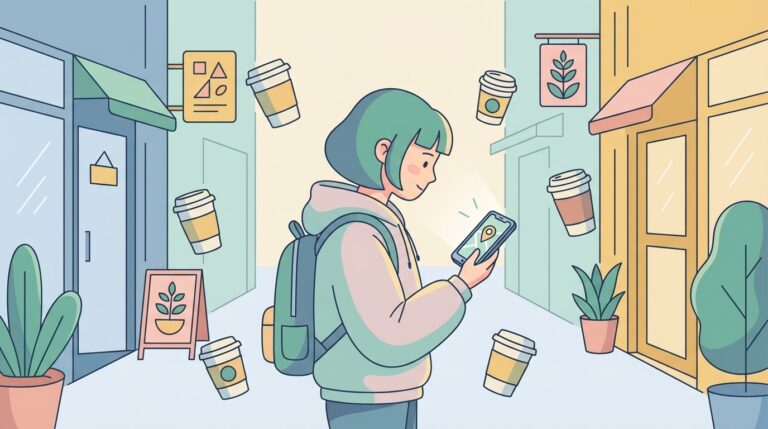
Phase 1: Immersive Hook
Hello! I’m your Daily Hangul Editor, your local Korean friend and veteran tutor.
Picture this: You’ve just finished a delicious meal of Samgyeopsal in the bustling streets of Hongdae. Your friend suggests getting coffee. In a K-Drama, this is the exact moment the camera cuts to a stunning, sunlit cafe with minimalist decor, where the main characters share a meaningful conversation over beautifully crafted lattes.
You open your map app to find a place just like that. But wait… what do you even search for? If you type ‘coffee shop,’ you might end up at a crowded, noisy franchise. How do you find those hidden, ‘aesthetic’ cafes that Koreans are always posting on Instagram?
If you don’t know the right keywords, you’ll miss out on half of Seoul’s incredible cafe culture. But don’t worry! Today, I’m going to teach you the exact phrases locals use to hunt down the best spots. Get ready to upgrade your cafe-hopping game!
Phase 2: Deep Dive into Core Expressions
Here are the secret keywords you need to find the perfect cafe.
1. 분위기 좋은 카페 (A cafe with a good atmosphere)
- Pronunciation: bunwigi joeun kape [boon-we-gee jo-eun ka-peh]
- Meaning: Literal: A cafe with good atmosphere / Real nuance: An aesthetic, cozy, or beautifully decorated cafe.
- K-Culture Moment: This is the ultimate search term. When a K-Drama couple goes on a blind date (소개팅), the guy will almost certainly search Naver for “강남역 분위기 좋은 카페” (Gangnam Station aesthetic cafe) beforehand to impress his date.
- Editor’s Insight: ‘분위기’ (vibe/atmosphere) is everything in Korea. It’s not just about how the coffee tastes; it’s about the lighting, the music, and the interior. If someone asks what kind of cafe you want to go to, this is your bulletproof answer.
- Situation Spectrum:
[🚫 절대 금지] ———— [⚠️ 주의] ———— [✅ 자유롭게]
- Casual (Friends): ✅
- Semi-formal (Colleagues): ✅
- Formal (Boss/Elders): ✅ (It’s a very safe, polite phrase!)
- 🤔 Think About It: Why is ‘vibe’ (분위기) so critical in Korean socializing? Do people in your home country prioritize the taste of the coffee or the interior of the cafe more?
2. 감성 카페 (Aesthetic Cafe)
- Pronunciation: gamseong kape [gahm-sung ka-peh]
- Meaning: Literal: Emotional cafe / Real nuance: A highly aesthetic, Instagram-worthy, trendy cafe.
- K-Culture Moment: If you follow any Korean influencers or K-Pop idols, the photos they post of themselves sipping Americanos in minimalist, slightly dim, mid-century modern spaces? Those are Gamseong Cafes.
- Editor’s Insight: ‘감성’ literally means emotion or sensibility, but in modern slang, it translates to ‘aesthetic.’ A ‘감성 카페’ usually has signature desserts, unique furniture, and sometimes… very uncomfortable low tables!
- Situation Spectrum:
[🚫 절대 금지] ———— [⚠️ 주의] ———— [✅ 자유롭게]
- Casual (Friends): ✅
- Semi-formal (Colleagues): ✅
- Formal (Boss/Elders): ⚠️ (Older generations might not fully grasp this trendy slang, so stick to ‘분위기 좋은 카페’ for them.)
- 🤔 Think About It: The word ‘emotion’ evolved into meaning ‘visual aesthetic’ in Korea. How does social media change the way we use language?
3. 핫플 (Hot Place)
- Pronunciation: hatpeul [hat-peul]
- Meaning: A trendy, popular place (short for ‘Hot Place’).
- K-Culture Moment: Seongsu-dong or Yeonnam-dong are packed with Hat-peuls. If a K-Pop idol visits a cafe, it instantly becomes a Hat-peul, often resulting in massive queues out the door.
- Editor’s Insight: Koreans love abbreviations! This is a Konglish (Korean-English) word. If you say “우리 동네 핫플 가자!” (Let’s go to a hot place in our neighborhood!), you will sound like a true local.
- Situation Spectrum:
[🚫 절대 금지] ———— [⚠️ 주의] ———— [✅ 자유롭게]
- Casual (Friends): ✅
- Semi-formal (Colleagues): ✅
- Formal (Boss/Elders): 🚫 (Too slangy for the CEO!)
Phase 3: Textbook vs Real Life
| Situation | 📖 Textbook Korean | 🗣️ Real Korean | 💡 Why is it different? |
|---|---|---|---|
| Suggesting a cafe | 커피숍에 갈까요? (Shall we go to a coffee shop?) | 근처 예쁜 카페 갈래? (Wanna go to a pretty cafe nearby?) | ‘커피숍’ sounds a bit dated (like the 90s). Young people just say ‘카페’ (cafe). |
| Looking for a trendy spot | 유명한 카페가 어디에 있습니까? (Where is a famous cafe?) | 요새 여기가 완전 핫플이래! (They say this place is a total hot-ple lately!) | Locals rely heavily on social proof and trends (‘핫플’). |
| Describing the cafe | 인테리어가 아름답습니다. (The interior is beautiful.) | 여기 완전 인스타 감성이다! (This place has total Insta-vibes!) | Social media heavily dictates how young Koreans describe spaces. |
Phase 4: Cultural Deep Dive
4-1. Non-verbal Communication: The Art of the ‘Map App’
When finding a cafe, Koreans don’t just walk around hoping to bump into one. They pull out Naver Map or KakaoMap, type “분위기 좋은 카페” (Aesthetic cafe), and immediately filter by Blog Reviews (블로그 리뷰) or Photo Reviews. They will rapidly scroll through photos of the desserts and the interior. If the vibe doesn’t match, they move on.
Also, if you find a great cafe but it’s packed, watch out for the Korean Nunchi (눈치). If you’re standing near a table where people have empty cups, they might feel the Nunchi (social pressure) to leave so you can sit down.
4-2. K-Culture Connection: Cafe-Hopping (카페 투어)
In Korea, going to cafes is treated as a legitimate hobby called “카페 투어” (Cafe Tour / Cafe Hopping). People will travel an hour just to visit a newly opened cafe in Seongsu-dong because it has a unique concept (like a cafe shaped like a giant croissant). It’s not just about caffeine; it’s a spatial experience.
Critical View: Because of this trend, some cafes focus too much on the aesthetic (‘감성’) and neglect the comfort. You might find yourself sitting on a milk crate with a table lower than your knees—all for the sake of the ‘vibe’!
Phase 5: Immersive Roleplay
Scenario A: The Post-Lunch Coffee Hunt
- Setting: A sunny Saturday afternoon in Yeonnam-dong. You just finished eating spicy tteokbokki with your Korean friend, Ji-eun.
- Characters:
- YOU: A B1 Korean learner, ready to use your new vocabulary.
- Ji-eun (28): Your trendy Korean friend who loves taking photos.
Ji-eun: 배부르다! 우리 이제 어디 갈까?
(baebureuda! uri ije eodi galkka?)
[I’m full! Where should we go now?]
YOU: 커피 마시고 싶어요. 근처에 좋은 곳 있어요?
(keopi masigo sipeoyo. geuncheoe joeun got isseoyo?)
[I want to drink coffee. Is there a good place nearby?]
Ji-eun: 음… 연남동이니까 예쁜 데 많지! 카카오맵 볼게.
(eum… yeonnamdong-inikka yeppeun de manjji! kakaomaep bolge.)
[Hmm… Since it’s Yeonnam-dong, there are many pretty places! I’ll look at KakaoMap.]
(🎭 Stage Direction: Ji-eun starts rapidly scrolling through her phone.)
Ji-eun: 아, 여기 새로 생긴 곳인데 사진 찍기 딱 좋겠다. 갈래?
(a, yeogi saero saengin gosinde sajin jjikgi ttak joketda. gallae?)
[Ah, this is a newly opened place and it looks perfect for taking pictures. Wanna go?]
🔀 Your Turn! How should you respond?
– A) “아니요, 그냥 스타벅스 가요.” (No, let’s just go to Starbucks.)
– B) “오, 좋아요! 완전 감성 카페네요!” (Oh, sounds good! It’s a totally aesthetic cafe!)
– C) “거기 커피 맛없을 것 같아요.” (I think the coffee there will taste bad.)✅ Best Choice: B — You validate her choice and use the ultimate local slang (감성 카페). Ji-eun will be so impressed!
⚠️ Choice A Analysis: While practical, it kills the Yeonnam-dong vibe. Koreans usually prefer unique local cafes over franchises when hanging out in trendy neighborhoods.
Scenario B: Bonus K-Pop Scenario (생일 카페)
- Setting: A small cafe in Hongdae covered in posters of your favorite K-Pop idol. It’s their birthday!
Barista: 주문하시겠어요?
(jumunhasigesseoyo?) [Would you like to order?]
YOU: 네, 아이스 아메리카노 하나 주세요. 아, 혹시 특전 받을 수 있나요?
(ne, aiseu amerikano hana juseyo. a, hoksi teukjeon badeul su innayo?)
[Yes, one iced Americano please. Ah, by any chance, can I get the special gifts (cup sleeves/photocards)?]
Barista: 네! 영수증이랑 같이 컵홀더 챙겨드릴게요.
(ne! yeongsujeung-irang gachi keopoldeo chaenggyeo-deurilgeyo.)
[Yes! I’ll give you the cup holder with your receipt.]
Phase 6: 10-Second Shadowing Drill
Practice speaking like a trendy Seoulite!
🥺 근처에 / 분위기 좋은 카페 / 알아요?
(geuncheo-e / bunwigi joeun kape / arayo?)
[Do you know any cafes with a good atmosphere nearby?]
Tone: A little pleading and curious, lifting the pitch at the end.
🤩 와, / 여기 / 완전 / 감성 카페다!
(wa, / yeogi / wanjeon / gamseong kapeda!)
[Wow, this place is totally an aesthetic cafe!]
Tone: Bright and excited, emphasize ‘wanjeon’ (totally).
Phase 7: K-Culture Glossary
| Korean | Romanization | English | Context |
|---|---|---|---|
| 분위기 | bunwigi | Atmosphere / Vibe | The most important word for rating spaces in Korea. |
| 감성 | gamseong | Aesthetic / Emotion | Used to describe visually pleasing, trendy places or objects. |
| 핫플 | hatpeul | Hot Place | A trendy, crowded spot everyone is talking about. |
| 카페 투어 | kape tueo | Cafe Hopping | The hobby of visiting multiple unique cafes in a day. |
| 생카 | saeng-ka | Birthday Cafe | Cafes rented by K-Pop fans to celebrate an idol’s birthday, giving out custom cup sleeves. |
| 웨이팅 | we-i-ting | Waiting / Line | Konglish for waiting in line at a popular restaurant or cafe. |
Phase 8: Traveler’s Survival Kit
🆘 Survival Phrases for Cafe Hunting
– 🇰🇷 “여기서 먹고 갈게요.” (yeogiseo meokgo galgeyo.)
– 🗣️ Pronunciation: [yuh-gi-suh muk-go gal-geh-yo]
– 📍 Meaning: “I will eat here.” (For staying in the cafe, not takeout. You must say this so they give you a glass cup, not plastic!)
- 🇰🇷 “콘센트 자리 있어요?” (konsenteu jari isseoyo?)
- 🗣️ Pronunciation: [kon-sen-teu ja-ri iss-uh-yo]
- 📍 Meaning: “Are there any seats with a power outlet?” (Crucial if you need to charge your phone!)
📌 Editor’s Travel Note
– The Map Secret: DO NOT use Google Maps in Korea! It cannot provide walking directions due to security laws. Download Naver Map or KakaoMap. Search “카페” or “분위기 좋은 카페” directly in those apps.
– Leaving Your Belongings: In Korean cafes, people will leave their laptops, phones, and wallets on the table to reserve a seat while they go to the restroom or order. It’s incredibly safe, so don’t panic if your Korean friend walks away leaving their MacBook behind!
Phase 9: Think Deeper — “A Step Further”
🧠 Think Deeper: Space, Society, and the Cafe Boom
Have you ever wondered why Seoul has so many cafes? In Korea, housing is dense, and many young adults live with their parents until they get married. Therefore, bringing friends or a date back to your house is quite rare. Cafes essentially function as the “extended living room” of the Korean youth. They are spaces to study, date, gossip, and relax outside the home. The pursuit of a ‘감성 카페’ (aesthetic cafe) isn’t just about taking pretty pictures; it’s about renting a beautiful personal space for the price of a cup of coffee.💬 Your Turn: Do people in your country hang out at each other’s houses, or do you prefer meeting at public spaces like cafes? Share in the comments!
Phase 10: FAQ & Troubleshooting
Q: “Can I ask a stranger on the street for cafe recommendations?”
A: Maybe. It’s not common to ask strangers for specific cafe recommendations unless you are totally lost. Koreans usually rely 100% on their map apps and blogs. If you must ask, ask a young person: “죄송한데, 이 근처에 핫플 카페 어딘지 아세요?” (Excuse me, do you know where a hot-place cafe is around here?)
❌ Common Mistake #1: Searching for “커피숍” (Coffee shop) on maps.
✅ Do this instead: Search for “카페” (Cafe). It yields much better, trendier results!❌ Common Mistake #2: Sitting down before ordering if there are barely any seats.
✅ Do this instead: In popular Hat-peuls, you MUST secure a table first. Leave your jacket or bag on the chair, then go to the counter to order.
Phase 11: Wrap-up & Action Items
One-Liner Summary: To find the best cafes in Korea, skip the “coffee shop” search and start looking for “분위기 좋은 카페” (aesthetic cafes) on your local map app!
Action Mission 3 Steps:
– 🥉 Bronze (Solo): Stand in front of a mirror and say “여기 완전 감성 카페다!” (This place is totally an aesthetic cafe!) 3 times with excitement.
– 🥈 Silver (Online): Go to Google/Naver Image search, type “서울 감성 카페”, pick a photo you like, and post the link in our learning community.
– 🥇 Gold (Real Life): Next time you are with a Korean friend, ask them: “우리 동네 핫플 카페 가요!” (Let’s go to a hot-place cafe in our neighborhood!)
🎬 K-Culture Mission:
Download KakaoMap or Naver Map, move the map to ‘성수동’ (Seongsu-dong), and search “분위기 좋은 카페”. Look at the top 3 photo reviews. What kind of vibe do they have?
Phase 12: Interactive Quiz
1. You are walking in Gangnam and want to suggest finding a pretty cafe with a good vibe to your friend. What is the most natural thing to say?
A) 커피숍에 갑시다.
B) 근처 분위기 좋은 카페 찾아볼까요?
C) 감성 어디 있어요?
2. Fill in the blank: “Wow, look at the line for this cafe! It must be a real _______!”
A) 커피숍 (keopisyop)
B) 핫플 (hatpeul)
C) 눈치 (nunchi)
3. True or False – K-Culture Edition: “It is extremely dangerous to leave your smartphone on a cafe table in Seoul to reserve your seat.”
4. Roleplay Outcome: If you choose Choice C (“I think the coffee there will taste bad”) in Scenario A, what will Ji-eun most likely do?
A) Agree and go to a franchise instead.
B) Feel a bit disappointed because the ‘vibe’ (분위기) and taking photos is just as important as the coffee taste in a ‘감성 카페’.
(Answers: 1. B, 2. B, 3. False – It is very safe and common practice!, 4. B)
Frequently Asked Questions (FAQ)
Q: What does "분위기 좋은 카페 (A cafe with a good atmosphere)" mean in Korean and how do you pronounce it?
A: In Korean, "분위기 좋은 카페 (A cafe with a good atmosphere)" is pronounced [bunwigi joeun kape [boon-we-gee jo-eun ka-peh] and means: Literal: A cafe with good atmosphere / Real nuance: An aesthetic, cozy, or beautifully decorated cafe.
Q: What does "감성 카페 (Aesthetic Cafe)" mean in Korean and how do you pronounce it?
A: In Korean, "감성 카페 (Aesthetic Cafe)" is pronounced [gamseong kape [gahm-sung ka-peh] and means: Literal: Emotional cafe / Real nuance: A highly aesthetic, Instagram-worthy, trendy cafe.
Q: What does "핫플 (Hot Place)" mean in Korean and how do you pronounce it?
A: In Korean, "핫플 (Hot Place)" is pronounced [hatpeul [hat-peul] and means: A trendy, popular place (short for 'Hot Place').







