

안녕하세요! I am the Lead Editor of Daily Hangul.
Have you ever watched a Korean variety show like Going Seventeen, Run BTS, or Running Man, where a simple game suddenly turns into a high-stakes, dramatic scene full of betrayals and laughter? Or maybe you’ve walked through the vibrant streets of Sinchon or Hongdae and heard roars of laughter coming from the second floor of a building.
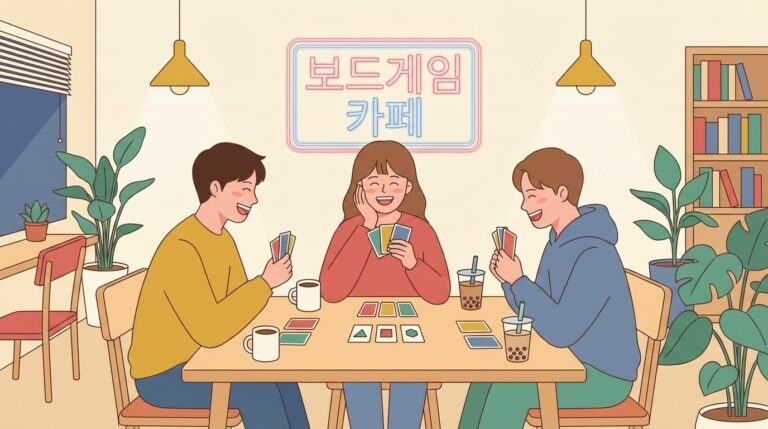
Welcome to the world of the Korean Board Game Cafe (보드게임 카페). It’s not just a place to play games; it’s a cultural hub where young Koreans bond, test their Nunchi (눈치), and most importantly, bet on who will pay for dinner later!
If you simply translate “Let’s play” from your textbook, you’ll survive. But if you want to sound like a local and rule the table, you need the real expressions. This guide is based on real experiences from my B2 students who completely changed their social lives in Korea just by learning these exact phrases. Let’s dive in!
Phase 2: Core Expressions Deep Dive
1. 룰 설명 좀 부탁드릴게요. (Please explain the rules.)
- Pronunciation: [Rul seolmyeong jom butakdeurilgeyo] (Rool / sul-myung / jom / boo-tak-deu-ril-gge-yo. Make the ‘kk’ sound in ‘gge’ tight and sharp!)
- Meaning: Literal: Please do the favor of explaining the rules. / Real nuance: How do we play this?
- K-Culture Moment: You are in a private room at a board game cafe, and you’ve just picked out Splendor. Instead of reading a 20-page manual, you press the call button on the table. A part-time worker comes in, and you smoothly drop this phrase.
- Editor’s Insight: You could say “어떻게 해요?” (How do I do this?), but since you are asking a staff member to spend 5 minutes explaining something, adding ‘좀 부탁드릴게요’ (please do me a favor) shows great manners and high B2-level fluency.
- Situation Spectrum:
[🚫 절대 금지] ———— [⚠️ 주의] ———— [✅ 자유롭게]
- Close Friends (Casual): ⚠️ (Too formal. Use: “이거 어떻게 하는 거야?”)
- Cafe Staff (Formal/Service): ✅
- 🤔 Think About It: Why do Koreans prefer asking a staff member to explain the rules rather than reading the manual? Could it be related to Korea’s highly developed, fast-paced ‘빨리빨리 (Ppal-li Ppal-li)’ service culture?
2. 우리 내기할까? 진 사람이 쏘기!
- Pronunciation: [Uri naegihalkka? Jin sarami ssogi!] (‘Ssogi’ sounds like a sharp snake hiss ‘Ss’ followed by ‘oh-gee’).
- Meaning: Literal: Shall we make a bet? The losing person shoots! / Real nuance: Wanna bet? The loser treats us to food/drinks!
- K-Culture Moment: The tension in a K-Drama rises. The main characters lock eyes over a game of Jenga. One smirks and says, “진 사람이 오늘 술 쏘기.” (The loser buys drinks tonight). This is the ultimate ice-breaker.
- Editor’s Insight: ‘쏘다’ literally means ‘to shoot’ (like a gun or an arrow). But in casual Korean slang, it means ‘to treat someone to a meal or drink’. It’s an essential B2 vocabulary word. If you say “제가 살게요” (I will buy), it’s polite. If you say “내가 쏠게!” (I’ll shoot/treat!), you sound like a true insider.
- Situation Spectrum:
[🚫 절대 금지] ———— [⚠️ 주의] ———— [✅ 자유롭게]
- Close Friends (Casual): ✅
- Co-workers (Semi-formal): ⚠️ (Change to: “진 사람이 커피 쏘는 거 어때요?”)
- Boss/Elders (Formal): 🚫
- 🤔 Think About It: Betting for small things (like coffee or ice cream) is a massive part of Korean workplace and campus culture. Does your culture have a specific word for casually “treating” friends after a game?
3. 아, 아깝다! 막판 한 번 더 해!
- Pronunciation: [Ah, akkapda! Makpan han beon deo hae!]
- Meaning: Literal: Ah, what a waste! Last board, do it one more time! / Real nuance: Ah, so close! Let’s do one final rematch!
- K-Culture Moment: You just lost a game of Halli Galli by one card. You grab your friend’s wrist before they can pack up the game and shout this.
- Editor’s Insight: ‘아깝다’ (akkapda) means something is a waste or a pity, but during a game, it means “I was so close to winning!” ‘막판’ (makpan) means the final round. Koreans always say “This is the last round” about five times before actually leaving the cafe.
- Situation Spectrum:
[🚫 절대 금지] ———— [⚠️ 주의] ———— [✅ 자유롭게]
- Close Friends (Casual): ✅
- Co-workers (Semi-formal): ⚠️ (Change to: “아쉽네요. 마지막으로 한 판만 더 할까요?”)
- 🤔 Think About It: The concept of ‘막판’ (the final stage/round) shows how deeply ingrained games and rounds are in the Korean language.
Phase 3: Textbook vs Real Life
| Situation | 📖 Textbook Korean | 🗣️ Real Korean | 💡 Why is it different? |
|---|---|---|---|
| Suggesting a game | 어떤 보드게임을 할까요? | 무슨 게임 할래? | Casual speech drops formal endings for efficiency and closeness. |
| Asking for rules | 규칙을 알려주세요. | 룰 설명 좀 부탁드릴게요. | Koreans frequently use the English loanword ‘룰’ (rule) in gaming contexts. |
| Wanting a rematch | 다시 한 번 합시다. | 아, 막판! 한 판 더! | Real life is emotional! Short, punchy slang (‘막판’) conveys the urgency of wanting revenge. |
Bottom Note for B2 Learners: You don’t need to use aggressive slang to sound natural. Just dropping textbook stiffness and using conversational fillers like “아” or “진짜” makes a huge difference!
Phase 4: Cultural Deep Dive
4-1. Non-verbal Communication: The Art of Game Nunchi
When playing games in Korea, Nunchi (눈치) is everything. It’s the ability to read the room. If your older co-worker or senior (선배) is losing badly, you might want to subtly let them win a round—though close friends will show absolutely no mercy. Also, when paying the penalty (벌칙) like a flick on the forehead (딱밤), the physical gesture is exaggerated for comedic effect, just like on TV!
4-2. K-Culture Connection: The “Penalty” (벌칙) Entertainment
In Western cultures, the fun of a board game is usually just winning. But in Korea, deeply influenced by variety shows like New Journey to the West or Running Man, the focus is heavily on the penalty of the loser.
Winning isn’t enough; watching your friend wear a silly hat, get hit with a toy hammer (뽕망치), or pay for everyone’s midnight BBQ (야식) is the real goal. Board game cafes in Korea often provide toy hammers specifically for these penalties!
Phase 5: Immersive Roleplay Scenario
Setting: Friday night, 8 PM. A vibrant board game cafe near Gangnam Station. Neon signs, private curtained rooms, and the sound of bells ringing from other tables. You are sitting with your Korean friend, Minho.
Characters:
– YOU: An expat living in Korea. You know some Korean but haven’t been to a board game cafe yet.
– Minho (28): Your Korean friend. Highly competitive, loves variety shows, and speaks to you in casual Korean (반말).
(The dialogue begins)
Minho: 야, 우리 무슨 게임 할까? 보드게임 카페 처음이지?
[Ya, uri museun geim halkka? Bodeugeim kape cheoeumiji?]
(Hey, what game should we play? It’s your first time at a board game cafe, right?)
YOU: 응, 처음이야. 재밌는 걸로 추천해 줘!
[Eung, cheoeumiya. Jaeminneun geollo chucheonhae jwo!]
(Yeah, it’s my first time. Recommend something fun!)
Minho: 그럼 무조건 할리갈리지. 이거 한국인들 필수 게임이야.
[Geureom mujogeon halligalliji. Igeo hangugindeul pilsu geimiya.]
(Then it has to be Halli Galli. It’s a mandatory game for Koreans.)
YOU: 그래? 근데 나 룰을 하나도 몰라.
[Geurae? Geunde na rureul hanado molla.]
(Really? But I don’t know the rules at all.)
Minho: 괜찮아. 직원분한테 룰 설명해 달라고 하면 돼. (Presses the call button)
[Gwaenchana. Jigwonbunhante rul seolmyeonghae dallago hamyeon dwae.]
(It’s fine. We can just ask the staff to explain the rules.)
(Staff explains the rules and leaves)
Minho: 어때, 쉽지? 근데 그냥 하면 재미없잖아?
[Eottae, swipji? Geunde geunyang hamyeon jaemieopjana?]
(How is it, easy right? But if we just play, it’s no fun, right?)
Minho: 우리 내기할까? 진 사람이 오늘 치맥 쏘기!
[Uri naegihalkka? Jin sarami oneul chimaek ssogi!]
(Shall we bet? The loser treats us to chicken and beer tonight!)
🔀 Your Turn! How will you respond?
– A) “아니, 난 돈이 없어.” (No, I don’t have money.)
– B) “콜! 내가 이길 거니까 넌 카드나 준비해!” (Deal! I’m going to win, so get your credit card ready!)
– C) “저는 보드게임을 잘 못합니다.” (I am not good at board games.)✅ Best Choice: B — ‘콜!’ (Call!) is the perfect slang for accepting a bet or challenge. It shows confidence and completely matches the Korean gaming vibe.
⚠️ Choice C Analysis: Too formal and serious! It kills the fun Nunchi of the moment.
YOU: 콜! 내가 이길 거니까 넌 카드나 준비해!
[Kol! Naega igil geonikka neon kadeuna junbihae!]
(Deal! I’m going to win, so get your credit card ready!)
Minho: 오~ 자신감 좋은데? 시작해!
[O~ jasingam joeunde? Sijakhae!]
(Oh~ I like the confidence! Let’s start!)
(10 minutes later… You hit the bell first and win!)
YOU: 아싸! 내가 이겼다! 잘 먹을게!
[Assa! Naega igyeotda! Jal meogeulge!]
(Yes! I won! Thanks for the food!)
Minho: 아, 아깝다! 야, 막판 한 번 더 해! 진짜 막판!
[Ah, akkapda! Ya, makpan han beon deo hae! Jinjja makpan!]
(Ah, so close! Hey, let’s do one last game! Seriously the last game!)
Phase 6: 10-Second Shadowing Drill
Practice these lines with the correct emotion and pausing!
- 😤 Confident: 나랑 / 내기할래? / 진 사람이 / 커피 쏘기!
(Narang / naegihallae? / jin sarami / keopi ssogi!) - 🥺 Pleading: 아 진짜 / 아깝다! / 우리 / 막판 한 번만 / 더 하자!
(A jinjja / akkapda! / uri / makpan han beonman / deo haja!) - 😊 Polite: 저기요, / 이 게임 / 룰 설명 좀 / 부탁드릴게요~
(Jeogiyo, / i geim / rul seolmyeong jom / butakdeurilgeyo~)
Phase 7: K-Culture Glossary
| Korean | Romanization | English | Context |
|---|---|---|---|
| 보드게임 카페 | bodeugeim kape | Board Game Cafe | A cafe where you rent a table and play games. Ordering a drink is usually mandatory. |
| 꿀잼 | kkuljaem | Super fun | ‘꿀’ (honey) + ‘잼’ (short for 재미/fun). Use this when the game is amazing. |
| 쏘다 | ssoda | To treat (pay) | The most important word for Korean social gatherings and bets. |
| 벌칙 | beolchik | Penalty | The punishment for the loser (e.g., getting hit with a toy hammer). |
| 인디안밥 | indianbap | Indian-bap | A classic penalty where the loser gets lightly beaten on the back by the winners while they chant “Indian-bap!” |
Phase 8: Traveler’s Survival Kit
Even if you’re just traveling, board game cafes are a great rainy-day activity in Korea. Here is what you need to survive:
🆘 Survival Phrases TOP 3
– 🇰🇷 “2명이요. 방 있나요?” (Dumyeong-iyo. Bang innayo?)
– 🗣️ Meaning: Table for two. Do you have a private room?
– 🇰🇷 “음료는 어디서 주문해요?” (Eumnyoneun eodiseo jumunhaeyo?)
– 🗣️ Meaning: Where do I order drinks?
– 🇰🇷 “이거 반납할게요.” (Igeo bannaphalgeyo.)
– 🗣️ Meaning: I will return this (when bringing the game back to the counter).📌 Editor’s Travel Note
– 1인 1음료 (1 Drink Per Person): Most board game cafes require every person to order at least one drink, on top of the hourly room fee.
– Tablets: Many modern cafes in Korea (like Red Button) have tablets inside the room where you can watch video tutorials of the rules instead of asking the staff!
Phase 9: Think Deeper – “Language & Power”
🧠 Think Deeper: The Magic of ‘Yaja Time’ (야자타임)
Korean language is deeply tied to social hierarchy through its honorifics (존댓말). However, when Koreans play games, something fascinating happens. The strict rules of age and rank often blur. Sometimes, groups even initiate Yaja Time (야자타임)—a game rule where the youngest person gets to use casual language (반말) to the oldest person for a set duration. This shows that while Korean society respects hierarchy, they use games and “play” as a safe, culturally accepted pressure valve to temporarily dismantle power dynamics and bond on an equal level.💬 Your Turn: Does your culture have a concept where social hierarchies are temporarily ignored for the sake of fun? Share your thoughts in the comments!
Phase 10: FAQ & Troubleshooting
Q: Is it okay if I scream or get loud when I win?
Yes! Board game cafes in Korea are surprisingly loud, especially if you are in a curtained or private room. Screaming when you win a round of Halli Galli is practically a tradition.
Q: Do I have to clean up the game pieces?
Yes, it is basic etiquette to organize the cards and tokens back into the box before returning them to the “반납대” (Return Counter).
❌ Common Mistake #1: Saying “제가 돈을 낼게요” (I will pay the money) when setting up a fun bet.
✅ Do This Instead: Use “제가 쏠게요!” (I’ll treat/shoot!). It sounds much more natural and fits the lively atmosphere of a game cafe.
Phase 11: Wrap-up & Action Items
One-Liner Summary: To rule a Korean board game cafe, remember to ask the staff for rules politely, bet confidently with “콜!” (Call!), and demand a rematch with “막판!” (Last game!).
Action Mission:
– 🥉 Bronze: Stand in front of a mirror and say “아깝다! 막판 한 번 더 해!” with the most dramatic K-Drama face you can make.
– 🥈 Silver: Leave a comment below using the word “쏘다”. (Example: “내일 친구한테 커피 쏠 거예요.”)
– 🥇 Gold: Visit a board game cafe in Korea (or in your local Koreatown) and use “룰 설명 좀 부탁드릴게요” to the staff!
K-Culture Mission:
Watch an episode of Run BTS or Going Seventeen this week. Keep your ears open—I guarantee you will hear “내기할래?” or “막판!” within the first 20 minutes!
Phase 12: Interactive Quiz
1. Fill in the Blank:
You just narrowly lost a game of Jenga. You want to play ONE final round. What do you say?
“아, 아깝다! ( _____ ) 한 번 더 해!”
2. Situational Judgment:
You want to suggest that the loser of the game buys the team fried chicken. What is the most natural B2-level phrase?
– A) 진 사람이 치킨 사주십시오.
– B) 진 사람이 치킨 쏘기!
– C) 진 사람이 돈을 주세요.
3. True or False – K-Culture Edition:
In a Korean board game cafe, you only pay the hourly fee and do not need to order any food or drinks. (T / F)
(Answers: 1. 막판 / 2. B / 3. False – Most places enforce the 1인 1음료 rule!)
Frequently Asked Questions (FAQ)
Q: What does "룰 설명 좀 부탁드릴게요. (Please explain the rules.)" mean in Korean and how do you pronounce it?
A: In Korean, "룰 설명 좀 부탁드릴게요. (Please explain the rules.)" is pronounced [Rul seolmyeong jom butakdeurilgeyo] and means: Literal: Please do the favor of explaining the rules. / Real nuance: How do we play this?
Q: What does "우리 내기할까? 진 사람이 쏘기!" mean in Korean and how do you pronounce it?
A: In Korean, "우리 내기할까? 진 사람이 쏘기!" is pronounced [Uri naegihalkka? Jin sarami ssogi!] and means: Literal: Shall we make a bet? The losing person shoots! / Real nuance: Wanna bet? The loser treats us to food/drinks!
Q: What does "아, 아깝다! 막판 한 번 더 해!" mean in Korean and how do you pronounce it?
A: In Korean, "아, 아깝다! 막판 한 번 더 해!" is pronounced [Ah, akkapda! Makpan han beon deo hae!] and means: Literal: Ah, what a waste! Last board, do it one more time! / Real nuance: Ah, so close! Let's do one final rematch!







