

Hello! I’m the Lead Editor of Daily Hangul.
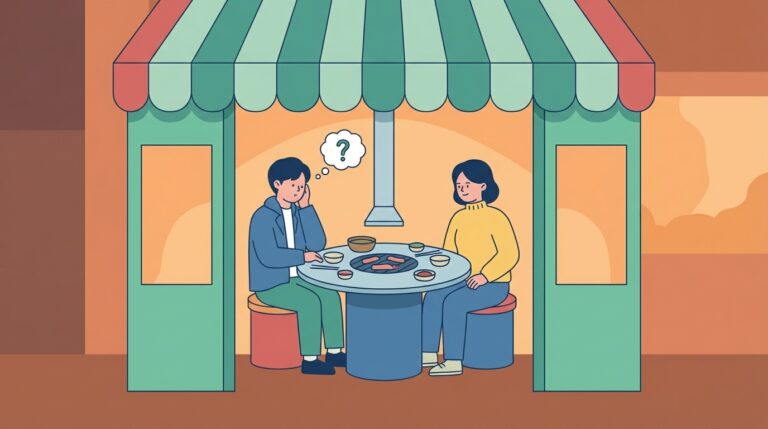
Imagine this: You’re sitting at a lively Korean barbecue place, the sound of sizzling pork belly filling the air. Your Korean friend pours you a shot of Soju, looks at you with a suddenly serious face, and asks: “Hey… if you were born again, would you want to be a man or a woman?”
If you’ve watched K-Dramas like Goblin or Reborn Rich, you know that reincarnation (환생) is a huge cultural trope. But in real life, this isn’t just fantasy—it’s the ultimate Korean icebreaker! We call these Balance Games (밸런스 게임). It’s a popular social game where you must choose between two extreme or interesting hypotheticals.
Not knowing how to answer this can lead to an awkward silence, but knowing the exact grammar and cultural nuance? That instantly makes you an “Insider” (인싸).
Today, we’re going to master the “-(는/ㄴ)다면” (If I were to…) grammar, tailored exactly to B1 learners. This guide is based on real interactions my students have had in Seoul. Let’s dive in!
Phase 2: Core Expressions Deep Dive
1. 만약 다시 태어난다면…
- Pronunciation: [manyak dasi tae-eonandamyeon] + [man-yak da-shi teh-uh-nan-da-myun]
- Meaning: If (by any chance) I were born again…
- K-Culture Moment: This is the classic setup. You’ll hear this on K-Pop variety shows when idols play the Balance Game. The word 만약 (if) emphasizes that it’s a pure hypothetical.
- Editor’s Insight: The grammar -(는/ㄴ)다면 is different from the basic -(으)면. While
-(으)면is for likely conditions (“If it rains tomorrow”),-(는/ㄴ)다면is for pure imagination or unlikely events. It has a dreamy, dramatic feel.- Situation Spectrum:
[🚫 절대 금지] ———— [⚠️ 주의] ———— [✅ 자유롭게]
- Casual with friends: ✅
- Semi-formal (Coworkers at Hoesik): ✅ (Great icebreaker!)
- Formal (Boss/Elders): ⚠️ (Might be too playful for a strict boss)
- 🤔 Think About It: Why do Koreans love playing hypothetical “Balance Games” so much? Does your culture have similar “What if” games to break the ice?
2. 남자로 / 여자로 살아보고 싶어요.
- Pronunciation: [namjaro / yeojaro sarabogo sipeoyo] + [nam-ja-ro / yuh-ja-ro sa-ra-bo-go shi-puh-yo]
- Meaning: I want to try living as a man / woman.
- K-Culture Moment: The suffix
-아/어 보다means “to try doing something.” You aren’t just saying “I want to be a man”—you are saying “I want to experience the life of a man.”- Editor’s Insight: It sounds incredibly natural and thoughtful. It shows you’re curious about the other perspective, which usually leads to a great follow-up conversation about why.
- Situation Spectrum:
[🚫 절대 금지] ———— [⚠️ 주의] ———— [✅ 자유롭게]
- Casual with friends: ✅
- Semi-formal: ✅
- Formal: ⚠️
3. 저는 그냥 지금이 좋아요.
- Pronunciation: [jeoneun geunyang jigeumi joayo] + [juh-neun geu-nyang ji-geum-i jo-ah-yo]
- Meaning: Literal: I just like right now. / Real nuance: I like who I am right now (I wouldn’t change a thing).
- K-Culture Moment: The “safe” yet highly respected answer. If an idol is asked this question, answering “I just like who I am right now because I get to be with our fans!” is the ultimate crowd-pleaser.
- Editor’s Insight: The word 그냥 (just) softens the sentence, making it sound relaxed and confident rather than defensive.
Phase 3: Textbook vs Real Korean
| Situation | 📖 Textbook Korean | 🗣️ Real Korean | 💡 Why is it different? |
|---|---|---|---|
| Answering the question | 만약 내가 다시 태어난다면, 나는 남자가 되고 싶습니다. | 다시 태어나면? 난 무조건 남자/여자! | Real life drops the formal markers and uses “무조건 (unconditionally/absolutely)” for emphasis. |
| Being indecisive | 어느 쪽인지 결정하기 어렵습니다. | 아, 이거 완전 고민되는데? | “고민되다” (to be worried/conflicted) is the go-to expression for hard choices. |
| Refusing the question | 저는 다시 태어나고 싶지 않습니다. | 아~ 전 그냥 안 태어날래요 ㅋㅋㅋ | Adding “그냥” and laughing makes a potentially dark answer sound like a joke. |
Bottom Note for B1 Learners: You don’t need to memorize extreme slang. Just dropping the subject “저는/나는” and adding “무조건” will instantly make you sound like a local!
Phase 4: Cultural Deep Dive
4-1. Non-verbal Communication: The “Thinking” Face
When asked a hypothetical question in Korea, don’t answer too fast. Culturally, taking a moment to show you are deeply considering the question is a sign of good Nunchi (눈치). Tilt your head slightly, make a “Hiss” sound by drawing breath through your teeth (쓰읍-), and say “아…” before answering. It builds anticipation!
4-2. K-Culture Connection: The “Balance Game” (밸런스 게임)
If you follow K-Pop or watch Korean YouTube, you’ve definitely seen the Balance Game. It’s the Korean equivalent of “Would You Rather.” Idols are constantly asked questions like, “If you were born again, would you rather be the leader or the youngest (maknae)?”
In daily life, especially during a Hoesik (company drinking dinner) or while waiting for food at a cafe, Koreans use these questions to avoid awkward silences. Knowing how to handle the -(는/ㄴ)다면 grammar means you can actually initiate these games, turning you from a quiet foreigner into the life of the party.
Phase 5: Immersive Roleplay Scenario
Scenario A: The Samgyeopsal Confession
- Setting: Friday night, 7 PM. A smoky, bustling Samgyeopsal restaurant near Gangnam Station. You are with three Korean coworkers.
- Characters:
- YOU: A B1 Korean learner, working in Seoul. You want to bond with your team.
- Minsu (32): Your friendly, humorous Korean coworker who loves leading the conversation.
Dialogue:
Minsu: 아, 배부르다! 우리 소화도 시킬 겸 밸런스 게임 할까요?
(A, baebureuda! uri sohwado sikil gyeom baelleonseu geim halkkayo?)
[Ah, I’m full! Should we play a balance game to digest?]
YOU: 오, 좋아요! 무슨 질문이에요?
(O, joayo! museun jilmunieyo?)
[Oh, sounds good! What’s the question?]
Minsu: 자, 만약 다시 태어난다면! 남자로 태어날래요, 여자로 태어날래요?
(Ja, manyak dasi tae-eonandamyeon! namjaro tae-eonallaeyo, yeojaro tae-eonallaeyo?)
[Okay, if you were born again! Would you want to be born as a man, or a woman?]
(🎭 Stage Direction: Minsu points his Soju glass at you like a microphone)
🔀 Your Turn! How do you answer?
– A) “저는 남자가 되고 싶습니다.” (Textbook style)
– B) “쓰읍… 완전 고민되는데? 저는 무조건 지금 성별이요!”
– C) “질문이 너무 이상해요.”✅ Best Choice: B — You used the non-verbal “thinking” sound, acknowledged it’s a tough choice, and gave a natural, enthusiastic answer using “무조건”.
⚠️ Choice C Analysis: Saying “the question is weird” kills the mood. In Korea, playing along with the hypothetical is a social skill!
Minsu: 오, 진짜요? 왜요?
(O, jinjjayo? waeyo?)
[Oh, really? Why?]
YOU: 지금 제 삶이 꽤 마음에 들거든요.
(Jigeum je salmi kkwae maeume deulgeodeunyo.)
[Because I quite like my life right now.]
Scenario B: Bonus K-Pop Fan Sign Event
- You are at a fan-sign event for your favorite K-Pop idol. You only have 10 seconds!
- YOU: 오빠! 만약 다시 태어난다면, 그때도 아이돌 할 거예요?
(Oppa! manyak dasi tae-eonandamyeon, geuttaedo aidol hal geoyeyo?)
[Oppa! If you were born again, would you still be an idol?] - Idol: 당연하죠! 그래야 팬분들을 또 만나죠~ 😉
(Dangyeonhajyo! geuraeya paen-bundeureul tto mannajyo~)
[Of course! That’s how I can meet our fans again~]
Phase 6: 10-Second Shadowing Drill
Practice this out loud. Pay attention to the pauses (/) and emotions!
🤔 쓰읍... / 만약 / 다시 태어난다면요? (sseueup... / manyak / dasi tae-eonandamyeonyo?)
😊 저는 / 무조건 / 지금 제 모습으로 / 살고 싶어요! (jeoneun / mujogeon / jigeum je moseubeuro / salgo sipeoyo!)
Phase 7: K-Culture Glossary
| Korean | Romanization | English | Contextual Meaning |
|---|---|---|---|
| 밸런스 게임 | baelleonseu geim | Balance Game | A “Would you rather” game. A staple in Korean icebreaking culture. |
| 환생 | hwansaeng | Reincarnation | A huge theme in Korean webtoons and dramas (e.g., dying and returning to the past). |
| 무조건 | mujogeon | Unconditionally | Used casually to mean “Absolutely” or “Without a doubt 100%.” |
| 회식 | hoesik | Company dinner | The after-work drinking/eating culture where these games usually happen. |
| 눈치 | nunchi | Social awareness | The ability to read the room. Having good nunchi means playing along with the game. |
Phase 8: Traveler’s Survival Kit
While discussing reincarnation might not save your life, the -(는/ㄴ)다면 (If… happens) grammar is CRUCIAL for travel emergencies!
🆘 Traveler’s Survival Expressions using -( 맞는)다면
– 🇰🇷 “만약 여권을 잃어버렸다면 어떻게 해야 하나요?” (manyak yeogwoneul ileobeoryeotdamyeon eotteoke haeya hanayo?)
– 🗣️ Meaning: If (by chance) I lost my passport, what should I do?
– 📍 Where to use: Police station, hotel front desk, embassy.
– 💡 Pro Tip: Adding ‘만약’ (if) makes it clear you are asking about a hypothetical scenario, so the staff doesn’t panic thinking you already lost it!📌 Editor’s Travel Note
Taxi drivers in Korea love small talk. A common hypothetical they might ask you is: “만약 한국에서 살게 된다면, 어디서 살고 싶어요?” (If you were to live in Korea, where would you want to live?). Prepare a fun answer like “Busan, because I love the ocean!”
Phase 9: Think Deeper — “한 발 더 깊이”
🧠 Think Deeper: Media vs Reality
Why is reincarnation (환생) and regression (회귀—going back in time) such a dominant theme in Korean media right now? Some sociologists argue that it reflects a cultural exhaustion with highly competitive, modern society. When society feels so tough that success seems impossible in this lifetime, the idea of “starting over with new stats” or “being born again” becomes a comforting fantasy. However, underneath this escapism is actually a deep desire for a second chance to live life right.💬 Your Turn: Does your country’s popular media also feature a lot of reincarnation or “second chance” stories? How does your culture view the idea of being born again? Share in the comments!
Phase 10: FAQ & Troubleshooting
- Q: Can I ask this “If you were born again…” question to my boss?
- A: ⚠️ Maybe. If it’s a relaxed Hoesik (company dinner) and your boss is making jokes, it’s totally fine and shows you understand Korean office bonding. But in a quiet office setting? Avoid it.
- Q: What if I don’t want to answer the question?
- A: You can laugh and say, “비밀이에요!” (It’s a secret!). It keeps the mood light without forcing you to answer.
❌ Common Mistake #1: Confusing -(으)면 and -(는/ㄴ)다면.
– “내일 비가 온다면…” (X – Sounds like rain is a mythical, impossible event)
– “내일 비가 오면…” (O – Standard “if it rains tomorrow”)
✅ Remember: Use-(는/ㄴ)다면for purely hypothetical, highly unlikely, or imaginative scenarios!
Phase 11: Wrap-up & Action Items
One-Liner Summary: To master Korean icebreakers, use -(는/ㄴ)다면 to ask hypothetical questions, and don’t forget your Nunchi thinking face!
Action Mission:
– 🥉 Bronze: Say “저는 무조건 지금 제 모습으로 살고 싶어요!” to your mirror three times.
– 🥈 Silver: Leave a comment below answering: 만약 다시 태어난다면, 남자로 태어날래요, 여자로 태어날래요?
– 🥇 Gold: Next time you have a language exchange or dinner with a Korean friend, initiate a Balance Game using today’s grammar!
K-Culture Mission:
Search for “아이돌 밸런스 게임” (Idol Balance Game) on YouTube and see how many times you can hear the word “만약” (if) or “무조건” (unconditionally)!
Phase 12: Interactive Quiz
1. Fill in the blank:
Your friend asks: “만약 다시 태어난다면, 부자로 태어날래요, 천재로 태어날래요?”
You want to say “I absolutely want to be a genius!”
Answer: “저는 _______ 천재요!”
(Hint: The word for “unconditionally / absolutely”)
2. Situational Judgment:
You want to ask your friend what they would do IF they won the lottery. Which grammar is more natural?
– A) 로또에 당첨되면…
– B) 로또에 당첨된다면…
3. True or False – K-Culture Edition:
In Korea, it is considered rude to take a few seconds to think before answering a “Balance Game” question. (T / F)
(Answers: 1. 무조건, 2. B – since winning the lottery is highly unlikely/hypothetical, 3. False – acting like you are thinking deeply (눈치) makes the game more fun!)
Frequently Asked Questions (FAQ)
Q: What does "만약 다시 태어난다면..." mean in Korean and how do you pronounce it?
A: In Korean, "만약 다시 태어난다면..." is pronounced [manyak dasi tae-eonandamyeon] and means: If (by any chance) I were born again...
Q: What does "남자로 / 여자로 살아보고 싶어요." mean in Korean and how do you pronounce it?
A: In Korean, "남자로 / 여자로 살아보고 싶어요." is pronounced [namjaro / yeojaro sarabogo sipeoyo] and means: I want to try living as a man / woman.
Q: What does "저는 그냥 지금이 좋아요." mean in Korean and how do you pronounce it?
A: In Korean, "저는 그냥 지금이 좋아요." is pronounced [jeoneun geunyang jigeumi joayo] and means: Literal: I just like right now. / Real nuance: I like who I am right now (I wouldn't change a thing).







