Phase 1: Immersive Hook — The Yeouido Hustle
Hello! This is your Daily Hangul Editor.
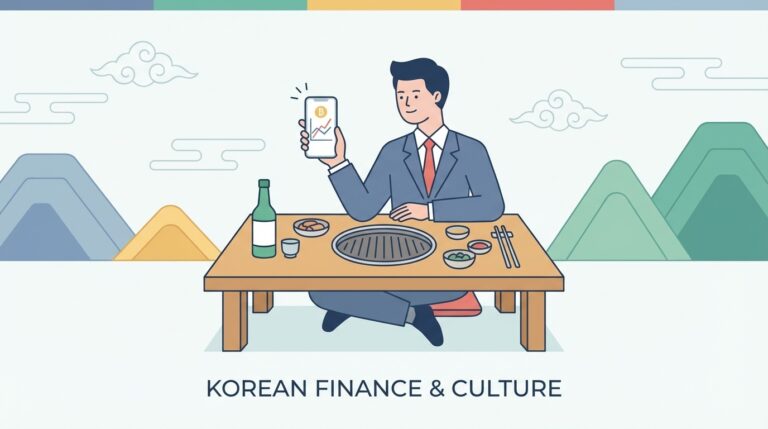
Imagine this: You are sitting at a bustling Samgyeopsal (pork belly) restaurant in Yeouido, often dubbed the Wall Street of Seoul. The clinking of Soju glasses fills the air. You peek over at your Korean colleague’s smartphone, and they are intensely staring at a crypto trading app. But wait… the chart is covered in RED. In the West, a red chart means a market crash, panic, and burning money. But your colleague is smiling, ordering another round of premium beef. Why?
Because in Korea, RED means UP, and BLUE means DOWN.
At the C2 level, you already know the grammar. You can order coffee and ask for directions. But can you debate the volatility of the cryptocurrency market, discuss regulatory frameworks, and throw in a perfectly timed financial slang that makes a Korean trader drop their Soju glass in respect?
Today, we are diving deep into the high-stakes world of Korean Investment & Finance. This guide is built on real debates happening in Seoul’s boardrooms and late-night drinking sessions (Hoesik). Let’s dive in.
Phase 2: Deep Dive into Core Expressions
Let’s unpack the high-level vocabulary you need for a sophisticated crypto debate.
1. 규제의 사각지대에 놓여 있다 (gyuje-ui sagakjidae-e noyeo itda)
- Pronunciation: [gyu-je-eui sa-gak-ji-dae-e no-yeo it-da] (Think of ‘gak’ as the sound of briefly clearing your throat)
- Meaning: Literal: Placed in the blind spot of regulation. / Real nuance: Operating in a legal gray area or unregulated territory.
- K-Culture Moment: You will hear this exact phrasing on late-night news programs (like JTBC Newsroom) or in a K-Drama courtroom scene when a sharp-suited lawyer points out a flaw in the system.
- Editor’s Insight: This is a powerhouse phrase for formal debates. It shows you don’t just know the word ‘규제’ (regulation), but you understand spatial metaphors in formal Korean.
- Situation Spectrum:
[🚫 절대 금지] ———— [⚠️ 주의] ———— [✅ 자유롭게]
- Casual with friends: ⚠️ (A bit too formal, might sound like a news anchor)
- Semi-formal (Colleagues): ✅
- Formal (Boss/Debate): ✅
- 🤔 Think About It: Why does Korean use the term ‘사각지대’ (blind spot, literally ‘dead-angle zone’) so often in social issues? How does your native language visually describe systemic flaws?
2. 투기와 투자의 경계선 (tugi-wa tuja-ui gyeonggyeseon)
- Pronunciation: [tu-gi-wa tu-ja-eui gyeong-gye-seon]
- Meaning: Literal: The boundary line between speculation and investment.
- K-Culture Moment: In dramas like Reborn Rich, the wealthy chaebol grandfather often scolds his ambitious grandsons with this concept: “Are you investing, or are you just gambling?”
- Editor’s Insight: ‘투기’ (Speculation/Gambling) carries a heavy moral judgment in Korean society, often associated with reckless greed. Using this contrasts beautifully with the rational ‘투자’ (Investment).
- Situation Spectrum:
[🚫 절대 금지] ———— [⚠️ 주의] ———— [✅ 자유롭게]
- Casual with friends: ✅
- Semi-formal (Colleagues): ✅
- Formal (Boss/Debate): ✅
- 🤔 Think About It: In Western crypto culture, ‘degens’ (degenerate gamblers) is sometimes worn as a badge of honor. In Korea, ‘투기’ is strictly negative. What does this say about traditional Korean financial conservatism?
3. 단기적 변동성에 일희일비하지 마세요 (dangijeok byeondongseong-e ilhuiilbihaji maseyo)
- Pronunciation: [dan-gi-jeok byeon-dong-seong-e il-hui-il-bi-ha-ji ma-se-yo]
- Meaning: Literal: Do not alternate between one joy and one sorrow over short-term volatility. / Real nuance: Don’t let short-term market swings dictate your emotional state.
- K-Culture Moment: This is the ultimate “wise mentor” phrase. Picture a seasoned investor in a sleek Gangnam office pouring tea for a panicked junior trader.
- Editor’s Insight: Ilhuiilbi (일희일비) is a four-character idiom (Saja-seongeo). Using Saja-seongeo in a business context immediately elevates your Korean to native-like sophistication.
- Situation Spectrum:
[🚫 절대 금지] ———— [⚠️ 주의] ———— [✅ 자유롭게]
- Casual with friends: ✅ (Used playfully)
- Semi-formal (Colleagues): ✅
- Formal (Boss/Debate): ✅
- 🤔 Think About It: Korean has hundreds of four-character idioms derived from Chinese characters. They function like zipped files of complex emotional concepts. Do you have similar ‘compact’ phrases in your culture?
Phase 3: Textbook vs Real Life Korean
When debating, you must know how to switch between the podium and the pub.
| 상황 (Situation) | 📖 교과서 한국어 (Textbook) | 🗣️ 진짜 한국어 (Real Korean) | 💡 왜 다를까? (Why the difference?) |
|---|---|---|---|
| Market crashed | 가상화폐 가격이 급락했습니다. (Prices plummeted) | 완전 떡락했어요! 나 물렸어… (It mega-crashed! I’m trapped/bitten…) | ‘떡락’ (rice-cake drop) is vivid slang. ‘물리다’ (bitten) implies being trapped by a bad investment. |
| Market skyrocketed | 가치 상승이 예상됩니다. (Value increase is expected) | 가즈아!! 떡상 간다! (Let’s gooo!! It’s skyrocketing!) | ‘가즈아’ (Gaza) originated in crypto forums as a desperate rally cry, now a mainstream meme. |
| I invested everything | 제 모든 자산을 투자했습니다. (I invested all assets) | 영끌해서 코인 탔어요. (I pulled my soul together to ride the coin.) | ‘영끌’ (Yeong-kkeul) reflects the desperation of youth trying to build wealth in a tough economy. |
Bottom Note: At the C2 level, do not overuse ‘가즈아’ or ‘떡락’ in formal debates. Keep them in your back pocket for the Hoesik (after-party) to show your Korean colleagues you truly understand the culture.
Phase 4: Cultural Deep Dive — K-Culture & Finance
4-1. Non-verbal Communication: The Nunchi of the Red and Blue
When discussing financial losses, the Korean concept of Nunchi (reading the room) is critical. If a colleague is staring blankly at a screen showing blue numbers (remember: Blue = Loss in Korea), do not loudly ask, “How is your portfolio doing?” Offer them a quiet cup of mixed coffee (믹스커피) or suggest getting Soju after work. Silence is often the most polite financial discourse in Korea.
4-2. K-Culture Connection: The Soju Tent Trope & The ‘Yeong-kkeul’ Generation
If you’ve watched K-Dramas, you know the scene: the protagonist, having lost their company or life savings, sits alone in a plastic-tented street stall (Pojangmacha), downing shots of Soju in the rain.
Today, the object of that despair (or triumph) is often crypto. Because Seoul’s real estate prices have skyrocketed beyond the reach of the average salaryman, Millennials and Gen Z engage in ‘영끌’ (Yeong-kkeul: pulling even one’s soul) to invest in high-volatility assets like cryptocurrency. Therefore, debating crypto regulation in Korea isn’t just about economics; it is a sensitive social debate about generational wealth, hope, and survival.
Phase 5: Immersive Roleplay — The Gangnam BBQ Debate
Setting: Friday, 7 PM. A smoky Samgyeopsal joint near Gangnam Station. Bottles of Cass beer and Chamisul Soju line the table. You are having a team dinner (Hoesik) with your Korean colleagues after a wild week in the crypto market.
Characters:
– YOU: A foreign professional working in Seoul, known for a cautious investment style.
– Min-su (32): Your Korean coworker. He’s a risk-taker, heavy crypto investor, and currently very excited about a new altcoin.
Dialogue:
민수: 아, 어제 비트코인 보셨어요? 완전히 떡상했잖아요! 제 말이 맞죠?
(A, eoje biteukoin bosyeosseoyo? Wanjeonhi tteoksanghaetjanayo! Je mari matjyo?)
(Ah, did you see Bitcoin yesterday? It totally skyrocketed! I told you, right?)
YOU: 네, 봤어요. 하지만 며칠 전에는 급락했었잖아요. 변동성이 너무 심한 것 같아요.
(Ne, bwasseoyo. Hajiman myeochil jeoneneun geumnakaesseotjanayo. Byeondongseong-i neomu simhan geot gatayo.)
(Yes, I saw. But it plummeted a few days ago. The volatility seems too extreme.)
민수: 에이, 그건 단기 조정이죠. 코인은 미래 화폐라니까요!
(Ei, geugeon dangi jojeong-ijyo. Koineun mirae hwapyeranikkayo!)
(Hey, that’s just a short-term correction. Crypto is the future currency!)
YOU: 기술은 인정하지만, 아직은 규제의 사각지대에 놓여 있어서 투기에 가깝지 않나요?
(Gisureun injeonghajiman, ajigeun gyuje-ui sagakjidae-e noyeo isseoseo tugi-e gakkapji annayo?)
(I acknowledge the tech, but isn’t it closer to speculation since it’s still in a regulatory blind spot?)
(🎭 Stage Direction: Min-su passionately waves his lettuce wrap [Ssam] in the air.)
민수: 그래서 규제가 들어오기 전에 빨리 타야죠! 지금 안 사면 나중에 벼락거지 돼요. 이번에 저수지 뚫고 진짜 달방 간다니까요. 같이 영끌하시죠!
(Geuraeseo gyujega deureo-ogi jeone ppalli tayajyo! Jigeum an samyeon najung-e byeorakgeoji dwaeyo. Ibeone jeosuji ttulgo jinjja dalbang gandanikkayo. Gachi yeongkkeulhasijyo!)
(That’s why we need to ride it before regulations come in! If you don’t buy now, you’ll suddenly become poor [byeorak-geoji]. Let’s pull our souls together and invest!)
🔀 당신의 차례! (Your Turn!) How do you politely decline while keeping the mood light?
- A) 저는 그런 위험한 투기는 절대 안 합니다. (I absolutely do not do such dangerous speculation.)
- B) 하하, 민수 씨 수익 나면 저 소고기나 사주세요! 저는 제 페이스대로 갈게요. (Haha, when you make a profit, buy me some beef! I’ll go at my own pace.)
- C) 규제가 없으면 사기입니다. 정부가 개입해야 해요. (If there is no regulation, it is a scam. The government must intervene.)
✅ Best Choice: B — Why? In a Korean Hoesik setting, maintaining Kibun (mood/feelings) is crucial. Option B cleverly defuses the pressure by using humor and bringing the topic back to food (buying expensive beef is a classic Korean way to celebrate wealth), while firmly setting your boundary.
⚠️ Choice A & C Analysis: While grammatically flawless and excellent for an academic debate, these are too blunt for a Friday night BBQ and might kill the team spirit.
Phase 6: 10-Second Shadowing Drill
Let’s practice the intonation of a professional yet passionate debater.
😤 단호하게 (Firmly):
암호화폐는 / 혁신적인 기술이지만, / 정부의 / 명확한 규제가 / 필요합니다!
(amhohwapyeneun / hyeoksinjeogin gisurijiman, / jeongbu-ui / myeonghwakan gyujega / pilyohamnida!)
(Cryptocurrency is an innovative technology, but clear government regulation is necessary!)
Pro-tip: Emphasize ‘혁’ in 혁신적 and ‘명’ in 명확한 to sound authoritative and confident.
Phase 7: K-Culture Mini Glossary (Crypto & Finance Edition)
| 한국어 | Romanization | English | Cultural Context |
|---|---|---|---|
| 영끌 | yeong-kkeul | Pulling one’s soul | Short for ‘영혼까지 끌어모으다’. Describes taking massive loans to invest in real estate or crypto due to economic anxiety. |
| 존버 | jon-beo | HODL (Hold On for Dear Life) | A vulgar but incredibly common slang meaning ‘enduring fiercely’ during a market crash. |
| 파란불 | paranbul | Blue light (Loss) | In Korea, stock/crypto charts use Blue for price drops and Red for increases. “My screen is a blue light” means “I’m losing money.” |
| 벼락거지 | byeorak-geoji | Suddenly beggar | A newly coined term for someone who suddenly became relatively poor because they didn’t invest while others made fortunes. |
Phase 8: Traveler’s Survival Kit (Financial Edition)
Even if you aren’t day-trading in Seoul, you will need to handle money, exchange rates, and banks during your stay.
🆘 Survival Phrases for Banks & Exchange (환전소)
– 🇰🇷 “오늘 달러 환율이 어떻게 되나요?” (oneul dalleo hwanyuri eotteoke doenayo?)
– 🗣️ Meaning: What is the USD exchange rate today?
– 📍 Where to use: Myeongdong currency exchange booths, Airport banks.
– 🇰🇷 “수수료가 얼마인가요?” (susuryoga eolma-ingayo?)
– 🗣️ Meaning: How much is the commission/fee?📌 Editor’s Travel Note
– Cash vs Card: Korea is a near-cashless society. However, if you visit Myeongdong for street food or independent currency exchange booths for better rates, bring crisp, clean banknotes.
– Crypto Payments: While rare for daily goods, some tech-forward cafes in Gangnam briefly experimented with accepting crypto. However, standard credit cards (Visa/Mastercard) or T-money cards are your best friends.
Phase 9: Think Deeper — “한 발 더 깊이”
Global Era: Konglish in the Korean Crypto Market
Take a close look at Korean crypto forums. You won’t find traditional Korean financial terms; instead, you’ll see a massive influx of localized English: 코인 (Coin), 펌핑 (Pumping), 디파이 (DeFi), 스테이킹 (Staking).
At the C2 level, it is fascinating to observe how the Korean language absorbs foreign concepts. Traditional stock market terms use Sino-Korean words (e.g., 주식, 배당), reflecting older generations’ influence. However, the crypto space is dominated by Millennials and Gen Z, who natively integrate English into their daily internet speech. This linguistic divide mirrors the generational divide in wealth and investment strategies in modern Korea.
💬 Your Turn: Does your native language create new words for new financial technologies, or does it just borrow the English terms? Share your thoughts in the comments!
Phase 10: FAQ & Troubleshooting
Q: Can I tell my boss, “우리 주식이 떡락했어요” (Our stocks plummeted/tteok-rak-haesseoyo)?
Absolutely NO. ‘떡락’ is Internet slang. If you use it with a superior or in a formal meeting, you will sound highly unprofessional. Instead, use: “주가가 급락했습니다” (jugaga geumnakaetseumnida).
Q: How do I politely disagree in a Korean debate without losing face?
Start with “네, 그 말씀도 맞지만…” (Yes, what you said is also correct, but…). In Korean culture, directly saying “You are wrong” (틀렸어요) is aggressive. Acknowledge their point first, then pivot to your argument.
❌ Common Mistake #1: Confusing ‘틀리다’ (To be wrong/incorrect) and ‘다르다’ (To be different).
✅ Do this: When debating opinions, say “제 생각은 좀 달라요” (My thoughts are a bit different), NEVER “그 생각은 틀렸어요” (That thought is wrong).
Phase 11: Wrap-up & Action Missions
One-Liner Summary: To master Korean financial debates, balance the formal logic of “규제” (regulation) with the cultural empathy of “Nunchi” and emotional market slang.
Your Action Missions:
– 🥉 Bronze (Solo): Read the shadowing sentence (Phase 6) out loud 3 times, focusing on the assertive intonation.
– 🥈 Silver (Online): Go to a Korean news YouTube channel (like YTN or SBS News), find a video about the economy or Bitcoin, and see if you can spot the word ‘변동성’ (Volatility) or ‘규제’ (Regulation) in the comments.
– 🥇 Gold (Real Life): Next time you discuss investments with a Korean friend, ask them: “요즘 투자와 투기의 경계선이 참 모호한 것 같아요. 어떻게 생각하세요?” (Lately, the line between investment and speculation seems very blurred. What do you think?)
K-Culture Mission: Watch an episode of the drama Reborn Rich (재벌집 막내아들) or Itaewon Class (이태원 클라쓰) and observe how the characters’ body language changes when they look at stock/crypto charts. Notice the red and blue!
Phase 12: Interactive Challenge — Quiz
1. Situational Judgment:
You are in a formal board meeting discussing a new blockchain project. You want to point out that the legal rules aren’t clear yet. What is the most appropriate C2-level phrase?
– A) 이거 완전 사각지대네요.
– B) 현재 이 기술은 규제의 사각지대에 놓여 있습니다.
– C) 정부가 떡락을 유도하고 있습니다.
2. True or False (K-Culture Edition):
– In a Korean trading app, if your screen is filled with red text and red charts, it means you are losing a lot of money. (T / F)
3. Fill in the Blank:
– 단기적 시장의 움직임에 _______하지 마시고, 길게 보세요. (Don’t alternate between joy and sorrow over short-term market movements, look long-term.)
(Scroll down for answers)
Answers: 1: B (A is too casual, C is slang and inappropriate). 2: False (Red means the price is going UP in Korea!). 3: 일희일비 (ilhuiilbi)
Frequently Asked Questions (FAQ)
Q: What does "규제의 사각지대에 놓여 있다 (gyuje-ui sagakjidae-e noyeo itda)" mean in Korean and how do you pronounce it?
A: In Korean, "규제의 사각지대에 놓여 있다 (gyuje-ui sagakjidae-e noyeo itda)" is pronounced [gyu-je-eui sa-gak-ji-dae-e no-yeo it-da] and means: Literal: Placed in the blind spot of regulation. / Real nuance: Operating in a legal gray area or unregulated territory.
Q: What does "투기와 투자의 경계선 (tugi-wa tuja-ui gyeonggyeseon)" mean in Korean and how do you pronounce it?
A: In Korean, "투기와 투자의 경계선 (tugi-wa tuja-ui gyeonggyeseon)" is pronounced [tu-gi-wa tu-ja-eui gyeong-gye-seon] and means: Literal: The boundary line between speculation and investment.
Q: What does "단기적 변동성에 일희일비하지 마세요 (dangijeok byeondongseong-e ilhuiilbihaji maseyo)" mean in Korean and how do you pronounce it?
A: In Korean, "단기적 변동성에 일희일비하지 마세요 (dangijeok byeondongseong-e ilhuiilbihaji maseyo)" is pronounced [dan-gi-jeok byeon-dong-seong-e il-hui-il-bi-ha-ji ma-se-yo] and means: Literal: Do not alternate between one joy and one sorrow over short-term volatility. / Real nuance: Don't let short-term market swings dictate your emotional state.