

Phase 1: Immersive Hook — The Great Counter Battle
Hello! I’m the Lead Editor of Daily Hangul.
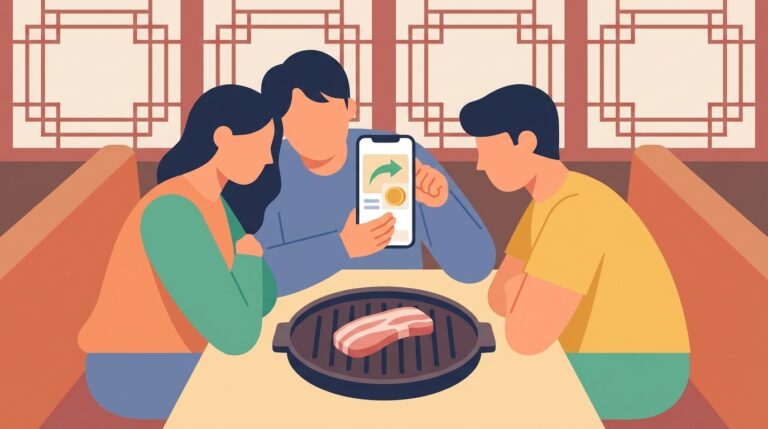
Have you ever watched a K-Drama and seen a scene where two characters are aggressively wrestling at the restaurant counter, waving their credit cards in the air? To an outsider, it looks like a heated argument. But look closely—they are actually fighting over who gets to pay the bill!
In Korea, paying for your friends or colleagues is historically a sign of affection and Jeong (warm-heartedness). However, times are changing! Today, especially among younger generations, splitting the bill—known as Dutch Pay (더치페이)—and transferring money via mobile banking apps is the norm.
If you don’t know the rules of this ‘money dance,’ you might end up either paying for a whole group of 10 people or awkwardly standing at the counter while everyone else seamlessly taps their phones.
Don’t worry! This guide is built from the real, sometimes embarrassing, experiences of my past students. Let’s learn how to navigate Korean bills and bank transfers like a true local!
Phase 2: Core Expressions Deep Dive
Let’s look at the 3 golden phrases you need when the bill arrives.
1. 따로 계산할게요 (We will pay separately)
- Pronunciation: [Tta-ro gye-san-hal-ge-yo]
- Sound-alike guide: ‘tt’ is a sharp, tense T. ‘Gye’ sounds like ‘gyeh’.
- Meaning: (Literal) I will calculate separately. / (Real) We want to split the bill.
- K-Culture Moment: You are at a trendy cafe in Seongsu-dong. You order an iced Americano, and your friend orders a latte. When you step up to the register, you say this so the cashier knows to charge your cards individually.
- Editor’s Insight: This is your survival phrase at cafes and fast-food joints! Just say this, and the cashier will kindly ask, “What did you have?” and charge you one by one.
- Situation Spectrum:
[🚫 절대 금지] ———— [⚠️ 주의] ———— [✅ 자유롭게]
- Cashier at a cafe: ✅
- Cashier at a busy K-BBQ place with 10 people: ⚠️ (They might get annoyed. It’s better to pay all at once and transfer money later!)
- 🤔 Think About It: Why do Koreans prefer paying all at once and doing bank transfers later instead of holding up the line? How is this different from your home country?
2. 제가 낼게요 (I will pay)
- Pronunciation: [Je-ga nael-ge-yo]
- Sound-alike guide: ‘Je’ like in ‘Jelly’. ‘Nael’ rhymes with ‘Bell’.
- Meaning: (Literal) I will put it out. / (Real) It’s on me / I’ll treat you.
- K-Culture Moment: This is the phrase you shout when you want to initiate the ‘K-Drama Counter Battle.’ If an older Korean friend or colleague says this, they are showing their affection.
- Editor’s Insight: If someone older says this, you should politely say “Oh, no, it’s okay!” once. If they insist, just say “Thank you, I will eat well!” (감사합니다. 잘 먹겠습니다!)
- Situation Spectrum:
[🚫 절대 금지] ———— [⚠️ 주의] ———— [✅ 자유롭게]
- To younger friends/colleagues: ✅
- To someone who explicitly invited you to treat you: ✅
3. 얼마 보내면 돼요? (How much should I send?)
- Pronunciation: [Eol-ma bo-nae-myeon dwae-yo?]
- Sound-alike guide: ‘eo’ sounds like ‘uh’. ‘Eol-ma’ means ‘how much’.
- Meaning: (Literal) How much if I send is it okay? / (Real) How much do I owe you for my share?
- K-Culture Moment: The K-BBQ dinner is over. One person paid the $100 bill with their card. Everyone steps outside the restaurant, takes out their phones, opens KakaoPay or Toss (Korean banking apps), and asks the payer this exact question.
- Editor’s Insight: This phrase makes you sound 100% fluent in Korean social dynamics. It shows you are ready to do your part instantly.
- Situation Spectrum:
[🚫 절대 금지] ———— [⚠️ 주의] ———— [✅ 자유롭게]
- Friends / Colleagues: ✅
- To a boss who clearly said “I’m treating”: 🚫 (Don’t ask to pay them back, it ruins their cool moment!)
Phase 3: Textbook vs Real Life
Here is how textbooks teach it, versus what you’ll actually hear on the streets of Hongdae.
| Situation | 📖 Textbook Korean | 🗣️ Real Korean | 💡 Why is it different? |
|---|---|---|---|
| Suggesting to split the bill | 각자 비용을 냅시다. (Let’s pay our respective costs.) | 우리 엔빵(N빵) 하자! (Let’s N-bbang!) | ‘N빵’ means dividing the total by ‘N’ number of people. It’s a fun, highly common slang among MZ generation! |
| Asking for bank details | 당신의 계좌번호를 알려주세요. (Please inform me of your account number.) | 카뱅(Kakaobank) 있어요? / 계좌 보내주세요. | Mobile banking is so fast in Korea that people just ask if you use specific apps like KakaoPay or Toss. |
| Offering to treat | 오늘은 제가 식사비를 지불하겠습니다. | 오늘 내가 쏠게! (I’ll shoot today!) | ‘쏘다’ (to shoot) is a very common slang for ‘treating’ someone to a meal or drinks. |
Bottom Note for A1 Learners: You don’t need to use “엔빵 하자” (N-bbang) yourself yet, but if your Korean friends say it, you’ll now know exactly what it means!
Phase 4: Cultural Deep Dive
4-1. Non-verbal Communication: The “Nunchi” of the Bill
In Korea, there’s a strong concept of Nunchi (눈치)—reading the room. When the bill arrives, watch the hands. If the eldest person grabs the bill, it usually means they are treating. You shouldn’t aggressively snatch it back. Instead, let them pay, and later say, “Next time, I’ll buy the coffee!” (다음에는 제가 커피 살게요!)
4-2. K-Food Connection: The Speed of Bank Transfers
Korean restaurants are all about Pali-Pali (빨리빨리 – hurry hurry) culture. At a busy K-BBQ restaurant with a long line outside, asking the cashier to split a bill 6 ways using 6 different credit cards is considered a slight nuisance.
Instead, the Korean social rule is: One person pays for everything at the counter, and the others instantly bank-transfer (계좌 이체) their share while walking to the subway. It’s efficient, fast, and keeps the restaurant moving!
Phase 5: Immersive Roleplay Scenario
Setting: Friday night, 8 PM. A bustling K-BBQ restaurant in Gangnam. The table is filled with empty soju bottles and lettuce plates. You are with three Korean coworkers.
Characters:
– YOU: An expat in Korea, working at a tech company for 3 months.
– Minsu (32): Your friendly Korean coworker who loves to eat.
Minsu: 아, 배부르다! 오늘 고기 진짜 맛있었죠?
(A, baebureuda! Oneul gogi jinjja masisseotjyo?)
[Ah, I’m full! The meat was really good today, right?]
YOU: 네, 진짜 최고였어요!
(Ne, jinjja choegoyosseoyo!)
[Yes, it was truly the best!]
Minsu: 자, 가실까요?
(Ja, gasilkkayo?)
[Well, shall we go?]
(🎭 Stage Direction: Minsu grabs the restaurant bill from the table and walks to the counter. He takes out his Samsung Pay.)
Minsu: (To the cashier) 한 번에 결제해 주세요.
(Han beone gyeoljehae juseyo.)
[Please charge it all at once.]
🔀 Your Turn! The transaction is done. How do you respond to Minsu outside?
– A) “땡큐!” (Thank you!)
– B) “민수 씨, 얼마 보내면 돼요? 계좌번호 알려주세요!” (Minsu, how much should I send? Please let me know your account number!)
– C) “저 따로 계산할게요.” (I will pay separately.)✅ Best Choice: B — Since Minsu already paid the whole bill, you immediately ask how much to bank transfer. This makes you look incredibly polite and socially aware!
⚠️ Choice C Analysis: It’s too late! Minsu already paid. Saying this now will just cause confusion.
Phase 6: 10-Second Shadowing Drill
Let’s practice your flow! Speak out loud along with the guide.
😊 민수 씨, / 얼마 / 보내면 돼요?
(Min-su ssi, / eol-ma / bo-nae-myeon dwae-yo?)
“Minsu, how much should I send?”
📱 카카오페이 / 되나요?
(Ka-ka-o-pe-i / doe-na-yo?)
“Do you use KakaoPay?”
Phase 7: K-Culture Glossary
| Korean | Romanization | English | Context |
|---|---|---|---|
| 더치페이 | deochi-pei | Dutch pay / Splitting the bill | Used commonly in Korea to mean splitting the bill equally. |
| N빵 | en-bbang | Splitting equally by N | MZ slang. “N” means the number of people, “bbang” means dividing. |
| 계좌 이체 | gye-jwa i-che | Bank transfer | The literal term for transferring money. |
| 쏘다 | sso-da | To treat (someone) | Literally “to shoot.” Used when buying a meal for someone. |
| 회식 | hoe-sik | Company dinner | Often paid by the company card, so no Dutch pay needed! |
Phase 8: Traveler’s Survival Kit
Are you just visiting Korea and don’t have a Korean bank account? Here is what you need to know!
🆘 Survival Phrase #1: Card or Cash?
– 🇰🇷 “여기 카드 돼요?” (yeogi kadeu dwaeyo?)
– 🗣️ English Guide: yuh-gee kah-deu dweh-yo?
– 📍 Where to use: Small traditional markets, street food stalls, taxis.
– 💡 Pro Tip: Korea is a cashless society! 99% of places accept cards. However, at street food stalls in Myeongdong or Gwangjang Market, cash or local bank transfer is highly preferred.📌 Editor’s Travel Note
– No Tipping: Do not leave cash on the table! Korea has zero tipping culture. If you leave money, the server will literally run down the street to return it to you.
– Namane Card / Wowpass: As a tourist, you can’t use KakaoPay without a resident card. Look into prepaid tourist cards like WOWPASS to easily split bills with fellow travelers!
Phase 9: Think Deeper — “A Step Further”
Food & Identity: The Shift from ‘Jeong’ to Fairness
Traditionally, Korean dining was deeply rooted in the concept of Jeong (정) – a collective feeling of warmth, attachment, and community. Because of Jeong, friends would almost fight to pay the entire bill, and everyone shared dishes from the same central pot. However, as Korea rapidly modernized, the MZ generation (Millennials and Gen Z) began valuing fairness and boundaries. This gave rise to “N-bbang” (N빵) and the Dutch Pay culture we see today. It’s a fascinating transition from a deeply collective society to one that respects individual boundaries while still enjoying the communal act of eating together.
💬 Your Turn:
In your culture, do you usually split the bill perfectly down to the cents, or do friends take turns buying meals? Share in the comments!
Phase 10: FAQ & Troubleshooting
Q: Is it rude to ask an older person to “Dutch Pay”?
Yes and no. If you are a university student eating out with a senior (Sunbae), they will usually insist on paying. If you demand to split it, it might hurt their pride. Instead, let them pay, and say, “I’ll buy dessert!” (제가 디저트 살게요!).
Q: Can I just say “Dutch Pay” in Korean?
Yes! Koreans use the English word “더치페이” (Deo-chi-pe-i) all the time. It is a fully adopted loanword.
❌ Common Mistake #1: Calculating the exact cents at the table.
✅ Do this instead: Don’t sit at the table with a calculator dividing who ate 2 pieces of meat vs 3 pieces. Koreans usually split the total amount equally by the number of people, regardless of who ate slightly more.
Phase 11: Wrap-up & Action Items
Summary: In Korea, if everyone is paying together, one person usually pays first, and the rest politely ask “얼마 보내면 돼요?” (How much should I send?) to bank-transfer their share!
Your 3-Step Mission:
– 🥉 Bronze (Solo): Say “따로 계산할게요” 3 times in front of your mirror.
– 🥈 Silver (Online): Text your Korean friend or language partner: “다음에 만나면 제가 쏠게요!” (Next time we meet, I’ll treat!)
– 🥇 Gold (Real Life): Next time you grab coffee with a friend in Korea, confidently walk up to the counter and say “따로 계산할게요.”
K-Culture Mission:
Watch a K-Drama this week and look for a restaurant scene. Notice who grabs the bill and who pays. Did they fight over it, or did they N-bbang?
Phase 12: Interactive Quiz
Test your new Nunchi skills!
1. You are at a cafe with one friend and want to pay for just your own coffee at the counter. What do you say?
a) 얼마 보내면 돼요? (How much do I send?)
b) 따로 계산할게요. (I will pay separately.)
c) 제가 쏠게요! (I’ll shoot!)
2. Fill in the blank: The MZ slang for splitting the bill equally is “___빵 하자!”
a) K
b) T
c) N
3. True or False: If a waiter gives you great service at a K-BBQ restaurant, you should leave a 15% tip on the table.
(Answers: 1: b, 2: c, 3: False – Never tip in Korea!)
Frequently Asked Questions (FAQ)
Q: What does "따로 계산할게요 (We will pay separately)" mean in Korean and how do you pronounce it?
A: In Korean, "따로 계산할게요 (We will pay separately)" is pronounced [Tta-ro gye-san-hal-ge-yo] and means: a key conversational Korean expression covered in this lesson.
Q: What does "제가 낼게요 (I will pay)" mean in Korean and how do you pronounce it?
A: In Korean, "제가 낼게요 (I will pay)" is pronounced [Je-ga nael-ge-yo] and means: a key conversational Korean expression covered in this lesson.
Q: What does "얼마 보내면 돼요? (How much should I send?)" mean in Korean and how do you pronounce it?
A: In Korean, "얼마 보내면 돼요? (How much should I send?)" is pronounced [Eol-ma bo-nae-myeon dwae-yo?] and means: a key conversational Korean expression covered in this lesson.







