

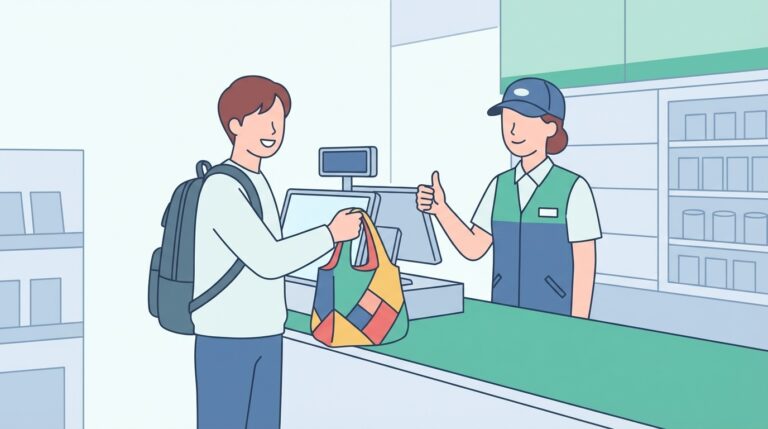
Are You Still Buying Plastic Bags in Korea? How to Say “I Brought My Reusable Bag” Like a Local!
Phase 1: 공감 — 몰입형 오프닝 (Immersive Hook)
Hello there! I’m your Daily Hangul Editor, your veteran Korean tutor and local culture navigator.
Imagine this: You’re at a bustling GS25 convenience store in Seoul. You’ve just picked up a triangle kimbap (삼각김밥) and some banana milk. You walk up to the counter, ready to pay. The cashier scans your items at lightning speed, looks up, and says a phrase that sounds like one long word:
“Bongtupiryohaseyo?”
You freeze. The line of busy office workers behind you starts to shift impatiently. You just nod, and suddenly you see an extra 50 won added to your bill, along with a plastic bag you didn’t really want.
Sound familiar? Whether you’re at a convenience store, a massive Emart, or a local traditional market, navigating the checkout counter is a true test of your Korean survival skills. Today, we’re going to level up from just nodding nervously to confidently pulling out your eco-friendly bag and saying, “I brought my own!” like an absolute insider.
Not only will this save you a few won, but showing that you care about 환경과 재활용 (Environment and Recycling) will instantly earn you deep respect from the locals. Let’s dive in!
Phase 2: 핵심 표현 심층 분석 (Deep Dive)
Let’s break down the essential expressions you need for your zero-waste shopping trip in Korea.
1. 장바구니 챙겨 왔어요.
- Pronunciation: [Jangbaguni chaenggyeo wasseoyo.] + Sound-alike guide: “Jang-bah-goo-nee cheng-gyeo wa-sso-yo.”
- Meaning: I brought my reusable shopping bag.
- K-Culture Moment: You’re at a large supermarket like Lotte Mart. The cashier is about to grab a standard plastic bag, but you whip out your colorful, folded reusable bag from your pocket. The cashier smiles—you just made their job easier and saved the earth!
- Editor’s Insight: 장바구니 literally means “market basket,” but today it refers to any reusable tote bag. The verb 챙기다 is a magical Korean word. It doesn’t just mean “to bring”; it implies taking care to pack something intentionally. It shows you are prepared!
- Situation Spectrum:
[🚫 절대 금지] ———— [⚠️ 주의] ———— [✅ 자유롭게]
- Casual (to friends): ✅ “나 장바구니 챙겨 왔어.”
- Semi-formal (to a cashier): ✅ “장바구니 챙겨 왔어요.”
- Formal (to a boss): ✅ “장바구니 챙겨 오셨어요?”
- 🤔 Think About It: Why do Koreans use the word 챙기다 (to pack with care/attention) instead of just 가져오다 (to bring)? How does this reflect the Korean cultural emphasis on being prepared and mindful of others?
2. 봉투 필요하세요?
- Pronunciation: [Bongtu piryohaseyo?] + Sound-alike guide: “Bong-too pee-ryo-ha-se-yo?” (The ‘r’ in piryo sounds like a very soft ‘d/r’ hybrid)
- Meaning: Do you need a bag?
- K-Culture Moment: This is the universal greeting at any Korean checkout counter. It happens so fast in convenience stores that it sounds like one single word. If you’re a fan of slice-of-life K-dramas, you’ll hear part-timers saying this robotically to every customer.
- Editor’s Insight: 봉투 originally meant “envelope” (like for a letter or wedding money), but in shopping contexts, it means a plastic or paper bag.
- Situation Spectrum:
[🚫 절대 금지] ———— [⚠️ 주의] ———— [✅ 자유롭게]
- Casual (to friends): 🚫 (You wouldn’t ask a friend this unless you work there!)
- Receiving the question from staff: ✅
- 🤔 Think About It: Notice the honorific 시 (si) in 필요하세요?. Even a young teenage cashier must use formal honorifics to customers. Does your language change its grammar based on the customer-service dynamic?
3. 괜찮아요. 여기에 담을게요.
- Pronunciation: [Gwaenchanayo. Yeogie dameulgeyo.] + Sound-alike guide: “Gwen-cha-na-yo. Yuh-gee-eh dah-meul-ge-yo.”
- Meaning: No, thank you. I’ll put it in here.
- K-Culture Moment: You bought just a few snacks. Instead of using a bag, you open your backpack or your own tote bag and tell the cashier you’ll just put the items inside.
- Editor’s Insight: 괜찮아요 is the polite, soft way to say “No” in Korea. Never just say “아니요” (No) bluntly to a cashier—it sounds harsh! 담다 means to put something into a container or bag.
- Situation Spectrum:
[🚫 절대 금지] ———— [⚠️ 주의] ———— [✅ 자유롭게]
- To cashiers/staff: ✅ (Perfectly polite and natural)
Phase 3: 교과서 vs 진짜 한국어 (Textbook vs Real Life)
Textbooks teach you to be perfectly grammatical, but real Korean shopping is all about speed and efficiency (빨리빨리 – ppalli-ppalli!).
| 상황 | 📖 교과서 한국어 | 🗣️ 진짜 한국어 | 💡 왜 다를까? |
|---|---|---|---|
| Cashier asking if you need a bag | 비닐봉지를 주시겠습니까? (Would you like a plastic bag?) | 봉투 필요하세요? 또는 봉투 드릴까요? | Cashiers speak to hundreds of people daily. They drop the object markers (를) for maximum efficiency. |
| Declining a bag politely | 아니요, 저는 비닐봉지가 필요하지 않습니다. | 아, 괜찮아요. (손사래를 치며) | Koreans rarely say a direct “No” (아니요) to an offer. “It’s okay” (괜찮아요) with a gentle hand wave is the cultural standard. |
| Saying you brought a bag | 저는 장바구니를 가지고 왔습니다. | 장바구니 챙겨 왔어요. 또는 여기에 담아 갈게요. | Dropping “I” (저는) makes you sound like a native. 챙기다 is the preferred, natural verb over 가지고 오다. |
Bottom Note for B1 Learners: Don’t worry about forming long, perfect sentences at the register. A simple “장바구니 있어요 (I have a reusable bag)” accompanied by a smile is 100% better than a rigid, slow textbook sentence!
Phase 4: 문화적 맥락 — K-Culture 딥다이브 (Cultural Deep Dive)
4-1. 비언어적 요소 (Non-verbal Communication)
At the checkout counter, Korean Nunchi (눈치 – the subtle art of reading the room) is crucial. When you say “장바구니 챙겨 왔어요,” don’t just stand there!
– The Quick Pack: If the cashier isn’t packing it for you, you must pack your items quickly so the next person can pay.
– The Hand Gesture: When declining a bag (“괜찮아요”), gently wave one or both hands side-to-side in front of your chest. This physical gesture softens your refusal significantly.
4-2. K-Culture 연결 고리: The Supermarket Hustle (K-Food/K-Travel)
If you’ve watched Korean variety shows or vlogs, you know that large supermarkets like E-mart or Homeplus are basically theme parks for foodies. But there’s a strict rule: They do not give out free plastic bags.
Due to Korea’s strong environmental protection (환경 보호) laws, you have three choices:
1. Bring your own 장바구니.
2. Buy a reusable paper/fabric bag at the register.
3. Buy a 종량제 봉투 (Jongnyangje bongtu – standard city garbage bag).
Pro tip: Many locals buy the city garbage bag (usually 500-1000 won) to carry their groceries home, and then use that exact bag later for their household trash. It’s the ultimate Korean life hack for recycling!
Phase 5: 실전 롤플레이 시나리오 (Immersive Roleplay)
Setting: Friday evening, 6:30 PM. You and your Korean friend Min-su are at a local supermarket picking up snacks and drinks for a weekend trip. The line is long, and the cashier is scanning items incredibly fast.
Characters:
– YOU: An eco-conscious expat living in Seoul.
– Min-su (30s): Your easygoing Korean friend who sometimes forgets the details.
– Cashier: A fast-paced, efficient worker.
Dialogue:
Cashier: 포인트 카드 있으세요?
(Pointeu kadeu isseuseyo?)
(Do you have a loyalty card?)
YOU: 아니요, 없어요.
(Aniyo, eopseoyo.)
(No, I don’t.)
Cashier: 봉투 필요하세요? 50원입니다.
(Bongtu piryohaseyo? Osibwonimnida.)
(Do you need a bag? It’s 50 won.)
Min-su: 앗, 나 가방 안 가져왔는데. 어떡하지? 그냥 비닐봉투 하나 사자.
(At, na gabang an gajyeowanneunde. Eotteokhaji? Geunyang binilbongtu hana saja.)
(Oops, I didn’t bring a bag. What should we do? Let’s just buy a plastic bag.)
🔀 당신의 차례! 어떻게 대답할까요? (Your Turn! How will you respond?)
– A) “그래요. 하나 주세요.” (Sure. Let’s get one.)
– B) “잠깐만요! 저 장바구니 챙겨 왔어요.”
– C) “아니요! 일회용품은 지구를 파괴해요!” (No! Disposables destroy the earth!)✅ Best Choice: B — You swoop in to save the day (and the planet)!
⚠️ Choice C 분석: Unless you’re in a dramatic K-Drama climax, this is way too intense for a supermarket line. B is perfectly natural and impressive.
(Continuing with Choice B)
YOU: 잠깐만요! 저 장바구니 챙겨 왔어요. 짠!
(Jamkkanmanyo! Jeo jangbaguni chaenggyeo wasseoyo. Jjan!)
(Wait! I brought my reusable bag. Ta-da!)
(🎭 Stage Direction: You proudly pull out a folded eco-bag from your jacket.)
Min-su: 오~ 대박. 너 완전 현지인 다 됐네! 센스 최고야.
(O~ daebak. Neo wanjeon hyeonjiin da dwaenne! Senseu choegoya.)
(Oh~ wow. You’re totally a local now! Great sense.)
Cashier: 장바구니에 바로 담아드릴까요?
(Jangbagunie baro damadeurilkkayo?)
(Shall I put them directly into your bag?)
YOU: 네, 여기에 담아주세요. 감사합니다!
(Ne, yeogie damajuseyo. Gamsahamnida!)
(Yes, please put them in here. Thank you!)
Min-su: 덕분에 50원 아꼈다! 내가 이따 아이스크림 쏠게!
(Deokbune osibwon akkyeotda! Naega itta aiseukeurim ssolge!)
(Thanks to you, we saved 50 won! I’ll treat you to ice cream later!)
Phase 6: 10초 섀도잉 드릴 (Shadowing Drill)
Practice these lines out loud. Pay attention to the pauses (/) and the emotion tags!
- 😤 (Confidently) 아, / 봉투는 괜찮아요. / 제가 / 장바구니 / 챙겨 왔어요.
(Ah, / bongtuneun gwaenchanayo. / jaega / jangbaguni / chaenggyeo wasseoyo.) -
😊 (Politely) 일회용 봉투 말고, / 여기에 / 담아주세요.
(Ilhoeyong bongtu malgo, / yeogie / damajuseyo.)
Phase 7: K-Culture 미니 사전 (K-Culture Glossary)
| 한국어 | Romanization | English | 맥락 설명 (Context) |
|---|---|---|---|
| 장바구니 | jangbaguni | Reusable shopping bag | Eco-bag used for grocery shopping. A must-have for expats in Korea! |
| 일회용품 | ilhoeyongpum | Disposable items | Items like plastic bags, paper cups, or wooden chopsticks. Korea is actively trying to reduce these. |
| 분리수거 | bunnisugeo | Separate garbage collection | Korea has one of the strictest recycling systems in the world. You must separate paper, plastic, vinyl, and food waste! |
| 챙기다 | chaenggida | To pack / take care of | Used when you intentionally prepare something (e.g., packing an umbrella, bringing a bag, or taking care of a friend). |
| 종량제 봉투 | jongnyangje bongtu | Standard garbage bag | The official colored bags you must buy to throw away general trash in Korea. Often sold at supermarket checkouts as a shopping bag substitute. |
Phase 8: 여행자 서바이벌 키트 (Traveler’s Survival Kit)
Are you traveling to Korea soon? You will 100% need these phrases at convenience stores (GS25, CU, 7-Eleven) or Emart!
🆘 서바이벌 표현 TOP 3
1. 🇰🇷 “봉투는 됐어요.” (Bongtuneun dwaesseoyo.)
– Meaning: I don’t need a bag. (Slightly more casual/direct than 괜찮아요, very common among locals).
2. 🇰🇷 “영수증 버려주세요.” (Yeongsujeung beoryeojuseyo.)
– Meaning: Please throw away the receipt. (Save some paper!)
3. 🇰🇷 “종량제 봉투 하나 주세요.” (Jongnyangje bongtu hana juseyo.)
– Meaning: Please give me one standard garbage bag. (To carry groceries and use later for trash).📌 Editor’s Travel Note
– Self-Checkout (무인 계산대): Many Korean marts now have self-checkout kiosks. You’ll see a button that says “비닐봉투 (Plastic Bag) 50원” or “장바구니 사용 (Use Reusable Bag)”. Just tap the reusable bag option!
– Daiso Hack: If you forgot your bag, drop by a Daiso. They sell incredibly cute and durable reusable bags (에코백) for just 1,000 to 2,000 won!
Phase 9: 비판적 사고 코너 — “한 발 더 깊이” (Think Deeper)
Global Era & The Shift in Korean Consumer Culture
If you watched older K-dramas from the 2000s, you might remember scenes where characters carry heavy, black plastic bags (검은 비닐봉지) full of groceries. Today, that image is almost extinct. Over the last decade, Korea has implemented fierce environmental policies, turning a culture of heavy packaging into one of the leading nations in recycling (분리수거). The rise of the “Zero Waste” movement among the MZ generation has made carrying a stylish 장바구니 not just a necessity, but a fashion statement and a sign of good social responsibility.
💬 Your Turn: Does your home country charge for plastic bags at the supermarket? How has the culture around “reusable items” changed in your lifetime? Share in the comments!
Phase 10: FAQ & 오해 방지 (Troubleshooting)
Q: Can I just say “가방 (gabang – bag)” instead of “장바구니 (jangbaguni)”?
Yes, but there is a nuance difference! 가방 usually refers to your personal backpack, purse, or handbag. 장바구니 specifically refers to a tote/shopping bag meant for groceries. If you say “제 가방에 넣을게요” (I’ll put it in my bag), the cashier will watch you stuff a frozen pizza into your Gucci purse.
Q: If I buy coffee at a cafe, do they ask about bags?
At cafes, they usually ask: “캐리어에 담아드릴까요? (Shall I put it in a cup carrier?)” If you brought your own tumbler, you can say, “개인 텀블러에 담아주세요 (Please put it in my personal tumbler).”
❌ 흔한 실수 (Common Mistake):
Saying “봉투 싫어요 (I hate bags)” when the cashier asks if you want one.
✅ 이렇게 하세요:
Use the magic word for polite refusal: “아, 괜찮아요 (Ah, it’s okay/I’m good)” with a slight smile.
Phase 11: 요약 및 액션 아이템 (Wrap-up)
🎯 One-Liner Summary:
When asked “봉투 필요하세요?”, confidently wave your hands, say “괜찮아요, 장바구니 챙겨 왔어요,” and save both your money and the environment!
🔥 Action Mission:
– 🥉 Bronze (혼자서): Grab your favorite tote bag at home, stand in front of the mirror, and practice saying “장바구니 챙겨 왔어요” 3 times.
– 🥈 Silver (온라인): Post a picture of your favorite reusable bag on a Korean language learning forum or Instagram, captioning it: “오늘 마트 갈 때 장바구니 챙겨 갈 거예요! 🌍💚”
– 🥇 Gold (실전): The next time you are at a Korean convenience store or H-Mart in your country, bring your own bag and decline the plastic bag in Korean!
📺 K-Culture Mission:
Go to YouTube and search for “한국 마트 브이로그 (Korean Supermarket Vlog)”. Skip to the end where they pay. Listen carefully to see if you can catch the cashier saying “봉투 필요하세요?”
Phase 12: 퀴즈 — 인터랙티브 챌린지 (Interactive Quiz)
Test your new B1 survival skills!
1. [상황 판단] You are at a convenience store. You bought a single bottle of water. The cashier asks, “봉투 필요하세요?” What is the most natural Korean response?
– A) 네, 저는 장바구니가 없습니다.
– B) 아, 괜찮아요. 그냥 가져갈게요.
– C) 아니요. 필요 없어요!
2. [빈칸 채우기] A: 비닐봉투 하나 드릴까요? / B: 아니요, 괜찮아요. 제가 _______ 챙겨 왔어요.
– A) 지갑 (wallet)
– B) 종량제 (garbage)
– C) 장바구니 (reusable bag)
3. [True or False – K-Culture Edition]
– In major Korean supermarkets like Emart or Homeplus, you can easily get a free plastic shopping bag at the checkout. (T / F)
4. [Roleplay Outcome] What happens if you buy a 종량제 봉투 (Jongnyangje bongtu) at the supermarket checkout?
– A) You can use it to carry your groceries home, and then use it as an official garbage bag for your house later.
– B) The cashier will be offended because you called their store trash.
– C) You get a discount on your groceries.
👀 정답 확인하기 (Click to see answers)
- B (A is too robotic and formal, C sounds a bit harsh. B is perfectly natural and polite! “Just taking it as is” is 그냥 가져갈게요.)
- C (장바구니 – reusable shopping bag)
- False (It is illegal for large supermarkets to give out free single-use plastic bags in Korea due to environmental laws.)
- A (This is the ultimate local life hack! Buying the standard city garbage bag serves a dual purpose.)
Did you enjoy this lesson? How do you say “reusable bag” in your native language? Let me know in the comments below, and don’t forget to pack your 장바구니 today! 🛍️✨
Frequently Asked Questions (FAQ)
Q: What does "장바구니 챙겨 왔어요." mean in Korean and how do you pronounce it?
A: In Korean, "장바구니 챙겨 왔어요." is pronounced [Jangbaguni chaenggyeo wasseoyo.] and means: I brought my reusable shopping bag.
Q: What does "봉투 필요하세요?" mean in Korean and how do you pronounce it?
A: In Korean, "봉투 필요하세요?" is pronounced [Bongtu piryohaseyo?] and means: Do you need a bag?
Q: What does "괜찮아요. 여기에 담을게요." mean in Korean and how do you pronounce it?
A: In Korean, "괜찮아요. 여기에 담을게요." is pronounced [Gwaenchanayo. Yeogie dameulgeyo.] and means: No, thank you. I'll put it in here.







