

Phase 1: Immersive Hook
Hello there! This is your lead editor from Daily Hangul.
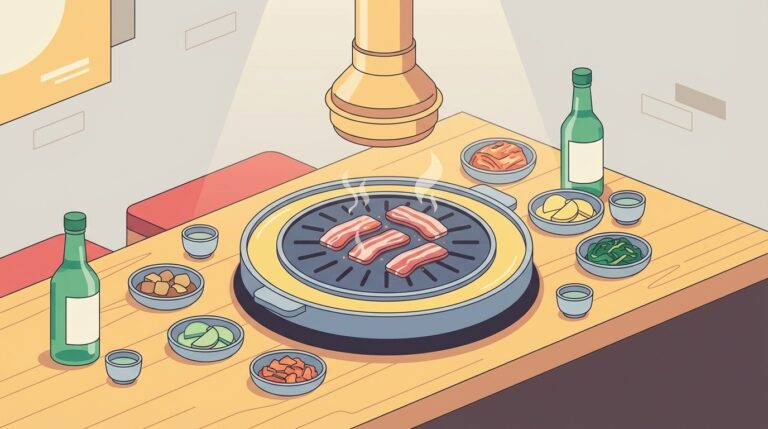
Picture this: It’s Friday, 7 PM. You’re sitting in a smoky, bustling BBQ restaurant in the heart of Gangnam. Sizzling pork belly is on the grill, soju bottles are lining up on the table, and everyone’s face is slightly flushed. Suddenly, your team leader stands up, raises a glass, and shouts something. Everyone cheers. You smile and clink your glass, but deep down, you’re sweating. ‘What did they just say? Am I supposed to say something back? Wait, why is my coworker hiding their face while drinking?’
If you’ve ever watched a Korean office drama like Misaeng (Incomplete Life) or My Liberation Notes, you know exactly what I’m talking about. The legendary Korean company dinner, or Hoesik (회식), is not just a meal. It’s an extension of the workplace, a complex web of unwritten rules, hierarchy, and bonding.
At the B2 level, you already know basic Korean honorifics. But knowing how to conjugate verbs and knowing how to survive a Hoesik without committing a major social faux pas are two completely different things. Today, as your veteran tutor and local Seoulite friend, I’m going to decode the secret language and etiquette of the Korean company dinner. Let’s make you the ultimate insider!
Phase 2: Deep Dive into Core Expressions
1. 오늘 정말 수고 많으셨습니다.
- Pronunciation: o-neul jeong-mal su-go man-eu-syeot-seum-ni-da (The ‘으’ sound in ‘syeot’ is like the disgusted sound you make when you step in gum!)
- Meaning: (Literal) You had a lot of hard work today. vs (Real Nuance) Thank you for your hard work today / Great job everyone.
- K-Culture Moment: This is the ultimate ice-breaker and closing remark. When the team leader raises a glass for the first toast, or when you are wrapping up the night and putting your coats on, this phrase echoes through the restaurant.
- Editor’s Insight: This isn’t just about acknowledging physical labor. It’s a deep cultural expression of empathy and solidarity. You’re saying, ‘I see the effort you put in, and we are in this together.’
- Situation Spectrum:
[🚫 Never] ———— [⚠️ Caution] ———— [✅ Freely]- Close Friends (Casual): ⚠️ (Too formal, use ‘고생했어!’)
- Coworkers (Semi-formal): ✅
- Boss/Elders (Formal): ✅ (Perfect!)
- 🤔 Think About It: Why does Korean have so many expressions acknowledging others’ ‘hard work’ and ‘suffering’ (수고, 고생)? What does this tell you about the Korean view of community and shared burdens?
2. 제가 한잔 올리겠습니다.
- Pronunciation: je-ga han-jan ol-li-get-seum-ni-da
- Meaning: (Literal) I will raise up a glass to you. vs (Real Nuance) Let me pour you a drink.
- K-Culture Moment: You notice your manager’s soju glass is empty. Instead of just saying ‘Drink more,’ you grab the bottle, use this phrase, and pour it with two hands. Instant promotion points!
- Editor’s Insight: You probably learned ‘주다’ (to give) and its honorific ‘드리다’. But in a formal business dinner setting, ‘올리다’ (to lift/offer up) elevates your Korean to a highly sophisticated, polite level. It shows humility.
- Situation Spectrum:
[🚫 Never] ———— [⚠️ Caution] ———— [✅ Freely]- Close Friends (Casual): 🚫 (Too stiff, sounds like a historical drama!)
- Coworkers (Semi-formal): ⚠️ (A bit too formal for peers)
- Boss/Elders (Formal): ✅ (Execellent choice)
3. 집게는 제가 잡겠습니다. / 제가 구울게요.
- Pronunciation: jip-ge-neun je-ga jap-get-seum-ni-da / je-ga gu-ul-ge-yo
- Meaning: (Literal) I will hold the tongs / I will grill. vs (Real Nuance) Don’t worry, I’ll take care of grilling the meat for our table.
- K-Culture Moment: The moment the raw meat arrives, there is a silent battle of Nunchi (reading the room) over who gets the tongs. As the youngest or the junior member (Maknae), claiming the tongs proactively makes you look incredibly reliable.
- Editor’s Insight: Grilling meat in Korea is a service to the table. ‘집게를 잡다’ (holding the tongs) is almost an idiomatic expression for taking charge of the meal’s flow.
- Situation Spectrum:
[🚫 Never] ———— [⚠️ Caution] ———— [✅ Freely]- Close Friends (Casual): ✅
- Coworkers (Semi-formal): ✅
- Boss/Elders (Formal): ✅
Phase 3: Textbook vs Real Life
| Situation | 📖 Textbook Korean | 🗣️ Real Life Korean | 💡 Why the Difference? |
|---|---|---|---|
| Making a Toast | 우리 모두를 위하여 건배합시다! (Let’s toast for all of us!) | 짠! (Jjan!) or 위하여! (Wi-ha-yeo!) | Formal toasts are for VIP speeches. ‘짠’ (the sound of glasses clinking) is the go-to casual cheer. |
| Offering a drink | 술 더 드릴까요? (Shall I give you more alcohol?) | 한잔 더 받으시죠. (Please receive another glass.) | ‘받다’ (receive) shifts the focus to the elder’s action, making it more polite than focusing on your giving. |
| Suggesting moving to another spot | 다른 식당으로 갑시다. (Let’s go to another restaurant.) | 2차 가시죠! (Let’s go to the 2nd round!) | Hoesik is serialized. 1차 (Dinner) -> 2차 (Pub/Karaoke) -> 3차 (Beer/Soup) is a cultural rhythm. |
Bottom Note: For B2 learners, dropping overly rigid textbook grammar for these natural conversational anchors will make you sound remarkably fluent.
Phase 4: Cultural Deep Dive
4-1. Non-verbal Communication: The Art of the Pour
Knowing the words is only 50% of the battle. In a Korean Hoesik, your body language speaks volumes. This is where Nunchi (눈치) comes into play.
– The Two-Hand Rule: Whenever you pour or receive a drink from someone older or higher in rank, always use two hands. (If pouring with your right hand, lightly support your right elbow or forearm with your left hand).
– The Head Turn: When drinking in front of a senior, do not maintain eye contact. Turn your head slightly to the side (usually away from them), cover the glass with your hand, and drink quietly. It’s a sign of ultimate respect.
4-2. K-Culture Connection: The K-Drama Tropes & Reality
If you watch K-Dramas, you’ll often see the protagonist forced to drink until they pass out, only to be piggybacked home by the handsome lead.
– The Reality Check: While heavy drinking used to be the norm in Korean corporate culture, things have changed drastically. Nowadays, forcing someone to drink (술 강요) is considered a major HR violation in modern Korean companies.
– The Strategy: It is perfectly acceptable to say, “제가 술을 잘 못 마십니다” (I can’t drink alcohol well) or fill your soju glass with water. You can still participate in the “Jjan!” (clinking) without drinking the alcohol.
Phase 5: Immersive Roleplay Scenario
Scenario A: The Gangnam Hoesik Test
Setting: A loud, energetic BBQ restaurant near Gangnam Station. The team just wrapped up a major project.
Characters:
– YOU: A foreign employee who wants to make a good impression.
– Min-su (32): Your friendly coworker who sits next to you.
– Team Leader Kim (45): Your boss. Strict, but loves a good team dinner.
Dialogue:
Team Leader Kim: (Raises his glass) 자, 이번 프로젝트 무사히 끝낸 기념으로! 모두 수고 많았습니다! 🍻
(ja, i-beon peu-ro-jek-teu mu-sa-hi kkeut-naen gi-nyeom-eu-ro! mo-du su-go man-at-seum-ni-da!)
[Translation] Alright, to celebrate finishing this project safely! Great job everyone!
Min-su: 부장님도 고생하셨습니다! 짠~
(bu-jang-nim-do go-saeng-ha-syeot-seum-ni-da! jjan~)
[Translation] You worked hard too, boss! Cheers~
(🎭 Stage Direction: Everyone clinks glasses. A few minutes later, Team Leader Kim notices your glass is empty. He picks up the Soju bottle and leans toward you.)
Team Leader Kim: 우리 글로벌 인재, 한잔 받아!
(u-ri geul-lo-beol in-jae, han-jan ba-da!)
[Translation] Our global talent, have a glass!
🔀 Your Turn! How do you respond?
– A) Hold out your glass with one hand and say: “네, 주세요!” (Yes, give me!)
– B) Hold your glass with both hands, bow slightly, and say: “감사합니다. 제가 먼저 올렸어야 하는데요!” (Thank you. I should have offered you one first!)
– C) Cover your glass and say: “아니요, 저 이제 안 마실래요.” (No, I don’t want to drink anymore.)✅ Best Choice: B — You followed the two-hand rule and showed excellent business etiquette by expressing humble regret that you didn’t pour for him first. Team Leader Kim will be incredibly impressed.
⚠️ Choice A Analysis: Grammatically correct, but a major cultural disaster. One-handed receiving from a boss is considered rude.
⚠️ Choice C Analysis: Too blunt. If you want to stop drinking, it’s better to accept the pour but just sip it, or politely excuse yourself by saying “제가 주량이 다 되어서요” (I’ve reached my alcohol limit).
Bonus Scenario: The Empty Glass Trap
What if you see your boss’s glass is empty?
YOU: 부장님, 잔이 비셨네요. 제가 한잔 올리겠습니다.
(bu-jang-nim, jan-i bi-syeot-ne-yo. je-ga han-jan ol-li-get-seum-ni-da.)
[Translation] Boss, your glass is empty. Let me pour you a drink.
(You pour with two hands. The boss smiles in approval.)
Phase 6: 10-Second Shadowing Drill
Let’s practice the rhythm! Pay attention to the pauses (/) and intonation.
😊 밝고 예의 바르게 (Brightly & Politely)
오늘 / 정~~~말 / 수고 많으셨습니다!
(o-neul / jeong~~~mal / su-go man-eu-syeot-seum-ni-da!)
🙇♂️ 겸손하게 (Humbly)
부장님, / 제가 / 한잔 올리겠습니다.
(bu-jang-nim, / je-ga / han-jan ol-li-get-seum-ni-da.)
🏃♂️ 적극적으로 (Proactively)
아, / 집게는 / 제가 잡겠습니다!
(a, / jip-ge-neun / je-ga jap-get-seum-ni-da!)
Phase 7: K-Culture Glossary (Mini Dictionary)
| Korean | Romanization | English | Context |
|---|---|---|---|
| 눈치 | nunchi | Social intelligence | The ability to read the room and anticipate what is needed (e.g., flipping the meat before it burns). |
| 회식 | hoesik | Company dinner | Team building outside of office hours, often involving food and drinks. |
| 막내 | maknae | The youngest/junior | The youngest team member who usually takes on tasks like grilling meat or handing out cutlery. |
| 자작 | jajak | Pouring for oneself | In Korean drinking culture, it is considered sad or slightly rude to pour your own drink. Always pour for others! |
| 1차/2차 | il-cha / i-cha | 1st round / 2nd round | The stages of a night out. 1차 is usually dinner, 2차 is drinks/karaoke. |
Phase 8: Traveler’s Survival Kit
Even if you’re not in Korea for business, you will definitely visit a Korean BBQ restaurant! Here is your essential survival kit for ordering and eating like a local.
🆘 Survival Phrases TOP 3
1. 🇰🇷 “사장님, 여기 불판 좀 갈아주세요!” (sa-jang-nim, yeo-gi bul-pan jom gal-a-ju-se-yo!)
– 🗣️ Meaning: Boss, please change the grill here!
– 📍 Use when: Your meat starts burning because the grill is totally blackened.
2. 🇰🇷 “반찬 좀 더 주실 수 있나요?” (ban-chan jom deo ju-sil su it-na-yo?)
– 🗣️ Meaning: Can we have some more side dishes?
– 📍 Use when: You’ve eaten all the delicious Kimchi and want a free refill.
3. 🇰🇷 “앞치마 하나 주시겠어요?” (ap-chi-ma ha-na ju-si-get-seo-yo?)
– 🗣️ Meaning: Could I get an apron?
– 📍 Use when: You are wearing a nice shirt and don’t want pork grease splashing on it.📌 Editor’s Travel Note
– Call Buttons: Look for the little bell (콜벨) on the table. You don’t need to yell; just press the button!
– Scissors are for Food: Don’t be shocked when the waiter brings out giant metal scissors. In Korea, scissors are the ultimate kitchen tool for cutting meat and noodles!
– Tipping: There is absolutely NO tipping culture in Korea. If you leave money on the table, the waiter might chase you down the street thinking you forgot your change!
Phase 9: Think Deeper — Language & Power
🧠 Think Deeper: The Hierarchy of the Table
The Korean language is deeply tied to social hierarchy, and nowhere is this more visible than at a Hoesik. Notice how vocabulary changes entirely depending on rank: A senior gives (준다) a drink, but a junior offers up (올린다) a drink. The very act of eating and drinking becomes a physical map of respect, age, and corporate rank. While modern Korea is becoming more egalitarian, this linguistic scaffolding remains a core part of social harmony.💬 Your Turn: Does your culture have a “table etiquette” that reflects social hierarchy or respect for elders? Share your thoughts in the comments!
Phase 10: FAQ & Troubleshooting
❌ Common Mistake #1: Pouring your own drink.
✅ Do This Instead: In Korea, pouring your own drink is called Jajak (자작). There’s a playful superstition that if you pour your own drink, you’ll be single for 3 years! Always pour for your neighbor, and let them pour for you.
Q: Is it okay to completely refuse alcohol at a Hoesik?
A: Yes, absolutely! Times have changed. If you don’t drink for religious, health, or personal reasons, simply say: “제가 약을 먹고 있어서 술은 어렵습니다” (I am taking medication, so alcohol is difficult) or “종교적인 이유로 술을 마시지 않습니다” (I don’t drink for religious reasons). It is widely respected now.
Q: I’m not the youngest (Maknae). Do I still have to grill?
A: Not necessarily. Usually, the junior members take care of it. However, if you are a guest or a foreigner, your Korean colleagues will likely try to grill for you as a sign of hospitality. If you jump in and say “제가 해볼게요!” (Let me try!), they will love your enthusiasm.
Phase 11: Wrap-up & Action Items
🎯 One-Liner Summary: Surviving a Korean company dinner isn’t about drinking heavily; it’s about mastering the art of respect (Nunchi), two-handed pouring, and shared hard work (Sugo).
Action Mission:
– 🥉 Bronze (Solo): Stand in front of a mirror, pretend to hold a soju glass with two hands, and say “오늘 정말 수고 많으셨습니다!”
– 🥈 Silver (Online): Leave a comment below with “수고하셨습니다” to thank your fellow Korean learners for studying hard today!
– 🥇 Gold (Real World): Next time you are at a Korean BBQ restaurant (anywhere in the world), try ordering or asking to change the grill in Korean!
🎬 K-Culture Mission:
Find a clip from the drama Misaeng or Itaewon Class on YouTube featuring a team dinner. Spot the moment they clink glasses. Can you see who turns their head away to drink?
Phase 12: Interactive Quiz
Let’s test your Hoesik survival skills!
1. Your boss pours you a glass of Soju. What is the correct way to receive it?
A) Hold the glass with one hand and nod.
B) Hold the glass with two hands and say “감사합니다.”
C) Tell him you’ll pour your own drink.
2. Fill in the blank: The team had a long, exhausting day. As you leave, you should say to your coworkers:
“오늘 정말
[ _________ ] 많으셨습니다!”
3. True or False: In a Korean restaurant, you should leave a 15% tip if the waiter grilled the meat for you.
(Scroll down for answers)
.
.
.
Answers:
1. B (Two hands are mandatory for receiving from a senior! C is Jajak, which is a big no-no.)
2. 수고 (su-go) (Meaning hard work/effort.)
3. False! (There is no tipping culture in Korea. The excellent grilling service is completely free!)
How did you do? Ready for your next Hoesik? 건배! (Cheers!) 🍻
Frequently Asked Questions (FAQ)
Q: What does "오늘 정말 수고 많으셨습니다." mean in Korean and how do you pronounce it?
A: In Korean, "오늘 정말 수고 많으셨습니다." is pronounced [o-neul jeong-mal su-go man-eu-syeot-seum-ni-da (The '으' sound in 'syeot' is like the disgusted sound you make when you step in gum!] and means: (Literal) You had a lot of hard work today. vs (Real Nuance) Thank you for your hard work today / Great job everyone.
Q: What does "제가 한잔 올리겠습니다." mean in Korean and how do you pronounce it?
A: In Korean, "제가 한잔 올리겠습니다." is pronounced [je-ga han-jan ol-li-get-seum-ni-da] and means: (Literal) I will raise up a glass to you. vs (Real Nuance) Let me pour you a drink.
Q: What does "집게는 제가 잡겠습니다. / 제가 구울게요." mean in Korean and how do you pronounce it?
A: In Korean, "집게는 제가 잡겠습니다. / 제가 구울게요." is pronounced [jip-ge-neun je-ga jap-get-seum-ni-da / je-ga gu-ul-ge-yo] and means: (Literal) I will hold the tongs / I will grill. vs (Real Nuance) Don't worry, I'll take care of grilling the meat for our table.







