

How to Survive a Korean Company Dinner: The Ultimate Toasting Guide 🍻
Phase 1: The Immersive Hook
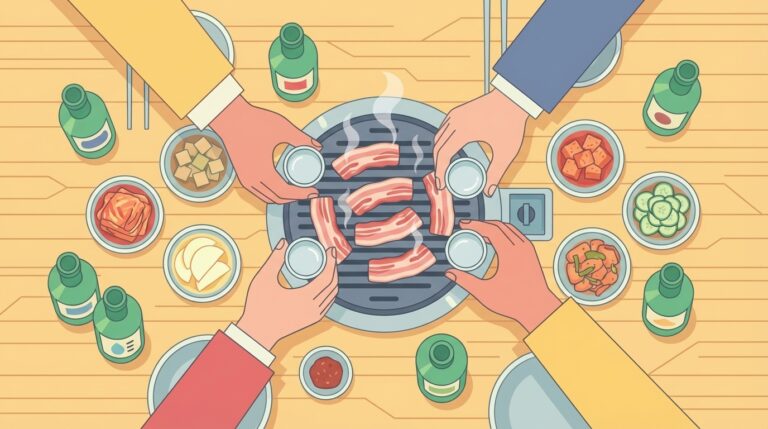
Hello! I’m your Senior Editor at Daily Hangul. Imagine this: You are sitting in a smoky Korean BBQ restaurant. The sizzling sound of pork belly (삼겹살) fills the air. Green bottles of Soju are lined up on the table. You are at your first 회사 생활 – 회식 (Company Dinner). Suddenly, your manager holds up a small glass, looks right at you, and waits for you to say something. Your mind goes blank. The subtitles in your favorite K-Drama usually just say “Cheers,” but is it really that simple?
If you don’t know what to say, you might just awkwardly sip your drink. But if you know the right words, you instantly become an “Insider” (인싸) and win the hearts of your Korean colleagues! This guide is built from the real sweat and tears of my students who survived their first Korean office parties. Let’s dive in!
Phase 2: Deep Dive into Core Expressions
1. 건배!
- Pronunciation: geon-bae [sounds like “gun-bae”]
- Meaning: Literal = Empty the glass / Real nuance = Cheers!
- K-Culture Moment: This is the most standard way to say cheers. You’ve definitely seen characters shout this in K-Dramas before clinking their Soju glasses.
- Editor’s Insight: It’s safe, classic, and polite. It literally means “dry glass,” but don’t worry—you don’t actually have to finish your drink in one gulp!
- Situation Spectrum:
[🚫 절대 금지] ———— [⚠️ 주의] ———— [✅ 자유롭게]- Casual (Friends): ✅
- Semi-formal (Coworkers): ✅
- Formal (Boss/Elders): ✅
- 🤔 Think About It: Why do many Asian cultures use the phrase “empty the glass” (like Ganbei in Chinese or Kanpai in Japanese) for cheers? Does your native language focus on “health” (Salud, Santé) or “the glass” when toasting?
2. 위하여!
- Pronunciation: wi-ha-yeo [sounds like “we-ha-yo”]
- Meaning: Literal = For the sake of! / Real nuance = To us! / For our success!
- K-Culture Moment: At a team dinner, the boss raises a glass and shouts, “For our sales team!” (영업팀을!). The whole table roars back, “위하여!” (Wihayeo!).
- Editor’s Insight: This is the ultimate team-building word. It sounds a bit grand, so we don’t use it with just one friend at a cafe. It’s strictly for group dinners and celebrations.
- Situation Spectrum:
[🚫 절대 금지] ———— [⚠️ 주의] ———— [✅ 자유롭게]- Casual (Friends): ⚠️ (A bit too serious for just friends)
- Semi-formal (Coworkers): ✅
- Formal (Boss/Elders): ✅
- 🤔 Think About It: Koreans value “Woori” (우리 – We/Our) over “I” (나 – Me). How does shouting “Wihayeo!” together strengthen this community spirit?
3. 수고하셨습니다!
- Pronunciation: su-go-ha-syeot-seum-ni-da [sounds like “soo-go-ha-shot-sum-nee-da”]
- Meaning: Literal = You put in hard work / Real nuance = Great job today, thank you for your hard work!
- K-Culture Moment: After a long, stressful project, your team goes out for Chimaek (Chicken and Beer). Before drinking, everyone says this to acknowledge the collective suffering and effort.
- Editor’s Insight: This isn’t exactly “Cheers,” but it is the most common phrase said while raising a glass after work. It shows deep empathy and respect.
- Situation Spectrum:
[🚫 절대 금지] ———— [⚠️ 주의] ———— [✅ 자유롭게]- Casual (Friends): ✅
- Semi-formal (Coworkers): ✅
- Formal (Boss/Elders): ✅
- 🤔 Think About It: Korean has many expressions acknowledging someone’s effort and fatigue. What does this tell us about the Korean work ethic?
Phase 3: Textbook vs Real Life
| Situation | 📖 Textbook Korean | 🗣️ Real Korean | 💡 Why the difference? |
|---|---|---|---|
| Casual Cheers | 건배합시다. (Let’s toast) | 짠! (Jjan!) | “Jjan” mimics the sound of glasses clinking. It’s cute, fast, and very popular among younger generations! |
| Proposing a Toast | 건배 제의를 하겠습니다. | 한 말씀 하시죠! (Please say a few words!) | In real life, people naturally prompt the boss or the guest of honor to speak first before drinking. |
| When drinking | 술을 마십니다. | 원샷! (One shot!) | Konglish (Korean-English) is everywhere in drinking culture. It means “Bottoms up!” |
Bottom Note: For A2 learners, using “건배” (Geonbae) is perfectly fine. Save “짠” (Jjan) for your close friends or fellow K-Pop fans!
Phase 4: Cultural Deep Dive
4-1. Non-verbal Communication: The “Nunchi” of Drinking
In Korea, language is only half the battle. When clinking glasses with someone older or higher in rank (like your boss), your glass should touch below the rim of their glass. It’s a physical display of respect! Also, when you drink, turn your head slightly away from the senior person.
4-2. K-Culture Connection: The “Maknae” Trope in K-Dramas
Have you noticed in K-Dramas that the youngest person in the office (the 막내 – Maknae) is always the one grilling the meat, distributing the napkins, and pouring the drinks? This is a classic Hoesik trope! While modern Korean companies are changing to be more equal, the tradition of pouring drinks for each other (never for yourself!) is still very much alive. Pouring your own drink is said to bring bad luck!
Phase 5: Immersive Roleplay Scenario
Setting: Friday, 7:00 PM. A lively BBQ restaurant near Gangnam Station. The table is covered in side dishes, and the Soju glasses are ready. You are sitting with your Korean team on your 3rd day of a business trip.
Characters:
– YOU: The eager foreign employee wanting to make a good impression.
– Manager Kim (50s): Your boss. Strict at work, but loves a good dinner party.
– Min-su (32): Your friendly Korean coworker who speaks a little English.
(Dialogue)
Manager Kim: 자, 다들 잔 채우세요! 🥩
(Ja, dadeul jan chaeuseyo!)
(English: Alright, everyone fill your glasses!)
(🎭 Stage Direction: The sizzling sound of pork belly fills the air. Manager Kim holds up his glass.)
Min-su: 네, 부장님! 신입사원 환영회니까 한 말씀 하시죠!
(Ne, bujangnim! Sinipsawon hwanyeonghoenikka han malsseum hasijyo!)
(English: Yes, boss! It’s a welcome party for the new employee, so please say a few words!)
Manager Kim: 에이, 내가 무슨. 우리 막내가 건배 제의 한번 해봐!
(Ei, naega museun. Uri maknaega geonbae jeui hanbeon haebwa!)
(English: Ah, what do you mean. Let our newest member propose a toast!)
(🎭 Stage Direction: Everyone looks at YOU. Panic sets in.)
You: 네? 제가요?
(Ne? Jaegayo?)
(English: Excuse me? Me?)
Min-su: (Whispering) Just say something short and shout the team cheer!
You: 아… 네! 오늘 정말 감사합니다.
(A… ne! Oneul jeongmal gamsahamnida.)
(English: Ah… yes! Thank you so much for today.)
You: 우리 팀을…
(Uri timeul…)
(English: For our team…)
🔀 Decision Point! How do you finish the toast?
– A) “건배!” (Geonbae!)
– B) “위하여!” (Wihayeo!)
– C) “짠~!” (Jjan~!)✅ Best Choice: B — “Wihayeo!” is the perfect choice here. It shows you understand Korean corporate team-building culture.
⚠️ Choice C Analysis: “Jjan!” is way too cute and casual to say to Manager Kim. He might laugh, but it’s a bit risky for a newcomer!
Manager Kim: 오~ 한국 회식 문화를 잘 아는데?
(O~ hanguk hoesik munhwareul jal aneunde?)
(English: Oh~ you know Korean company dinner culture well!)
You: 드라마에서 배웠습니다!
(Deuramaeseo baewotseumnida!)
(English: I learned it from dramas!)
Min-su: 하하! 자, 다 같이! 위하여!
(Haha! Ja, da gachi! Wihayeo!)
(English: Haha! Alright, all together! Wihayeo!)
Phase 6: 10-Second Shadowing Drill
Read this out loud and practice the rhythm! Pay attention to the pauses (/).
😤 단호하고 힘차게 (Firmly and energetically):
우리 팀을 / 위. 하. 여!
(uri timeul / wi. ha. yeo!)
😊 감사하는 마음으로 (With gratitude):
오늘 하루도 / 수고하셨습니다!
(oneul harudo / su-go-ha-syeot-seum-ni-da!)
Phase 7: K-Culture Glossary
| 한국어 | Romanization | English | Context |
|---|---|---|---|
| 회식 | hoesik | Company Dinner | A core part of Korean working culture. Eating and drinking with coworkers. |
| 눈치 | nunchi | Social Awareness | The ability to read the room. Knowing when to pour a drink requires good nunchi. |
| 막내 | maknae | The Youngest | The youngest person in a group, family, or K-Pop band. Often has minor chores at dinner. |
| 짠 | jjan | Cheers (Casual) | The sound of glasses clinking. Used only with friends. |
| 소맥 | somac | Soju + Beer | A popular cocktail made by mixing Soju and Macju (Beer). |
Phase 8: Traveler’s Survival Kit
Even if you aren’t on a business trip, you will definitely visit a Korean restaurant or pub (Pocha) during your travels!
🆘 Survival Phrases for Korean Restaurants
– 🇰🇷 “여기요!” (Yeogiyo!)
– 🗣️ Pronunciation: [yuh-gee-yo]
– 📍 Where to use: Any restaurant or bar.
– 💡 Meaning: “Over here!” Use this loudly to call the waiter. It’s not rude in Korea; it’s necessary!
- 🇰🇷 “소주 한 병 주세요.” (Soju han byeong juseyo.)
- 🗣️ Pronunciation: [so-ju han byung joo-se-yo]
- 📍 Where to use: Ordering drinks.
- 💡 Meaning: “Please give me one bottle of Soju.”
📌 Editor’s Travel Note
– Call Buttons: Most Korean tables have a small bell (콜벨) on the table. Just press it instead of shouting!
– Tipping: There is absolutely NO tipping in Korea. If you leave money on the table, the waiter might chase you down the street to return it!
– ID Check: Bring your physical passport. Many pubs in Hongdae or Itaewon are very strict about checking IDs, even if you look older!
Phase 9: Think Deeper — Language & Power
🧠 Think Deeper:
In Korean culture, the way you hold a glass speaks volumes about social hierarchy. Pouring with two hands, clinking your glass slightly lower than your boss’s, and turning your head to drink—these aren’t just drinking habits. They are physical manifestations of the Korean language’s “Honorific” (높임말) system. Just as you change your verbs to show respect, you change your body language. It’s a beautiful, intricate dance of mutual respect.
💬 Your Turn: Does your culture have specific rules about drinking or eating with elders? Share your experiences in the comments!
Phase 10: FAQ & Troubleshooting
- Q: Do I HAVE to drink alcohol at a Hoesik?
- A: No! While K-Dramas show everyone getting drunk, modern Korean companies are very respectful of personal choices. You can fill your Soju glass with water or Sprite (사이다) and still yell “Geonbae!”
- Q: Can I pour my own drink?
- A: It’s a cultural superstition that pouring your own drink makes you stay single for 3 years! Always pour for others, and let them pour for you.
- Q: Is it okay to say “짠” (Jjan) to my boss if I want to be friendly?
- A: Maybe… but usually No. Unless your boss is very young and specifically tells you to treat them like a friend, stick to “건배” or “위하여”.
❌ Common Mistake #1: Clinking your glass higher than the boss’s glass.
✅ How to fix: Always aim for the middle or bottom of the senior person’s glass to show humility.
Phase 11: Wrap-up & Action Missions
One-Liner Summary: To survive a Korean company dinner, master the team spirit of “Wihayeo” and always pour drinks with two hands!
Take Action Now!
– 🥉 Bronze: Stand in front of a mirror with a cup and practice saying “수고하셨습니다!” (Sugohasyeotseumnida) while holding it with two hands.
– 🥈 Silver: Leave a comment below using the word “건배” (Geonbae) in a sentence!
– 🥇 Gold: Next time you eat at a Korean restaurant, raise your water cup with your friends and confidently shout “짠!” (Jjan!).
K-Culture Mission: Watch an episode of a Korean drama tonight. Spot a Hoesik scene and see if you can catch them saying “건배” or turning their heads to drink!
Phase 12: Interactive Quiz
1. You are drinking beer with your best friend who is the same age as you. What is the most natural thing to say?
– A) 건배 제의를 하겠습니다.
– B) 짠!
– C) 수고하셨습니다.
💡 Click to see the answer
Answer: B. It’s cute, casual, and perfect for close friends!
2. True or False: In a Korean restaurant, you should leave a 15% tip for good service.
💡 Click to see the answer
Answer: False! Tipping does not exist in Korea and can cause confusion.
3. Fill in the blank: To show respect, you should hold the bottle with _____ when pouring a drink for your boss.
💡 Click to see the answer
Answer: Two hands. Using one hand is considered rude to elders or superiors.
(Did you get them all right? Let me know your score in the comments!)
Frequently Asked Questions (FAQ)
Q: What does "건배!" mean in Korean and how do you pronounce it?
A: In Korean, "건배!" is pronounced [geon-bae [sounds like "gun-bae"] and means: Literal = Empty the glass / Real nuance = Cheers!
Q: What does "위하여!" mean in Korean and how do you pronounce it?
A: In Korean, "위하여!" is pronounced [wi-ha-yeo [sounds like "we-ha-yo"] and means: Literal = For the sake of! / Real nuance = To us! / For our success!
Q: What does "수고하셨습니다!" mean in Korean and how do you pronounce it?
A: In Korean, "수고하셨습니다!" is pronounced [su-go-ha-syeot-seum-ni-da [sounds like "soo-go-ha-shot-sum-nee-da"] and means: Literal = You put in hard work / Real nuance = Great job today, thank you for your hard work!







