

안녕하세요! 매일한글(Daily Hangul) 에디터입니다.
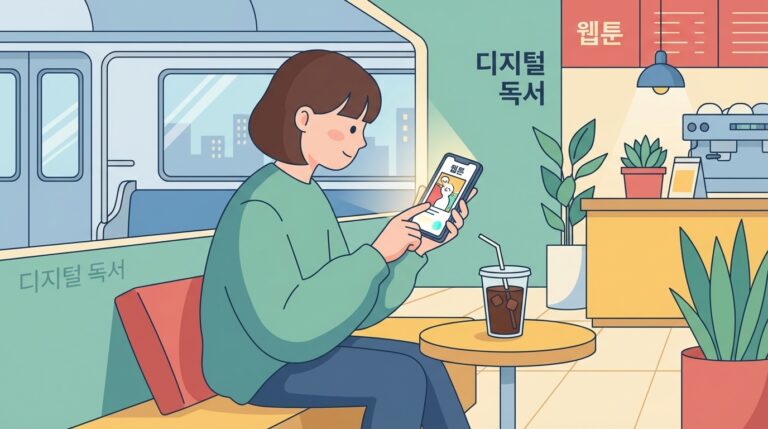
Imagine this: You are riding the Seoul Subway Line 2 during rush hour. It’s quiet, but the atmosphere is intense. You look around, and almost everyone is staring at their smartphones, their thumbs scrolling down at lightning speed. Are they reading the news? Scrolling Instagram?
Look closer. You’ll see endless lines of vertical text. Welcome to the massive world of Korean E-books (전자책) and Web Novels (웹소설)!
In Korea, reading isn’t just something you do in a quiet library (도서관) or a massive Kyobo Bookstore (교보문고). Thanks to the Pali-pali (hurry up) culture and incredibly fast internet, reading has become digital, fast-paced, and mobile.
If you only know how to say “책을 읽어요” (I read a book), you’re missing out on a huge part of modern Korean culture. Today, let’s upgrade your vocabulary so you can talk about your favorite e-books and webtoons like a true local!
Phase 2: Core Expressions Deep Dive 🕵️♀️
Let’s look at the 3 most essential phrases you need when talking about digital reading in Korea.
1. 전자책으로 봐요 (I read it as an e-book)
- Pronunciation: jeonjachaeg-euro bwayo (jeon-ja-chaeg sounds like “John-ja-check”)
- Meaning: I read e-books. / I read it on my device.
- K-Culture Moment: You’re at a cafe with a friend, and they notice you aren’t carrying a heavy bag today. You tap your iPad and say, “요즘은 전자책으로 봐요.” (These days, I read e-books.)
- Editor’s Insight: Notice we use 봐요 (see/watch) instead of 읽어요 (read) here? In casual Korean, people often say “책을 보다” (to see a book) just as much as “책을 읽다” (to read a book), especially when looking at screens!
- Situation Spectrum:
[🚫 절대 금지] ———— [⚠️ 주의] ———— [✅ 자유롭게]
- Friends (Casual): ✅
- Coworkers (Semi-formal): ✅
- Boss/Elders (Formal): ✅ (Just make sure to use -요!)
- 🤔 Think About It: “전자” means “electronic” (like Samsung Electronics – 삼성전자). Why do you think Koreans prefer reading on screens rather than carrying physical books during their daily commute?
2. 주말에 정주행했어요 (I binge-read/watched it over the weekend)
- Pronunciation: jumal-e jeongjuhaenghaess-eoyo (jeong-ju-haeng sounds like “jung-joo-hang”)
- Meaning: Literal: “Driving straight ahead.” Real nuance: Binge-watching or Binge-reading a series from start to finish.
- K-Culture Moment: You know those hit K-Dramas like Marry My Husband or Moving? They all started as web novels or webtoons! When a drama gets famous, fans flock to the e-book platforms to 정주행 the original story.
- Editor’s Insight: This is an absolute Insider (인싸) word. If you use this, Koreans will be so impressed. It perfectly captures the obsessive joy of not sleeping until you finish the final chapter.
- Situation Spectrum:
[🚫 절대 금지] ———— [⚠️ 주의] ———— [✅ 자유롭게]
- Friends (Casual): ✅
- Coworkers (Semi-formal): ✅
- Boss/Elders (Formal): ⚠️ (It’s a slangy term, so avoid using it in a formal presentation, but fine for small talk!)
3. 구독 취소하는 걸 깜빡했어요 (I forgot to cancel my subscription)
- Pronunciation: gudok chwisohaneun geol kkamppakhaess-eoyo.
- Meaning: I forgot to cancel my subscription.
- K-Culture Moment: Korea has massive e-book subscription apps like Millie’s Library (밀리의 서재) or Ridi (리디). Sometimes, they offer a “First month free” deal, and… well, we all know what happens next.
- Editor’s Insight: 구독 (Subscription) is a magic word. You use it for YouTube channels, Netflix, and e-book libraries!
Phase 3: Textbook vs Real Korean 📖
| Situation | 📖 Textbook Korean | 🗣️ Real Life Korean | 💡 Why the difference? |
|---|---|---|---|
| How do you read? | 저는 인터넷으로 책을 읽습니다. (I read books on the internet.) | 전 폰으로 웹소설 봐요. (I read web novels on my phone.) | Koreans specify the device (폰) and the exact medium (웹소설) casually. |
| Reading a lot at once | 책을 많이 읽었어요. (I read a lot of books.) | 밤새 정주행했어요. (I stayed up all night binge-reading.) | Slang (정주행) captures the emotional intensity of K-Culture consumption! |
| Asking about platforms | 도서관에서 책을 빌립니까? (Do you borrow books from the library?) | 밀리(밀리의 서재) 구독해요? (Do you subscribe to Millie?) | Digital “libraries” (subscription apps) have largely replaced physical library visits for busy workers. |
Phase 4: Cultural Deep Dive — The K-Culture Connection 🇰🇷
4-1. The “Thumb Scroll” Culture
If you watch someone reading an e-book or webtoon on the Seoul subway, you’ll notice they rarely “flip” pages by swiping left or right. Instead, they scroll down. Korean web platforms invented the “vertical scrolling” format specifically optimized for smartphones. It’s fast, seamless, and perfectly matches the quick pace of Korean life.
4-2. Web Novels to K-Dramas
Have you noticed how many K-Dramas feature characters waking up inside a novel or traveling back in time? This is a massive trope in Korean web novels! When you tell a Korean friend you are reading a fantasy e-book, they might ask, “회빙환이에요?” (Is it Reincarnation, Possession, or Return?). Learning e-book vocabulary connects you directly to the root of modern K-Dramas!
Phase 5: Immersive Roleplay 🎭
Scenario A: The Cafe Encounter
Setting: A trendy cafe in Yeonnam-dong on a Saturday afternoon. You are sipping an iced Americano and reading a heavy, 500-page Korean textbook. Your Korean friend, Min-ji, sits down across from you.
Min-ji: 와, 그 책 진짜 무거워 보이네요! 안 무거워요? 😲
(wa, geu chaek jinjja mugeowo boineyo! an mugeowoyo?)
[Wow, that book looks really heavy! Isn’t it heavy?]
(🎭 Stage Direction: Min-ji points at your massive book with wide eyes.)
YOU: 네, 조금 무겁긴 해요. 한국어 공부하려고 샀어요.
(ne, jogeum mugeopgin haeyo. hangugeo gongbuharyeogo sasseoyo.)
[Yeah, it’s a bit heavy. I bought it to study Korean.]
Min-ji: 에이, 요즘 누가 그렇게 무거운 걸 들고 다녀요! 차라리 전자책으로 보지.
(ei, yojeum nuga geureoke mugeoun geol deulgo danyeoyo! charari jeonjachaeg-euro boji.)
[Hey, who carries such heavy things these days! You should just read e-books instead.]
🔀 Your Turn! How will you respond?
– A) “전자책은 어떻게 사요?” (How do I buy e-books?)
– B) “오, 앱 추천해 줄 수 있어요?” (Oh, can you recommend an app?)
– C) “저는 종이책 감성이 더 좋아요.” (I prefer the vibe of paper books.)✅ Best Choice: It depends on your style, but B and C are incredibly natural!
If you choose C (종이책 감성 – paper book aesthetic), Min-ji will nod in deep respect. Koreans love the word “감성” (vibe/aesthetic).
Scenario B: Bonus – The Subway Wi-Fi
Setting: You just got on the KTX train to Busan. You want to download a new e-book chapter, but your data is slow.
YOU: 저기요, 혹시 KTX 와이파이 잘 터져요?
(jeogiyo, hoksi KTX waipai jal teojyeoyo?)
[Excuse me, does the KTX Wi-Fi work well?]
Stranger: 아, 터널 지날 때는 좀 끊겨요. 미리 다운받아 놓으시는 게 좋아요.
(a, teoneol jinal ttaeneun jom kkeunkyeoyo. miri daunbada noeusineun ge joayo.)
[Ah, it disconnects a bit when going through tunnels. It’s better to download it in advance.]
Phase 6: 10-Second Shadowing Drill 🗣️
Practice this sentence until it flows naturally. Pay attention to the pauses (/)!
😊 저는 / 요즘 / 한국 웹소설을 / 정~~~말 / 많이 읽어요!
(jeo-neun / yojeum / hanguk wepsosoreul / jeong~~~mal / mani ilgeoyo!)
I read a LOT of Korean web novels these days!
(Tip: Stretch out the “정~~~말” to sound extra enthusiastic!)
Phase 7: K-Culture Mini Glossary 📚
| 한국어 | Romanization | English | Cultural Context |
|---|---|---|---|
| 전자책 | jeonjachaek | E-book | Electronic books. Usually read on apps rather than dedicated e-readers in Korea. |
| 웹툰/웹소설 | weptun/wepsosol | Webtoon/Web novel | Serialized digital comics and novels. The backbone of modern Korean pop culture. |
| 정주행 | jeongjuhaeng | Binge-reading/watching | To consume a whole series non-stop. |
| 종이책 | jong-ichaek | Paper book | Traditional physical books. Often bought at massive stores like Kyobo Bookstore. |
| 스포 금지 | supo geumji | No Spoilers | “Spo” is short for spoiler. Crucial when discussing ongoing e-book series! |
Phase 8: Traveler’s Survival Kit 🧳
If you love reading and are traveling to Korea, you must visit a local bookstore or use the public transport Wi-Fi to download your books!
🆘 Survival Phrases for Book Lovers
– 🇰🇷 “이거 전자책으로도 나왔나요?” (igeo jeonjachaeg-eurodo nawatnayo?)
– 🗣️ Meaning: Is this available as an e-book as well?
– 📍 Where to use: At Kyobo, YP Books (영풍문고), or Aladdin Used Bookstore (알라딘 중고서점).
– 💡 Pro Tip: If you want a quiet place to read your e-books, look for a ‘북카페’ (Book Cafe). They are everywhere in areas like Hapjeong and Mangwon in Seoul!📌 Editor’s Travel Note
– Free Wi-Fi: Korean buses and subways have excellent free Wi-Fi (Public WiFi Free). Perfect for downloading a massive e-book file on the go!
– Library Apps: Did you know many Korean local libraries offer free e-book borrowing if you have a resident card? If you live in Korea, it’s a game-changer.
Phase 9: Think Deeper — “한 발 더 깊이” 🧠
Media vs Reality: The Fast-Paced Reading Culture
Have you ever wondered why bite-sized “web novels” and “webtoons” exploded in Korea, rather than traditional, lengthy e-books like on the Kindle? It deeply reflects Korea’s Pali-pali (hurry up) culture and the reality of city life. The average subway commute in Seoul is about 40 minutes. Web novels are specifically written in short, punchy chapters that take exactly 5 to 10 minutes to read. It’s literature perfectly engineered for the modern commuter’s lifestyle.
💬 Your Turn: How do people consume books in your country? Do people prefer physical books, Kindles, or reading on their smartphones? Let me know in the comments!
Phase 10: FAQ & Troubleshooting 🛠️
Q: Can I use “정주행 (binge-watch/read)” with my boss?
A: ⚠️ Maybe. It’s slightly slangy. If you have a chill relationship with your boss, it’s fine! But in a formal interview, say “한 번에 다 읽었습니다” (I read it all at once) instead.
Q: Do I need a Korean ID to buy e-books on Korean platforms?
A: Yes and no. For general books, you can usually sign up with an email. However, for 19+ (mature) content or specific web novels, platforms like Ridibooks require age verification using a Korean phone number.
❌ Common Mistake: Confusing 서점 (Bookstore, where you buy books) and 도서관 (Library, where you borrow books).
✅ How to fix: E-book platforms blur this line! Millie’s Library is literally “밀리의 서재” (Millie’s Study Room/Library), but you pay a subscription fee. When in doubt, just say “앱” (App)!
Phase 11: Wrap-up & Action Items 🎯
One-Liner Summary: To survive the Korean digital reading wave, remember that e-books are “전자책,” and binge-reading is “정주행!”
Your Action Missions:
– 🥉 Bronze (Solo): Stand in front of a mirror and say, “요즘 전자책으로 정주행하고 있어요!” 3 times.
– 🥈 Silver (Online): Go to Webtoon or an e-book app and read the title of 3 Korean books out loud.
– 🥇 Gold (Real Life): Next time you see a Korean friend, ask them: “요즘 재밌는 웹소설이나 전자책 있어요? 추천해 주세요!” (Are there any fun web novels or e-books these days? Recommend me some!)
K-Culture Mission: Download the Naver Webtoon app (or WEBTOON in English). Find a series that was turned into a K-Drama (like True Beauty or Sweet Home) and read the first chapter. Imagine the “정주행” feeling!
Phase 12: Interactive Quiz 📝
Let’s test what you’ve learned!
1. You stayed up until 3 AM reading a Korean romance web novel on your phone. How do you describe this to your friend?
A) 저 어제 도서관에 갔어요.
B) 저 어제 웹소설 정주행했어요.
C) 저 어제 종이책을 샀어요.
2. True or False: Koreans only read physical books on the subway.
– (T / F)
3. Fill in the blank:
“무거운 책 대신 가벼운 ( _________ )을/를 읽어요.”
(Instead of a heavy book, I read a light _________.)
(Check your answers in the comments below! Don’t forget to tell us your favorite book!)
Frequently Asked Questions (FAQ)
Q: What does "전자책으로 봐요 (I read it as an e-book)" mean in Korean and how do you pronounce it?
A: In Korean, "전자책으로 봐요 (I read it as an e-book)" is pronounced [jeonjachaeg-euro bwayo (jeon-ja-chaeg sounds like "John-ja-check"] and means: I read e-books. / I read it on my device.
Q: What does "주말에 정주행했어요 (I binge-read/watched it over the weekend)" mean in Korean and how do you pronounce it?
A: In Korean, "주말에 정주행했어요 (I binge-read/watched it over the weekend)" is pronounced [jumal-e jeongjuhaenghaess-eoyo (jeong-ju-haeng sounds like "jung-joo-hang"] and means: Literal: "Driving straight ahead." Real nuance: Binge-watching or Binge-reading a series from start to finish.
Q: What does "구독 취소하는 걸 깜빡했어요 (I forgot to cancel my subscription)" mean in Korean and how do you pronounce it?
A: In Korean, "구독 취소하는 걸 깜빡했어요 (I forgot to cancel my subscription)" is pronounced [gudok chwisohaneun geol kkamppakhaess-eoyo.] and means: I forgot to cancel my subscription.







