

Hello! Daily Hangul Editor here.
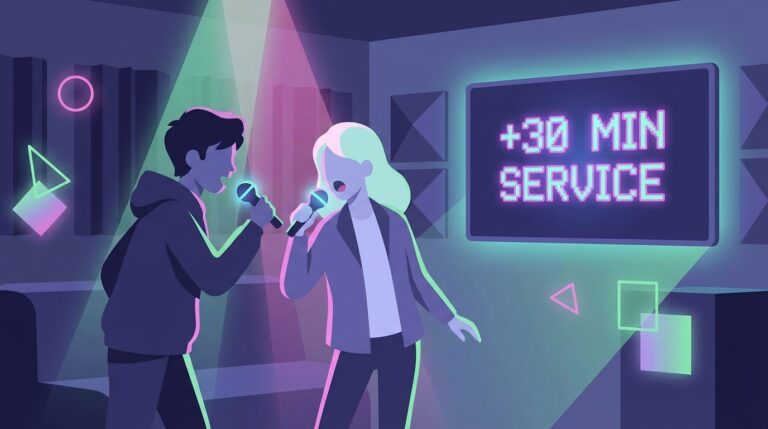
Picture this: It’s 11 PM on a Friday night in Hongdae. You and your friends have been singing K-Pop anthems at the top of your lungs in a neon-lit Noraebang (노래방 – karaoke room). You’re sweating, the vibe is electric, and you’re just about to queue up your favorite BTS song… but then, you look at the screen. The timer is aggressively blinking: 01:00. You only have one minute left!
In K-Dramas like Hospital Playlist, this is the exact moment the characters somehow magically get an extra 30 minutes on the clock without paying a dime. How do they do it? Is it TV magic?
Nope! It’s the beautiful Korean cultural concept of ‘Service’ (서비스). If you know exactly what to say (and how to say it), you won’t have to pack up your tambourines just yet. Today, I’m going to teach you the insider secrets to keeping the music going, completely based on real experiences from my students who successfully scored extra time!
Phase 2: Deep Dive into Key Expressions
Let’s look at the magical phrases that will get you that sweet, sweet extra time.
1. 사장님, 서비스 조금만 더 주시면 안 될까요?
- Pronunciation: [sajangnim, seobiseu jogeumman deo jusimyeon an doelkkayo?] / [sah-jahng-neem, suh-bee-seu jo-geum-mahn duh joo-shee-myun ahn dwel-kka-yo?]
- Meaning: Boss, couldn’t you give us just a little bit more service (extra time)?
- K-Culture Moment: You run out to the front counter. The owner is wiping down glasses. You use your most polite, slightly pleading voice. It’s the ultimate ‘please’ phrase used in university neighborhoods.
- Editor’s Insight: The word 서비스 (Service) in Konglish does NOT mean ‘customer service’ (like a waiter’s attitude). It means ‘on the house’ or ‘freebie’. By asking for it this way, you’re politely appealing to the owner’s generosity rather than demanding it.
- Situation Spectrum:
[🚫 Do Not Use] ———— [⚠️ Caution] ———— [✅ Freely Use]
- To a Noraebang Owner: ✅
- To a High-end Restaurant Staff: 🚫 (They don’t do ‘service’ like this!)
- 🤔 Think About It: Notice the negative framing at the end: “~안 될까요?” (Couldn’t you?). Why do Koreans ask “Could you NOT?” instead of “Can you?” It’s a way of showing humility, giving the listener an easy way to say no without losing face.
2. 시간 조금만 더 넣어주세요~
- Pronunciation: [sigan jogeumman deo neoeojuseyo~] / [shee-gahn jo-geum-mahn duh nuh-uh-joo-seh-yo~]
- Meaning: Please put in a little more time~
- K-Culture Moment: The timer hits zero. You open the door, pop your head out, make eye contact with the staff, and say this with a bright smile.
- Editor’s Insight: The verb 넣다 (to put in) is used because the owner physically ‘puts’ time into the computer system. Adding the tilde (~) at the end implies you should elongate the sound to sound friendly and approachable—a hint of Aegyo (애교)!
- Situation Spectrum:
[🚫 Do Not Use] ———— [⚠️ Caution] ———— [✅ Freely Use]
- To the staff at a typical Noraebang: ✅
- To your Boss at work: 🚫 (Totally irrelevant!)
3. 와, 서비스 대박! 감사합니다!
- Pronunciation: [wa, seobiseu daebak! gamsahamnida!] / [wah, suh-bee-seu dae-bahk! gahm-sah-hahm-nee-dah!]
- Meaning: Wow, the service is awesome! Thank you!
- K-Culture Moment: You didn’t even ask, but suddenly the
00:00on the screen jumps back to30:00. Your group cheers, and you shout this toward the door so the owner can hear your appreciation.- Editor’s Insight: Acknowledging the freebie loudly and cheerfully almost guarantees you’ll get even more time later. Koreans love enthusiastic reactions (리액션)!
Phase 3: Textbook vs Real Life
How do textbooks teach this vs. how we actually speak in Hongdae or Gangnam?
| Situation | 📖 Textbook Korean | 🗣️ Real Korean | 💡 Why is it different? |
|---|---|---|---|
| Asking for extra time | 추가 시간을 받을 수 있습니까? (Can I receive additional time?) | 사장님~ 저희 서비스 좀만 더 주세요! (Boss~ give us a little more service!) | Textbook Korean sounds like a robot negotiating a contract. Real Korean relies on ‘Jeong’ (emotional connection) and friendly persuasion. |
| Reacting to free time | 무료 시간을 주셔서 감사합니다. (Thank you for giving me free time.) | 헐, 서비스 대박! 사장님 최고! (Heol, service is amazing! Boss is the best!) | Emotional expressions (대박, 최고) build rapport much faster than formal gratitude. |
| When you’re out of time | 시간이 다 끝났습니다. (The time has all ended.) | 아, 1분 남았다! (Ah, 1 minute left!) | We focus on what’s remaining to build urgency! |
Phase 4: Cultural Deep Dive
4-1. Non-verbal Communication: The Art of ‘Nunchi’ & ‘Aegyo’
Language is only 20% of the battle here. When asking for service, your body language matters immensely.
* Eye Contact: Don’t stare aggressively. Look at the owner with a soft, hopeful gaze.
* The ‘Aegyo’ Tone: You don’t need to act like a toddler, but lifting the pitch of your voice at the end of the sentence (~주세요~) makes a huge difference. If you sound like a grumpy military general, no free time for you!
* Nunchi (눈치): Read the room! If there is a huge line of people waiting outside the Noraebang on a Saturday night, the owner cannot give you free time because they need to sell the room. Don’t ask for service when the place is packed.
4-2. K-Culture Connection: The Concept of ‘Jeong’ (정)
Why do Noraebang owners give away free time? It all comes down to Jeong (정)—the Korean concept of affection, connection, and community warmth. When you are having a blast, treating their establishment with respect, and bringing good energy, the owner feels a connection to you.
Giving ‘service’ is their way of saying, “I see you having fun, and I want you to keep enjoying yourselves in my place.” It’s not a transaction; it’s a gift. You’ll see this in K-Dramas where a Pojangmacha (street tent) owner slips an extra egg roll onto the main character’s plate just because they look tired. It’s all the same cultural heartbeat!
Phase 5: Immersive Roleplay
Scenario A: The Midnight Noraebang Crisis
Setting: It’s 11:55 PM at a Coin Noraebang (코인 노래방) in Sinchon. You and your Korean friend, Minsu (28, energetic, loves singing high notes), are mid-song. Suddenly, the screen flashes 1 MINUTE LEFT.
Minsoo: 아, 벌써 끝났어? 우리 한 곡 더 불러야 되는데!
(Ah, beolsseo kkeunnasseo? Uri han gok deo bulleoya doeneunde!)
(Ah, is it already over? We need to sing one more song!)
(🎭 Stage Direction: Minsu looks at you with sad eyes, holding the tambourine lifelessly.)
YOU: 내가 카운터 가서 물어볼게!
(Naega kaunteo gaseo mureobolge!)
(I’ll go to the counter and ask!)
(🎭 Stage Direction: You walk out to the front desk. The owner is an older, friendly-looking man (사장님).)
🔀 Your Turn! How will you ask the owner?
– A) “저기요. 무료 시간 주십시오.” (Excuse me. Give me free time.)
– B) “사장님~ 저희 진짜 재밌게 놀고 있는데, 서비스 조금만 더 주시면 안 될까요?”
– C) “아저씨! 서비스 대박!”✅ Best Choice: B — You acknowledge you’re having fun and politely ask using the indirect “안 될까요?” format.
⚠️ Choice A Analysis: Sounds like a robot demanding a refund. The owner might get offended!
⚠️ Choice C Analysis: You use this after you get the service, not to ask for it. Also, calling him ‘아저씨’ (Ajussi) can sometimes sound less respectful than ‘사장님’ (Sajangnim/Boss).
Scenario B: The Post-Noraebang Late Night Snack
Setting: After successfully singing for another 30 minutes, you head to a Tteokbokki stand.
Owner (Auntie): 떡볶이 1인분 나왔습니다~ (Here is one portion of Tteokbokki~)
YOU: 우와, 맛있겠다! 이모님, 혹시 오뎅 국물 조금만 서비스로 주시면 안 될까요? (Wow, looks delicious! Auntie, by any chance, couldn’t you give us a little fish cake broth as service?)
Owner (Auntie): 아이고, 한국말 잘하네! 많이 먹어~ (Oh my, you speak Korean well! Eat a lot~)
(🎭 Stage Direction: She hands you a warm cup of broth for free!)
Phase 6: 10-Second Shadowing Drill
Let’s practice the flow. Pay attention to the pauses (/) and the emotion tags!
🥺 사장님~ / 저희 / 서비스 조금만 더 주시면 / 안 될까요?
(sa-jang-nim~ / jeo-hui / seo-bi-seu jo-geum-man deo ju-si-myeon / an doel-kka-yo?)
😊 와! / 사장님 최고! / 진짜 감사합니다!
(wa! / sa-jang-nim choe-go! / jin-jja gam-sa-ham-ni-da!)
Phase 7: K-Culture Glossary
| Korean | Romanization | English | Cultural Context |
|---|---|---|---|
| 노래방 | noraebang | Karaoke Room | Literally “Singing Room.” A staple of Korean nightlife and stress relief. |
| 코인 노래방 | koin noraebang | Coin Karaoke | Smaller booths where you pay per song (or short time blocks). Very popular among Gen Z. |
| 서비스 | seobiseu | ‘On the house’ | Free items/time given by a business owner. A core part of Korean hospitality. |
| 떼창 | ttechang | Singalong | When the whole crowd (or room) sings a song together at the top of their lungs. |
| 사장님 | sajangnim | Boss / Owner | The safest, most polite way to address a business owner or staff member. |
Phase 8: Traveler’s Survival Kit
If you’re visiting Korea, Noraebang is a MUST. Here are your survival phrases:
🆘 Survival Phrase #1: Getting a Room
– 🇰🇷 “한 시간에 얼마예요?” (han sigane eolmayeyo?)
– 🗣️ Pronunciation: [hahn shee-gah-neh ul-mah-yeh-yo?]
– 📍 Meaning: How much is it for one hour?🆘 Survival Phrase #2: Extending Time (Paying)
– 🇰🇷 “시간 연장할게요.” (sigan yeonjanghalgeyo.)
– 🗣️ Pronunciation: [shee-gahn yun-jahng-hahl-ggeh-yo.]
– 📍 Meaning: I will extend the time. (Use this if you just want to buy more time!)📌 Editor’s Travel Note
– Coin vs. General: General Noraebangs charge by the hour (great for groups and asking for ‘service’). Coin Noraebangs (코노) charge by the song (1,000 KRW for 2-3 songs). Coin Noraebangs usually operate via machines, so you can’t ask for service time there!
– No Tipping! Remember, there is NO tipping culture in Korea. Do not try to tip the Noraebang owner for giving you extra time. A loud “감사합니다!” (Thank you!) is all they want.
Phase 9: Think Deeper — “One Step Further”
🧠 Think Deeper: Language & Power — The Magic of “Service” and “Jeong”
In many Western cultures, a business transaction is strict: you get exactly what you pay for. If you want more, you buy more. However, the Korean word 서비스 (Service) reveals a deeply rooted cultural value: the blurring of lines between business and human connection. Because of Jeong (정), an owner giving you an extra 20 minutes isn’t seen as losing profit; it’s seen as treating a guest well. The language we use to ask for it—deferential, indirect, and warm—reflects a society that values collective harmony and mutual appreciation over strict rules.💬 Your Turn: Does your culture have a concept similar to “Service” (freebies given out of affection) at restaurants or entertainment venues? Share in the comments!
Phase 10: FAQ & Troubleshooting
Q: Can I ask for ‘service’ at a franchise café like Starbucks?
A: No! ‘Service’ is at the discretion of independent business owners (like local restaurants, Noraebangs, or street food stalls). Corporate chains have strict inventory and cannot give away free things.
Q: What if the owner says no to giving extra time?
A: Just smile and say, “네, 알겠습니다! 감사합니다~” (Okay, understood! Thank you~). They might be fully booked. Never argue or demand it.
❌ Common Mistake #1: Confusing ‘Service’ with ‘Customer Service’.
If you say to a hotel manager, “이 호텔은 서비스가 나빠요” (This hotel’s service is bad), you are talking about their attitude/quality. But if you say “서비스 주세요” at a Noraebang, you are asking for free time. Context is everything!
Phase 11: Wrap-up & Action Items
🎤 One-Liner Summary: To keep the party going, politely appeal to the owner’s Jeong by asking, “사장님, 서비스 조금만 더 주시면 안 될까요?”
Action Mission:
– 🥉 Bronze (Solo): Stand in front of a mirror and practice the “~안 될까요?” puppy-dog eyes and intonation 3 times.
– 🥈 Silver (Online): Find a YouTube vlog of someone going to a Korean Noraebang. Can you spot the moment they get “service” time?
– 🥇 Gold (Real Life): Next time you are in Korea (or at a Koreatown Noraebang), use this exact phrase at the front desk when you have 5 minutes left!
🎶 K-Culture Mission:
Go on Spotify or YouTube and search for “Noraebang Popular Songs” (노래방 애창곡). Pick one song to be your go-to anthem for your next trip to Korea!
Phase 12: Interactive Quiz
1. Situational Judgment: You are at a busy Noraebang on a Saturday night. There are 10 people waiting in the lobby. Your time is up. What should you do?
– A) Go ask the owner for 30 minutes of service.
– B) Pack your things quickly and leave so the next group can enter.
– C) Hide in the room.
(Answer: B. Remember ‘Nunchi’! If there’s a line, it’s rude to ask for service.)
2. Fill in the Blank:
“____, 서비스 조금만 더 주시면 안 될까요?” (Boss, couldn’t you give us a little more service?)
(Answer: 사장님 – Sajangnim)
3. True or False – K-Culture Edition:
If a restaurant gives you a free bottle of Coke and says “Service!”, you should leave a $2 tip on the table when you leave.
(Answer: False! Korea has absolutely no tipping culture. Leaving money on the table will confuse them!)
Ready to grab the mic? Let us know your go-to Noraebang song in the comments below! 🎤✨
Frequently Asked Questions (FAQ)
Q: What does "사장님, 서비스 조금만 더 주시면 안 될까요?" mean in Korean and how do you pronounce it?
A: In Korean, "사장님, 서비스 조금만 더 주시면 안 될까요?" is pronounced [sajangnim, seobiseu jogeumman deo jusimyeon an doelkkayo?] and means: Boss, couldn't you give us just a little bit more service (extra time)?
Q: What does "시간 조금만 더 넣어주세요~" mean in Korean and how do you pronounce it?
A: In Korean, "시간 조금만 더 넣어주세요~" is pronounced [sigan jogeumman deo neoeojuseyo~] and means: Please put in a little more time~
Q: What does "와, 서비스 대박! 감사합니다!" mean in Korean and how do you pronounce it?
A: In Korean, "와, 서비스 대박! 감사합니다!" is pronounced [wa, seobiseu daebak! gamsahamnida!] and means: Wow, the service is awesome! Thank you!







