

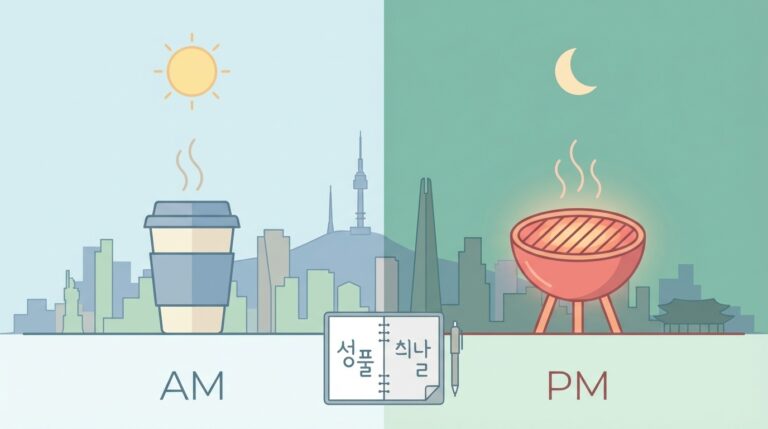
Phase 1: Immersive Hook
Hello! Daily Hangul Editor here. 👋
Imagine this: You finally scored KTX train tickets to Busan for your ultimate coastal getaway. The ticket app says your train leaves at 8:00. You wake up early, grab an iced Americano, and sprint to Seoul Station at 7:30 AM… only to find out your train doesn’t exist.
You check your ticket again. Right there, in tiny Korean letters, it says 오후 (PM). You just showed up 12 hours early! 😱
In K-Dramas, characters are always running late for dates or dramatically catching flights. But in real life, mixing up AM and PM in Korea can lead to missed concerts, failed restaurant reservations, or showing up to a friend’s house when they are fast asleep.
These two little words—오전 (AM) and 오후 (PM)—sound almost identical to a beginner, but mixing them up is a classic right-of-passage. Don’t worry, I’ve seen hundreds of my tutoring students make this exact mistake. By the end of this guide, you’ll be booking your K-BBQ dinners and K-Pop concerts like a true local!
Phase 2: Deep Dive into Core Expressions
Let’s break down the two most important time markers in Korean.
1. 오전 (AM / Before Noon)
- Pronunciation: [ojeon] 👉 Sounds like you’re saying “Oh, John!”
- Meaning: Literal (Before noon) vs. Real nuance (AM / Morning)
- K-Culture Moment: You’ll see this on your hotel breakfast voucher. “Breakfast is served from 오전 7시 to 오전 10시.” Miss this window, and you’re eating convenience store ramen!
- Editor’s Insight: In Korean, the AM/PM marker always comes BEFORE the time. We don’t say “7 AM.” We say “AM 7.” Think of it as setting the stage before introducing the actor (the time).
- Situation Spectrum:
[🚫 절대 금지] ———— [⚠️ 주의] ———— [✅ 자유롭게]
- Casual with friends: ✅ (But there’s a more natural way—see Phase 3!)
- Co-workers: ✅
- Boss/Elders: ✅
- 🤔 Think About It: “오” (O) means ‘noon’ in old Chinese characters, and “전” (Jeon) means ‘before’. Does your native language use ‘before/after noon’ or completely different words for AM/PM?
2. 오후 (PM / After Noon)
- Pronunciation: [ohu] 👉 Sounds like an owl hooting, or asking “Oh, who?”
- Meaning: Literal (After noon) vs. Real nuance (PM / Afternoon)
- K-Culture Moment: When K-Pop agencies drop teaser schedules, it’s always “오후 6시” (6 PM) KST. Memorize this word if you want to be the first to stream a new music video!
- Editor’s Insight: Because 오전 and 오후 both start with the “Oh” sound, beginners always mix them up. Remember: Hoo is later in the day!
- Situation Spectrum:
[🚫 절대 금지] ———— [⚠️ 주의] ———— [✅ 자유롭게]
- Casual with friends: ✅
- Co-workers: ✅
- Boss/Elders: ✅
Phase 3: Textbook vs Real Life
Textbooks teach you to use 오전/오후 for everything. But if you listen to Koreans on the streets of Hongdae, you’ll hear something different. Let’s compare!
| Situation | 📖 Textbook Korean | 🗣️ Real Korean | 💡 Why is it different? |
|---|---|---|---|
| Meeting for coffee in the morning | 오전 10시에 만나요. (Let’s meet at 10 AM) | 아침 10시에 봐요! (Let’s see each other at morning 10!) | Koreans love using natural daily rhythms (Morning/Night) over technical terms in casual chats. |
| Grabbing dinner | 오후 7시에 만나요. (Let’s meet at 7 PM) | 저녁 7시에 보자! (Let’s see each other at evening 7!) | Meal times are deeply embedded in Korean culture. “Evening” implies dinner time. |
| Late night gaming | 오전 2시 (2 AM) | 새벽 2시 (Dawn 2 o’clock) | If it’s dark outside, we call it “Dawn” (새벽) even if it’s technically AM! |
Bottom Note: As an A1 beginner, using 오전 and 오후 is perfectly safe and highly understood. But if you throw in 저녁 (Evening) instead of 오후, your Korean friends will think you’ve lived in Seoul for years!
Phase 4: Cultural Deep Dive
4-1. Non-verbal Communication: The “Wait” Hand
When scheduling a time, Koreans might raise their hand and gently wave it up and down while saying “아… 잠깐만요” (Ah… wait a minute) to check their calendar. Don’t rush them! This is part of Nunchi (reading the room)—giving someone space to politely check their schedule without pressure.
4-2. K-Travel Connection: The 24-Hour Trap
If you are using apps like KORAIL (for trains), CatchTable (for restaurants), or buying movie tickets, you need to be very careful.
While Koreans use the 12-hour clock (with 오전/오후) in spoken conversation, official apps often use the 24-hour clock!
So, if your Korean friend texts you:
“오후 8시에 만나요!” (Let’s meet at 8 PM!)
You need to book your restaurant table for 20:00, not 08:00. Showing up at 08:00 means you are demanding K-BBQ for breakfast! (Which, honestly, sounds delicious, but the restaurant will be closed).
Phase 5: Immersive Roleplay
Setting: Friday afternoon. You are texting your Korean coworker, Min-su, to plan a team dinner. He’s funny, friendly, and loves good food.
Characters:
– YOU: A foreign expat on your first month in Seoul.
– Min-su (32): Your local coworker who is determined to show you the best K-BBQ spot.
Dialogue:
Min-su: 오늘 삼겹살 먹으러 가요! 🥩
(oneul samgyeopsal meogeureo gayo!)
(English) Let’s go eat pork belly today!
YOU: 좋아요! 제가 예약할까요?
(joayo! jaega yeyakhalkkayo?)
(English) Sounds good! Should I make a reservation?
Min-su: 네, 부탁해요! 맛집으로요!
(ne, butakaeyo! matjibeuroyo!)
(English) Yes, please! To a famous spot!
YOU: 몇 시에 만날까요?
(myeot sie mannalkkayo?)
(English) What time should we meet?
Min-su: 7시 어때요?
(ilgopsi eottaeyo?)
(English) How about 7 o’clock?
YOU: 잠깐만요… 앱에 옵션이 두 개 있어요.
(jamkkanmanyo… aebe opsyeoni du gae isseoyo.)
(English) Wait… the app has two options.
(🎭 Stage Direction: You stare at the CatchTable app, sweating)
Min-su: ㅋㅋㅋ 무슨 옵션이요?
(kkk museun opsyeoniyo?)
(English) Hahaha! What options?
YOU: 오전 7시? 오후 7시?
(ojeon ilgopsi? ohu ilgopsi?)
(English) 7 AM? 7 PM?
Min-su: 아침부터 고기 먹을까요? 🤣
(achimbuteo gogi meogeulkkayo?)
(English) Should we eat meat from the morning? 🤣
🔀 Your Turn! How should you reply?
– A) “네! 오전 7시 예약할게요!” (Yes! I’ll book 7 AM!)
– B) “아, 당연히 오후 7시죠!” (Ah, 7 PM of course!)
– C) “저녁 7시에 봐요!” (See you at evening 7!)✅ Best Choice: C — Why? Using “저녁” (Evening) instead of “오후” sounds incredibly natural and native-like! Choice B is also perfectly fine and correct. Choice A will result in a very sleepy, very confused Min-su waiting outside a closed restaurant at sunrise.
Phase 6: 10-Second Shadowing Drill
Let’s practice the flow of speaking! Pay attention to the pauses (/).
😊 우리 / 내일 / 오후에 / 만나요!
(uri / naeil / ohu-e / mannayo!)
Translation: Let’s meet tomorrow afternoon!
Editor’s Tip: Make your voice bright on “오후에” to show you’re excited for the plans!
Phase 7: K-Culture Glossary
| 한국어 | Romanization | English | Cultural Context |
|---|---|---|---|
| 오전 | ojeon | AM / Morning | Used in official schedules, news, and textbooks. |
| 오후 | ohu | PM / Afternoon | Crucial for concert ticket drops and dinner plans. |
| 아침 | achim | Morning / Breakfast | Also means ‘breakfast’. “Did you eat 아침?” |
| 저녁 | jeonyeok | Evening / Dinner | Used constantly instead of PM for evening plans. |
| 약속 | yaksok | Plans / Promise | In Korea, any casual hangout is called a ‘promise’ (약속). |
Phase 8: Traveler’s Survival Kit
Don’t let time ruin your travel plans! Here is what you need to survive ticketing in Korea.
🆘 Survival Phrases TOP 3
– 🇰🇷 “오전이에요, 오후예요?” (ojeon-ieyo, ohu-yeyo?)
– 🗣️ English: Is it AM or PM?
– 📍 Where to use: Buying bus/train tickets at the counter, confirming tour times.
- 🇰🇷 “오후 두 장 주세요.” (ohu du jang juseyo.)
- 🗣️ English: PM, two tickets please.
- 📍 Where to use: Movie theaters, palaces, theme parks.
🇰🇷 “몇 시까지 해요?” (myeot sikkaji haeyo?)
- 🗣️ English: Until what time are you open?
- 📍 Where to use: Cafes or shops late at night.
📌 Editor’s Travel Note
– 24-Hour Clocks: If you buy a KTX train ticket from a machine, look for times like 14:00 or 18:30. They rarely use AM/PM on printed tickets!
– Navigating Cafes: Many cute, independent cafes in Seoul close surprisingly early (like 오후 8시 – 8 PM). Always double-check Naver Maps!
Phase 9: Think Deeper — “One Step Further”
Food & Identity: Why Time is Measured by Meals
🧠 Think Deeper:
Did you notice how Koreans naturally substitute “AM/PM” with “Breakfast time” (아침) or “Dinner time” (저녁)? In Korea, food isn’t just fuel; it’s the rhythm of life and the center of social connection. Asking “Have you eaten?” is practically a synonym for “How are you?” This deep cultural focus on communal eating makes meal times the most logical way to anchor a daily schedule.💬 Your Turn: How do people refer to time in your culture? Do you strictly say “6 PM,” or do you say “at sunset” or “after dinner”? Let me know in the comments!
Phase 10: FAQ & Troubleshooting
Q: Do I put AM/PM before or after the time?
Always BEFORE.
❌ 2시 오후 (2 o’clock PM)
✅ 오후 2시 (PM 2 o’clock)
Tip: Think of it as “It is the Afternoon’s 2 o’clock.”
Q: Can I just use military time (24-hour clock) when speaking?
It sounds very robotic. If you say “Let’s meet at 19 o’clock” (십구 시에 만나요), your friends will think they are in the military! Stick to 12-hour times with 오전/오후 in conversation.
❌ Common Mistake #1: Saying “오후 아침” (PM Morning) or mixing the markers.
✅ How to fix it: Choose ONE. Either use the textbook “오후 8시” (PM 8 o’clock) or the natural “저녁 8시” (Evening 8 o’clock).
Phase 11: Wrap-up & Action Items
One-Liner Summary: “오전” (Oh-jeon) is AM, “오후” (Oh-hoo) is PM, and they always go before the time!
Your Action Missions for Today:
– 🥉 Bronze: Look at your phone’s clock right now and say “오전” or “오후” out loud.
– 🥈 Silver: Change your phone’s clock to a 12-hour format and practice looking at it and thinking in Korean.
– 🥇 Gold (K-Culture Mission): Go to YouTube, search for your favorite K-Pop idol’s music video, and look at the release description. Can you spot “오후 6시”?
Don’t forget to tell us in the comments what time it is where you are reading this! 오전 or 오후? 🕒
Phase 12: Interactive Quiz
Let’s see if you’re ready to book that ticket!
1. Fill in the blank:
You want to meet for coffee at 11:00 in the morning.
“_____ 11시에 만나요.”
A) 오후
B) 오전
2. Situational Judgment:
You are buying a bus ticket to Sokcho. The cashier asks, “When do you want to leave?” You want to leave at 3 PM. What is the best way to reply?
A) 3시 오후 표 주세요.
B) 오후 3시 표 주세요.
C) 15시 표 주세요.
3. True or False – K-Culture Edition:
In casual conversation, Koreans prefer to say “저녁 7시” (Evening 7 o’clock) instead of “오후 7시” (PM 7 o’clock).
*
*
*
Answers:
1. B (오전) – 11 AM is before noon!
2. B – The time marker ALWAYS comes first! (오후 3시).
3. True! – Connecting time to meal/daylight phases is the secret to sounding like a native!
Frequently Asked Questions (FAQ)
Q: What does "오전 (AM / Before Noon)" mean in Korean and how do you pronounce it?
A: In Korean, "오전 (AM / Before Noon)" is pronounced [ojeon] and means: Literal (Before noon) vs. Real nuance (AM / Morning)
Q: What does "오후 (PM / After Noon)" mean in Korean and how do you pronounce it?
A: In Korean, "오후 (PM / After Noon)" is pronounced [ohu] and means: Literal (After noon) vs. Real nuance (PM / Afternoon)






