

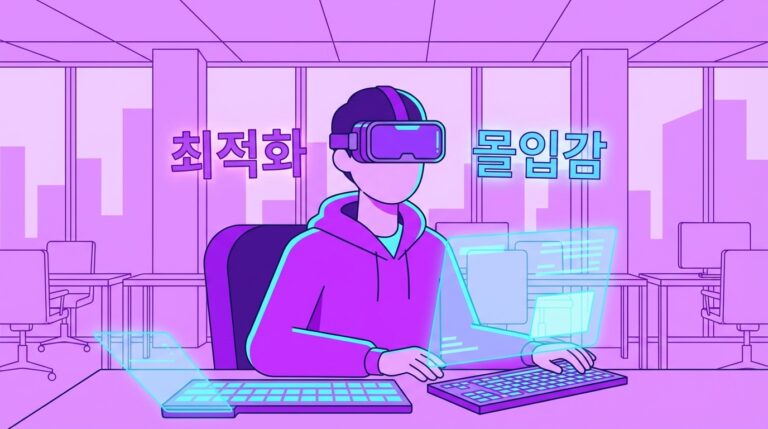
Phase 1: 공감 — 몰입형 오프닝 (Immersive Hook)
Hello, language explorers! This is your Daily Hangul Lead Editor.
Picture this: You are at a massive, neon-lit VR arcade in the heart of Gangnam. You strap on the sleek headset to play the latest K-Zombie survival game. The graphics are stunning, the haptic feedback is intense, but suddenly—your character sprints forward while your physical body stands still. Your stomach does a flip. You rip the headset off, breaking out in a cold sweat.
If you’re working in the gaming industry, especially in the booming Korean tech hubs like Pangyo, you know exactly what this is: VR Motion Sickness (사이버 멀미).
Korean developers are at the forefront of tackling this issue, utilizing advanced locomotion algorithms and dynamic FOV (Field of View) reduction. But if you’re sitting in a meeting with a top-tier Korean dev team, simply saying “It makes me sick” won’t cut it. You need the precision of a C2-level speaker to discuss how to fix it, why the frame drops occur, and what it does to the player’s immersion.
Today, we are diving deep into the high-level professional Korean used in the gaming industry to discuss VR motion sickness solutions. This isn’t just textbook vocabulary; these are the actual phrases you’ll hear in a boardroom at G-Star or over a post-launch Chimaek (chicken and beer) in Pangyo.
Phase 2: 핵심 표현 심층 분석 (Deep Dive)
1. 사이버 멀미를 최소화하다
- Pronunciation: [saibeo meolmireul choesohwahada] / sigh-beo mull-mee-reul chweh-so-hwa-ha-da
- Meaning: (Literal) To minimize cyber motion sickness / (Real nuance) Optimizing the VR experience to prevent user nausea.
- K-Culture Moment: Imagine a keynote presentation at the G-Star gaming convention in Busan. The lead engineer points to a graph and confidently declares how their new proprietary engine “minimizes cyber sickness.”
- Editor’s Insight: ‘멀미’ traditionally means motion sickness from cars or boats. Adding ‘사이버’ (cyber) adapts it perfectly for VR. The verb ‘최소화하다’ (to minimize) sounds highly professional, academic, and solution-oriented.
- Situation Spectrum:
[🚫 절대 금지] ———— [⚠️ 주의] ———— [✅ 자유롭게]
- Casual with friends: ⚠️ (A bit too formal; friends would just say “멀미 덜 나게 하다”)
- Semi-formal (Coworkers): ✅
- Formal (Boss/Clients): ✅
- 🤔 Think About It: Notice how Korean easily adopts English tech words (사이버) and fuses them with native bodily sensations (멀미). Does your native language create hybrid tech terms, or does it invent entirely new words?
2. 프레임 드랍을 잡다
- Pronunciation: [peureim deurabeul japda] / peu-ray-im deu-rah-beul jahp-da
- Meaning: (Literal) To catch the frame drop / (Real nuance) To resolve or fix the issue of dropping frame rates, which is a primary cause of VR sickness.
- K-Culture Moment: It’s 2 AM in a developer’s crunch time. The lead programmer slams his empty Americano cup on the desk and sighs in relief, “드디어 프레임 드랍 잡았다!” (Finally, I caught the frame drop!).
- Editor’s Insight: The verb ‘잡다’ (to catch) is one of the most versatile words in Korean. You don’t just ‘solve’ (해결하다) a bug; you ‘catch’ it (버그를 잡다). It implies hunting down a mischievous problem and wrestling it into submission.
- Situation Spectrum:
[🚫 절대 금지] ———— [⚠️ 주의] ———— [✅ 자유롭게]
- Casual with friends: ✅
- Semi-formal (Coworkers): ✅
- Formal (Boss/Clients): ⚠️ (In an extremely formal pitch, use ‘해결하다’ instead of ‘잡다’)
- 🤔 Think About It: Why do Koreans ‘catch’ problems? It reflects a very active, hands-on approach to problem-solving. How do you conceptually ‘fix’ intangible software issues in your culture?
3. 몰입감을 깨지 않다
- Pronunciation: [moripgameul kkaeji anta] / mo-reep-gahm-eul kkeh-jee ahn-tah
- Meaning: (Literal) To not break the feeling of immersion / (Real nuance) Implementing a solution (like dynamic FOV blurring) so seamlessly that the player’s psychological presence in the game remains intact.
- K-Culture Moment: Reading a hardcore gamer’s review on a Korean tech forum (like Ruliweb). They praise a game: “멀미 방지 옵션을 켜도 몰입감을 전혀 깨지 않네요.” (Even with the anti-sickness option on, it doesn’t break immersion at all.)
- Editor’s Insight: ‘-감’ is a suffix denoting a feeling or sense (e.g., 자신감 – confidence, 책임감 – sense of responsibility). ‘몰입감’ is the holy grail of VR. Notice the verb ‘깨다’ (to break)—immersion is viewed as something fragile, like glass.
- Situation Spectrum:
[🚫 절대 금지] ———— [⚠️ 주의] ———— [✅ 자유롭게]
- Casual with friends: ✅
- Semi-formal (Coworkers): ✅
- Formal (Boss/Clients): ✅
Phase 3: 교과서 vs 진짜 한국어 (Textbook vs Real Life)
| 상황 | 📖 교과서 한국어 | 🗣️ 진짜 한국어 | 💡 왜 다를까? |
|---|---|---|---|
| VR 멀미가 날 때 | 가상현실 게임을 하니 멀미가 납니다. | 와, 이거 멀미 오지는데? (Wow, this sickness is insane) | ‘오지다’ is a common gamer slang for ‘extreme’. |
| 문제를 해결했을 때 | 어지럼증 문제를 해결했습니다. | 멀미 싹 잡았습니다. (Caught the sickness completely) | ‘싹’ (completely/cleanly) adds a satisfying verbal flair to ‘잡다’. |
| 게임이 끊길 때 | 화면이 매끄럽지 않습니다. | 렉 걸려서 뚝뚝 끊겨요. (It stutters because of lag) | Gamers use ‘렉’ (lag) universally; ‘뚝뚝’ is a mimetic word for stuttering. |
Bottom Note: As C2 learners, integrating words like ‘싹’ or ‘잡다’ elevates your Korean from ‘fluent’ to ‘native-like industry insider.’ Keep ‘오지다’ strictly for gaming buddies!
Phase 4: 문화적 맥락 — K-Culture 딥다이브 (Cultural Deep Dive)
4-1. 비언어적 요소 (Non-verbal Communication)
In a Korean office, when a developer removes a VR headset and feels nauseous, they often pinch the bridge of their nose with their thumb and index finger, tightly closing their eyes. They might also do a rapid, dismissive hand wave in front of their face. If you see this, don’t ask “Are you okay?” immediately. Read the room—employ your Nunchi (눈치). Let them sit for a second before offering, “물 좀 드릴까요?” (Would you like some water?).
4-2. K-Culture 연결 고리 (K-Culture Connection)
The “빨리빨리” (Ppalli-Ppalli) Tech Culture
South Korea’s internet infrastructure is famously fast, and Korean gamers (frequenters of PC Bangs) have absolutely zero tolerance for latency. A ping drop of a few milliseconds can ruin an E-sports match. This cultural impatience translates directly into VR development. ‘Frame drops’ aren’t just technical flaws; they are an insult to the ‘Ppalli-Ppalli’ ethos. Therefore, VR motion sickness is treated not as a minor user inconvenience, but as a critical, game-breaking bug that must be ‘caught’ (잡다) immediately to survive in the hyper-competitive Korean market.
Phase 5: 실전 롤플레이 시나리오 (Immersive Roleplay)
시나리오 A: 메인 롤플레이 (The Post-Mortem in Pangyo)
- Setting: Friday, 8 PM. A trendy craft beer pub in Pangyo, the Silicon Valley of Korea. You and your Korean dev team are having a Hoesik (회식) after successfully testing a new VR locomotion mechanic.
- Characters:
- YOU: A Lead Foreign Developer who designed the new FOV reduction algorithm.
- Ji-hoon: (35, Tech Art Director), highly skilled, slightly exhausted, loves mixing tech jargon with slang.
지훈: 짠! 하아, 이번 주 진짜 고생 많았어요. 🍻
(Jjan! Haa, ibeon ju jinjja gosaeng manasseoyo.)
[Cheers! Phew, we really worked hard this week.]
(🎭 Stage Direction: Ji-hoon clinks his beer glass with yours and takes a deep gulp)
YOU: 지훈 님이 최적화 잘해주신 덕분이죠.
(Jihun nimi choejeokhwa jalhaejusin deokbunijyo.)
[It’s all thanks to you optimizing it so well.]
지훈: 에이, 아니에요. 근데 이번에 도입한 동적 시야각 조절… 그거 진짜 물건이던데요?
(Ei, anieyo. Geunde ibeone doipan dongjeok siyagak jojeol… geugeo jinjja mulgeonideondeyo?)
[Ah, no way. But that dynamic FOV adjustment we introduced this time… that thing is a real masterpiece, huh?]
YOU: 그렇죠? 테스트해 보니까 어땠어요?
(Geureochyo? Teseuteuhae bonikka eottaesseoyo?)
[Right? How was it when you tested it?]
지훈: 화면 휙휙 돌릴 때 어지럼증이 싹 가시더라고요. 어떻게 세팅하신 거예요?
(Hwamyeon hwikhwik dollil ttae eojireomjeungi ssak gasideoragoyo. Eotteoke setinghasin geoyeyo?)
[When I whipped the screen around, the dizziness completely disappeared. How did you set it up?]
🔀 당신의 차례! 어떻게 대답할까요? (Your Turn! How to reply?)
– A) “주사율을 높여서 멀미를 최소화했습니다.” (Academic & dry)
– B) “이동할 때만 주변 시야를 블러 처리해서 프레임 드랍을 잡았죠. 몰입감은 안 깨고요.”
– C) “제가 코딩을 오지게 잘해서 멀미를 죽였습니다!”✅ Best Choice: B — Reason: It perfectly blends high-level technical explanation (블러 처리, 주변 시야) with idiomatic industry Korean (프레임 드랍을 잡다, 몰입감은 안 깨다).
⚠️ Choice C 분석: Too aggressive and slangy. ‘오지게’ and ‘죽이다’ might get a laugh at a PC Bang, but it undermines your professional credibility even at a casual team dinner.
지훈: 아, 역시 디테일이 다르네요! 다음 프로젝트도 문제없겠어요.
(A, yeoksi diteiri dareuneyo! Daeum peurojekteudo munjeeopgesseoyo.)
[Ah, the detail really is on another level! The next project will be no problem.]
시나리오 B: K-Culture 보너스 롤플레이 (The VR Cafe Date)
- Setting: A VR Cafe in Hongdae. You are with a friend trying out a VR rollercoaster.
- Part-timer: 손님, 혹시 멀미 나시면 바로 손들어주세요! (Customer, if you feel motion sickness, please raise your hand immediately!)
- YOU: 네, 알겠습니다. (Yes, understood.)
- (2 minutes later, the game stutters)
- YOU: 저기요! 프레임이 너무 끊겨서 어지러워요. 잠깐 쉴게요! (Excuse me! The frames are stuttering too much, I feel dizzy. I need to rest a bit!)
Phase 6: 10초 섀도잉 드릴 (Shadowing Drill)
Master the rhythm of a Korean tech professional. Pay attention to the pauses (/) and the emotional tags!
😤 자신감 있게 (Confidently):
이번 업데이트로 / 프레임 드랍을 완전히 잡아서, / 사이버 멀미를 / 최소화했습니다.
(ibeon eopdeiteuro / peureim deurabeul wanjeonhi jabaseo, / saibeo meolmireul / choesohwahetseumnida.)
Phase 7: K-Culture 미니 사전 (K-Culture Glossary)
| 한국어 | Romanization | 영어 | 맥락 설명 |
|---|---|---|---|
| 눈치 | nunchi | Social intelligence / reading the room | Crucial in a dev environment to know when a colleague is burnt out or physically sick from VR testing. |
| 최적화 | choejeokhwa | Optimization | The ultimate goal in gaming. A game that lacks this is heavily criticized by Korean netizens. |
| 프레임 드랍 | peureim deurap | Frame drop | English loanword universally used in Korea to describe lag/stuttering. |
| 렉 | rek | Lag | From ‘lag’. Used broadly in life too (e.g., “뇌에 렉 걸렸다” – My brain is lagging). |
| 판교 | Pangyo | Pangyo (City) | The “Silicon Valley” of Korea. Hub of major gaming companies like Nexon, NCSoft, and Kakao. |
Phase 8: 여행자 서바이벌 키트 (Traveler’s Survival Kit)
Visiting a VR theme park or PC Bang in Korea is a must-do for gamers. Here is your survival kit when the tech betrays your stomach!
🆘 서바이벌 표현 TOP 3
1. 🇰🇷 “저 너무 어지러워서 잠깐 벗을게요.” (jeo neomu eojireowoseo jamkkan beoseulgeyo.)
– 🗣️ English: I’m too dizzy, I’ll take this off for a second.
2. 🇰🇷 “이거 화면 초점이 안 맞아요.” (igeo hwamyeon chojeomi an majayo.)
– 🗣️ English: The screen focus is off on this.
3. 🇰🇷 “화면이 자꾸 멈춰요.” (hwamyeoni jakku meomchwoyo.)
– 🗣️ English: The screen keeps freezing.📌 Editor’s Travel Note
– VR Cafes (VR 방): In places like Hongdae or Gangnam, staff will physically guide you. If you feel sick, don’t try to walk blindly! Raise your hand and say “저기요!” (Excuse me!).
– Hygiene: You will usually be given a white disposable eye-mask (안대) shaped like a ninja mask to wear under the headset. Don’t lose it, or you’ll have to buy another!
Phase 9: 비판적 사고 코너 — “한 발 더 깊이” (Think Deeper)
글로벌 시대의 한국어 (Korean in the Global Era)
Look closely at the gaming terminology we discussed: 프레임 (Frame), 드랍 (Drop), 사이버 (Cyber), 블러 (Blur). The Korean gaming industry relies heavily on English loanwords, known as Konglish or just imported tech jargon. Yet, these foreign words are tightly governed by native Korean grammar and verbs like 잡다 (to catch) or 깨다 (to break). This hybridization shows that while English provides the technical nouns, Korean provides the active, emotional verbs that dictate how a problem is handled. It’s a perfect reflection of Korea’s tech identity: globally integrated, yet distinctly Korean in execution.
💬 Your Turn: Does the tech industry in your country use English words mixed with native verbs? Or does your language invent completely new vocabulary for concepts like ‘frame drops’ or ‘VR sickness’? Let me know in the comments!
Phase 10: FAQ & 오해 방지 (Troubleshooting)
- Q: Can I use ‘멀미 난다’ (I have motion sickness) to describe a person I dislike?
- A: Yes! It’s a high-level, slightly dramatic slang. If a person is incredibly annoying, you can say, “아, 걔 생각만 해도 멀미 나” (Ugh, just thinking of them gives me motion sickness). Use with caution!
- Q: What’s the difference between 어지럽다 and 헷갈리다?
- A: 어지럽다 is physical dizziness (like from VR). 헷갈리다 is mental confusion (like a difficult math problem). Don’t mix them up!
❌ 흔한 실수 (Common Mistake): Saying “가상현실 멀미를 해결했습니다” in a casual developer meeting.
✅ 이렇게 하세요: While grammatically perfect, it sounds like you are reading a textbook. Use “VR 멀미 잡았습니다” to sound like a true industry insider.
Phase 11: 요약 및 액션 아이템 (Wrap-up)
One-Liner Summary: To master Korean in the VR gaming industry, remember that you don’t just solve problems—you minimize (최소화하다) sickness, catch (잡다) frame drops, and protect immersion (몰입감).
Action Mission 3단계:
– 🥉 Bronze: Stand in front of a mirror and say “프레임 드랍을 잡았다!” with the enthusiasm of a developer who just finished a 48-hour coding marathon.
– 🥈 Silver: Go to a Korean gaming YouTube channel and leave a comment: “이 게임 몰입감 최고네요!”
– 🥇 Gold: Next time you are in Korea, visit a VR cafe in Hongdae. If the game lags, confidently tell the staff, “화면이 끊겨서 어지러워요.”
K-Culture Mission:
Search for “지스타 (G-Star) VR” on YouTube. Watch a developer interview or booth showcase. Listen closely—I guarantee you will hear words like 최적화, 몰입감, and 멀미 within the first 5 minutes!
Phase 12: 퀴즈 — 인터랙티브 챌린지 (Interactive Quiz)
1. Situational Judgment: Your boss asks how the new VR locomotion update is going. It’s successful and users aren’t getting sick anymore. What is the most C2-level, professional response?
A) 멀미가 이제 없습니다.
B) 사이버 멀미를 성공적으로 최소화했습니다.
C) 멀미를 오지게 잡았습니다.
(Answer: B. It’s the most professional. A is too simple, C is slang.)
2. Fill in the Blank:
“VR 게임에서 가장 중요한 것은 유저의 ( _______ )을 깨지 않는 것입니다.”
(Answer: 몰입감 – immersion)
3. True or False – K-Culture Edition:
Korean PC Bangs and VR arcades expect users to tolerate minor lag and frame drops patiently.
(Answer: False. The ‘Ppalli-Ppalli’ culture means zero tolerance for lag!)
Great job today! You are now equipped to navigate the high-tech boardrooms of Pangyo. Keep practicing, and see you in the next Daily Hangul module!
Frequently Asked Questions (FAQ)
Q: What does "사이버 멀미를 최소화하다" mean in Korean and how do you pronounce it?
A: In Korean, "사이버 멀미를 최소화하다" is pronounced [saibeo meolmireul choesohwahada] and means: (Literal) To minimize cyber motion sickness / (Real nuance) Optimizing the VR experience to prevent user nausea.
Q: What does "프레임 드랍을 잡다" mean in Korean and how do you pronounce it?
A: In Korean, "프레임 드랍을 잡다" is pronounced [peureim deurabeul japda] and means: (Literal) To catch the frame drop / (Real nuance) To resolve or fix the issue of dropping frame rates, which is a primary cause of VR sickness.
Q: What does "몰입감을 깨지 않다" mean in Korean and how do you pronounce it?
A: In Korean, "몰입감을 깨지 않다" is pronounced [moripgameul kkaeji anta] and means: (Literal) To not break the feeling of immersion / (Real nuance) Implementing a solution (like dynamic FOV blurring) so seamlessly that the player's psychological presence in the game remains intact.







