

Phase 1: 공감 — 몰입형 오프닝 (Immersive Hook)
Hello! It’s your Daily Hangul Editor.
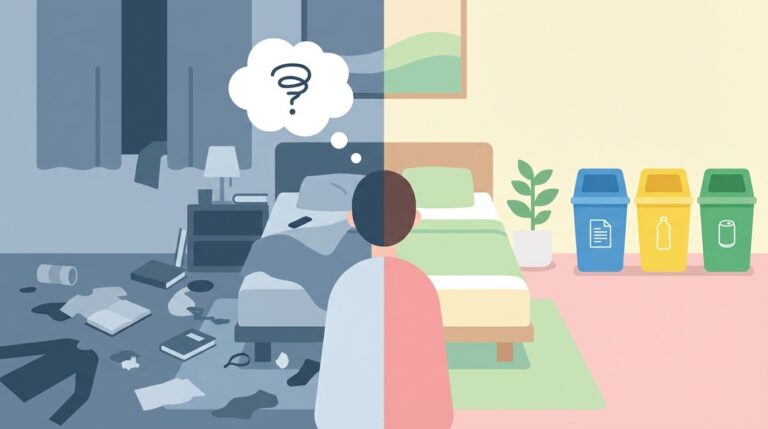
Picture this classic K-Drama scene: The main character is sleeping in on a lazy Saturday morning in their tiny Seoul studio apartment. Suddenly, the door’s digital lock beeps. Beep-beep-beep-boop! The door swings open, and it’s Mom. She takes one look around the floor covered in clothes, instant ramen cups, and unread manhwa books, and lets out a dramatic sigh: “어휴, 돼지우리야?” (Ugh, is this a pigsty?)
If you’ve ever watched a Korean drama, or seen a reality show revealing a K-Pop idol’s shockingly messy dorm room, you know that keeping a space clean is a universal struggle. But in Korean, we have specific nuances for “cleaning” vs. “organizing.”
Today, we are going to learn how to talk about tidying up your room. Whether you are living in a Korean dorm, staying at an Airbnb in Hongdae, or just want to tell your Korean friend that your room is a mess, these A1-level survival phrases will save you!
Phase 2: 핵심 표현 심층 분석 (Deep Dive)
1. 방 정리해요 (I tidy up the room)
- Pronunciation: [bang jeong-ni-hae-yo]
Pro Tip: The ‘ng’ in ‘jeong’ and the ‘r’ in ‘ri’ merge to sound like an ‘n’. So it sounds like ‘jung-knee’.- Meaning: (Literal) I organize the room. (Real nuance) I tidy up / pick up things in the room.
- K-Culture Moment: You’ll hear this on K-Pop reality shows when the neat-freak member of the group claps their hands and tells the others, “Guys, let’s tidy up our dorm before the manager comes!”
- Editor’s Insight: 정리해요 is about putting things in their proper place. It’s different from 청소해요 (cheong-so-hae-yo), which means deep cleaning with a vacuum and mop. If you are just putting clothes in the closet, it’s 정리해요.
- Situation Spectrum:
[🚫 절대 금지] ———— [⚠️ 주의] ———— [✅ 자유롭게]
- Friends (Casual): ✅ (방 정리해! – Tidy your room!)
- Co-workers (Semi-formal): ⚠️ (Use ‘정리하세요’ to be polite)
- Boss/Elders (Formal): 🚫 (Never command a boss to clean!)
- 🤔 Think About It: Koreans use the word 정리 (jeong-ni) for more than just physical things. You can 정리해요 a romantic relationship (break up), or 정리해요 your thoughts. Does your language use the word ‘organize’ for emotions too?
2. 지저분해요 (It is messy)
- Pronunciation: [ji-jeo-bun-hae-yo]
Sound-alike: ‘ji’ like in Jeep, ‘jeo’ like the ‘juh’ in jump.- Meaning: (Literal) It is messy / cluttered.
- K-Culture Moment: This is the ultimate K-Drama Mom word. When she walks into her child’s room, this is the first thing she will say, usually accompanied by a disapproving click of the tongue (쯧쯧).
- Editor’s Insight: It’s a very descriptive, slightly negative word. Use it to describe your own messy room to show humility, but be careful using it to describe someone else’s house!
- Situation Spectrum:
[🚫 절대 금지] ———— [⚠️ 주의] ———— [✅ 자유롭게]
- Friends (Casual): ✅
- Co-workers (Semi-formal): ⚠️ (Okay for your own desk, not theirs!)
- Boss/Elders (Formal): 🚫
- 🤔 Think About It: In Korea, inviting someone to your home is a big deal. Why do you think Koreans often apologize by saying “My house is a bit messy” even when it’s perfectly clean?
3. 버려요 (Throw it away)
- Pronunciation: [beo-ryeo-yo]
Sound-alike: ‘beo’ sounds like ‘bun’ without the n. ‘ryeo’ sounds like the ‘ryo’ in Tokyo, but softer.- Meaning: (Literal) I throw away. (Real nuance) Toss it / Get rid of it.
- K-Culture Moment: During spring cleaning, a couple is arguing. “Are you keeping this old t-shirt?” “Yes!” “No, 버려!” (Throw it away!).
- Editor’s Insight: When you are tidying up, this is the most powerful verb. Just remember, in Korea, you can’t just throw things away anywhere—you must separate your trash! (More on that later).
- Situation Spectrum:
[🚫 절대 금지] ———— [⚠️ 주의] ———— [✅ 자유롭게]
- Friends (Casual): ✅
- Co-workers (Semi-formal): ✅
- Boss/Elders (Formal): ⚠️ (Use ‘버리세요’ if suggesting they throw something away, but tread lightly!)
Phase 3: 교과서 vs 진짜 한국어 (Textbook vs Real Life)
| 상황 | 📖 Textbook Korean | 🗣️ Real Korean | 💡 Why is it different? |
|---|---|---|---|
| Telling your friend to clean up | 방을 정리하십시오. (Please organize the room.) | 방 좀 치워! (Clean your room!) | Friends use “치워” (clear it away) in casual speech (banmal) for a natural, close vibe. |
| Mentioning the mess | 방이 지저분합니다. (The room is messy.) | 아, 돼지우리야. (Ugh, it’s a pigsty.) | Koreans love using dramatic metaphors in daily life! |
| Asking if you should toss it | 이것을 버릴까요? (Shall I throw this away?) | 이거 버려? (Toss this?) | Dropping the subject, object particles, and polite endings makes it fast and efficient. |
Phase 4: 문화적 맥락 — K-Culture 딥다이브 (Cultural Deep Dive)
4-1. 비언어적 요소 (Non-verbal Communication)
Living with Korean roommates? You need Nunchi (눈치 – the art of reading the room). If your roommate is aggressively sighing while picking up your socks, they aren’t just breathing heavily. That passive-aggressive tidying is a non-verbal cue meaning, “Clean up your stuff!” When handing someone trash to throw away, don’t just toss it at them; hand it over gently, ideally with a small “미안” (Sorry).
4-2. K-Culture Connection: The Infamous “Bunrisugeo” (분리수거)
If you watch reality shows featuring K-Pop idols living in dorms, you’ll often see them doing rock-paper-scissors. The loser gets the worst chore: 분리수거 (Bun-ri-su-geo), which means “Recycling / Separating trash.”
South Korea has one of the strictest and most efficient recycling systems in the world. You can’t just put all your trash in one bag and 버려요. You must separate paper, plastics, vinyl, glass, and—most importantly—food waste (음식물 쓰레기) into specific, color-coded bags purchased from the local convenience store. It’s a huge part of Korean daily life!
Phase 5: 실전 롤플레이 시나리오 (Immersive Roleplay)
시나리오 A: The Emergency Cleanup (Main Scenario)
- Setting: A tiny, cluttered shared dorm room in Seoul. Clothes are on the chairs, snack wrappers are on the desk.
- Characters:
- YOU: An exchange student who just wanted to relax today.
- Min-su (22): Your Korean roommate. He is currently panicking.
Min-su: 야! 큰일 났어! (Ya! Keun-il nasseo! / Hey! We have a big problem!)
YOU: 왜요? 무슨 일 있어요? (Waeyo? Museun il isseoyo? / Why? What’s going on?)
Min-su: 우리 엄마… 30분 뒤에 여기 오신대! (Uri eomma… 30-bun dwie yeogi osindae! / My mom… says she’s coming here in 30 minutes!)
YOU: 헐. (Heol. / OMG.)
Min-su: 내 방 너무 지저분해. 어떡하지? (Nae bang neomu ji-jeo-bun-hae. Eotteokhaji? / My room is too messy. What do I do?)
🔀 Your Turn! How should you reply?
– A) “아, 알겠어요. 빨리 방 정리해요!” (Ah, I get it. Let’s quickly tidy the room!)
– B) “그냥 다 창문 밖으로 버려요!” (Just throw everything out the window!)
– C) “수고하세요. 저는 카페 갈게요.” (Good luck. I’m going to a cafe.)✅ Best Choice: A — You are a great friend! 정리해요 is the perfect word here because you don’t have time to deep clean; you just need to hide the mess!
⚠️ Choice B/C Analysis: B is a funny joke, but definitely impossible. C is a betrayal! (Though “수고하세요” – keep up the hard work – is technically correct usage, Min-su might cry.)
(🎭 Stage Direction: You and Min-su frantically start shoving clothes into the closet.)
Min-su: 고마워! 이 쓰레기는 다 버려줘! (Gomawo! I sseuregineun da beoryeojwo! / Thanks! Please throw away all this trash!)
YOU: 네, 제가 버릴게요. (Ne, jega beorilgeyo. / Yes, I’ll throw it away.)
시나리오 B: The Airbnb Request (Bonus Scenario)
- Setting: The front desk of a guesthouse in Busan.
- YOU: “안녕하세요. 제 방이 조금 지저분해요. (Hello. My room is a little messy.)”
- Staff: “아, 죄송합니다. 청소해 드릴까요? (Ah, I’m sorry. Shall I clean it for you?)”
- YOU: “네, 방 정리해 주세요. (Yes, please tidy up the room.)”
Phase 6: 10초 섀도잉 드릴 (Shadowing Drill)
Let’s practice the rhythm of Korean! Follow the slash marks for pauses.
😢 아... / 방이 너무 / 지저분해요. (Ah... / bang-i neo-mu / ji-jeo-bun-hae-yo.)
Feel the despair of a messy room!
😤 빨리 / 방을 / 정리해요! (Ppal-li / bang-eul / jeong-ni-hae-yo!)
Say it with determination! Let’s clean!
😊 이거 / 버려요? (I-geo / beo-ryeo-yo?)
Ask politely with a slight upward tone at the end.
Phase 7: K-Culture 미니 사전 (K-Culture Glossary)
| 한국어 | Romanization | English | Context |
|---|---|---|---|
| 분리수거 | bunrisugeo | Recycling / Sorting trash | A daily chore in Korea. Extremely strict rules! |
| 돼지우리 | dwaejiuri | Pigsty | What moms call messy rooms. (돼지 = pig, 우리 = pen) |
| 원룸 | won-rum | One-room (Studio) | Typical housing for university students. Kitchen, bed, and desk in one single room. |
| 쓰레기 | sseuregi | Trash / Garbage | You will hear this a lot when cleaning! |
| 대청소 | dae-cheong-so | Spring Cleaning | ‘Dae’ means big. Big cleaning day! |
Phase 8: 여행자 서바이벌 키트 (Traveler’s Survival Kit)
Even if you aren’t living in Korea, knowing how to talk about a “room” and “cleaning” is essential for hotels and Airbnbs!
🆘 서바이벌 표현 TOP 3
– 🇰🇷 “방 청소해 주세요.” (bang cheong-so-hae ju-se-yo)
– 🗣️ English: Please clean the room.
– 📍 Where to use: Hotels, guesthouses.
- 🇰🇷 “수건 좀 주세요.” (su-geon jom ju-se-yo)
- 🗣️ English: Please give me some towels.
- 📍 Where to use: When housekeeping misses your room.
🇰🇷 “이거 버려주세요.” (i-geo beo-ryeo-ju-se-yo)
- 🗣️ English: Please throw this away for me.
- 📍 Where to use: Handing a coffee cup to a cafe worker or trash to a hotel maid.
📌 Editor’s Travel Note
If you stay in a Korean Airbnb, the host will likely leave you detailed instructions on 분리수거 (Recycling). Do not ignore this! If you mix food waste with regular trash, the host can get fined. Always ask “쓰레기는 어디에 버려요?” (Where do I throw away the trash?).
Phase 9: 비판적 사고 코너 — “한 발 더 깊이” (Think Deeper)
🧠 Think Deeper: Media vs Reality (The K-Drama Apartment)
In K-Dramas, the main characters often live in massive, perfectly clean, multi-story apartments with giant living rooms. But in reality, many young Koreans in Seoul live in a 원룸 (One-room) or 고시원 (Goshiwon) which is only 4 to 15 square meters! Because the space is so small, 정리 (organizing) isn’t just about being neat; it’s about survival. If you don’t 정리해요, you literally have no space to sleep. The media often glosses over this dense urban reality, but learning the vocabulary of daily chores gives you a peek into real Korean life.💬 Your Turn: Have you ever noticed the difference between houses in K-Dramas and real life? How important is “organizing” in your culture compared to deep cleaning?
Phase 10: FAQ & 오해 방지 (Troubleshooting)
Q: Can I tell my boss “책상이 지저분해요” (Your desk is messy)?
A: NO! 🚫 Even if their desk looks like a hurricane hit it, pointing out that an elder or superior is messy is considered very rude. Keep 지저분해요 for yourself, your friends, or your younger siblings!
Q: I want to tell my friend to throw something away. Do I say “버려요”?
A: If you are speaking casually (banmal) to a close friend, drop the ‘요’ and just say “버려!” (beo-ryeo!).
❌ Common Mistake #1: Confusing 정리 (Organizing) with 청소 (Cleaning).
✅ How to fix it: If you are putting books on a shelf or folding clothes, it’s 정리해요. If you are vacuuming the floor or scrubbing the toilet, it’s 청소해요.
Phase 11: 요약 및 액션 아이템 (Wrap-up)
🧹 One-Liner Summary: Use 정리해요 to tidy up, complain that your room is 지저분해요, and don’t forget to 버려요 your trash properly!
Action Mission 3단계:
– 🥉 Bronze: Stand in your room right now, look at your desk, and say out loud: “아… 지저분해요!”
– 🥈 Silver: Leave a comment below saying what you need to 정리해요 today! (e.g., 내 방 정리해요!)
– 🥇 Gold: Next time you are with a Korean friend or at a Korean cafe, point to your empty cup and ask “이거 버려요?” (Do I throw this away?).
🎬 K-Culture Mission:
Watch a vlog of a K-Pop idol on YouTube (like a “Dorm Tour”). Keep your ears open! I guarantee you will hear the words 지저분해 or 정리해 within the first 10 minutes!
Phase 12: 퀴즈 — 인터랙티브 챌린지 (Interactive Quiz)
1. You are folding your laundry and putting books on your bookshelf. What are you doing?
A) 대청소해요 (Deep cleaning)
B) 방 정리해요 (Tidying the room)
C) 버려요 (Throwing away)
2. True or False: In Korea, it is totally fine to put all your trash, including leftover food and plastic bottles, into one single garbage bag.
A) True
B) False
3. Fill in the blank: Your friend asks what they should do with an empty snack wrapper. You say, “이거 _____!” (Throw this away!)
A) 버려
B) 지저분해
C) 눈치
(Answers: 1. B, 2. B – You MUST do 분리수거!, 3. A)
Frequently Asked Questions (FAQ)
Q: What does "방 정리해요 (I tidy up the room)" mean in Korean and how do you pronounce it?
A: In Korean, "방 정리해요 (I tidy up the room)" is pronounced [bang jeong-ni-hae-yo] and means: (Literal) I organize the room. (Real nuance) I tidy up / pick up things in the room.
Q: What does "지저분해요 (It is messy)" mean in Korean and how do you pronounce it?
A: In Korean, "지저분해요 (It is messy)" is pronounced [ji-jeo-bun-hae-yo] and means: (Literal) It is messy / cluttered.
Q: What does "버려요 (Throw it away)" mean in Korean and how do you pronounce it?
A: In Korean, "버려요 (Throw it away)" is pronounced [beo-ryeo-yo] and means: (Literal) I throw away. (Real nuance) Toss it / Get rid of it.







