Hello there! I’m the Chief Editor at Daily Hangul, your veteran tutor and local cultural navigator.
Phase 1: Empathy — Immersive Hook
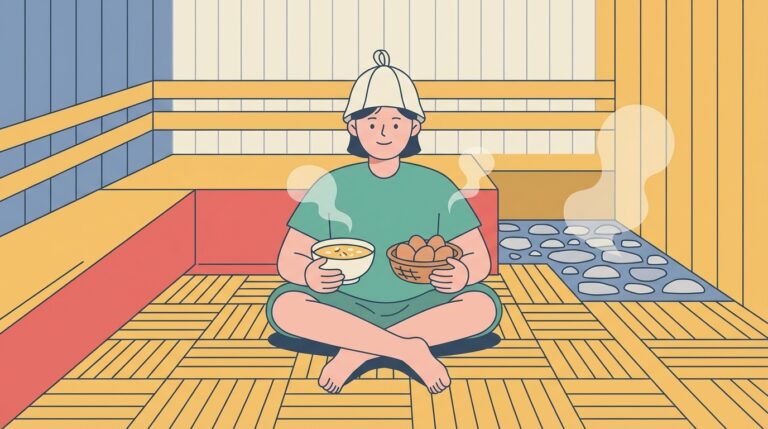
You’ve probably seen it in a K-Drama: a character, having run away from home or after a massive heartbreak, ends up sleeping on the floor of a large, brightly lit room. They are wearing a matching oversized T-shirt and shorts, with a towel folded on their head resembling sheep horns (Yangmeori). They aggressively crack a brown roasted egg on their friend’s forehead and chug a sweet rice punch (Sikhye).
Welcome to the Jjimjilbang (찜질방), the Korean traditional bathhouse and sauna. But wait—if you actually visit one, you’ll quickly realize it’s not just a giant pajama party. It involves rooms heated up to a blistering 90°C (194°F)! You might see an elderly Korean man sitting inside a furnace-like room, wiping off buckets of sweat, and muttering, “Ah… so refreshing!”
Wait, refreshing? In an oven?
As an advanced (C1) Korean learner, you already know basic greetings. Today, we are diving deep into the intricate vocabulary of Korean sauna health benefits and precautions. Knowing these expressions won’t just keep you safe from fainting; it will earn you the ultimate nod of respect from the locals. Let’s sweat it out!
Phase 2: Core Expressions Deep Dive
Let’s explore the expressions Koreans use when they are literally roasting themselves for health.
1. 아, 시원하다! (Ah, siwonhada!)
- Pronunciation: [a, si-won-ha-da] / The ‘won’ sounds like the English word “won” (as in “I won the game”).
- Meaning: Literal: “Ah, it’s cool!” / Real nuance: “Ah, this is incredibly cathartic and relieving!”
- K-Culture Moment: You’ll hear this from Korean uncles sitting in boiling hot water or stepping into a 85°C yellow clay sauna room. It completely baffles foreigners. In Korean culture, releasing trapped physical tension (through extreme heat or spicy food) provides a deeply cathartic release, which is described as “cool” or “refreshing.”
- Editor’s Insight: If you step into a scorching hot sauna and naturally let out an “Ah, siwonhada!”, Koreans will look at you and think, “Wow, this person truly understands the Korean soul.”
- Situation Spectrum:
[🚫 Absolute Ban] ———— [⚠️ Caution] ———— [✅ Freely Use]
- Close Friends (Casual): ✅ (시원하다! / siwonhada!)
- Coworkers/Acquaintances: ✅ (시원하네요! / siwonhaneyo!)
- Boss/Elders (Formal): ✅ (시원합니다! / siwonhamnida!)
- 🤔 Think About It: Why does the Korean language use the same word for a cool autumn breeze and a boiling hot sauna? How does your native language express the concept of “painful relief”?
2. 몸을 좀 지지고 싶어요. (Momeul jom jijigo sipeoyo.)
- Pronunciation: [mo-meul jom ji-ji-go si-peo-yo] / ‘ji-ji-go’ sounds like a bouncy “gee-gee-go”.
- Meaning: Literal: “I want to pan-fry/grill my body a bit.” / Real nuance: “I want to soothe my aching muscles with intense heat.”
- K-Culture Moment: This is an advanced, highly native expression. When the weather gets cold or after a long week of overtime work (야근), Korean office workers will say this. 지지다 originally means to pan-fry or sear (like making pancakes), but here it means pressing your tired body against a scorching hot stone floor.
- Editor’s Insight: This sounds incredibly native. It shows you understand the visceral, physical nature of Korean healing.
- Situation Spectrum:
[🚫 Absolute Ban] ———— [⚠️ Caution] ———— [✅ Freely Use]
- Close Friends (Casual): ✅ (몸 좀 지지자. / mom jom jijija.)
- Coworkers (Semi-formal): ⚠️ (Use cautiously; it’s a bit folksy/informal in vibe.)
- Boss/Elders (Formal): 🚫 (Too informal.)
- 🤔 Think About It: Does your culture have food-related verbs that are used to describe physical relaxation?
3. 무리하지 말고 수분 보충하세요. (Murihaji malgo subun bochunghaseyo.)
- Pronunciation: [mu-ri-ha-ji mal-go su-bun bo-chung-ha-se-yo]
- Meaning: Literal: “Don’t overdo it and replenish your moisture.” / Real nuance: “Take it easy and drink some water so you don’t pass out.”
- K-Culture Moment: Safety first! Saunas have immense health benefits (detoxing, improving circulation), but heat exhaustion is real. This is what a caring Korean friend or a Jjimjilbang staff member will tell you when your face turns suspiciously red.
- Editor’s Insight: 수분 보충 (Moisture/Hydration replenishment) is a very C1-level health term used frequently in daily life, much more than simply saying “물 마셔요” (drink water).
- Situation Spectrum:
[🚫 Absolute Ban] ———— [⚠️ Caution] ———— [✅ Freely Use]
- Anyone: ✅ (Highly polite and caring phrase.)
Phase 3: Textbook vs. Real Life Korean
| Situation | 📖 Textbook Korean | 🗣️ Real Korean | 💡 Why the difference? |
|---|---|---|---|
| Feeling stiff/tired | 몸이 피곤합니다. (My body is tired.) | 몸이 찌뿌둥하네. 사우나 가야겠다. (My body feels heavy/stiff. Gotta hit the sauna.) | “찌뿌둥하다” perfectly captures that heavy, pre-detox physical state. |
| Sweating a lot | 땀을 많이 흘렸습니다. (I sweated a lot.) | 땀을 쫙 뺐더니 살 것 같네. (Sweated it all out, feel like I’m alive again.) | “쫙 빼다” emphasizes the intentional, satisfying extraction of toxins. |
| Feeling dizzy | 어지럽습니다. 쉴게요. (I’m dizzy. I will rest.) | 핑 도네요. 밖에 좀 나갔다 올게요. (My head is spinning. I’ll step out for a bit.) | “핑 돈다” is an onomatopoeic slang for sudden dizziness due to heat/blood pressure drops. |
Phase 4: Cultural Deep Dive — K-Culture Connection
4-1. Non-verbal Communication: The Art of “Nunchi” in the Sauna
In the Jjimjilbang, Nunchi (눈치) is everything. Even though everyone is relaxing, there is an unspoken etiquette. If you are in the extremely hot Bulgama (불가마 – Fire Kiln), do not talk loudly. It is considered a meditative, healing space. People close their eyes and focus on their breathing. If you want to chat with your friends, move to the cooler, open common areas.
4-2. K-Food Connection: The Original Electrolyte Drink
Why do you always see K-Drama characters eating Sikhye (식혜 – Sweet Rice Punch) and Maekbanseok Gyeran (맥반석 계란 – Roasted Eggs) in the sauna? It’s not just a tasty K-Food trope; it’s ancient science!
When you sweat out toxins in the Hanjeungmak, you lose water, salt, and energy. Sikhye provides instant sugar and hydration, while the roasted eggs (cooked slowly on hot stones) provide easily digestible protein and sodium. It is the Korean equivalent of drinking Gatorade after an intense workout.
Critical tip: Don’t crack the egg on someone’s head unless you are very close friends. It hurts more than K-Dramas make it look!
Phase 5: Immersive Roleplay Scenario
Setting: Saturday night, 9 PM. A massive 5-story Jjimjilbang in Yongsan, Seoul. You and your Korean friend, Min-su (30, energetic, loves health trends), are currently sitting inside the 75°C Hwangtobang (Yellow Clay Room). Sweat is dripping down your chin. It’s been 10 minutes.
Min-su: 어우, 땀 좀 빼니까 찌뿌둥했던 몸이 다 풀리네요. 그쵸?
(Eou, ttam jom ppaenikka jjippudunghaetdeon momi da pullineyo. Geuchyo?)
(Wow, sweating a bit is relieving all the stiffness in my body. Right?)
(🎭 Stage Direction: Min-su wipes his forehead with his Yangmeori towel, looking completely at peace.)
YOU: 네, 진짜 시원하네요. 근데 여기 너무 뜨거운 거 아니에요?
(Ne, jinjja siwonhaneyo. Geunde yeogi neomu tteugeoun geo anieyo?)
(Yeah, it’s really refreshing. But isn’t it too hot in here?)
Min-su: 에이, 이 정도는 약과죠. 옆에 90도 불가마도 있는데!
(Ei, i jeongdoneun yakgwajyo. Yeope gusip-do bulgamado inneunde!)
(Ah, this is nothing. There’s a 90-degree fire kiln next door!)
Min-su: 얼굴이 좀 빨개지신 것 같은데, 괜찮아요?
(Eolguri jom ppalgaejisin geot gateunde, gwaenchanayo?)
(Your face looks a bit red, are you okay?)
🔀 Your Turn! How will you respond?
– A) “저 죽을 것 같아요. 당장 나갈래요!” (I feel like dying. I’m going out right now!)
– B) “아니요, 한국인처럼 몸 좀 더 지질게요!” (No, I’m going to roast my body more like a Korean!)
– C) “갑자기 핑 도네요. 무리하지 말고 수분 보충하러 나갈게요.”✅ Best Choice: C — Reason: While B shows enthusiasm, safety comes first in a sauna! Choice C uses advanced C1 vocabulary (“핑 도네요”, “무리하지 말고”, “수분 보충”), proving your fluency while safely exiting a potentially dizzying situation.
⚠️ Choice A Analysis: A bit dramatic. While understandable, Choice C sounds much more natural and mature.
(🎭 Stage Direction: You and Min-su step out into the cool hall.)
Min-su: 좋아요! 제가 매점에서 식혜랑 계란 쏠게요!
(Joayo! Jaega maejeomeseo sikhyerang gyeran ssolgeyo!)
(Good! I’ll treat us to Sikhye and eggs at the snack bar!)
Phase 6: 10-Second Shadowing Drill
Speak out loud! Follow the emotional tags and pauses ( / ).
😌 아으~ / 뜨끈하게 / 땀을 쫙 빼니까 / 진짜 시원하네요!
(A-eu~ / tteukkeunhage / ttameul jjak ppaenikka / jinjja siwonhaneyo!)
Translation: Ahhh~ After sweating it all out in the nice heat, it feels so refreshing!
Phase 7: K-Culture Glossary (Jjimjilbang Edition)
| Korean | Romanization | English Meaning | Cultural Context |
|---|---|---|---|
| 찜질방 | Jjimjilbang | Korean Bathhouse | A 24-hour gender-segregated bathhouse featuring communal sleeping areas and various hot/cold saunas. |
| 한증막 / 불가마 | Hanjeungmak / Bulgama | Traditional Fire Kiln | The hottest rooms in the sauna, often heated by burning pine wood. Temperatures can reach 90°C+. |
| 양머리 | Yangmeori | Sheep Head Towel | Folding a towel to look like Princess Leia buns. Popularized by early 2000s K-Dramas like My Lovely Sam Soon. |
| 세신사 | Sesinsa | Body Scrub Professional | The professional staff in the wet sauna who vigorously scrub dead skin off your body using an Italy Towel. |
| 때를 밀다 | Ttaereul milda | To scrub dead skin | A quintessential Korean bathhouse ritual for ultimate cleanliness and blood circulation. |
Phase 8: Traveler’s Survival Kit
If you are visiting a Jjimjilbang in Korea, these are the Top 3 Survival Phrases you must know, especially when dealing with the extreme heat.
🆘 Survival Phrase #1: Finding the oasis
– 🇰🇷 “얼음방이 어디에 있어요?” (Eoreumbangi eodie isseoyo?)
– 🗣️ Meaning: “Where is the Ice Room?”
– 📍 When to use: When you step out of the 90°C room and desperately need to drop your core temperature to avoid fainting.🆘 Survival Phrase #2: Restocking
– 🇰🇷 “수건 한 장만 더 주실 수 있나요?” (Sugeon han jangman deo jusil su innayo?)
– 🗣️ Meaning: “Could I please have one more towel?”
– 📍 When to use: At the front desk. Korean saunas usually provide exactly 2 towels per person. If you sweat a lot, you might need an extra.🆘 Survival Phrase #3: Paying for snacks
– 🇰🇷 “이거 락커 키로 결제되나요?” (Igeo rakkeo kiro gyeoljedaenayo?)
– 🗣️ Meaning: “Can I pay for this with my locker key?”
– 📍 When to use: At the snack bar.📌 Editor’s Travel Note: Health & Safety Warning
– Phones in the oven: DO NOT take your smartphone into the high-temperature Hanjeungmak. They can literally overheat and shut down (or worse, burst!). Leave them in the storage cubbies outside the room.
– Hydration: Do not drink alcohol before going into the hot rooms. It is extremely dangerous for your heart.
Phase 9: Think Deeper — “One Step Further”
🧠 Think Deeper: The Communal Body & Stripping Hierarchy
Korean society is famously structured around strict hierarchies—age, job title, and social status dictate the level of politeness (Honorifics) you must use. However, the bathhouse culture breaks this down. When everyone sheds their expensive suits and wears the exact same oversized, unflattering cotton Jjimjilbang uniform, social classes blur. Sweating profusely next to a stranger creates a unique, silent communal bonding. The physical discomfort of the extreme heat brings a shared mental relief. The Jjimjilbang is perhaps the most democratic space in Korea, where a CEO and a college student are equally vulnerable to the heat of the Hanjeungmak.
💬 Your Turn: Does your culture have a space where social hierarchies are temporarily suspended? Share your thoughts in the comments!
Phase 10: FAQ & Troubleshooting
Q: Do I have to get completely naked?
Yes and No! In the gender-segregated wet bath areas (목욕탕), you must be completely naked. However, the hot saunas (황토방, 불가마) and common sleeping areas are unisex, and you must wear the provided Jjimjilbang uniform (찜질복).
Q: I have a tattoo. Can I enter?
Unlike traditional Onsens in Japan, Korean Jjimjilbangs are generally very lenient about tattoos. Unless you have massive, threatening gang tattoos that cover your entire body, standard fashion tattoos are perfectly fine.
❌ Common Mistake #1: Falling asleep inside the high-temperature sauna (Hanjeungmak).
✅ Do this instead: K-Dramas show people sleeping in the Jjimjilbang, but that is in the cool common areas. Sleeping in a 70°C+ room can lead to severe dehydration or heatstroke. Limit your sessions to 10-15 minutes!
Phase 11: Wrap-up & Action Items
- One-Liner Summary: A Korean sauna isn’t just about getting hot; it’s about cathartic relief (Siwonhada!), safely detoxing (Ttameul jjuk ppaeda), and knowing your limits (Murihaji maseyo).
-
Action Mission 3 Stages:
- 🥉 Bronze: Say “아으~ 시원하다!” out loud next time you step into a hot shower.
- 🥈 Silver: Leave a comment on this blog using the word “찌뿌둥하다” to describe a time you felt tired.
- 🥇 Gold: Visit a Korean Jjimjilbang (or a local sauna), buy a Sikhye, and tell your friend “몸 좀 지지자!”
- K-Culture Mission: Watch a variety show like Running Man or a K-Drama featuring a Jjimjilbang scene. Pay attention to whether they are in the wet area, the hot dry sauna, or the common snack area. Spot the Yangmeori!
Phase 12: Interactive Quiz
1. Situational Judgment: You step into a 80°C Yellow Clay Room. An old man is sitting there, eyes closed, whispering “아, 시원하다.” What does he mean?
– A) He is hallucinating from the heat and thinks it’s cold.
– B) The air conditioning is broken.
– C) The intense heat is releasing his muscle tension, bringing cathartic relief.
(Answer: C)
2. Fill in the Blank: After a long week at the office, my body feels stiff and heavy.
“몸이 ( ________ )하네. 사우나 가야겠다.”
(Answer: 찌뿌둥)
3. True or False – K-Culture Edition: You should always take your smartphone inside the 90°C Bulgama to take aesthetic Instagram photos.
(Answer: False. The heat can destroy your phone’s battery. Leave it outside the hot rooms!)
Did you pass? Let me know your score below, and until next time—stay hydrated and siwonhada! 🧖♂️✨
Frequently Asked Questions (FAQ)
Q: What does "아, 시원하다! (Ah, siwonhada!)" mean in Korean and how do you pronounce it?
A: In Korean, "아, 시원하다! (Ah, siwonhada!)" is pronounced [a, si-won-ha-da] and means: Literal: "Ah, it's cool!" / Real nuance: "Ah, this is incredibly cathartic and relieving!"
Q: What does "몸을 좀 지지고 싶어요. (Momeul jom jijigo sipeoyo.)" mean in Korean and how do you pronounce it?
A: In Korean, "몸을 좀 지지고 싶어요. (Momeul jom jijigo sipeoyo.)" is pronounced [mo-meul jom ji-ji-go si-peo-yo] and means: Literal: "I want to pan-fry/grill my body a bit." / Real nuance: "I want to soothe my aching muscles with intense heat."
Q: What does "무리하지 말고 수분 보충하세요. (Murihaji malgo subun bochunghaseyo.)" mean in Korean and how do you pronounce it?
A: In Korean, "무리하지 말고 수분 보충하세요. (Murihaji malgo subun bochunghaseyo.)" is pronounced [mu-ri-ha-ji mal-go su-bun bo-chung-ha-se-yo] and means: Literal: "Don't overdo it and replenish your moisture." / Real nuance: "Take it easy and drink some water so you don't pass out."