

Hello there! I’m your Head Editor at Daily Hangul.
Phase 1: Immersive Hook
Imagine this: You’re at Incheon International Airport (ICN). The departure board is flashing, and you have two hours before your flight. In a classic K-Drama, this is the exact moment the chaebol heir sits in a dimly lit, exclusive VIP lounge, swirling a glass of whiskey before dramatically flying off to New York.
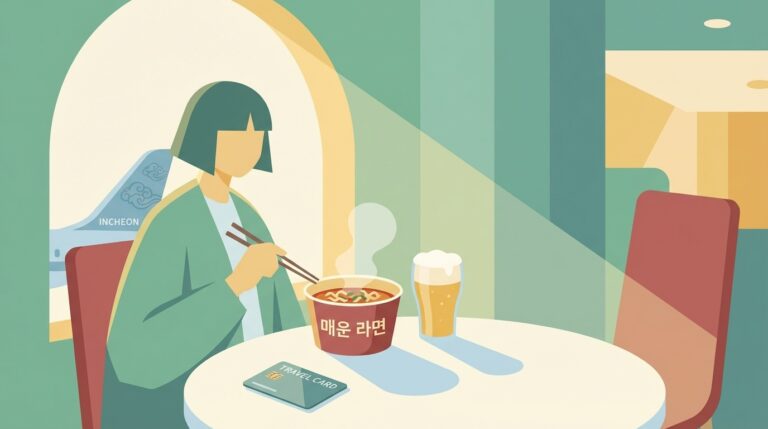
But let’s talk about the real-life Korean travel scene. Instead of sitting at the crowded boarding gates, savvy Korean travelers are heading upstairs to the Matina or Sky Hub Lounges. They aren’t paying the steep $40 entry fee, either. They’re scanning a sleek piece of plastic, walking straight in, and immediately pouring a pint of draft beer alongside a hot bowl of Shin Ramyun.
How? Welcome to the magic of the ‘PP카드’ (Priority Pass Card) and premium travel credit cards. At the C2 (Advanced) level, you don’t just want to know how to ask where the bathroom is. You want to know how to discuss credit card benefits, annual fees, and spending requirements like a true Seoulite who knows how to game the system. Let’s dive into the highly optimized, hyper-efficient world of Korean travel hacks!
Phase 2: Deep Dive into Core Expressions
If you walk into a Korean bank to open a travel card, or if you’re discussing travel hacks with your Korean colleagues, these are the high-level terms you absolutely must know.
1. 전월 실적 조건 없는 카드로 추천해 주세요.
- Pronunciation: [Jeon-wol sil-jeok jo-geon eom-neun kadeu-ro chu-cheon-hae ju-se-yo.] (Jeon-wol sounds like ‘John Wall’, sil-jeok sounds like ‘seal-juhk’)
- Meaning: Please recommend a card with no previous month’s spending requirements.
- K-Culture Moment: You’re sitting with a financial advisor at a bank in Gangnam. Korean credit cards offer insane benefits, but there’s a catch—the notorious 전월 실적 (previous month’s spending threshold). If you don’t spend, say, 300,000 KRW the month before, your lounge access is blocked.
- Editor’s Insight: This phrase instantly signals that you are a financial insider. You aren’t just a tourist; you understand the hidden mechanics of Korean consumerism.
- Situation Spectrum:
[🚫 절대 금지] ———— [⚠️ 주의] ———— [✅ 자유롭게]
- Close Friends (Casual): ✅ (Say: “전월 실적 없는 걸로 할래.”)
- Bank Teller (Formal/Polite): ✅
- 🤔 Think About It: Why do you think Korean card companies heavily enforce the ‘전월 실적’ system rather than just charging higher annual fees? How does this reflect the fast-paced, high-spending lifestyle of modern Korea?
2. 동반자 1인까지 무료입장 가능한가요?
- Pronunciation: [Dong-ban-ja irin-kka-ji mu-ryo-ip-jang ga-neung-han-ga-yo?]
- Meaning: Is free entry available for up to one companion?
- K-Culture Moment: You’re at the front desk of the Incheon Airport lounge with your friend. You confidently hand over your premium card.
- Editor’s Insight: Notice the use of 동반자 (companion) instead of the basic word 친구 (friend). In formal administrative or business Korean (C2 level), Sino-Korean vocabulary (Hanja) like ‘동반자’ elevates your speech to sound highly educated and context-appropriate.
- Situation Spectrum:
[🚫 절대 금지] ———— [⚠️ 주의] ———— [✅ 자유롭게]
- Airport Staff (Formal): ✅
- Friends (Casual): ⚠️ (Too formal for friends. Use: “내 카드로 너도 공짜로 들어갈 수 있어!”)
- 🤔 Think About It: In Korean culture, taking care of your group (일행) is crucial. How does having a card that covers a ‘companion’ elevate your social standing during a trip?
3. 이거 한 번 여행 가면 연회비 뽕을 뽑고도 남죠.
- Pronunciation: [I-geo han beon yeo-haeng ga-myeon yeon-hoe-bi ppong-eul ppop-go-do nam-jyo.]
- Meaning: Literal: If you go on a trip once, you’ll pull the roots of the annual fee with leftovers. Real: One trip alone more than makes up for the annual fee.
- K-Culture Moment: You’re having a beer with your coworkers, bragging about your new premium travel card that has a 150,000 KRW annual fee (연회비).
- Editor’s Insight: 뽕을 뽑다 is the ultimate native idiom. It means to get your money’s worth to the absolute maximum. It’s slightly slangy but universally used among adults to express high satisfaction with an investment or purchase.
- Situation Spectrum:
[🚫 절대 금지] ———— [⚠️ 주의] ———— [✅ 자유롭게]
- Friends/Coworkers (Casual/Semi-formal): ✅
- Boss/Seniors (Formal): ⚠️ (A bit too casual for the CEO, but fine for a friendly manager.)
Phase 3: Textbook vs Real Life
Let’s compare how a textbook teaches you to evaluate a credit card versus how young Korean professionals actually talk about them.
| Situation | 📖 Textbook Korean | 🗣️ Real Korean | 💡 Why the Difference? |
|---|---|---|---|
| Evaluating benefits | 이 카드는 혜택이 매우 좋습니다. (The benefits are very good.) | 이거 완전 혜자 카드예요. (This is totally a ‘Hyeja’ card.) | “혜자” comes from a celebrity known for generous lunchboxes; it’s the ultimate slang for ‘great value’. |
| Getting your money’s worth | 비용만큼의 가치를 합니다. (It is worth the cost.) | 가성비 갑이에요. / 뽕을 뽑아요. (It’s the boss of cost-effectiveness.) | Koreans are obsessed with ‘가성비’ (Price-to-performance ratio) in a highly competitive economy. |
| Using lounge benefits | 라운지 혜택만 이용하고 싶습니다. (I only want to use lounge benefits.) | 체리피킹 하기 좋은 카드네요. (It’s a good card for cherry-picking.) | Adopting English terms (Cherry-picking) is very common in Korean financial/consumer jargon. |
Phase 4: Cultural Deep Dive — K-Culture Connection
4-1. The K-Food Ritual of Incheon Lounges
If you think airport lounges are just about quiet seating and mediocre sandwiches, you haven’t experienced Korea. Incheon Airport lounges are essentially K-Food buffets. The absolute, undeniable ritual for any Korean traveler is to eat a bowl of 컵라면 (Cup Noodles, usually Shin Ramyun) and draft beer right before boarding.
Why? Because Koreans know they will miss the spicy, comforting taste of home while abroad. If you sit in the Matina Lounge, you will hear the collective slurping of noodles. Using your PP card to get this “free” last taste of Korea is considered the pinnacle of travel readiness.
4-2. The “Nunchi” of Card Swiping
When handing your card to the lounge attendant, remember your non-verbal communication. Even if you’re holding a shiny metal VIP card, always hand it over with two hands (or one hand supporting the other arm). Humility, or at least the appearance of it, is key. Flexing your wealth loudly is generally frowned upon; the true Korean flex is quietly reaping maximum benefits through smart choices (가성비).
Phase 5: Immersive Roleplay Scenario
Setting: A trendy cafe in Yeonnam-dong. It’s Friday afternoon. You and your savvy Korean coworker, Min-su, are looking at laptops, planning your upcoming business trip to Singapore.
Characters:
– YOU: An advanced Korean learner, currently holding a basic bank debit card.
– Min-su (32): Your coworker. He practically has a PhD in credit card points and travel hacks.
Dialogue:
Min-su: 싱가포르 갈 때 라운지 이용할 거죠? PP카드 있어요?
(Singgaporeu gal ttae raunji iyong-hal geojyo? PP-kadeu isseoyo?)
[You’re going to use the lounge when we go to Singapore, right? Do you have a PP card?]
YOU: 아, 저 아직 PP카드 없어요. 그냥 게이트 앞에서 기다리려고요.
(A, jeo ajik PP-kadeu eopseoyo. Geunyang geiteu apeseo gidariryeogoyo.)
[Ah, I don’t have one yet. I was just going to wait at the gate.]
Min-su: (Gasping in horror) 에이, 안 되죠! 창이공항 라운지가 얼마나 좋은데.
(Ei, an doejyo! Changi-gonghang raunjiga eolmana joeunde.)
[Hey, no way! Do you know how good Changi Airport lounges are?]
Min-su: 이번 참에 연회비 싼 걸로 하나 만들어요. 전월 실적 부담 없는 걸로요.
(Ibeon chame yeonhoebi ssan geollo hana mandeureoyo. Jeonwol siljeok budam eomneun geolloyo.)
[Take this chance to make one with a cheap annual fee. One without the burden of previous month’s spending.]
🔀 Your Turn! How do you respond like a native C2 speaker?
– A) 네, 은행에 가서 물어보겠습니다. (Very textbook, a bit robotic.)
– B) 연회비 비싸지 않아요? 그냥 돈 내고 들어갈게요. (Misses the point of the Korean ‘cherry-picking’ culture.)
– C) 오, 그래요? 연회비 뽕 뽑기 좋은 카드로 하나 추천해 주세요! (Perfect native nuance!)✅ Best Choice: C. Using “뽕 뽑기” shows you completely understand the cultural obsession with maximizing value, and asking for a recommendation (추천) plays perfectly into Min-su’s desire to share his insider knowledge.
(If you chose C…)
Min-su: 당연하죠! 제가 가성비 갑인 혜자 카드로 딱 리스트 뽑아드릴게요. 📱
(Dangyeonhajyo! Jaega gaseongbi gabin hyeja kadeuro ttak riseuteu ppobadeurilgeyo.)
[Of course! I’ll pull up a list of the absolute best value cards for you.]
Phase 6: 10-Second Shadowing Drill
Practice your flow! The key here is sounding natural and relaxed, not like you’re reading a textbook.
😊 저기요, / 이 카드로 / 동반자 1인까지 / 무료입장 가능한가요?
(jeogiyo, / i kadeuro / dongbanja irin-kkaji / muryo-ipjang ganeunghangayo?)
Tone: Polite, slightly upward inflection at the end, confirming information.
Phase 7: K-Culture Glossary (Travel Hack Edition)
| Korean | Romanization | English | Contextual Meaning |
|---|---|---|---|
| PP카드 | PP kadeu | Priority Pass Card | The universal Korean term for any card granting lounge access. |
| 전월 실적 | jeonwol siljeok | Previous month’s spending record | The minimum amount you must spend on a card to unlock its perks. |
| 연회비 | yeonhoebi | Annual fee | The yearly cost of holding a credit card. |
| 가성비 | gaseongbi | Cost-effectiveness | A core philosophy of modern Korean consumerism. |
| 실물 카드 | silmul kadeu | Physical card | Crucial! Many lounges don’t accept Apple Pay/Samsung Pay; you need the physical plastic. |
Phase 8: Traveler’s Survival Kit (Lounge Edition)
Even with C2 fluency, the airport can be stressful. Here are your absolute survival phrases for the lounge front desk.
🆘 Survival Phrases
– 🇰🇷 “PP카드랑 탑승권 여기 있습니다.” (PP-kadeurang tapseung-gwon yeogi itseumnida.)
– Meaning: Here is my PP card and boarding pass.
– 🇰🇷 “본인 한정인가요?” (Bonin hanjeong-ingayo?)
– Meaning: Is the benefit limited to the cardholder only?
– 🇰🇷 “샤워실 이용 대기 걸어둘 수 있을까요?” (Syawosil iyong daegi georeodul su isseulkkayo?)
– Meaning: Can I put myself on the waitlist for the shower room?📌 Editor’s Travel Note
Incheon Airport lounges (especially Matina) can have long lines during peak hours (7 AM – 9 AM, 6 PM – 8 PM). Sometimes, the “cost-effectiveness” (가성비) isn’t worth the 40-minute wait in line. Check the app The Lounge (더라운지) to see real-time congestion levels!
Phase 9: Think Deeper — Language & Power (The Culture of “Flex”)
🧠 Think Deeper: Global Era & The “Cherry-Picker” Identity
Why are there so many complex Korean words dedicated entirely to credit card benefits? In Korea’s hyper-competitive, capitalist society, being smart with your money is a badge of honor. To pay full price for something when a discount or a hack exists is often considered ‘호구’ (a sucker). The vocabulary we explored today—전월 실적, 뽕을 뽑다, 가성비—reflects a society that values extreme efficiency. As Korea globalized, international travel became a middle-class norm rather than a luxury. Thus, the “PP Card” evolved from a CEO’s status symbol into a tool for the everyday office worker looking to maximize their well-deserved vacation.
💬 Your Turn: Does your country have a culture of “credit card hacking” or churning? What idioms do you use to describe getting your money’s worth? Share in the comments!
Phase 10: Troubleshooting & FAQ
- Q: Can I use my Korean friend’s PP card if they aren’t traveling with me?
- A: 🚫 NO. Korean identity verification (본인 인증) is notoriously strict. The name on the boarding pass must match the name on the physical PP card and the credit card exactly. Do not even try it!
- Q: Is it rude to ask a bank teller if a card is “가성비”?
- A: It’s not rude, but it’s casual. To a professional, ask: “연회비 대비 혜택이 가장 좋은 카드가 무엇인가요?” (Which card has the best benefits compared to the annual fee?)
❌ Common Mistake: Confusing “신용카드” (Credit Card) with “체크카드” (Debit Card).
✅ Do this instead: Most premium lounge benefits in Korea require a 신용카드. If you are a foreigner on a specific visa, getting a credit card might be difficult, but some premium 체크카드 do offer lounge access if you meet the 전월 실적!
Phase 11: Wrap-up & Action Items
One-Liner Summary: To master Korean travel hacks at the C2 level, you must speak the language of ‘efficiency and value’ (가성비) when discussing card benefits.
Action Mission:
– 🥉 Bronze: Say “이거 연회비 뽕을 뽑고도 남죠!” out loud with dramatic K-Drama flair.
– 🥈 Silver: Go to a Korean forum (like Naver Cafe ‘스사사’ – a famous travel/card community) and read a post about PP cards to spot the vocabulary you learned today.
– 🥇 Gold: Next time you are at Incheon Airport, confidently hand over your card and boarding pass using our Survival Kit phrases!
Phase 12: Interactive Challenge (Quiz)
1. Situational Judgment: You are at the Matina Lounge desk. You want to bring your non-cardholder friend in with you using your card’s benefits. What do you say?
– A) 제 친구 공짜예요? (My friend is free?)
– B) 동반자 1인 무료입장 가능한가요? (Is free entry available for one companion?)
– C) 전월 실적 확인해 주세요. (Please check my previous month’s spending.)
2. Fill in the Blank (K-Culture Slang):
“이 카드 혜택 진짜 좋아. 완전 ( ____ ) 카드야!”
3. True or False:
If your friend lends you their PP card, you can use it at Incheon Airport as long as you know their PIN number. (T/F)
(Answers: 1. B – ‘A’ is too casual for front desk staff. / 2. 혜자 (Hyeja) / 3. False – Strict ID checks mean the name on the boarding pass must match the card!)
Frequently Asked Questions (FAQ)
Q: What does "전월 실적 조건 없는 카드로 추천해 주세요." mean in Korean and how do you pronounce it?
A: In Korean, "전월 실적 조건 없는 카드로 추천해 주세요." is pronounced [Jeon-wol sil-jeok jo-geon eom-neun kadeu-ro chu-cheon-hae ju-se-yo.] and means: Please recommend a card with no previous month's spending requirements.
Q: What does "동반자 1인까지 무료입장 가능한가요?" mean in Korean and how do you pronounce it?
A: In Korean, "동반자 1인까지 무료입장 가능한가요?" is pronounced [Dong-ban-ja irin-kka-ji mu-ryo-ip-jang ga-neung-han-ga-yo?] and means: Is free entry available for up to one companion?
Q: What does "이거 한 번 여행 가면 연회비 뽕을 뽑고도 남죠." mean in Korean and how do you pronounce it?
A: In Korean, "이거 한 번 여행 가면 연회비 뽕을 뽑고도 남죠." is pronounced [I-geo han beon yeo-haeng ga-myeon yeon-hoe-bi ppong-eul ppop-go-do nam-jyo.] and means: Literal: If you go on a trip once, you'll pull the roots of the annual fee with leftovers. Real: One trip alone more than makes up for the annual fee.







