

Phase 1: 공감 — 몰입형 오프닝 (Immersive Hook)
Hello! It’s your Daily Hangul Editor. 👋
Let’s set the scene: You’ve been watching K-Dramas like Weightlifting Fairy Kim Bok-joo or Cheese in the Trap. University life in Korea looks like a dream, right? Romantic walks under cherry blossoms, studying in aesthetically pleasing cafes, and effortlessly going to classes with your friends.
Record scratch.
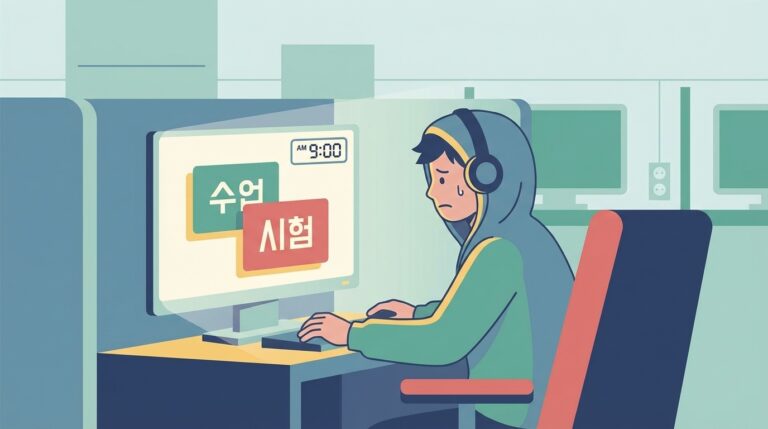
Reality check! If you actually study at a Korean university, your very first week is less of a romance and more of a survival thriller. At 8:59:59 AM, thousands of students are sitting in PC Bangs (internet cafes), violently clicking their mice to register for classes. We literally call this 수강신청 전쟁 (Course Registration War).
But what happens when the dust settles, you look at your hard-earned schedule, and realize… wait, my mandatory Korean History class and my Major Seminar are at the exact same time?!
If you don’t know how to navigate an overlapping schedule (시간표가 겹치다), you might end up taking a class you hate or, worse, delaying your graduation! Today, we are going to learn exactly how to fix this mess and talk to your professors or TAs like a true local student.
(Note: This guide is based on real frantic messages I’ve received from my exchange student tutees at Yonsei and Korea University!)
Phase 2: 핵심 표현 심층 분석 (Deep Dive)
Let’s look at the survival phrases you absolutely need when your schedule is a mess.
1. 시간표가 겹쳐요. (My schedules overlap.)
- Pronunciation: [si-gan-pyo-ga gyeop-cheo-yo]
- Sound-alike guide: ‘gyeop’ sounds like ‘yup’ but with a ‘g’ at the front. ‘cheo’ sounds like the ‘chu’ in ‘chubby’.
- Meaning: Literal: The timetable is layered. / Real nuance: I have a scheduling conflict.
- K-Culture Moment: You’ll hear this a lot in group chats during the first week of the semester. “아, 전공 필수랑 교양 시간표 겹쳤어! (Ah, my required major and elective schedules overlap!)”
- Editor’s Insight: The verb 겹치다 means ‘to overlap’ or ‘to fold over’. Koreans use this physically descriptive word for abstract things like time or events. It feels very visual, like two pieces of paper stacked on top of each other!
- Situation Spectrum:
[🚫 절대 금지] ———— [⚠️ 주의] ———— [✅ 자유롭게]
- Friends (Casual): ✅ (시간표 겹쳤어)
- Teaching Assistant/Professor (Formal): ✅ (시간표가 겹쳐서요 / 겹쳤습니다)
- 🤔 Think About It: In English, we say our schedules ‘conflict’ or ‘clash’ (which sounds like a fight). In Korean, they ‘overlap’ (겹치다). How does your native language describe a double-booked schedule?
2. 수강 정정 기간이 언제예요? (When is the course add/drop period?)
- Pronunciation: [su-gang jeong-jeong gi-ga-ni eon-je-ye-yo?]
- Meaning: Literal: When is the course correction period? / Real nuance: When can I fix my schedule?
- K-Culture Moment: This is the ‘second chance’ war. If you failed the first registration, the 정정 기간 (add/drop period) is when you constantly refresh the university portal to ‘pick up’ seats that other students drop.
- Editor’s Insight: ‘수강’ means taking a course, and ‘정정’ means correction. It’s an academic term, but everyone uses it daily in university life.
- Situation Spectrum:
[🚫 절대 금지] ———— [⚠️ 주의] ———— [✅ 자유롭게]
- Friends (Casual): ✅ (정정 기간 언제야?)
- University Office (Formal): ✅ (수강 정정 기간이 언제예요?)
3. 이 과목 취소할게요. (I will drop this course.)
- Pronunciation: [i gwa-mok chwi-so-hal-ge-yo]
- Meaning: Literal: I will cancel this subject. / Real nuance: I’m dropping this class.
- K-Culture Moment: In reality, Korean students heavily use Konglish here. They often say “나 이 과목 드랍(drop)할 거야.” But when speaking officially to a professor or clicking a button on the portal, it is always ‘취소(cancel)’ or ‘철회(withdraw)’.
- Editor’s Insight: Use ‘취소하다’ with the university staff, but feel free to say ‘드랍하다’ with your Korean classmates to sound like an insider!
Phase 3: 교과서 vs 진짜 한국어 (Textbook vs Real Life)
| Situation | 📖 Textbook Korean | 🗣️ Real Korean | 💡 Why the difference? |
|---|---|---|---|
| Telling a friend your schedule is ruined | “제 시간표가 중복되었습니다.” (My timetable has duplicated.) | “시간표 겹쳤어. 아 망했다 ㅠㅠ” (Schedules overlapped. Ah, I’m ruined T_T) | Friends express emotions! ‘망했다’ (I failed/ruined it) is the most common reaction to a bad schedule. |
| Dropping a class | “수강을 변경하겠습니다.” (I will change my enrollment.) | “나 이거 드랍(drop)하려고.” (I’m gonna drop this.) | University students love mixing English academic terms (Konglish) into casual chat for efficiency. |
| Trying to get a full class | “남은 자리가 있습니까?” (Are there any remaining seats?) | “혹시 남는 자리 주울 수 있을까?” (Do you think I can ‘pick up’ a leftover seat?) | ‘줍다’ (to pick up from the ground) perfectly describes the desperate act of snagging a canceled seat! |
Phase 4: 문화적 맥락 — K-Culture 딥다이브 (Cultural Deep Dive)
4-1. Non-verbal Communication: The Art of “Nunchi” (눈치)
When you visit the department office (학과 사무실) because of an overlapping schedule, you are usually asking for a favor—like squeezing into a class that is already full. This requires 눈치 (Nunchi), the subtle art of reading the room.
– Don’t march in demanding a fix.
– Stand slightly hesitantly, use a soft, slightly apologetic voice, and hold your hands together in front of you. This physical display of politeness makes Teaching Assistants (조교님) much more willing to help you navigate the complex university system!
4-2. K-Culture Connection: “빌가” (Begging for a class)
In K-Dramas, university life is all about MTs (Membership Training trips) and campus romance. But the gritty reality is 빌가 (Bil-ga). It’s slang for “빌어서 가는 수강신청” (Begging to get into a course).
When a mandatory class overlaps with another, and the only alternative is full, Korean students will literally email the professor with a heartfelt essay on why they must take this class to graduate, essentially begging for an extra seat. It’s a rite of passage! If your schedules overlap, you might need to try your own ‘빌가’!
Phase 5: 실전 롤플레이 시나리오 (Immersive Roleplay)
Main Scenario: Rescue My Schedule!
- Setting: Wednesday afternoon, 2nd week of the semester. The Department Office (학과 사무실). Phones are ringing, and students look stressed.
- Characters:
- YOU: An international exchange student. Your required Korean Language class overlaps with your Major Seminar.
- 조교님 (Teaching Assistant): A busy but kind grad student in their late 20s.
조교님: 다음 분 오세요. 무슨 일로 오셨어요? 📋
(da-eum bun o-se-yo. mu-seun il-lo o-syeot-seo-yo?)
[Next person, please. What brings you here?]
(🎭 Stage Direction: The TA looks up from a massive stack of papers, adjusting their glasses.)
YOU: 안녕하세요 조교님, 다름이 아니라… 제 시간표가 겹쳐서요.
(an-nyeong-ha-se-yo jo-gyo-nim, da-reumi a-ni-ra… je si-gan-pyo-ga gyeop-cheo-seo-yo.)
[Hello TA, it’s nothing else but… my schedules are overlapping.]
조교님: 아, 수강 정정 기간이라서요. 어떤 과목이 겹치나요?
(a, su-gang jeong-jeong gi-gan-i-ra-seo-yo. eo-tteon gwa-mo-gi gyeop-chi-na-yo?)
[Ah, because it’s the add/drop period. Which subjects are overlapping?]
YOU: 전공 필수랑 교양 과목이 같은 시간이에요.
(jeon-gong pil-su-rang gyo-yang gwa-mo-gi ga-teun si-ga-ni-e-yo.)
[My required major and elective course are at the same time.]
조교님: 음, 전공 필수는 꼭 들어야 하니까 교양을 취소하셔야겠네요. 혹시 다른 교양 과목 찾아보셨어요?
(eum, jeon-gong pil-su-neun kkok deu-reo-ya ha-ni-kka gyo-yang-eul chwi-so-ha-syeo-ya-get-ne-yo. hok-si da-reun gyo-yang gwa-mok cha-ja-bo-syeot-seo-yo?)
[Hmm, you must take the required major, so you’ll have to drop the elective. Have you looked for other elective courses?]
🔀 당신의 차례! 어떻게 대답할까요? (Your Turn! How should you reply?)
- A) “아니요. 조교님이 찾아주세요.” (No. You find it for me.)
- B) “네, 그런데 다른 과목들은 다 자리가 없어요. 어떻게 하죠?” (Yes, but the other courses have no seats. What should I do?)
- C) “저 그냥 둘 다 들을게요!” (I will just take both!)
✅ Best Choice: B — 이유 (Reason): It shows you tried to solve the problem yourself but hit a wall, asking politely for guidance.
⚠️ Choice A 분석: Absolutely 🚫! A TA is not your personal assistant; they will find this very rude.
⚠️ Choice C 분석: Impossible in the university system. The portal will spit out an error!
(Assuming you chose B)
조교님: 아… 그럼 교수님께 직접 메일을 보내서 남는 자리가 있는지 여쭤보시는 게 좋을 것 같아요.
(a… geu-reom gyo-su-nim-kke jik-jeop me-i-reul bo-nae-seo nam-neun ja-ri-ga it-neun-ji yeo-jjwo-bo-si-neun ge jo-eul geot ga-ta-yo.)
[Ah… then it would be best to email the professor directly to ask if there are any extra seats.]
YOU: 아, 네! 감사합니다. 메일 써볼게요!
(a, ne! gam-sa-ham-ni-da. me-il sseo-bol-ge-yo!)
[Ah, yes! Thank you. I’ll try writing an email!]
Phase 6: 10초 섀도잉 드릴 (Shadowing Drill)
Practice making your voice sound a little worried but polite! Pay attention to the pauses (/).
🥺 조교님, / 전공 필수 과목이 / 겹쳐서요... / 혹시 / 수강 정정 / 어떻게 하나요?
(jo-gyo-nim, / jeon-gong pil-su gwa-mo-gi / gyeop-cheo-seo-yo… / hok-si / su-gang jeong-jeong / eo-tteoh-ge ha-na-yo?)
Tip: Drag out the ‘요(yo)’ at the end of ‘겹쳐서요~~~’ just a tiny bit to sound extra polite and in need of help!
Phase 7: K-Culture 미니 사전 (K-Culture Glossary)
| 한국어 | Romanization | English | 맥락 설명 (Context) |
|---|---|---|---|
| 수강신청 | su-gang-sin-cheong | Course Registration | The ultimate battle of the semester. |
| 올클 | ol-keul | All Clear | Getting every single class you wanted (a rare, legendary achievement). |
| 피씨방 | pi-ssi-bang | PC Cafe | Where students go for high-speed internet to win the registration war. |
| 광클 | gwang-keul | Crazy Clicking | Clicking the mouse at light-speed the second the clock hits 9:00 AM. |
| 공강 | gong-gang | Free period | An empty time slot between classes. (If it’s too long, it’s called 우주공강 – cosmic gap!) |
Phase 8: 여행자(유학생) 서바이벌 키트 (Traveler/Student Survival Kit)
Navigating a massive Korean university campus is exactly like traveling in a new city. Here are 3 survival phrases you need when you’re lost on campus trying to fix your schedule!
🆘 서바이벌 표현 (Survival Phrases)
– 🇰🇷 “실례지만, [문과대] 학과 사무실이 어디예요?”
– (sil-lye-ji-man, [mun-gwa-dae] hak-gwa sa-mu-si-ri eo-di-ye-yo?)
– 🗣️ Excuse me, where is the [College of Liberal Arts] department office?
– 🇰🇷 “이 건물 몇 호인지 아세요?”
– (i geon-mul myeot-ho-in-ji a-se-yo?)
– 🗣️ Do you know what room number this building is?
– 🇰🇷 “학생증은 어디서 만들어요?”
– (hak-saeng-jeung-eun eo-di-seo man-deu-reo-yo?)
– 🗣️ Where do I make a student ID card?📌 Editor’s Campus Note
– Useful App: Don’t use Google Maps on campus! Download ‘에브리타임’ (Everytime). It’s the ultimate app for Korean university students. It builds your timetable automatically and tells you if classes overlap!
– Finding Buildings: Korean universities often use numbers or acronyms (e.g., J-Building). Always double-check the campus map online before walking 20 minutes up a hill (looking at you, Yonsei and KU!).
Phase 9: 비판적 사고 코너 — “한 발 더 깊이” (Think Deeper)
미디어 vs 현실 (Media vs Reality): The Myth of Campus Romance
🧠 Think Deeper:
If you watch K-Dramas, university life seems focused on romance, drinking games, and club activities. However, fixing an overlapping schedule reveals the intense competitiveness of Korean society. Because GPA (학점) is critical for getting a job at a top company (대기업), students fight desperately for classes that give easy A’s (꿀강). Course registration isn’t just admin work; it’s the first step in a highly competitive job market.💬 Your Turn: Does your university system rely on “first-come, first-served” speed clicking, or is it based on a lottery or academic year? Share your culture’s course registration style in the comments!
Phase 10: FAQ & 오해 방지 (Troubleshooting)
Q: “Can I just email the professor to say ‘My schedule overlaps, please let me in’?”
– Maybe, but be careful! Don’t just say “시간표가 겹쳐요 (My schedules overlap).” To a professor, you must be extremely formal. Use: “교수님, 전공 필수 과목과 시간이 겹쳐 부득이하게 교수님의 수업을 신청하지 못했습니다… (Professor, due to a clash with a required major, I unfortunately…)”.
Q: “Can I call the TA ‘선생님(Teacher)’?”
– Yes! If you don’t know if they are a TA (조교님) or a staff member (직원), calling them ‘선생님’ is the safest, most polite option.
❌ 흔한 실수 (Common Mistake):
Speaking to TAs in informal language (반말) just because they look young.
✅ 이렇게 하세요 (Do this instead):
TAs are usually graduate students and hold authority over your grades and administration. Always use polite form (존댓말), ending in ~요 or ~습니다!
Phase 11: 요약 및 액션 아이템 (Wrap-up)
- One-Liner Summary: When your classes crash into each other, politely tell the office: “시간표가 겹쳐서요. 수강 정정해야 할 것 같아요.” (My schedules overlap. I think I need to adjust my courses.)
-
Action Mission 3단계:
- 🥉 Bronze: Look at your own schedule (or calendar) and say “아, 시간표 겹쳤다!” out loud to the mirror.
- 🥈 Silver: Write down your ideal class schedule using Korean words (전공 = Major, 교양 = Elective).
- 🥇 Gold: If you are studying in Korea, ask a Korean classmate: “수강 정정 언제 할 거예요?” (When are you going to do your course add/drop?)
- K-Culture Mission: Go to YouTube and search “수강신청 브이로그” (Course Registration Vlog). Watch the pure panic on students’ faces at 8:59 AM. You’ll understand the culture immediately!
Engagement: Have you ever failed to get a class you really wanted? How did you fix it? Let me know below!
Phase 12: 퀴즈 — 인터랙티브 챌린지 (Interactive Quiz)
1. Fill in the blank:
You realize your Korean History class and Science class are at 2:00 PM. You say to your friend:
“야! 나 두 과목 시간표가 _______! 망했어!”
A) 싸웠어 (fought)
B) 겹쳤어 (overlapped)
C) 취소했어 (canceled)
2. True or False — K-Culture Edition:
“Korean students usually just walk into a full class and sit down if they really want to take it.” (T / F)
3. Situational Judgment:
You are talking to the department TA to drop a class. What is the BEST phrase?
A) 나 이거 드랍할래. (I wanna drop this.)
B) 이 과목 취소하고 싶습니다. (I would like to cancel/drop this course.)
C) 시간표 겹쳐. (Schedules overlap.)
👀 정답 보기 (Click for Answers)
1. B (겹쳤어) – We use ‘overlap’ for conflicting schedules!
2. False – You must officially register through the portal, or do ‘빌가’ (begging via email) to the professor to open an extra seat on the system.
3. B – Always use polite language (존댓말) and the official term ‘취소’ (cancel) with university staff!
Frequently Asked Questions (FAQ)
Q: What does "시간표가 겹쳐요. (My schedules overlap.)" mean in Korean and how do you pronounce it?
A: In Korean, "시간표가 겹쳐요. (My schedules overlap.)" is pronounced [si-gan-pyo-ga gyeop-cheo-yo] and means: a key conversational Korean expression covered in this lesson.
Q: What does "수강 정정 기간이 언제예요? (When is the course add/drop period?)" mean in Korean and how do you pronounce it?
A: In Korean, "수강 정정 기간이 언제예요? (When is the course add/drop period?)" is pronounced [su-gang jeong-jeong gi-ga-ni eon-je-ye-yo?] and means: Literal: When is the course correction period? / Real nuance: When can I fix my schedule?
Q: What does "이 과목 취소할게요. (I will drop this course.)" mean in Korean and how do you pronounce it?
A: In Korean, "이 과목 취소할게요. (I will drop this course.)" is pronounced [i gwa-mok chwi-so-hal-ge-yo] and means: Literal: I will cancel this subject. / Real nuance: I'm dropping this class.







