

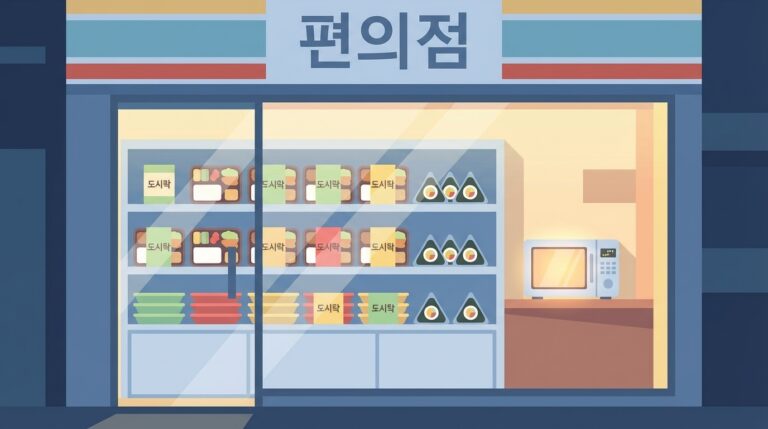
Reviewing K-Convenience Store Food Like a Local Pro!
Hello! It’s your Daily Hangul Editor. Grab a seat—preferably on one of those iconic green plastic chairs outside a Korean convenience store (편의점).
Picture this: It’s 11 PM in Seoul. You just finished binge-watching a K-Drama where the main characters bond over a late-night cup of ramen and a Triangle Gimbap (삼각김밥). Feeling inspired, you rush down to the neon-lit GS25 or CU on your corner. You’re standing in front of the glowing aisle of Dosirak (Bento boxes) and Gimbap. You pick one up, eat it, and it’s amazing. But when you want to review it on your Instagram or tell your Korean friends about it, you freeze. Are you just going to say “맛있어요” (It’s delicious) again?
If you want to sound like a real Korean foodie or a local Youtuber reviewing convenience store hauls, you need the right vocabulary. Let’s dive into the words that will upgrade you from a tourist to an absolute insider! (Trust me, knowing these will make your Korean friends go, “Whoa, how do you know that?”)
Phase 2: Deep Dive into Core Expressions
1. 가성비 대박이에요 (The cost-performance is amazing)
- Pronunciation: ga-seong-bi dae-bak-i-e-yo [gah-sung-bee dae-bah-gee-eh-yo]
- Meaning: Literal: Cost-effectiveness is a big hit. / Real nuance: It’s a fantastic value for the money.
- K-Culture Moment: You’ll hear this constantly in Korean Youtube vlog reviews. Imagine buying a Dosirak packed with bulgogi, sausage, kimchi, and egg rolls for just 5,000 KRW. You take a bite, look at the camera, and drop this line.
- Editor’s Insight: This phrase isn’t just about things being cheap; it’s about getting more than what you paid for. It’s the highest compliment you can give to a convenience store item.
- Situation Spectrum:
[🚫] ———— [⚠️] ———— [✅]
- Close Friends (Casual): ✅ (Drop the “요” and just say “가성비 대박!”)
- Coworkers (Semi-formal): ✅
- Boss/Elders (Formal): ⚠️ (A bit too slangy. Use “가격 대비 좋네요” instead.)
- 🤔 Think About It: Korea has a highly competitive consumer market. Why do you think “cost-effectiveness” (가성비) became such a buzzword in modern Korean society?
2. 전자레인지에 돌려주세요 (Please microwave it)
- Pronunciation: jeon-ja-re-in-ji-e dol-lyeo-ju-se-yo [jeon-jah-ray-in-jee-eh dol-lyuh-joo-seh-yo]
- Meaning: Literal: Please spin it in the microwave. / Real nuance: Please heat this up for me.
- K-Culture Moment: You bring a Dosirak to the counter. The cashier scans it and asks if you want it heated. This is your survival phrase!
- Editor’s Insight: Notice the verb “돌리다” (to spin/turn). Instead of saying “warm it up” (데우다), Koreans naturally say “spin it,” referring to the rotating glass plate inside the microwave. It sounds incredibly natural!
- Situation Spectrum:
[🚫] ———— [⚠️] ———— [✅]
- Friends (Casual): ✅ (“돌려줄까?” – Shall I heat it?)
- Cashier/Staff (Formal/Polite): ✅
- Boss/Elders (Formal): ⚠️ (Use “데워주세요” for maximum politeness.)
- 🤔 Think About It: Languages often evolve based on the physical mechanisms of technology (like “dialing” a phone). Do you have similar technology-based verbs in your native language?
3. 단짠단짠의 정석이에요 (It’s the epitome of sweet and salty)
- Pronunciation: dan-jjan-dan-jjan-ui jeong-seok-i-e-yo [dahn-jjahn-dahn-jjahn-wee jung-suk-ee-eh-yo]
- Meaning: Literal: It’s the textbook example of sweet-salty-sweet-salty. / Real nuance: It has the perfect balance of sweet and savory flavors.
- K-Culture Moment: You’re eating a Bulgogi Gimbap. The soy sauce is salty, but the marinade is sweet. It creates an addictive loop where you can’t stop eating. That’s “단짠단짠”.
- Editor’s Insight: “단” comes from 달다 (sweet) and “짠” comes from 짜다 (salty). It’s the ultimate flavor profile in modern Korean snacks and fast food.
- Situation Spectrum:
[🚫] ———— [⚠️] ———— [✅]
- Friends/Social Media (Casual): ✅
- Coworkers (Semi-formal): ✅
- Formal dining (Formal): 🚫 (Too trendy/casual for a high-end restaurant review.)
- 🤔 Think About It: Flavor descriptions reveal a lot about food trends. How would you describe the most popular flavor profile in your country’s snack culture?
Phase 3: Textbook vs Real Korean
| Situation | 📖 Textbook Korean | 🗣️ Real Korean | 💡 Why is it different? |
|---|---|---|---|
| Expressing it’s delicious | 이 김밥은 맛이 좋습니다. (This gimbap tastes good.) | 이거 완전 꿀맛! / 미쳤다! (This is totally honey-taste! / Crazy!) | Younger generations use intense, emotional words to express strong satisfaction. |
| Asking to heat food | 전자레인지로 데워주세요. (Please warm it with the microwave.) | 이거 30초만 돌려주세요. (Please spin this for 30 secs.) | “Spinning” focuses on the quick action, fitting the fast-paced convenience store vibe. |
| Praising the price/value | 가격이 저렴합니다. (The price is cheap.) | 혜자스럽다 / 가성비 갑 (It’s like Hye-ja / King of value) | “Hye-ja” comes from an actress known for a generous Dosirak brand, creating a cultural meme. |
Bottom Note: As a B2 learner, throwing in a casual “가성비 갑” (Top-tier value) among friends will instantly elevate your Korean from “student” to “local resident.”
Phase 4: Cultural Deep Dive
4-1. Non-verbal Communication (The Convenience Store ‘Nunchi’)
When reviewing or buying food, non-verbal cues matter. In a Korean convenience store, transactions are fast. If the cashier asks “데워드릴까요?” (Shall I heat it up?), a quick nod with a soft “네” (Yes) is enough. But the real Nunchi (눈치 – situational awareness) test comes after eating. Unlike in some countries, you are expected to perfectly clean up after yourself. Separating your trash into plastic (플라스틱), general waste (일반쓰레기), and food waste (음식물쓰레기) is a vital part of convenience store dining etiquette.
4-2. K-Culture Connection: The Dosirak Revolution
If you watch K-Dramas from 10 years ago, convenience store food was portrayed as a sad, cheap meal for struggling students. But today? It’s a gourmet battleground! This shift gave birth to the term “혜자스럽다” (hye-ja-seu-reop-da). Actress Kim Hye-ja launched a Dosirak line so incredibly generous in portion and quality that her name became a literal adjective for “generous and high quality.” So, if you review a heavily packed gimbap, call it “혜자 김밥”—your Korean friends will be deeply impressed by your cultural knowledge.
Phase 5: Immersive Roleplay
Scenario A: The Late-Night Snack Review
- Setting: 11:30 PM. Inside a brightly lit GS25 in Hongdae. You and your Korean coworker, Min-su, are sitting at the window counter. You just cracked open a new “Spicy Pork” Dosirak.
- Characters:
- YOU: An expat working in Seoul, always eager to try new K-Food.
- 민수 (Min-su, 32): Your friendly Korean coworker who loves to introduce you to local trends.
민수: 오, 그 새로 나온 제육 도시락이네? 맛있어? 🍱
(o, geu saero naon jeyuk dosiragine? masisseo?)
(English) Oh, is that the new spicy pork dosirak? Is it good?
(🎭 Stage Direction: Min-su leans in, looking curiously at your food.)
YOU: 네! 진짜 맛있는데요? 고기도 많고.
(ne! jinjja masinneundeyo? gogido manko.)
(English) Yes! It’s actually really good? There’s a lot of meat too.
민수: 역시 편의점 도시락은 가성비지. 안 매워?
(yeoksi pyeonuijeom dosirageun gaseongbiji. an maewo?)
(English) As expected, convenience store dosiraks are all about cost-performance. Is it not spicy?
🔀 Your Turn! How should you reply?
– A) 네, 아주 맵습니다. (Yes, it is very spicy.)
– B) 맵찔이한테는 좀 힘드네요! (It’s a bit tough for a spicy-food novice!)
– C) 와, 개매워요. (Wow, it’s freaking spicy.)✅ Best Choice: B — Why? Using “맵찔이” (Maep-jjiri: someone with zero spice tolerance) is a fantastic piece of self-deprecating humor that locals love. It instantly lightens the mood!
⚠️ Choice C Analysis: “개-” (gae) is a very common slang prefix for “freaking/extremely,” but it’s too rough for a coworker. Save it for your closest drinking buddies.
Scenario B: Bonus Roleplay at the Counter
- Setting: Paying for your Gimbap at the register.
- Cashier: 봉투 필요하세요? (bongtu piryohaseyo? – Do you need a bag?)
- YOU: 아니요, 괜찮아요. (aniyo, gwaenchanayo. – No, it’s okay.)
- Cashier: 영수증 버려드릴까요? (yeongsujeung beoryeodeurilkkayo? – Shall I throw away the receipt?)
- YOU: 네, 버려주세요. (ne, beoryeojuseyo. – Yes, please throw it away.)
Phase 6: 10-Second Shadowing Drill
Read these out loud to master the natural rhythm and intonation of a true Seoulite!
😊 사장님, / 이거 전자레인지에 / 1분만 / 돌려주세요~
(sajangnim, / igeo jeonjareinjie / ilbunman / dollyeojuseyo~)
“Boss (Staff), please microwave this for just 1 minute~”
😲 와! / 이거 완전 / 단짠단짠의 / 정석인데요?
(wa! / igeo wanjeon / danjjandanjjanui / jeongseogindeyo?)
“Wow! This is totally the epitome of sweet and salty!”
Phase 7: K-Culture Glossary
| Korean | Romanization | English | Contextual Explanation |
|---|---|---|---|
| 혼밥 | honbap | Eating alone | A massive cultural shift in Korea; eating alone used to be taboo, but is now a standard lifestyle, heavily supported by convenience store food. |
| 가성비 | gaseongbi | Cost-effectiveness | A critical factor in Korean consumer reviews. Good quality for a low price. |
| 단짠단짠 | danjjandanjjan | Sweet and salty | The magical flavor loop that makes snacks addictive. |
| 맵찔이 | maepjjiri | Spice novice | A cute, slightly self-deprecating term for someone who can’t handle spicy food. |
| 삼각김밥 | samgak gimbap | Triangle rice ball | The iconic, cheap, and fast Korean convenience store snack. Unwrapping it perfectly is a skill! |
Phase 8: Traveler’s Survival Kit
Are you heading to Korea soon? You’ll likely visit a convenience store on your very first day. Here is what you need to survive the rapid-fire questions at the register.
🆘 Survival Phrases TOP 3
– 🇰🇷 “봉투 하나 주세요.” (bongtu hana juseyo.)
– 🗣️ Sound-alike: bong-too ha-na joo-seh-yo
– 📍 Meaning: “Please give me one bag.”
– 🇰🇷 “데워드릴까요?” (deweodeurilkkayo?) -> “네, 데워주세요.” (ne, dewejuseyo.)
– 🗣️ Sound-alike: deh-woh-joo-seh-yo
– 📍 Meaning: “Shall I heat it up?” -> “Yes, please heat it.”
– 🇰🇷 “적립 하시나요?” (jeongnip hasinayo?) -> “아니요, 괜찮아요.”
– 🗣️ Sound-alike: ah-nee-yo, gwaen-cha-na-yo
– 📍 Meaning: “Are you collecting points?” -> “No, it’s okay.”📌 Editor’s Travel Note
– The 1+1 Culture: Look out for “1+1” or “2+1” tags on shelves! If you buy a 2+1 item but only bring two to the counter, the cashier will usually say “하나 더 가져오세요” (Please bring one more).
– Cash vs Card: Korea is a cashless society. You can pay for a 1,200 KRW gimbap with a credit card, and no one will blink an eye!
Phase 9: Think Deeper — “Food & Identity”
🧠 Think Deeper:
Traditionally, Korean food culture is deeply rooted in communal dining—sharing large pots of stew (찌개) and numerous side dishes. So, how did the highly individualized “Convenience Store Dosirak” become so popular? It reflects the rapid rise of single-person households (1인 가구) and the relentless “Pali-pali” (hurry up) work culture. The dosirak offers a compromise: a fast, solitary meal, yet it still tries to mimic a traditional home-cooked meal by cramming in rice and 5-6 different side dishes. It’s a fascinating blend of modern efficiency and traditional culinary identity.💬 Your Turn: How is the “fast food” or “convenience food” in your country adapting to modern lifestyles? Does it try to imitate traditional meals, or is it completely different? Share in the comments!
Phase 10: FAQ & Troubleshooting
Q: Can I use “가성비 대박” to my boss during a business lunch?
No! While it’s great for casual settings or reviewing a dosirak, using it in a formal business setting sounds a bit unpolished. If you are reviewing a fancy restaurant with your boss, use “가격 대비 훌륭하네요” (It’s excellent for the price).
Q: Is it okay to eat inside the convenience store?
Yes! Most stores have designated eating areas (tables or window counters). However, drinking alcohol inside or right in front of the store can sometimes be restricted depending on local laws and the store’s permit. Always check for a “음주 금지” (No Drinking) sign.
❌ Common Mistake:
Saying “전자레인지 해주세요” (Please do microwave).
✅ Do this instead:
Say “전자레인지에 돌려주세요” (Please spin it in the microwave) or “데워주세요” (Please heat it up). “Microwave” is a noun in Korean, not a verb!
Phase 11: Wrap-up & Action Items
One-Liner Summary: To review K-convenience store food like a local, focus on its value (가성비), its flavor balance (단짠단짠), and don’t forget to “spin it” (돌려주세요) in the microwave!
Your Action Missions:
– 🥉 Bronze (Solo): Look at a picture of a Korean Dosirak online and say out loud: “와, 가성비 대박!”
– 🥈 Silver (Online): Comment “단짠단짠 최고!” on a Youtube video reviewing Korean food.
– 🥇 Gold (Real Life): Visit a Korean mart or convenience store, buy a Triangle Gimbap, and successfully ask the cashier: “이거 30초만 돌려주세요!”
🎯 Special K-Culture Mission:
The next time you watch a K-Drama, pay attention to the convenience store scenes. Look closely at how they open the Triangle Gimbap (there is a strict 1-2-3 pulling order printed on the plastic!).
Phase 12: Interactive Challenge Quiz
1. Situational Judgment: You bought a spicy tteokbokki and a sweet bulgogi gimbap. You take a bite of both. What is the most natural Korean phrase to describe this combo to your friend?
– A) 아주 달고 맵습니다.
– B) 단짠단짠의 정석이네!
– C) 가성비 대박!
2. Fill in the Blank:
You are at the register. The cashier scans your food and asks “데워드릴까요?”
You reply: “네, 전자레인지에 _______.”
3. True or False – K-Culture Edition:
“In Korean convenience stores, it is customary to leave your empty ramen cups on the table for the staff to clean up.” (T / F)
Click here for Answers!
1. B – It’s the perfect textbook example of the sweet-salty (or in this case, sweet-spicy/salty) flavor loop!
2. 돌려주세요 (or 데워주세요) – Remember, we “spin” things in the Korean microwave.
3. False – You must always throw away your own trash and separate the recycling and food waste into the designated bins at the store!
Frequently Asked Questions (FAQ)
Q: What does "가성비 대박이에요 (The cost-performance is amazing)" mean in Korean and how do you pronounce it?
A: In Korean, "가성비 대박이에요 (The cost-performance is amazing)" is pronounced [ga-seong-bi dae-bak-i-e-yo [gah-sung-bee dae-bah-gee-eh-yo] and means: Literal: Cost-effectiveness is a big hit. / Real nuance: It's a fantastic value for the money.
Q: What does "전자레인지에 돌려주세요 (Please microwave it)" mean in Korean and how do you pronounce it?
A: In Korean, "전자레인지에 돌려주세요 (Please microwave it)" is pronounced [jeon-ja-re-in-ji-e dol-lyeo-ju-se-yo [jeon-jah-ray-in-jee-eh dol-lyuh-joo-seh-yo] and means: Literal: Please spin it in the microwave. / Real nuance: Please heat this up for me.
Q: What does "단짠단짠의 정석이에요 (It's the epitome of sweet and salty)" mean in Korean and how do you pronounce it?
A: In Korean, "단짠단짠의 정석이에요 (It's the epitome of sweet and salty)" is pronounced [dan-jjan-dan-jjan-ui jeong-seok-i-e-yo [dahn-jjahn-dahn-jjahn-wee jung-suk-ee-eh-yo] and means: Literal: It's the textbook example of sweet-salty-sweet-salty. / Real nuance: It has the perfect balance of sweet and savory flavors.







