

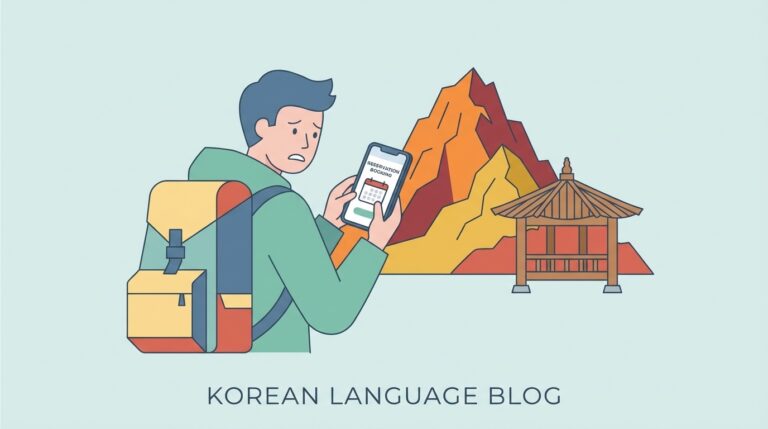
Conquering Jirisan: The Real Korean Guide to Ridge Hikes & Shelter “Blood-Ticketing”
Hello! I’m your Daily Hangul Editor, your resident language tutor and local cultural navigator.
Picture this: You’re watching the hit K-Drama Jirisan, captivated by the majestic peaks, the mysterious atmosphere, and the heroic park rangers. You think, “I want to hike that!” You look up the famous 3-day, 2-night ridge traverse course, get your gear ready, and casually try to book a mountain shelter a few days before your trip.
Error: Fully Booked.
Welcome to the ultimate test of both your physical stamina and your Korean survival skills. In Korea, hiking isn’t just a weekend hobby; it’s a massive subculture complete with its own lingo, fierce online battles for shelter beds, and unique etiquette. If you want to conquer Jirisan like a true local, textbook Korean won’t save you when the reservation server crashes. Let’s dive into the real, adrenaline-pumping vocabulary of Korean mountain culture!
Phase 2: Core Expressions Deep Dive
As a C1 learner, you’re ready to move beyond “산에 가요 (I go to the mountain)” and start using the specialized jargon that Korean hikers (and K-Pop fans!) use.
1. 대피소 피켓팅 뚫었어요? (Did you break through the shelter blood-ticketing?)
- Pronunciation: [daepiso piketting ttureosseoyo?] -> ‘ttureosseoyo’ sounds like ‘two-ross-oh-yo’ with a strong, tense ‘tt’.
- Meaning: Literal: Did you pierce through the shelter blood-ticketing? / Real nuance: Did you manage to successfully book a shelter despite the crazy competition?
- K-Culture Moment: 피켓팅 (Piketting) is a portmanteau of ‘피’ (blood) and ‘ticketing’. Originally coined by K-Pop fans fighting for concert tickets, this slang has perfectly transferred to Jirisan shelter reservations because the server literally crashes within 1 second of opening at 10 AM. Saying “예약했어요 (I reserved it)” is too mild. You have to “뚫다” (break through) it.
- Editor’s Insight: This expression carries a heavy sigh of relief and a badge of honor. You use it when you’ve achieved something that had a 99% chance of failure.
- Situation Spectrum:
[🚫 절대 금지] ———— [⚠️ 주의] ———— [✅ 자유롭게]
- Close friends/Fellow hikers (Casual): ✅
- Colleagues (Semi-formal): ✅ (Great icebreaker!)
- Formal Business/Elders (Formal): ⚠️ (Older hikers might just say “예약 성공했어요?”, but they will definitely understand and chuckle at ‘피켓팅’.)
- 🤔 Think About It: Why does Korean have so many aggressive verbs for administrative tasks (like 뚫다 – to pierce/break through, 잡다 – to catch)? How does Korea’s “빨리빨리” (hurry hurry) internet culture influence its language?
2. 지리산 종주 코스 (Jirisan Ridge Traverse Course)
- Pronunciation: [jirisan jongju koseu] -> ‘jongju’ sounds like ‘jong-joo’.
- Meaning: Literal: Longitudinal traverse / Real nuance: Hiking across the mountain peaks from one end to the other, rather than just climbing up and down one peak.
- K-Culture Moment: If you tell a Korean coworker you went to Jirisan, they’ll nod. If you tell them you did the “지리산 종주”, they will look at you with deep respect (or think you’re slightly crazy). It’s the ultimate bucket-list item for Korean hiking enthusiasts.
- Editor’s Insight: ‘종주’ implies endurance. It’s not just a hike; it’s a multi-day expedition carrying your life on your back.
- Situation Spectrum:
[✅ 자유롭게](Standard term used by everyone).- 🤔 Think About It: In many cultures, hiking is a solitary pursuit of nature. In Korea, completing a ‘jongju’ is often done in groups (산악회 – alpine clubs). How does the language reflect this shared endurance?
3. 안산, 즐산하세요! (Have a safe and joyful hike!)
- Pronunciation: [ansan, jeulsanhaseyo!] -> ‘an’ like in ‘ant’, ‘san’ like ‘sahn’, ‘jeul’ like the ‘j’ in jelly + ‘ul’.
- Meaning: Portmanteau of 안전한 산행 (Safe hike) and 즐거운 산행 (Joyful hike).
- K-Culture Moment: You’re passing by a group of older Koreans decked out in vibrant, neon GORE-TEX gear. They offer you a piece of cucumber and cheerfully shout this at you. It’s the “Aloha” of the Korean trail.
- Editor’s Insight: Koreans love abbreviating phrases to two syllables. It builds an instant sense of camaraderie (정 – Jeong) among hikers.
- Situation Spectrum:
[🚫 절대 금지] ———— [⚠️ 주의] ———— [✅ 자유롭게]
- Anyone on the trail (Casual to Formal): ✅ (Universal hiker greeting!)
Phase 3: Textbook vs Real Life
Let’s upgrade your vocabulary from the classroom to the trail.
| Situation | 📖 Textbook Korean | 🗣️ Real Korean | 💡 Why the difference? |
|---|---|---|---|
| Booking a shelter | 대피소를 예약하기 매우 어렵습니다. | 대피소 예약 완전 피켓팅이에요. 1초 컷이에요. | Koreans use internet slang (‘1초 컷’ – sold out in 1 sec) to exaggerate the intense competition. |
| Greeting hikers | 안전하게 등산하세요. | 안산하세요! / 즐산하세요! | Efficiency and community building. Abbreviated slang (줄임말) creates insider solidarity. |
| Eating at the peak | 정상에서 밥을 먹자. | 취사장에서 삼겹살 굽자. / 전투식량 먹자. | ‘전투식량’ (military rations) or cooking pork belly are the specific realities of Korean shelter dining. |
Bottom Note for C1 Learners: Using ‘1초 컷’ (1-cho cut) or ‘피켓팅’ instantly signals that you understand modern Korean digital culture, not just grammar.
Phase 4: Cultural Deep Dive
4-1. The “Nunchi” (눈치) of the Shelter
Korean mountain shelters (대피소) are not hotels; they are communal sleeping floors. At exactly 9:00 PM, the lights go out. This is where high-level 눈치 (Nunchi – situational awareness) is required. If you pack your bag with crinkling plastic bags at 4 AM, you will feel the silent, collective wrath of 50 hikers in the dark.
Pro Tip: Advanced hikers pack everything in silent pouches the night before.
4-2. K-Culture Connection: The “Chwisajang” (취사장) Michelin Star
If K-Dramas have Pojangmacha (street tents) for late-night soju, Korean mountains have the 취사장 (Cooking Area). Koreans don’t just eat cold sandwiches on a hike. They bring specialized compact stoves (버너) and cook ramen, pork belly (삼겹살), and share Makgeolli. It’s a bustling, noisy, warm environment where strangers become friends. You might sit down alone, and an auntie (아줌마) will inevitably ask, “학생, 이거 좀 먹어봐 (Student, try some of this),” handing you a massive wrap of pork and kimchi.
Phase 5: Immersive Roleplay
Scenario A: The Master Plan
Setting: A cozy cafe in Hongdae, one week before the reservation portal opens for the autumn foliage season on Jirisan. You are planning the Jongju with your Korean hiking buddy.
Characters:
– YOU: An adventurous expat wanting to tackle Jirisan.
– Minho (30): Your hyper-organized Korean friend, a veteran of “ticketing wars.”
Minho: 우리 다음 달 지리산 종주, 무조건 벽소령 대피소에서 자야 돼.
(uri daeum dal jirisan jongju, mujogeon byeoksoryeong daepisoyeseo jaya dwae.)
[For our Jirisan traverse next month, we absolutely must sleep at Byeoksoryeong Shelter.]
YOU: 그냥 내일 아침에 천천히 예약하면 안 돼? 자리가 없겠어?
(geunyang naeil achime cheoncheonhi yeyakhamyeon an dwae? jariga eopgesseo?)
[Can’t we just book it slowly tomorrow morning? Will there really be no spots?]
Minho: (Sighs, shaking his head) 너 지리산 단풍철을 너무 만만하게 본다. 대피소 예약은 K팝 아이돌 콘서트 피켓팅 급이야. 10시 정각에 광클해야 돼.
(neo jirisan danpungcheoreul neomu manmanhage bonda. daepiso yeyageun keipap aidol konseoteu piketting geubiya. yeolsi jeonggage gwangkeulhaeya dwae.)
[You’re underestimating the autumn foliage season at Jirisan. Shelter booking is on the level of a K-Pop idol concert blood-ticketing. You have to frantically click exactly at 10 o’clock.]
🔀 Your Turn! How should you respond?
– A) “아, 알겠어. 그럼 내가 내일 10시에 해볼게!” (Ah, got it. I’ll try at 10 AM tomorrow!)
– B) “진짜? 그럼 PC방 가야 되는 거 아니야? 내일 아침에 같이 가자!” (Really? Shouldn’t we go to a PC Bang then? Let’s go together tomorrow morning!)
– C) “예약 못 하면 그냥 텐트 치고 자면 되지~” (If we can’t book it, we can just pitch a tent and sleep~)✅ Best Choice: B — Why? Recognizing the severity of “Piketting” and suggesting a PC Bang (which has the fastest internet in Korea) shows immense cultural fluency!
⚠️ Choice C Analysis: Absolutely 🚫! Pitching a tent (야영) outside designated areas in Korean National Parks is strictly illegal and carries heavy fines.
Scenario B: The Peak (Bonus)
Setting: Cheonwangbong Peak (1,915m), freezing wind. An older hiker next to you is pouring hot coffee from a thermos.
Ahjussi: 젊은이! 외국에서 와서 턱까지 차오르게 고생했네. 이거 믹스커피 한 잔 마셔요.
[Young one! You came from abroad and worked so hard until you’re out of breath. Have a cup of this mix coffee.]
YOU: (With gratitude and freezing hands) 아, 감사합니다! 덕분에 몸이 확 녹네요. 안산하세요!
[Ah, thank you! My body is completely thawing thanks to you. Have a safe hike!]
Phase 6: 10-Second Shadowing Drill
Let’s practice the crucial phrase when greeting fellow hikers!
😊 안녕하세요! / 저희는 / 종주 중이에요. / 안산하세요! (annyeonghaseyo! / jeohuineun / jongju jung-ieyo. / ansanhaseyo!)
Tip: Keep the tone bright and energetic. The wind might be howling, so project your voice!
Phase 7: K-Culture Glossary (Mountain Edition)
| 한국어 | Romanization | English | Cultural Context |
|---|---|---|---|
| 입산통제 | ipsantongje | Trail Access Restriction | KNPS strictly controls trail access times (usually closing in the afternoon) to prevent night hiking accidents. |
| 산악회 | sanakhoe | Alpine Club | Massive groups of middle-aged Koreans who hike together, often renting chartered buses. Known for colorful gear and loud camaraderie. |
| 취사장 | chwisajang | Cooking Area | The designated room at a shelter where hikers cook. Cooking outside this area is strictly forbidden. |
| 광클 | gwangkeul | Frantic clicking | Slang from ‘광’ (crazy/mad) + ‘클릭’ (click). Necessary for shelter ticketing. |
| 야간산행 (야산) | yagansanhaeng | Night hiking | Usually done starting at 3 AM from a shelter to catch the sunrise at the peak. |
Phase 8: Traveler’s Survival Kit
If you are braving a Korean national park, you MUST know these phrases.
🆘 Survival Expressions
– 🇰🇷 “입산 시간 지났나요?” (ipsan sigan jinannayo?)
– 🗣️ Meaning: “Has the trail entry time passed?”
– 📍 When to use: At the park entrance. If you arrive too late, rangers will block you from starting.
- 🇰🇷 “아이젠 빌릴 수 있나요?” (aijen billil su innayo?)
- 🗣️ Meaning: “Can I rent crampons?”
- 📍 When to use: Near the shelter or entrance in winter. Jirisan has ice near the peak even in April!
🇰🇷 “자리 번호가 어디예요?” (jari beonhoga eodiyeyo?)
- 🗣️ Meaning: “Where is my seat/bed number?”
- 📍 When to use: Inside the crowded shelter, trying to find your allocated wooden floor space.
📌 Editor’s Travel Note
– Apps: Download the “국립공원공단” (KNPS) app for reservations. You’ll need a fast connection and possibly a Korean phone number for verification.
– Trash: Leave No Trace is strict. There are NO trash cans on Jirisan. You must carry all your garbage back down to the city.
Phase 9: Think Deeper — “A Step Further”
🧠 Think Deeper: Food & Identity at 1,900 Meters
From a purely survival standpoint, bringing lightweight energy bars on a grueling 3-day traverse makes sense. Yet, Korean hikers haul heavy backpacks filled with raw pork belly, fresh kimchi, burner stoves, and instant rice. Why? In Korean culture, “식구 (Sikgu)”—the word for family—literally translates to “mouths that eat together.” Sharing a hot, elaborate meal, even atop a freezing mountain, is the ultimate expression of “Jeong” (정, deep emotional connection). The mountain shelter isn’t just a place to rest; it’s a communal dining room where social bonds are forged over boiling ramen broth.💬 Your Turn: Does your culture have a unique “camping” or “hiking” food tradition? Or is efficiency the top priority? Share in the comments!
Phase 10: FAQ & Troubleshooting
Q: Is it polite to decline food from older hikers?
Yes, but do it graciously. Instead of a flat “No,” say, “정말 감사한데, 제가 배가 너무 불러서요 (I am truly thankful, but I am so full).”
Q: Can I just hike through the night to avoid booking a shelter?
Absolutely NOT. Night hiking (except for early morning ascents for sunrise from the shelter) is illegal in Korean National Parks to protect wildlife and hikers. You will be heavily fined.
❌ Common Mistake #1: Treating the shelter like a hotel.
✅ Do this instead: Bring your own sleeping bag or blanket, take off your hiking boots at the entrance, and maintain absolute silence after lights out (소등).
Phase 11: Wrap-up & Action Items
One-Liner Summary: Conquering Jirisan requires not just strong legs, but the cultural savvy to “break through” the ticketing wars and embrace the communal spirit of the “Chwisajang.”
Action Mission 3 Steps:
– 🥉 Bronze (Solo): Practice saying “대피소 피켓팅 뚫었어요!” out loud with a triumphant fist pump.
– 🥈 Silver (Online): Look up the “Jirisan National Park” website and see if you can navigate the Korean interface to find the shelter reservation page.
– 🥇 Gold (Real Life): Next time you meet a Korean friend who loves hiking, ask them “지리산 종주 해보셨어요?” and watch their eyes light up.
K-Culture Mission:
Watch Episode 1 of the K-Drama Jirisan. Pay close attention to the hikers’ colorful gear and the intense environment the park rangers deal with. Spot the “산악회” (alpine club) members!
Phase 12: Interactive Quiz
1. Situational Judgment: Your friend says they want to hike Jirisan tomorrow, and they will just figure out the sleeping arrangements when they get there. What is your response?
– A) “완벽한 계획이야!” (Perfect plan!)
– B) “대피소 피켓팅 안 하면 길바닥에서 자야 돼!” (If you don’t blood-ticket the shelter, you’ll sleep on the dirt!)
– C) “취사장에서 자면 돼.” (Just sleep in the cooking area.)
2. Fill in the Blank:
(Passing by a group of hikers on the trail)
“안녕하세요! _______ 하세요!”
3. True or False — K-Culture Edition:
It is considered rude to eat meat like pork belly (삼겹살) in the mountain shelter’s cooking area because of the smell. (T/F)
👉 Click to see answers!
1. B (A is a disaster. C is illegal—you cannot sleep in the cooking area!)
2. 안산/즐산 (ansan/jeulsan)
3. False. Cooking pork belly in the Chwisajang is practically a cultural heritage act in Korea. Just make sure to clean up your grease!
Frequently Asked Questions (FAQ)
Q: What does "대피소 피켓팅 뚫었어요? (Did you break through the shelter blood-ticketing?)" mean in Korean and how do you pronounce it?
A: In Korean, "대피소 피켓팅 뚫었어요? (Did you break through the shelter blood-ticketing?)" is pronounced [daepiso piketting ttureosseoyo?] and means: Literal: Did you pierce through the shelter blood-ticketing? / Real nuance: Did you manage to successfully book a shelter despite the crazy competition?
Q: What does "지리산 종주 코스 (Jirisan Ridge Traverse Course)" mean in Korean and how do you pronounce it?
A: In Korean, "지리산 종주 코스 (Jirisan Ridge Traverse Course)" is pronounced [jirisan jongju koseu] and means: Literal: Longitudinal traverse / Real nuance: Hiking across the mountain peaks from one end to the other, rather than just climbing up and down one peak.
Q: What does "안산, 즐산하세요! (Have a safe and joyful hike!)" mean in Korean and how do you pronounce it?
A: In Korean, "안산, 즐산하세요! (Have a safe and joyful hike!)" is pronounced [ansan, jeulsanhaseyo!] and means: Portmanteau of 안전한 산행 (Safe hike) and 즐거운 산행 (Joyful hike).







