

Phase 1: 공감 — 몰입형 오프닝 (Immersive Hook)
Hello there! Welcome back. I’m your lead editor and cultural navigator at Daily Hangul.
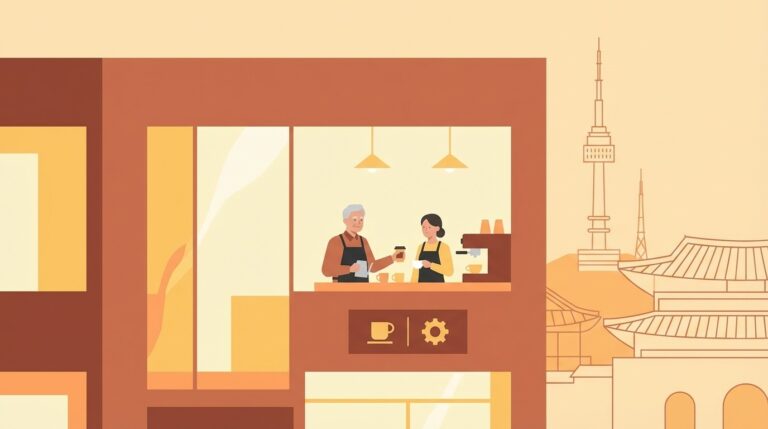
Picture this: You are watching a K-Drama like Navillera (나빌레라) or The Intern. A silver-haired gentleman, who once commanded a massive corporate division, is now wearing an apron, clumsily trying to foam milk for a cappuccino. The 30-something instructor corrects him, and there’s a brief moment of tension. The subtitles just say, “I’m starting over.” But what did he actually say? And what was the heavy, unspoken cultural weight hanging in the air?
South Korea is rapidly becoming a super-aged society. The “Silver Economy” (고령화 비즈니스) isn’t just a buzzword; it’s a massive societal shift. Everywhere you go in Seoul, from “Silver Cafes” to tech startups, retirees are entering vocational training programs (직업 훈련 프로그램) to learn coding, barista skills, or digital marketing.
As an advanced (C2) Korean learner, you aren’t just memorizing grammar anymore. You are reading the room. If you plan to work in Korea, consult, or even just engage deeply with Korean society, understanding the vocabulary of “post-retirement re-employment” is your golden ticket. It shows you understand not just the language, but the heart of modern Korea’s generational shifts. Let’s dive in!
Phase 2: 핵심 표현 심층 분석 (Deep Dive)
At the C2 level, we move beyond basic vocabulary into idioms and social metaphors. Here are three crucial expressions used in the Silver Economy.
1. 인생 이모작 (Life’s Second Harvest)
- Pronunciation: [in-saeng ee-mo-jak]
- Meaning: (Literal) Double-cropping of life / (Real Nuance) Starting a second career or new chapter after retirement.
- K-Culture Moment: In a documentary about senior entrepreneurs, the narrator will almost certainly use this phrase. When introducing themselves at a vocational center, a senior might proudly say, “저는 지금 인생 이모작을 준비하고 있습니다.” (I am preparing for my second harvest in life.)
- Editor’s Insight: “이모작” comes from agriculture (planting two different crops in one year). It’s a highly poetic, deeply respected term. It removes the stigma of “being unemployed” and replaces it with “cultivating something new.”
- Situation Spectrum:
[🚫 절대 금지] ———— [⚠️ 주의] ———— [✅ 자유롭게]
- Casual with young friends: 🚫 (They won’t get it or it’ll sound weird)
- Professional/Semi-formal (Talking to or about seniors): ✅
- Formal Speeches/Presentations: ✅
- 🤔 Think About It: Why does Korean rely heavily on agricultural metaphors (like seowing, harvesting) to describe human life? Does your native language use similar metaphors for retirement?
2. 왕년에는 말이야… (Back in my golden days…)
- Pronunciation: [wang-nyeo-ne-neun ma-ri-ya…]
- Meaning: (Literal) In former years, I tell you… / (Real Nuance) Back in my day… / When I was at my peak…
- K-Culture Moment: Picture a senior learning to use Excel. They get frustrated, sigh, and mutter, “왕년에는 내가 수백억을 주무르던 사람인데…” (Back in my day, I handled billions…). It’s the classic Kkondae (꼰대 – boomer) starter pack, often used in K-Dramas for comedic or tragic effect.
- Editor’s Insight: While younger Koreans roll their eyes at this, in a vocational training setting, it’s often a defense mechanism. It’s an expression of vulnerability from someone who used to be a master but is now a beginner again.
- Situation Spectrum:
[🚫 절대 금지] ———— [⚠️ 주의] ———— [✅ 자유롭게]
- You saying it about yourself (unless jokingly): ⚠️
- Listening to an elder say it: ✅ (Just nod and smile!)
- 🤔 Think About It: How does a culture built on age-based hierarchy handle the psychological shock when elders must learn from the youth?
3. 눈썰미가 참 좋으시네요 (You have a great eye for this)
- Pronunciation: [nun-sseol-mi-ga cham jo-eu-si-ne-yo]
- Meaning: (Literal) Your snow-sled-tail is good (false etymology!) / (Real Nuance) You pick things up very quickly just by watching.
- K-Culture Moment: A 25-year-old barista instructor watches a 65-year-old student perfectly tamp espresso on the first try. The instructor claps and says this. The senior beams with pride.
- Editor’s Insight: At C2, you should know that praising an elder directly (“잘하시네요” – You’re good) can sometimes sound patronizing, like you are evaluating them. “눈썰미가 좋다” shifts the compliment to their natural intuition and wisdom, making it perfectly polite.
- Situation Spectrum:
[🚫 절대 금지] ———— [⚠️ 주의] ———— [✅ 자유롭게]
- Praising a subordinate/student: ✅
- Praising an elder/senior student: ✅ (Highly recommended!)
Phase 3: 교과서 vs 진짜 한국어 (Textbook vs Real Life)
Let’s look at how the textbook phrases for finding a job evolve into advanced real-world usage.
| 상황 | 📖 교과서 한국어 | 🗣️ 진짜 한국어 | 💡 왜 다를까? |
|---|---|---|---|
| 은퇴 후 계획 묻기 | 은퇴 후에 무슨 일을 하실 겁니까? | 제2의 인생은 어떻게 설계하고 계신가요? | “제2의 인생” (Second life) sounds much more visionary and respectful than just “finding work.” |
| 새로운 기술 배우기 | 새로운 것을 배우는 것이 어렵습니다. | 영 감이 안 오네요. (or) 머리가 굳어서 쉽지 않네. | Seniors often use self-deprecating physical metaphors (“my brain has hardened”, “I can’t get the feel for it”). |
| 격려하기 | 열심히 하시면 할 수 있습니다. | 연륜은 무시 못 하죠. 금방 감 잡으실 거예요. | “연륜” (wisdom from years of experience) acknowledges their past, making the encouragement much deeper. |
Bottom Note for C2 Learners: Notice how we elevate the language by using words like 설계하다 (to design) and 연륜 (accumulated experience). This is the hallmark of C2 fluency.
Phase 4: 문화적 맥락 — K-Culture 딥다이브 (Cultural Deep Dive)
4-1. 비언어적 요소 (Non-verbal Communication): The Posture of Respect
When teaching or working with older adults in Korea, your body language speaks louder than your vocabulary. Even if you are the “Instructor” (the one with authority), you must maintain the physical posture of the “Junior” (the one with lesser age). This means:
– Using two hands when handing over training materials or tools (like a tablet or a coffee tamper).
– Never pointing with one finger. Always gesture with an open palm facing upward.
– Utilizing Nunchi (눈치): If an elder is struggling but looks too proud to ask for help, step in subtly without making a scene.
4-2. K-Drama Connection: The “Late Bloomer” Trope
In dramas like Navillera (where a 70-year-old learns ballet) or The Intern (Kkondae Intern, where a senior citizen joins as a corporate intern), the core conflict is always Age vs. Rank.
Korean society is hyper-structured around age. But the Silver Economy breaks this structure. Suddenly, 60-somethings are the rookies (막내), and 30-somethings are the bosses (팀장님). The K-Drama tension comes from the awkward dance of honorifics: The young boss must give orders using extreme polite Korean (극존칭), while the older intern must force themselves to use polite Korean to someone half their age.
Critical Viewpoint: While dramas often romanticize this dynamic, turning it into heartwarming comedy, the reality in actual Korean vocational centers can be incredibly stressful for both parties. Linguistic friction is a real hurdle in Korea’s re-employment sector.
Phase 5: 실전 롤플레이 시나리오 (Immersive Roleplay)
Setting: Friday afternoon. A brightly lit “Digital Literacy Center for Seniors” in Gangnam. You are a foreign HR consultant volunteering as a tech assistant.
Characters:
– YOU: A C2-level Korean speaker, empathetic and professional.
– Mr. Kim (65): A former bank executive. Proud, slightly stubborn, but secretly very eager to learn how to use a food delivery app.
Dialogue:
Mr. Kim: (Sighs heavily, tapping the tablet too hard) 아휴, 영 감이 안 오네. 내가 왕년에는 지점장까지 했던 사람인데, 이 조그만 기계 하나를 못 다루다니…
(Ahyu, yeong gami an one. Naega wangnyeoneneun jijeomjangkkaji haetdeon saraminde, i jogeuman gigye hanareul mot darudani…)
(Sigh, I can’t get the feel for this at all. Back in my day, I was a branch manager, and now I can’t even handle this little machine…)
(🎭 Stage Direction: Mr. Kim pushes the tablet away, looking embarrassed)
YOU: 에이, 선생님. 처음이라 그래요.
(Ei, seonsaengnim. Cheoeumira geuraeyo.)
(Ah, Sir, it’s just because it’s your first time.)
Mr. Kim: 우리 젊은 선생님 보기에 참 답답하죠? 머리가 다 굳어서 원…
(Uri jeolmeun seonsaengnim bogie cham dapdaphajo? Meoriga da gudeoseo won…)
(It must be frustrating for a young teacher like you to watch, right? My brain has just hardened…)
🔀 당신의 차례! 어떻게 대답할까요? (Your Turn! How do you respond?)
– A) “네, 조금 답답하지만 계속 연습하면 괜찮아질 거예요!” (Honest, but a linguistic disaster.)
– B) “할아버지, 걱정 마세요. 제가 다 해드릴게요.” (Treating him like a child. Extremely offensive in this context.)
– C) “무슨 말씀을요! 지점장까지 하셨던 그 연륜이 어디 가겠어요? 눈썰미가 좋으셔서 금방 감 잡으실 겁니다!” (Using his past experience to boost his confidence.)✅ Best Choice: C — Why? You acknowledge his “왕년” (golden days) respectfully by mentioning his past title (지점장), validate his “연륜” (wisdom), and use “눈썰미” to praise his learning ability. You have just won his absolute loyalty!
⚠️ Choice B Analysis: Never call an active senior learner “할아버지” (Grandpa) in a professional or educational setting. Always use “선생님” (Teacher/Sir) or “여사님” (Madam), regardless of whether they actually teach or not.
Phase 6: 10초 섀도잉 드릴 (Shadowing Drill)
Let’s practice delivering that perfect, respectful encouragement. Focus on the pauses (/) and the intonation!
😊 선생님, / 무슨 말씀을요! / (seon-saeng-nim / mu-seun mal-sseu-meul-yo!)
😤 지점장까지 하셨던 / 그 연륜이 / 어디 가겠습니까? / (ji-jeom-jang-kka-ji ha-syot-deon / geu yeon-ryu-ni / eo-di ga-get-seum-ni-kka?)
😊 눈썰미가 좋으셔서 / 금방 / 감 잡으실 겁니다! (nun-sseol-mi-ga jo-eu-syeo-seo / geum-bang / gam ja-beu-sil geom-ni-da!)
(Pro Tip: Emphasize ‘연륜’ and ‘눈썰미’ with a warm, confident tone!)
Phase 7: K-Culture 미니 사전 (K-Culture Glossary)
| 한국어 | Romanization | 영어 | 맥락 설명 |
|---|---|---|---|
| 평생교육원 | pyeong-saeng-gyo-yuk-won | Lifelong Education Center | The hub of the Silver Economy. Where seniors go to learn everything from real estate to coding. |
| 연륜 | yeon-ryun | Wisdom of age/Experience | The positive aspect of aging. The deep knowledge acquired over years. |
| 꼰대 | kkon-dae | Boomer / Condescending elder | A slang term for an older person who forces their outdated views on the youth. |
| 인생 이모작 | in-saeng ee-mo-jak | Life’s second harvest | A dignified, respectful term for starting a new career post-retirement. |
| 실버 택배 | sil-beo taek-bae | Silver Courier Service | A popular post-retirement job in Korea where seniors deliver packages locally using specialized carts. |
Phase 8: 여행자 & 비즈니스 서바이벌 키트 (Traveler & Business Survival Kit)
Even if you are just traveling or visiting Korea on a business trip, you will interact with the Silver Economy. Many palace guides, subway help desk staff, and local cafe baristas are seniors participating in government re-employment programs.
🆘 서바이벌 표현 TOP 3 (Silver Economy Interaction)
- 🇰🇷 “어르신, 실례하지만 길 좀 여쭤봐도 될까요?”
- 🗣️ (eo-reu-sin, sil-lye-ha-ji-man gil jom yeo-jjwo-bwa-do doelkka-yo?)
- 🇬🇧 Elder, excuse me, but may I ask for directions?
- 📍 Use it: When asking a senior volunteer or worker for help. “어르신” is highly respectful.
- 🇰🇷 “커피 정말 맛있네요. 솜씨가 대단하세요!”
- 🗣️ (keo-pi jeong-mal ma-sin-ne-yo. som-ssi-ga dae-dan-ha-se-yo!)
- 🇬🇧 The coffee is truly delicious. Your skills are amazing!
- 📍 Use it: At a “Silver Cafe.” Praising their “솜씨” (skill) will make their day.
- 🇰🇷 “천천히 하셔도 괜찮습니다.”
- 🗣️ (cheon-cheon-hi ha-syeo-do gwaen-chan-seum-ni-da.)
- 🇬🇧 It’s okay if you take your time.
- 📍 Use it: If a senior worker is struggling with a modern POS system or a payment terminal.
📌 Editor’s Note
– Title matters: Never use “아저씨/아줌마” (middle-aged man/woman) or “할아버지/할머니” (grandpa/grandma) in a service or professional setting. Default to 선생님 (Sir/Madam) or 어르신 (Elder).
Phase 9: 비판적 사고 코너 — “한 발 더 깊이” (Think Deeper)
🧠 Think Deeper: 언어와 권력 (Language & Power)
The post-retirement training center is a linguistic battlefield. Standard Korean dictates that age is the ultimate metric for respect. However, modern corporate and educational structures place Role above Age. When a 30-year-old instructor teaches a 65-year-old student, Korean society experiences a “glitch.”
To navigate this, Koreans developed a fascinating compromise: The younger instructor assumes ultimate authority but coats every sentence in extreme honorifics (극존칭), saying “하시겠습니다” instead of “할게요”. Meanwhile, the older student uses standard polite form (해요체), acknowledging the instructor’s authority without completely lowering themselves. It is a brilliant, highly complex linguistic dance of mutual respect.
💬 Your Turn:
How does your culture navigate situations where a much younger person is the boss or teacher of an older person? Does the language itself change, or just the tone? Let me know in the comments!
Phase 10: FAQ & 오해 방지 (Troubleshooting)
Q: In class, an older student told me to “drop the honorifics” (말 놓으세요). Should I?
A: NO! This is a C2-level trap. Even if they tell you to speak comfortably because you are the teacher, in a Korean professional setting, dropping honorifics to someone 30 years older than you will severely damage your reputation among others watching. Politely decline: “아닙니다, 선생님. 제가 존댓말을 쓰는 게 편해서요.” (No, Sir. I am more comfortable using honorifics.)
Q: Can I tell an older trainee “파이팅!” (Fighting!) to encourage them?
A: ⚠️ Maybe, but be careful. “파이팅” can sometimes feel a bit too casual and top-down.
❌ 흔한 실수 #1: “선생님, 파이팅하세요!”
✅ 이렇게 하세요: “선생님, 응원하겠습니다!” (I am cheering for you!) or “잘하실 수 있을 겁니다!” (You will be able to do well!).
Phase 11: 요약 및 액션 아이템 (Wrap-up)
One-Liner Summary: To master the Korean Silver Economy, swap out textbook phrases for deeply respectful metaphors like “인생 이모작” and praise their “연륜” and “눈썰미.”
Action Mission:
– 🥉 Bronze: Look in the mirror and practice the phrase “인생 이모작을 응원합니다!” three times with a respectful bow.
– 🥈 Silver: Go to a Korean language forum and write a short paragraph about what you want your “인생 이모작” to be.
– 🥇 Gold: The next time you visit Korea and see a senior citizen working at a cafe or subway, use “어르신” and “천천히 하셔도 괜찮습니다” to show profound cultural respect.
– 🎬 K-Culture Mission: Watch episode 1 of Navillera (나빌레라). Listen closely to how the young ballet teacher addresses the elderly student. Write down the titles they use!
Phase 12: 퀴즈 — 인터랙티브 챌린지 (Interactive Quiz)
Test your C2 “Silver Economy” instincts!
1. 상황 판단 문제 (Situational Judgment)
You are consulting at a “Senior Tech Startup.” An elderly employee successfully compiles their first Python code. What is the most C2-appropriate praise?
– A) 참 잘했어요! (Good job!)
– B) 할아버지 천재시네요! (Grandpa, you’re a genius!)
– C) 와, 눈썰미가 정말 좋으십니다!
2. True or False — K-Culture 에디션
“When an older person says ‘왕년에는 말이야…’ (Back in my day…), the polite Korean response is to tell them to focus on the present.”
– (T / F)
3. 빈칸 채우기 (Fill in the Blank)
은퇴 후 새로운 직업을 찾는 것을 농사에 비유하여 _________ 라고 부릅니다.
(Scroll down for answers!)
…
…
…
Answers:
1. C (A is for children. B uses the forbidden ‘할아버지’.)
2. False (It’s often a defense mechanism. Listen politely and acknowledge their past experience or ‘연륜’.)
3. 인생 이모작 (Life’s second harvest.)
How did you do? Let me know your score in the comments below! See you in the next lesson.
Frequently Asked Questions (FAQ)
Q: What does "인생 이모작 (Life's Second Harvest)" mean in Korean and how do you pronounce it?
A: In Korean, "인생 이모작 (Life's Second Harvest)" is pronounced [in-saeng ee-mo-jak] and means: (Literal) Double-cropping of life / (Real Nuance) Starting a second career or new chapter after retirement.
Q: What does "왕년에는 말이야... (Back in my golden days...)" mean in Korean and how do you pronounce it?
A: In Korean, "왕년에는 말이야... (Back in my golden days...)" is pronounced [wang-nyeo-ne-neun ma-ri-ya...] and means: (Literal) In former years, I tell you... / (Real Nuance) Back in my day... / When I was at my peak...
Q: What does "눈썰미가 참 좋으시네요 (You have a great eye for this)" mean in Korean and how do you pronounce it?
A: In Korean, "눈썰미가 참 좋으시네요 (You have a great eye for this)" is pronounced [nun-sseol-mi-ga cham jo-eu-si-ne-yo] and means: (Literal) Your snow-sled-tail is good (false etymology!) / (Real Nuance) You pick things up very quickly just by watching.






