

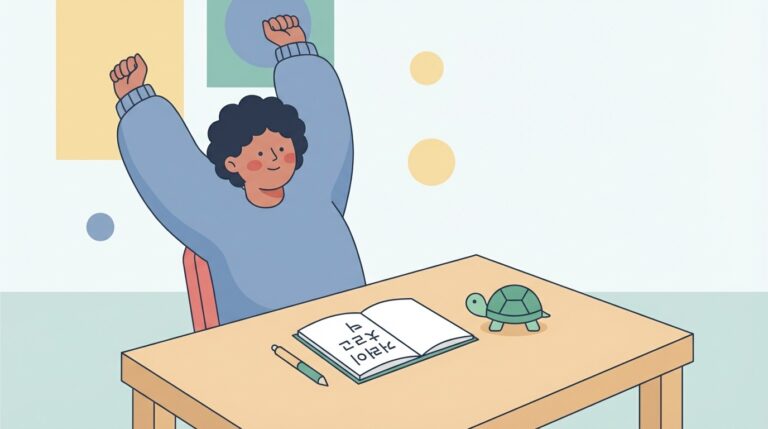
Hello! I’m the Lead Editor of Daily Hangul. Have you ever been riding the Seoul subway, looked around, and realized that 90% of the people are completely absorbed in their smartphones, their necks bent at a drastic 45-degree angle? Or maybe you’ve been binge-watching a K-Drama for five hours straight, and now your neck feels like it’s made of solid concrete.
Welcome to the modern Korean struggle! Today, we are tackling a very specific, yet incredibly common topic in Korea: “거북목” (Turtle Neck) and posture correction. If you study Korean for hours, work at a desk, or just love spending time at a PC Bang, this is the ultimate survival guide for your health.
This guide isn’t just about anatomy; it’s about the everyday survival phrases real Koreans use to complain about their aching bodies and find relief. Let’s dive in!
Phase 2: Deep Dive into Core Expressions
1. 거북목 (Forward Head Posture / “Turtle Neck”)
- Pronunciation: [geo-bung-mok] (Sounds like ‘guh-boong-mock’)
- Meaning: Literal: Turtle neck. Real nuance: Forward head posture caused by looking at screens too much.
- K-Culture Moment: You’ll often see K-Drama characters at the office rubbing the back of their necks while staring at their monitors. In real life, friends will lightly smack your back and say, “Hey, you look like a turtle right now!”
- Editor’s Insight: This word is universally understood in Korea. It’s almost become a national syndrome due to Korea’s hyper-connected, “Pali-Pali” (hurry-hurry) tech culture.
- Situation Spectrum:
[🚫 절대 금지] ———— [⚠️ 주의] ———— [✅ 자유롭게]
- Friends (Casual): ✅
- Coworkers (Semi-formal): ⚠️ (Only if you are close)
- Boss/Elders (Formal): 🚫 (Do not diagnose your boss!)
- 🤔 Think About It: Why did Koreans name a medical condition after a turtle? Is it because visual metaphors make clinical problems feel more relatable and less intimidating in daily conversation?
2. 뻐근하다 (To feel stiff / tight)
- Pronunciation: [ppeo-geun-ha-da] (The ‘ppeo’ sounds like the strong ‘p’ in ‘spa’ with an ‘uh’ sound)
- Meaning: Literal: Stiff. Real nuance: That heavy, dull ache in your muscles when you haven’t moved for hours.
- K-Culture Moment: After a grueling 3-hour gaming session at a PC Bang or finishing the TOPIK exam, Koreans will stretch their arms to the sky, groan loudly, and say “아, 뒷목 뻐근해” (Ah, the back of my neck is so stiff).
- Editor’s Insight: This is purely for muscle stiffness. Don’t use it when you have a sharp, stabbing pain or an infection.
- Situation Spectrum:
[🚫 절대 금지] ———— [⚠️ 주의] ———— [✅ 자유롭게]
- Friends (Casual): ✅
- Coworkers (Semi-formal): ✅ (Good for small talk!)
- Boss/Elders (Formal): ✅ (Safe to express your own fatigue)
- 🤔 Think About It: Korean has countless adjectives for physical sensations (뻐근하다, 찌뿌둥하다, 쑤시다). How does your native language describe different types of muscle pain?
3. 허리를 펴다 (To straighten one’s back)
- Pronunciation: [heo-ri-reul pyeo-da] (Sounds like ‘huh-ri-reul pyuh-da’)
- Meaning: Literal: Unfold the waist. Real nuance: Sit up straight!
- K-Culture Moment: It’s what every Korean mother yells at her child who is hunched over a study desk preparing for the Suneung (college entrance exam).
- Editor’s Insight: Beyond physical posture, “어깨를 펴다” (straighten your shoulders) is also used metaphorically to mean “gain confidence” or “be proud.”
- Situation Spectrum:
[🚫 절대 금지] ———— [⚠️ 주의] ———— [✅ 자유롭게]
- Friends (Casual): ✅
- Coworkers (Semi-formal): ⚠️ (Could sound bossy)
- Boss/Elders (Formal): 🚫 (Never tell an elder to sit up straight!)
- 🤔 Think About It: Historically, Koreans used a floor-sitting culture (좌식 문화). How do you think the sudden shift to modern desk culture impacted the nation’s posture?
Phase 3: Textbook vs Real Life
| Situation | 📖 Textbook Korean | 🗣️ Real Korean | 💡 Why is it different? |
|---|---|---|---|
| Fixing posture | 올바른 자세를 유지하십시오. | 허리 펴! / 자세 똑바로 해! | Textbooks use formal military/broadcast style; real life uses direct, caring commands among friends. |
| Complaining | 근육이 경직되었습니다. | 아, 몸 찌뿌둥해. / 뒷목 뻐근하다. | Koreans use sensory, mimetic words (찌뿌둥하다) to describe body feelings vividly. |
| Feeling relieved | 통증이 사라졌습니다. | 아~ 시원하다! | “시원하다” (cool) is culturally tied to the release of tension, not just temperature. |
Bottom Note for B2 Learners: Instead of saying “아파요” (it hurts) for everything, start using “뻐근해요” (stiff) to instantly sound like a local!
Phase 4: Cultural Deep Dive — K-Culture Connection
4-1. Non-verbal Communication & Nunchi
When a Korean friend says “목이 뻐근해” (My neck is stiff), Nunchi (social tact) dictates that you don’t just say “Oh, that’s too bad.” A true Korean friend will immediately offer to squeeze their shoulders or softly chop the back of their neck with the sides of their hands. However, be mindful of physical boundaries—only do this with close same-gender friends or when a clear level of comfort is established!
4-2. The “Siwonhada” Paradox and the Haniwon
If your turtle neck gets too bad in Korea, you don’t just go to a regular doctor—you visit a 한의원 (Haniwon – Oriental Medicine Clinic). Here, you might receive 침 (acupuncture) or 추나요법 (Chuna manual therapy), where a doctor physically aligns your spine.
Here is where the ultimate Korean paradox happens: When the doctor aggressively cracks your back or presses a painful knot in your stiff neck, a Korean will exhale deeply and say, “아~ 시원하다!” (Ah, so refreshing/cool!). Foreigners are often confused—how is pain “cool”? In Korea, “시원하다” goes beyond temperature. It means the satisfying release of blocked energy or tension. If you learn to say “시원하다” after a good stretch, Koreans will genuinely accept you as one of their own.
Phase 5: Immersive Roleplay Scenario
Main Scenario: The Study Cafe Intervention
Setting: It’s 9 PM at a quiet, aesthetic study cafe in Sinchon. You and your Korean language exchange partner, Minji, have been studying for the TOPIK B2 exam for three straight hours.
Characters:
– YOU: A dedicated learner whose neck is currently screaming in pain.
– Minji (25): Your energetic and caring Korean friend.
Minji: 야, 너 지금 완전 거북목이야. 모니터로 들어가겠다!
(Ya, neo jigeum wanjeon geobungmogiya. moniteoro deureogagetda!)
[Hey, you have a total turtle neck right now. You’re going to go inside the monitor!]
(🎭 Stage Direction: Minji gently taps your shoulder and gestures for you to sit back)
YOU: 아, 진짜? 집중하느라 몰랐어. 뒷목이 너무 뻐근해.
(A, jinjja? jipjunghaneura mollasseo. dwinmogi neomu ppeogeunhae.)
[Ah, really? I didn’t realize because I was focusing. The back of my neck is so stiff.]
Minji: 허리 좀 펴고 스트레칭 좀 해. 내가 어깨 좀 주물러 줄까?
(Heori jom pyeogo seuteureching jom hae. naega eokkae jom jumulleo julkka?)
[Straighten your back and do some stretching. Should I massage your shoulders a bit?]
YOU: 응, 조금만 부탁해. 악! 아파!
(Eung, jogeumman butakhae. ak! apa!)
[Yeah, just a little please. Ack! It hurts!]
Minji: 이거 뭉쳐서 그래. 참아봐. 자, 어때?
(Igeo mungchyeoseo geurae. chamabwa. ja, eottae?)
[It’s because the muscles are knotted. Endure it. There, how is it?]
🔀 당신의 차례! 어떻게 대답할까요? (Your turn! How do you reply?)
– A) “너무 아파요. 그만하세요.” (Too formal and cold for a friend)
– B) “우와, 진짜 시원하다! 고마워!” (The ultimate localized response)
– C) “너 의사야?” (A bit too sarcastic, might ruin the mood)✅ Best Choice: B — Recognizing the pain as “시원하다” (refreshing/relieving) shows you completely grasp Korean physical culture!
⚠️ Choice C Analysis: While friends joke around, dismissing a kind gesture like this can come off as ungrateful in Korean culture.
Bonus Scenario: The Pharmacy Run
Minji: 너 안 되겠다. 집 가는 길에 약국 들러서 파스 사 가자.
(Neo an doegetda. jip ganeun gire yakguk deulleoseo paseu sa gaja.)
[This won’t do. Let’s stop by the pharmacy on the way home and buy a pain relief patch.]
Pharmacist: 어떻게 오셨어요?
(Eotteoke osyeosseoyo?) [What brings you in? / How can I help you?]
YOU: 목이 너무 뻐근해서요. 파스 하나 주세요.
(Mogi neomu ppeogeunhaeseoyo. paseu hana juseyo.)
[My neck is really stiff. Please give me a pain relief patch.]
Phase 6: 10-Second Shadowing Drill
Take 10 seconds to practice these lines out loud. Pay attention to the pauses (/) and the emotional tags!
😫 아아~ / 뒷목이 너무 / 뻐근해요. (Aa~ / dwinmogi neomu / ppeogeunhaeyo.)
Expressive groan, feeling the weight of the world on your shoulders.
😤 거북목 조심해! / 허리 쫙 펴! (Geobungmok josimhae! / heori jjak pyeo!)
Firm, caring, almost commanding like a personal trainer.
😌 으음~ / 스트레칭 하니까 / 진짜 시원하다! (Eueum~ / seuteureching hanikka / jinjja siwonhada!)
Deep exhale, feeling completely relaxed and relieved.
Phase 7: K-Culture Glossary (Health & Posture)
| 한국어 | Romanization | English | Cultural Context |
|---|---|---|---|
| 파스 | paseu | Pain relief patch | The magical Korean cure-all for any muscle ache. Smells strongly of menthol. |
| 한의원 | haniwon | Oriental Medicine Clinic | Popular for treating posture issues using acupuncture and physical adjustments. |
| 뭉치다 | mungchida | Knotted (muscles) | Used when stress or bad posture causes hard muscle knots in the shoulders. |
| 직각어깨 | jikgageokkae | Right-angle shoulders | A K-Beauty standard for perfect posture, often used to praise K-Pop idols. |
| 찌뿌둥하다 | jjippudunghada | Feeling heavy/achy | That specific feeling when you wake up and your whole body feels heavy and stiff. |
Phase 8: Traveler’s Survival Kit
Carrying heavy backpacks and constantly looking down at Naver Maps will inevitably give you a traveler’s turtle neck. Here is what you need to survive:
🆘 Survival Phrases at the Korean Pharmacy (약국)
– 🇰🇷 “뒷목이 뻐근해요.” (dwinmogi ppeogeunhaeyo) – The back of my neck is stiff.
– 🇰🇷 “붙이는 파스 주세요.” (buchineun paseu juseyo) – Please give me sticky pain relief patches.
– 🇰🇷 “먹는 진통제도 있어요?” (meongneun jintongjedo isseoyo?) – Do you also have oral painkillers?📌 Editor’s Travel Note
– Pharmacy Signs: Look for the word 약 (Yak) written in big red or green letters.
– Types of Paseu: Pharmacists will often ask if you want a “쿨파스” (Cool patch – for immediate acute pain/swelling) or a “핫파스” (Hot patch – for chronic stiffness). For a stiff turtle neck, a hot patch often feels better!
Phase 9: Think Deeper — Media vs Reality
Media vs Reality: The Illusion of Perfect Posture
If you watch K-Dramas, you might assume all Koreans have perfect “직각어깨” (right-angle shoulders) and glide gracefully through their day. However, the reality of Korea’s hyper-competitive society tells a different story. Office workers regularly put in 10-hour days, and students practically live at study cafes until midnight preparing for exams.
This intense lifestyle has made “거북목” (turtle neck) an incredibly common, almost bonding experience among everyday Koreans. The media sells the ideal image of wellness and perfection, but the reality is a society relying on iced Americanos and menthol patches to keep their aching necks upright.
💬 Your Turn: In your culture, is there a specific physical ailment that is considered a “modern lifestyle disease”? How do people usually treat it? Share with us in the comments!
Phase 10: FAQ & Troubleshooting
Q: Can I tell my boss “자세가 거북목이에요” (Your posture is a turtle neck)?
🚫 No! Pointing out a superior’s physical flaws is considered rude. If you want to care for your boss, gently suggest a break: “부장님, 스트레칭 한 번 하시는 게 어떨까요?” (Manager, how about doing a stretch?)
Q: What’s the difference between 목이 아파요 and 뒷목이 뻐근해요?
✅ 목이 아파요 usually means “My throat hurts” (like a sore throat from a cold). If your neck muscles hurt from bad posture, you must specify 뒷목 (back of the neck) or say 뻐근해요 (stiff) to avoid getting cold medicine instead of a muscle patch!
❌ Common Mistake: Using “시원하다” only for cold drinks.
✅ How to fix it: Try saying “시원하다” the next time you step into a hot bath or stretch your stiff back. You’ll blow the minds of every Korean around you.
Phase 11: Wrap-up & Action Items
One-Liner Summary: To survive the Korean “Turtle Neck” epidemic, straighten your back (허리를 펴다) and proudly say “시원하다” when you finally stretch those stiff (뻐근하다) muscles!
Take Action Now:
– 🥉 Bronze: Sit up straight right now, stretch your arms, and groan “아~ 뻐근해!” to your empty room.
– 🥈 Silver: Leave a comment in Korean on your favorite K-Pop idol’s video saying, “오빠/언니, 거북목 조심하세요! 스트레칭 필수!” (Oppa/Unnie, watch out for turtle neck! Stretching is a must!)
– 🥇 Gold: Next time you visit Korea, successfully buy a “파스” (pain patch) from a pharmacy entirely in Korean!
🧘 K-Culture Mission:
Check your posture right now! Are you hunching over your phone reading this? Pull your chin back, drop your shoulders, and take a deep breath. Your future self will thank you.
Phase 12: Interactive Quiz Challenge
1. You are at a pharmacy because your shoulders are incredibly stiff from studying. What is the most natural thing to say?
A) 목이 너무 시원해요. (My neck is too refreshing.)
B) 어깨가 뻐근해서 파스 좀 주세요. (My shoulders are stiff, please give me a patch.)
C) 거북목을 치료해 주십시오. (Please cure my turtle neck.)
2. Fill in the blank:
친구: 야, 너 자세가 완전 ( _____ )이야. 당장 허리 펴!
(A) 토끼목 (Rabbit neck)
(B) 기린목 (Giraffe neck)
(C) 거북목 (Turtle neck)
3. True or False:
Saying “아~ 시원하다” while receiving a painful shoulder massage means you want the person to apply an ice pack because it’s burning.
(Answers: 1. B – ‘A’ makes no sense, and ‘C’ sounds like a robot. / 2. C / 3. False – It means you feel relieved and the tension is melting away!)
Frequently Asked Questions (FAQ)
Q: What does "거북목 (Forward Head Posture / "Turtle Neck")" mean in Korean and how do you pronounce it?
A: In Korean, "거북목 (Forward Head Posture / "Turtle Neck")" is pronounced [geo-bung-mok] and means: Literal: Turtle neck. Real nuance: Forward head posture caused by looking at screens too much.
Q: What does "뻐근하다 (To feel stiff / tight)" mean in Korean and how do you pronounce it?
A: In Korean, "뻐근하다 (To feel stiff / tight)" is pronounced [ppeo-geun-ha-da] and means: Literal: Stiff. Real nuance: That heavy, dull ache in your muscles when you haven't moved for hours.
Q: What does "허리를 펴다 (To straighten one's back)" mean in Korean and how do you pronounce it?
A: In Korean, "허리를 펴다 (To straighten one's back)" is pronounced [heo-ri-reul pyeo-da] and means: Literal: Unfold the waist. Real nuance: Sit up straight!







