

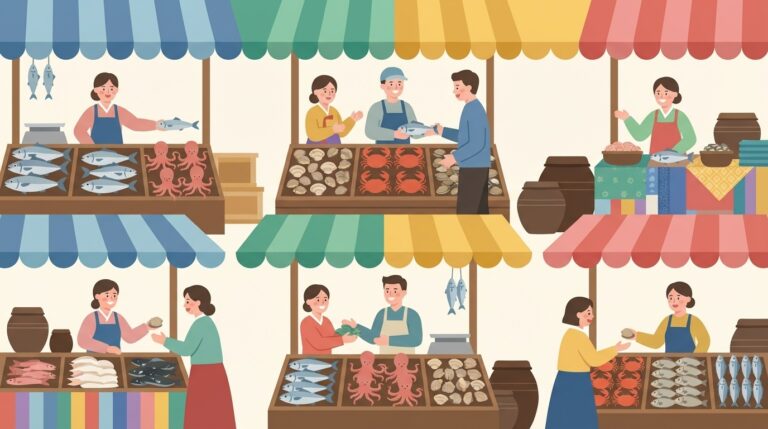
Hello there! Welcome back to Daily Hangul. I’m your Lead Editor, your veteran Korean tutor, and your personal guide to the hidden alleys of Seoul and beyond.
Have you ever watched a K-Drama like Hometown Cha-Cha-Cha or Our Blues? The bustling energy of the traditional fish market, the rubber boots, the vibrant ahjummas confidently slicing up fish, and characters sharing a plate of fresh sashimi with a bottle of soju after a long day. It looks incredibly romantic and authentic, doesn’t it?
But let’s be real. When you actually step into Noryangjin Fish Market in Seoul or Jagalchi Market in Busan, that romantic feeling can quickly turn into sheer panic. Merchants are shouting, water is splashing everywhere, and you have no idea how to ask if that giant squid is actually fresh. If you just stand there looking confused, you might end up paying a ‘tourist tax.’
Don’t worry! Today, we are going to learn exactly how to navigate a Korean traditional fish market like a true local. By the end of this post, you’ll be ordering fresh Hoe (Korean sashimi) and demanding the fish bones for a spicy stew like a boss. Let’s dive in!
Phase 2: Deep Dive into Key Expressions 🐟
Let’s learn the 3 magical phrases that will instantly make you look like a fish market veteran.
1. 요즘 뭐가 제일 맛있어요?
- Pronunciation: yojeum mwoga jeil masisseoyo? [yo-jeum / mwo-ga / je-il / ma-shi-sseo-yo?]
- Meaning: (Literal) What is the most delicious these days? -> (Real nuance) What is in season and freshest right now?
- K-Culture Moment: You approach a stall. Instead of pointing at a random fish you know the name of, you ask this. It shows you respect the merchant’s expertise. In K-Dramas, this is usually followed by the merchant proudly lifting a giant, flopping fish out of the tank.
- Editor’s Insight: The word ‘제철’ (je-cheol, meaning ‘in season’) is great, but asking ‘what is the most delicious’ feels much more conversational and friendly. It opens a dialogue.
- Situation Spectrum:
[🚫 Never] ———— [⚠️ Caution] ———— [✅ Freely]
- Close Friends (Casual): ✅ (요즘 뭐가 제일 맛있어?)
- Market Merchants (Formal/Polite): ✅
- Boss/Elders (Strict Formal): ⚠️ (Not used to elders, but fine for merchants)
- 🤔 Think About It: Korean cuisine relies heavily on seasonality (제철 음식). Why do you think Koreans place such a high value on eating what is currently in season rather than eating the same things year-round?
2. 뼈로 매운탕 거리도 챙겨주세요.
- Pronunciation: ppyeoro maeuntang georido chaenggyeojuseyo. [ppyeo-ro / mae-un-tang / geo-ri-do / chaeng-gyeo-ju-se-yo]
- Meaning: (Literal) Please pack the materials for spicy fish stew with the bones. -> (Real nuance) Don’t throw away the leftover bones/head after filleting; I want to make spicy stew!
- K-Culture Moment: After eating raw fish (회), Koreans always finish the meal with a bubbling, spicy fish stew (매운탕) made from the leftover bones. If you don’t ask for this, you’re missing out on 50% of the Korean seafood experience!
- Editor’s Insight: The word ‘거리’ (geo-ri) here means ‘materials’ or ‘ingredients’ for a specific dish. This phrase screams “I know Korean food culture!”
- Situation Spectrum:
[🚫 Never] ———— [⚠️ Caution] ———— [✅ Freely]
- Market Merchants: ✅
- Fancy Restaurants: ⚠️ (They usually provide it automatically, so asking might sound a bit redundant)
- 🤔 Think About It: Why does Korean food culture try to utilize every part of the ingredient, even the leftover fish heads and bones?
3. 서비스 좀 많이 주세요~
- Pronunciation: seobiseu jom mani juseyo~ [seo-bi-seu / jom / ma-ni / ju-se-yo~]
- Meaning: (Literal) Please give me a lot of service. -> (Real nuance) Please throw in some extra goodies for free!
- K-Culture Moment: You’re buying a huge sea bream. You hit the merchant with a cute smile and this phrase. Suddenly, two handfuls of fresh shrimp and some sea squirts are tossed into your bag for free. This is the magic of the Korean market!
- Editor’s Insight: In Korea, ‘Service’ (서비스) doesn’t mean waitstaff serving you; it means ‘free stuff’ or ‘on the house.’ Say it playfully, slightly elongating the end: ju-se-yo~~.
- Situation Spectrum:
[🚫 Never] ———— [⚠️ Caution] ———— [✅ Freely]
- Market Merchants: ✅ (With a smile!)
- Department Stores / Franchises: 🚫 (Prices are fixed; no freebies here!)
- 🤔 Think About It: The concept of ‘Service’ comes from the Korean concept of ‘Jeong’ (정 – warmth, connection). In your culture, is bargaining or asking for free extras considered rude or a normal part of building rapport?
Phase 3: Textbook vs Real Life 📖🗣️
| Situation | 📖 Textbook Korean | 🗣️ Real Korean (Market Style) | 💡 Why the Difference? |
|---|---|---|---|
| Asking the price | 이것은 얼마입니까? | 사장님, 이거 얼마예요? | Adding “사장님” (Boss) shows respect, and ~예요 is much more natural than the stiff ~입니까. |
| Asking for a discount | 가격을 깎아주세요. | 에이~ 깎아주세요~ (or) 덤 좀 주세요! | Saying “깎아주세요” directly can be blunt. Asking for “덤” (extra) is softer and more fun! |
| Is it fresh? | 이것은 신선합니까? | 오늘 들어온 거예요? | Asking “Did this come in today?” implies you know how freshness works, rather than just asking a yes/no question. |
Bottom Note: Stick to the ~요 endings. It’s polite enough to show respect, but casual enough to fit the bustling, friendly market vibe.
Phase 4: Cultural Deep Dive — K-Culture Connection 🌊
4-1. Non-verbal Communication: The Art of Pointing
In a fish market, it gets loud. Pointing is necessary, but how you point matters. Don’t use one finger aggressively as if you’re accusing the fish of a crime. Use your whole hand, palm open, gesturing toward the tank. And remember Korean Nunchi (눈치)—if the merchant is extremely busy fighting with a giant octopus, wait for eye contact before you shout your order.
4-2. K-Food Connection: The “Hoe” (회) Culture
If you’ve eaten Japanese Sashimi, you might expect Korean Hoe to be the same. It’s not! While Sashimi is often aged for a softer texture, Korean Hoe is all about chewiness (쫄깃함). It is served immediately after being caught.
Also, how you eat it is uniquely Korean. We don’t just dip it in soy sauce. We dip it in Chojang (초장 – sweet and spicy gochujang sauce), wrap it in a sesame leaf (깻잎) with raw garlic, and eat it in one bite. It’s a flavor explosion!
Phase 5: Immersive Roleplay Scenario 🎭
Main Scenario: Friday Night at Jagalchi Market
Setting: 6:00 PM, Busan Jagalchi Market. The smell of salt water is in the air. The floor is wet, and colorful neon signs reflect in the puddles. You are with your Korean friend, Min-su, standing in front of an energetic merchant.
Characters:
– YOU: A foreign resident exploring Busan for the weekend.
– Merchant (Sajangnim): A tough but warm-hearted woman in her 50s wearing a floral apron and rubber boots.
– Min-su: Your local Korean buddy.
Merchant: 어서 와요! 광어 아주 싱싱해! 한 마리 몰고 가!
(eoseo wayo! gwangeo aju singsinghae! han mari molgo ga!)
[Welcome! The flatfish is very fresh! Take one!]
(🎭 Stage Direction: She taps the glass tank with a net. A large flatfish splashes.)
Min-su: 야, 저거 진짜 크다. 우리 저거 먹을까?
(ya, jeogeo jinjja keuda. uri jeogeo meogeulkka?)
[Hey, that’s really big. Should we eat that one?]
YOU: 사장님, 이거 오늘 들어온 거예요?
(sajangnim, igeo oneul deureoon geoyeyo?)
[Boss, did this come in today?]
Merchant: 그럼! 방금 들어와서 아주 펄떡펄떡 뛰어. 5만 원에 줄게!
(geureom! banggeum deureowaseo aju peoltteokpeoltteok ttwieo. oman wone julge!)
[Of course! It just came in, it’s jumping around. I’ll give it to you for 50,000 won!]
🔀 Your Turn! How do you respond?
– A) “너무 비싸요. 3만 원에 주세요.” (Too expensive. Give it for 30,000 won.)
– B) “네, 알겠습니다. 5만 원 드릴게요.” (Okay, understood. Here is 50,000 won.)
– C) “우와~ 사장님, 저희 매운탕 거리랑 서비스 좀 많이 챙겨주세요!” (Wow~ Boss, please pack the stew ingredients and give us lots of extra service!)✅ Best Choice: C — Why? Choice A is too aggressive; cutting the price by almost half will offend her. Choice B is safe but boring! Choice C embraces the market culture. You accept the fair price but use your charm to get free shrimp or sea squirts, plus the essential stew bones!
Merchant: (Smiling brightly) 아이고, 한국말 잘하네! 알았어, 이모가 새우 팍팍 넣어줄게!
(aigo, hangungmal jalhane! arasseo, imoga saeu pakpak neoeojulge!)
[Oh my, you speak Korean well! Alright, Auntie will throw in lots of shrimp!]
Phase 6: 10-Second Shadowing Drill 🗣️
Practice this sentence until it rolls off your tongue naturally!
😊 사장님! / 요즘 / 뭐가 / 제~~~일 맛있어요?
(sa-jang-nim! / yo-jeum / mwo-ga / je~~~il / ma-si-sseo-yo?)
Tip: Pause slightly at the slashes (/). Elongate the ‘제’ (je) to sound genuinely curious and friendly. Keep your tone bright and slightly higher than your normal voice!
Phase 7: K-Culture Mini Glossary 📚
| Korean | Romanization | English | Contextual Meaning |
|---|---|---|---|
| 사장님 | sajangnim | Boss / Owner | The safest, most respectful way to address a merchant, taxi driver, or restaurant owner. |
| 서비스 / 덤 | seobiseu / deom | Service / Extra | Free items given to customers as a token of appreciation or ‘Jeong’ (affection). |
| 매운탕 | maeuntang | Spicy Fish Stew | A boiling, spicy soup made from the leftover bones and head of the filleted fish. |
| 초장 | chojang | Spicy Vinegar Paste | The red, tangy dipping sauce that Koreans prefer over soy sauce for raw fish. |
| 펄떡펄떡 | peoltteokpeoltteok | Flapping heavily | A mimetic word (onomatopoeia) describing a very fresh, energetic fish flapping around. |
Phase 8: Traveler’s Survival Kit 🧳
If you are heading to a traditional market, keep these in your back pocket!
🆘 Survival Expression #1: Asking the Price
– 🇰🇷 “사장님, 이거 얼마예요?” (sajangnim, igeo eolmayeyo?)
– 🗣️ Sound-alike: [Sah-jang-neem, ee-geo uhl-mah-yeh-yo?]
– 📍 Where to use: Any market stall, street food vendor, or small shop.
– 💡 Pro Tip: If you can’t understand the numbers they say rapidly in Korean, just smile and hold up your phone’s calculator app. They will gladly type the price for you!📌 Editor’s Travel Note
– Navigating: Google Maps doesn’t work well for walking directions in Korea. Download Naver Map or KakaoMap before heading to Noryangjin or Jagalchi.
– Cash vs. Card: Korea is a cashless society, but traditional markets are the exception. While they accept cards, bringing cash (KRW) might give you more leverage for a “Service” (덤) or a small discount!
– Shoes Alert: The floors of fish markets are always wet. Do not wear your favorite white sneakers! Wear waterproof shoes or something you don’t mind getting splashed.
Phase 9: Think Deeper — “One Step Further” 🧠
Food & Identity: The Concept of ‘Jeong’ (정) in the Market
When you ask for “Service” or “Deom” (덤 – extra), it might seem like a simple transaction to get more food for less money. But in Korean culture, this act is deeply tied to the concept of Jeong (정)—a feeling of connection, affection, and shared humanity. When a merchant gives you an extra handful of shrimp, they aren’t just losing profit; they are building a relationship with you. They want you to eat well, feel welcomed, and come back. The market isn’t just a place to buy calories; it’s a place where warmth is exchanged through food.
💬 Your Turn:
In your home country, is there a cultural equivalent to ‘Jeong’ or ‘Deom’ where merchants give you something extra just to be nice? Share your experiences in the comments!
Phase 10: FAQ & Troubleshooting 🛠️
Q: Everyone says “Ahjumma” in K-Dramas. Can I call the fish market lady “Ahjumma”?
A: MAYBE, but better to use “Sajangnim.”
“Ahjumma” literally means a middle-aged woman, but over the years, it has gained a slightly rude or dismissive undertone. Some older merchants don’t mind it, but calling them 사장님 (Sajangnim – Boss/Owner) or playfully calling them 이모 (Imo – Auntie) is much more respectful and will definitely get you better fish!
Q: Can I bargain for everything in the market?
A: NO.
If the price is clearly written on a whiteboard or printed sign, it’s usually fixed. Bargaining is only acceptable if the price is verbally given or if you are buying a large quantity.
❌ Common Mistake: Trying to bargain using formal, serious business Korean (e.g., “가격을 인하해 주십시오”).
✅ Do This Instead: Use a bright, slightly whining tone. “사장님~ 조금만 깎아주세요~” (Boss~ please cut the price just a little bit~)
Phase 11: Wrap-up & Action Items 🎯
One-Liner Summary: To survive a Korean fish market, address them as Sajangnim, ask what’s most delicious right now, and never forget to ask for your spicy stew ingredients!
Your Action Missions:
– 🥉 Bronze (Solo): Look in the mirror and practice saying “사장님! 요즘 뭐가 제일 맛있어요?” with a bright, curious expression.
– 🥈 Silver (Online): Go to YouTube, search for a Noryangjin Fish Market vlog, and try to catch how many times people say “사장님” or “매운탕.”
– 🥇 Gold (Real Life): Next time you visit Korea (or a local Korean grocery store), use one of these phrases to order your seafood!
K-Culture Mission:
Watch Episode 4 of Hometown Cha-Cha-Cha where they bid on fresh squid at the dock. Notice the hand gestures, the shouting, and the fast-paced numbers. That is the true heartbeat of the Korean coast!
Phase 12: Interactive Challenge 퀴즈 📝
Test your new fish market survival skills!
1. Fill in the Blank:
You bought a fish and want the bones to make a spicy stew later. You say: “뼈로 ________ 거리도 챙겨주세요.”
* A) 비빔밥 (Bibimbap)
* B) 매운탕 (Maeuntang)
* C) 불고기 (Bulgogi)
2. True or False — K-Culture Edition:
“When visiting a traditional Korean fish market, you must leave a 10% tip if the merchant gives you extra shrimp.”
* [ True / False ]
3. Situational Judgment:
You want to get a little bit of a discount or some extra seafood. Which approach is the most culturally appropriate?
* A) Staring them down and demanding a 50% discount.
* B) Calling them “Ahjumma” loudly and pointing with one finger.
* C) Smiling, calling them “Sajangnim,” and asking “서비스 좀 챙겨주세요~”
(Answers: 1: B, 2: False – Korea has no tipping culture! Giving a tip will confuse them., 3: C)
Did you get them all right? Let me know how you did in the comments below, and tell me what you’d like to learn next! Until next time, happy learning with Daily Hangul! 💙
Frequently Asked Questions (FAQ)
Q: What does "요즘 뭐가 제일 맛있어요?" mean in Korean and how do you pronounce it?
A: In Korean, "요즘 뭐가 제일 맛있어요?" is pronounced [yojeum mwoga jeil masisseoyo? [yo-jeum / mwo-ga / je-il / ma-shi-sseo-yo?] and means: (Literal) What is the most delicious these days? -> (Real nuance) What is in season and freshest right now?
Q: What does "뼈로 매운탕 거리도 챙겨주세요." mean in Korean and how do you pronounce it?
A: In Korean, "뼈로 매운탕 거리도 챙겨주세요." is pronounced [ppyeoro maeuntang georido chaenggyeojuseyo. [ppyeo-ro / mae-un-tang / geo-ri-do / chaeng-gyeo-ju-se-yo] and means: (Literal) Please pack the materials for spicy fish stew with the bones. -> (Real nuance) Don't throw away the leftover bones/head after filleting; I want to make spicy stew!
Q: What does "서비스 좀 많이 주세요~" mean in Korean and how do you pronounce it?
A: In Korean, "서비스 좀 많이 주세요~" is pronounced [seobiseu jom mani juseyo~ [seo-bi-seu / jom / ma-ni / ju-se-yo~] and means: (Literal) Please give me a lot of service. -> (Real nuance) Please throw in some extra goodies for free!







