

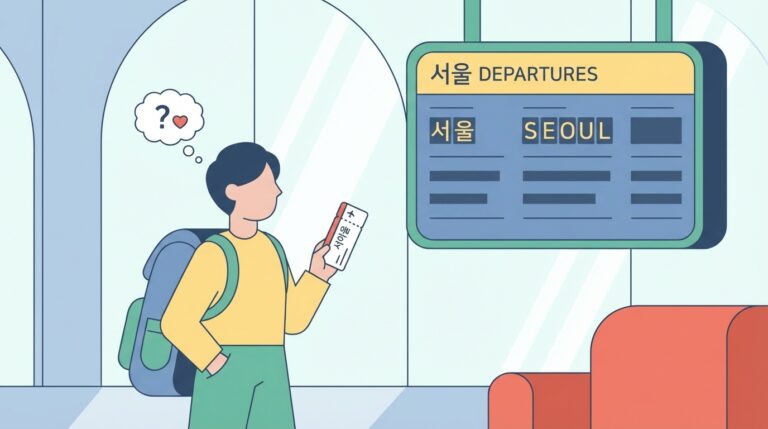
Phase 1: Immersive Hook – Lost in K-Drama Land?
Hello! I’m the lead editor of Daily Hangul, your veteran Korean tutor and local culture navigator.
Picture this: You’ve just landed at the massive, futuristic Incheon International Airport. The floor is sparkling, the architecture is stunning, and you feel exactly like the wealthy CEO returning from abroad in episode 1 of a K-Drama. You might even spot a crowd of fans with massive cameras waiting for a K-Pop idol at the arrivals hall!
But suddenly, reality hits. You have a connecting flight to Jeju Island, or maybe you just need to find your way out, and your boarding pass says ‘Gate 45’. The signs are everywhere, time is ticking, and the sheer size of the airport is overwhelming. Panic sets in.
Don’t worry! You don’t need a map or an app. Knowing just one magic phrase will save you from missing your flight and help you get insider help from the incredibly kind airport staff. I’ve had A1 beginner students text me in a panic from the terminal, and this is exactly what I taught them. Let’s dive in!
Phase 2: Deep Dive – The Magic Phrase
1. 게이트 어디예요?
- Pronunciation: ge-i-teu eo-di-ye-yo? [Sounds like: gate-o-dee-yay-yo?]
- Meaning: Where is the gate? (Literal: Gate, where is it?)
- K-Culture Moment: Picture a fast-paced reality show where K-Pop idols are running through the airport to catch a flight for their world tour. They look around frantically and ask the staff, “게이트 어디예요?!”
- Editor’s Insight: English puts ‘where’ at the beginning, but Korean puts the subject first, then asks ‘where is it?’ Think of it like bringing up the topic first: “As for the gate… where is it?” It’s polite, soft, and perfect for asking strangers.
- Situation Spectrum:
[🚫 절대 금지] ———— [⚠️ 주의] ———— [✅ 자유롭게]
- Close Friends (Casual): ⚠️ (Friends would just say ‘어디야?’ – eo-di-ya?)
- Airport Staff/Strangers: ✅ (Perfectly polite!)
- 🤔 Think About It: Notice how the English word ‘Gate’ is used in Korean? Due to globalization, Koreans use many English loanwords (Konglish) at the airport. Does your native language borrow words for modern travel?
2. [Number]번 게이트 어디예요?
- Pronunciation: [Number]-beon ge-i-teu eo-di-ye-yo?
- Meaning: Where is gate number [Number]?
- Editor’s Insight: Just add the number and ‘번’ (beon, meaning ‘number’) in front! For example, 15번 (sibo-beon) means ‘Number 15’. In Korean, we use Sino-Korean numbers (il, i, sam, sa…) for gates.
Phase 3: Textbook vs Real Life
| Situation | 📖 Textbook Korean | 🗣️ Real Life Korean | 💡 Why the difference? |
|---|---|---|---|
| Asking for the gate | 탑승구가 어디에 있습니까? (tab-seung-gu-ga eo-di-e it-seum-ni-kka?) | 15번 게이트 어디예요? (sibo-beon ge-i-teu eo-di-ye-yo?) | ‘탑승구’ (boarding gate) is too formal. Koreans love efficiency, so we just use the English word ‘gate’ + polite ending! |
| Getting someone’s attention | 실례합니다 (sil-lye-ham-ni-da) | 저기요! (jeo-gi-yo!) | ‘실례합니다’ sounds like a textbook robot. ‘저기요’ literally means ‘Over there!’ and is the standard way to call for attention. |
Phase 4: Cultural Deep Dive
4-1. Non-verbal Communication: The Two-Handed Point
When the airport staff tells you where the gate is, watch their hands. They won’t point with one index finger! In Korean culture, pointing at someone or something with one finger can be seen as slightly rude. Instead, they will use an open palm, fingers together, gesturing gracefully toward the direction. When you ask, adopting a slight nod or mini-bow will instantly boost your charm points!
4-2. K-Travel Connection: The ‘Ppalli-Ppalli’ (빨리빨리) Airport
Incheon Airport is regularly ranked as one of the best airports in the world, and part of that is due to Korea’s 빨리빨리 (Ppalli-ppalli, Hurry-hurry) culture. Everything is designed to be fast, from check-in to security. However, this means if you are walking slowly and looking confused, you might feel like you’re swimming against the current. Using ‘게이트 어디예요?’ helps you match the fast-paced energy of the environment and get quick, accurate help so you can join the flow!
Phase 5: Immersive Roleplay
Scenario A: The Connecting Flight Panic
Setting: Incheon Airport Terminal 1, 4:30 PM. You just got off a long flight. You are tired, holding a heavy carry-on, and your next flight leaves in 40 minutes. You need to find Gate 15, but you only see signs for Gates 1-10. You spot an airport staff member in a neat uniform.
You: (Walking up to the staff) 저기요! (Jeogiyo! / Excuse me!)
Staff: 네, 무엇을 도와드릴까요? (Ne, mueoseul dowadeurilkkayo? / Yes, how can I help you?)
🔀 Your Turn! How should you respond?
– A) “15번 게이트 어디예요?” (15-beon ge-i-teu eo-di-ye-yo?)
– B) “게이트 15 어딨어?” (ge-i-teu 15 eo-dit-seo?)
– C) “웨어 이즈 탑승구?” (we-eo i-jeu tab-seung-gu?)✅ Best Choice: A — It’s polite, natural, and puts the number before the word ‘gate’.
⚠️ Choice B Analysis: This is casual language (banmal). Using this with a stranger, especially airport staff, sounds very rude!
You: 15번 게이트 어디예요?
Staff: 아, 15번은 저쪽으로 쭉 가시면 됩니다. (Ah, for number 15, just go straight that way.)
(🎭 Stage Direction: The staff gestures with an open palm toward the right.)
You: 감사합니다! (Gamsahamnida! / Thank you!)
Phase 6: 10-Second Shadowing Drill
Let’s practice the rhythm! Pay attention to the pauses (/) and try to match the emotion.
🥺 애절하게 (Desperately – you have 10 minutes left!):
저기요, / 15번 게이트 / 어디예요?! (jeo-gi-yo, / si-bo-beon ge-i-teu / eo-di-ye-yo?!)
😊 밝게 (Brightly – you have plenty of time):
실례하지만, / 게이트 / 어디예요? (sil-lye-ha-ji-man, / ge-i-teu / eo-di-ye-yo?)
Phase 7: K-Culture Glossary
| Korean | Romanization | English | Cultural Context |
|---|---|---|---|
| 빨리빨리 | ppalli-ppalli | Hurry up / Fast | The core philosophy of modern Korean society. You will feel this energy everywhere, especially at airports! |
| 저기요 | jeogiyo | Excuse me | Used to get someone’s attention in a restaurant, store, or street. Literally ‘over there’. |
| 공항패션 | gonghang-paesyeon | Airport fashion | The outfits K-Pop idols and actors wear to the airport, which often become massive trends. |
| 눈치 | nunchi | Social awareness | Reading the room. e.g., using nunchi to see if a staff member is too busy to be asked a question. |
Phase 8: Traveler’s Survival Kit
Since you’re at the airport, here are the absolute must-know survival phrases for A1 learners!
🆘 Survival Phrases for the Airport
– 🇰🇷 “화장실 어디예요?” (hwa-jang-sil eo-di-ye-yo?) = Where is the restroom?
– 🇰🇷 “수하물 어디서 찾아요?” (su-ha-mul eo-di-seo cha-ja-yo?) = Where do I claim my baggage?
– 🇰🇷 “택시 타는 곳 어디예요?” (taek-si ta-neun got eo-di-ye-yo?) = Where is the taxi stand?📌 Editor’s Travel Note
– Navigating Incheon: Look down! Incheon Airport often has colored lines on the floor guiding you to transfers, KTX trains, or exits. Just follow the colored line!
– Papago is King: Don’t use Google Translate in Korea. Download Naver Papago. It understands Korean nuances much better and has an excellent image translation feature for signs.
Phase 9: Think Deeper – “한 발 더 깊이”
Global Korean: Konglish at the Airport
You might be surprised that the Korean word for ‘gate’ is just the English word ‘gate’ (게이트). In the global era, the Korean language has absorbed thousands of English words, adapting them to Korean pronunciation. We call this ‘Konglish’ (Korean + English). For a beginner, this is a huge advantage! Words like 버스 (bus), 택시 (taxi), 커피 (coffee), and 게이트 (gate) are already in your vocabulary.
💬 Your Turn:
Does your native language borrow words from English for travel and technology, or do you invent entirely new words for them? Share in the comments!
Phase 10: FAQ & Troubleshooting
Q: Do I say “Gate 15” or “15 Gate”?
In Korean, the number comes first! So it is “15번 게이트” (15-beon ge-i-teu). If you say “게이트 15”, people will understand, but it sounds a bit like Yoda from Star Wars!
Q: Can I just point at my ticket and say ‘어디예요?’ (Where is it?)
Yes! If you are nervous and forget the word ‘gate’, just point to your boarding pass, look polite, and say “이거… 어디예요?” (i-geo… eo-di-ye-yo? / This… where is it?). It works like a charm.
❌ Common Mistake #1: Saying “어디?” (eo-di? / Where?)
✅ How to fix it: “어디?” is super casual. Unless you are asking a 5-year-old child, always attach ‘예요’ (ye-yo) at the end to make it polite: “어디예요?”
Phase 11: Wrap-up & Action Items
🎯 One-Liner Summary:
When lost at the airport, just remember: [Place] 어디예요? (eo-di-ye-yo?)
Action Mission:
– 🥉 Bronze: Stand in front of a mirror, pretend you are holding a ticket, and ask “15번 게이트 어디예요?” out loud 3 times.
– 🥈 Silver: Next time you watch a K-Drama, listen closely when characters are outside. See if you can hear them say “어디예요?” or “저기요!”.
– 🥇 Gold (For your trip): Arrive at Incheon Airport, find an information desk, and actually ask “화장실 어디예요?” (Where is the restroom?) just to practice your Korean!
✈️ K-Culture Mission:
Go to YouTube and search ‘Incheon Airport Walking Tour’. Skip to a random timestamp, look at the signs in the video, and pretend to ask someone where that specific gate or place is using today’s phrase!
Phase 12: Interactive Quiz
1. Fill in the blank:
You need to find Gate 7. What do you say?
“7번 _____ 어디예요?”
(A) 탑승구
(B) 게이트
(C) 공항
2. Situational Judgment:
You want to ask an airport security guard where the restroom is. Which is the best approach?
(A) Tap their shoulder from behind and say “어디?”
(B) Wave one finger at them and say “화장실!”
(C) Say “저기요, 화장실 어디예요?” with a slight nod.
3. True or False – K-Culture Edition:
In Korea, it is considered very polite to point at objects or directions using only your index finger. (True / False)
(Answers: 1: B is most natural, though A is technically correct but formal. 2: C. 3: False! Use an open hand.)
Did you enjoy today’s Daily Hangul lesson? Tell us what situation you want to learn next in the comments below!
Frequently Asked Questions (FAQ)
Q: What does "게이트 어디예요?" mean in Korean and how do you pronounce it?
A: In Korean, "게이트 어디예요?" is pronounced [ge-i-teu eo-di-ye-yo? [Sounds like: gate-o-dee-yay-yo?] and means: Where is the gate? (Literal: Gate, where is it?)
Q: What does "[Number]번 게이트 어디예요?" mean in Korean and how do you pronounce it?
A: In Korean, "[Number]번 게이트 어디예요?" is pronounced [Number] and means: Where is gate number [Number]?






