

Phase 1: 공감 — 몰입형 오프닝 (Immersive Hook)
Hello! I’m the Head Editor of Daily Hangul.
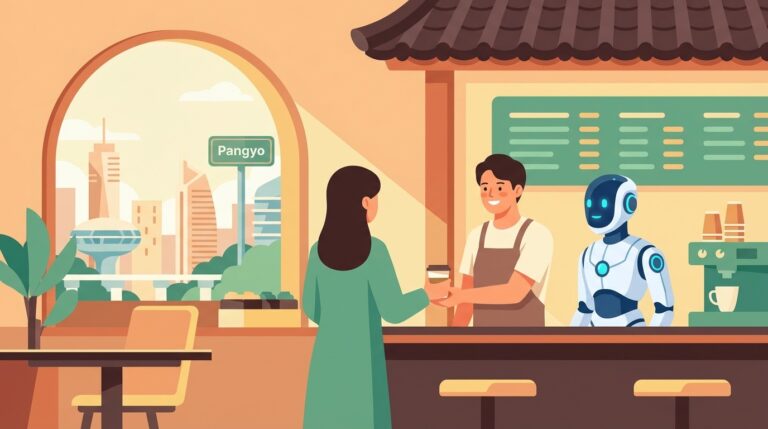
Picture this: It’s a Friday night in Pangyo (판교), often dubbed the Silicon Valley of South Korea. You are sitting at a bustling Korean BBQ restaurant with your local tech-industry friends. The smoke from the pork belly (삼겹살) dances in the air, but the conversation is heavy. One of the senior developers sighs, clinking his soju glass against yours, and mutters something about AI taking over.
He doesn’t just say, “AI will replace us.” He uses a profoundly Korean expression—something about “losing his rice bowl.” Wait, what does rice have to do with ChatGPT?
As a C2-level learner, you already know the dictionary words for “artificial intelligence” (인공지능) and “future” (미래). But to truly engage in high-level, existential discussions about the future of work with Korean professionals, you need to understand the socio-cultural anxiety embedded in their vocabulary. In a society infamous for its hyper-competitive job market, the fear of being replaced by machines hits differently.
Today, we aren’t just learning vocabulary; we are decoding the Korean psyche regarding AI and human survival. Let’s dive deep into the expressions that will make your Korean colleagues say, “Wow, you really get us.”
Phase 2: 핵심 표현 심층 분석 (Deep Dive)
1. 밥그릇을 뺏기다
- Pronunciation: [bap-geu-reu-seul ppaet-ggi-da] / sounds like “bob-geu-reu-seul ppet-ggi-da”
- Meaning: Literal: To have one’s rice bowl taken away / Real nuance: To have one’s livelihood or job threatened/stolen.
- K-Culture Moment: In K-Dramas, when a corrupt executive tries to fire factory workers, the union leader will shout, “Are you trying to steal our rice bowls?!” In the AI era, developers and writers use this to express the visceral fear of AI taking their jobs.
- Editor’s Insight: This is highly emotional. It doesn’t just mean losing a job; it means losing the means to feed your family. It brings abstract tech fears down to basic human survival.
- Situation Spectrum:
[🚫 절대 금지] ———— [⚠️ 주의] ———— [✅ 자유롭게]
- Casual with friends: ✅
- Semi-formal (close colleagues): ✅
- Formal (to a boss or public speech): 🚫 (Too informal and emotional)
- 🤔 Think About It: Why does Korean equate a job with a “rice bowl”? Rice (밥) in Korea is synonymous with life, affection, and survival. How does your native language express the concept of “livelihood”?
2. 도태되다
- Pronunciation: [do-tae-doe-da] / sounds like “dough-tae-dway-da”
- Meaning: Literal: To be selected out (natural selection) / Real nuance: To fall behind, to be weeded out by the changing times.
- K-Culture Moment: You’ll hear this on serious Korean news panels or in intense office dramas. “If we don’t adopt AI, our company will fall behind.”
- Editor’s Insight: This word carries the heavy weight of Korea’s hyper-competitive society (경쟁 사회). It implies an evolutionary failure to adapt.
- Situation Spectrum:
[🚫 절대 금지] ———— [⚠️ 주의] ———— [✅ 자유롭게]
- Casual: ⚠️ (A bit too academic/serious for a pub chat)
- Semi-formal/Business: ✅
- Formal/Presentations: ✅
- 🤔 Think About It: South Korea went from a war-torn country to a tech powerhouse in decades. The fear of “falling behind” (도태되다) is a national trauma. Does your culture have a similar urgency for technological adaptation?
3. 대체 불가능한 인재
- Pronunciation: [dae-chae bul-ga-neung-han in-jae] / sounds like “deh-cheh bull-gah-neung-hahn in-jeh”
- Meaning: Literal: Irreplaceable talent / Real nuance: A professional with unique human skills (like empathy, creativity, or leadership) that AI cannot replicate.
- K-Culture Moment: This is the buzzword in every Korean self-help book and HR seminar right now. It’s the ultimate compliment you can give a professional.
- Editor’s Insight: While AI can code and write, Koreans believe that human Nunchi (눈치 – the ability to read the room) and Jeong (정 – deep emotional connection) make someone truly ‘대체 불가능’ (irreplaceable).
- Situation Spectrum:
[🚫 절대 금지] ———— [⚠️ 주의] ———— [✅ 자유롭게]
- Casual: ⚠️ (Sounds like you’re reading from a textbook)
- Semi-formal: ✅
- Formal (Job interviews, networking): ✅ (Highly recommended!)
- 🤔 Think About It: What specific skills do you think make someone an “irreplaceable talent” in the age of generative AI?
Phase 3: 교과서 vs 진짜 한국어 (Textbook vs Real Life)
| 상황 | 📖 교과서 한국어 | 🗣️ 진짜 한국어 | 💡 왜 다를까? |
|---|---|---|---|
| Worried about AI taking jobs | AI가 제 직업을 대체할 것 같습니다. (AI will replace my job.) | 이러다 AI한테 내 밥그릇 뺏기는 거 아니야? (Will AI steal my rice bowl at this rate?) | Koreans use the visceral metaphor of “밥” (rice) to express deep anxieties about livelihood and survival. |
| Describing someone who refuses to learn AI | 새로운 기술을 배우지 않으면 실패합니다. (If you don’t learn new tech, you will fail.) | AI 안 쓰면 시대에 도태되는 거지 뭐. (If you don’t use AI, you’re just weeded out by the times.) | “도태되다” reflects the fierce “survival of the fittest” mindset deeply ingrained in Korean corporate culture. |
| Complimenting a uniquely skilled human | 당신은 훌륭한 사람입니다. (You are a great person.) | 팀장님은 기계가 범접할 수 없는 아우라가 있으세요. (You have an aura machines can’t encroach upon.) | Adding “범접할 수 없는” (unapproachable/unrivaled) elevates the compliment to a poetic, C2-level standard. |
Phase 4: 문화적 맥락 — K-Culture 딥다이브 (Cultural Deep Dive)
4-1. 비언어적 요소: The Weight of the Sigh (한숨)
When discussing existential threats like AI replacing jobs, language alone isn’t enough. In Korea, expressing deep concern is often accompanied by a deep, audible sigh (한숨) while looking down, perhaps swirling the drink in your glass. However, directly making eye contact with a senior while sighing can be seen as challenging their authority. If a senior expresses worry about their “rice bowl,” the appropriate non-verbal response is to pour them a drink with two hands and listen with a solemn, empathetic nod.
4-2. K-Culture Connection: Why AI Can’t Replace “Nunchi” & “Jeong”
Let’s connect this to the broader Korean workplace culture often seen in K-Dramas like Misaeng (미생). Why do Koreans firmly believe certain jobs will survive AI? The answer lies in 눈치 (Nunchi) and 정 (Jeong).
An AI can analyze data perfectly, but can it read the subtle tension between the Marketing Director and the Sales VP during a meeting? Can it understand the unwritten hierarchy of pouring drinks at a Hoesik (team dinner)? Can an AI feel Jeong—the complex, unspoken bond of loyalty and affection built after years of struggling together?
In the Korean business landscape, a purely logical machine is seen as “lacking humanity” (인간미가 없다). Jobs that require mediating these complex emotional and hierarchical webs—like HR, high-level negotiation, and empathetic leadership—are widely considered the “surviving jobs” (살아남을 직업군) in Korea.
Phase 5: 실전 롤플레이 시나리오 (Immersive Roleplay)
시나리오 A: 메인 롤플레이 (The Pangyo Tech Hub Dinner)
- Setting: Friday, 8:00 PM. A trendy craft beer pub in Pangyo. The neon lights reflect off the sleek glass buildings outside.
- Characters:
- YOU: A foreign project manager working at a Korean tech firm.
- Minsu (35): A Senior Developer at your firm, slightly intoxicated and experiencing an existential crisis about his career due to the rise of ChatGPT.
Minsu: 하아… (한숨) 요즘 AI 코딩하는 거 보면 진짜 소름 돋아. 이러다 우리 다 실업자 되는 거 아니야?
(Ha-a… yojeum AI kodinghaneun geo bomyeon jinjja soreum doda. Ireoda uri da sireopja doeneun geo aniya?)
[Sigh… Watching AI code these days gives me goosebumps. Aren’t we all going to end up unemployed at this rate?]
(🎭 Stage Direction: Minsu stares blankly at his beer glass, looking genuinely defeated.)
YOU: 에이, 선배님. 그래도 AI가 완벽하지는 않잖아요.
(Ei, seonbaenim. Geuraedo AI-ga wanbyeokhajineun anchanayo.)
[Come on, Senior. AI isn’t perfect yet anyway.]
Minsu: 지금은 그렇지. 근데 몇 년 뒤면? 솔직히 나이 먹고 새로운 거 따라가기도 벅찬데, 진짜 시대에 도태될까 봐 무섭다.
(Jigeumeun geureochi. Geunde myeot nyeon dwimyeon? Soljikhi nai meokgo saeroun geo ttaragagido beokchande, jinjja sidaee dotaedoelkka bwa museopda.)
[For now, sure. But in a few years? Honestly, it’s exhausting trying to keep up with new things as I get older. I’m scared I’ll truly fall behind the times.]
🔀 당신의 차례! 어떻게 대답할까요? (Your Turn! How will you respond?)
– A) “맞아요. AI가 제 직업을 대체할 확률이 높습니다.” (Textbook, cold, AI-like response)
– B) “걱정 마세요! 선배님은 팀에서 대체 불가능한 인재시잖아요. AI가 선배님 밥그릇은 절대 못 뺏어요!” (Warm, uses native idioms, highly empathetic)
– C) “대박! 그럼 우리 다 백수 되는 거예요? ㅋㅋㅋ” (Too casual, dismissive of his real anxiety)✅ Best Choice: B — In Korean culture, when someone shows vulnerability, you don’t offer a cold logical analysis (like A) or laugh it off (like C). You reassure their value using culturally resonant idioms (대체 불가능한 인재, 밥그릇).
시나리오 B: K-Culture 보너스 롤플레이 (The Taxi Ride)
- Setting: A taxi ride from Incheon Airport into Seoul.
- You: “기사님, 요즘 자율주행 택시 얘기도 나오던데, 걱정 안 되세요?” (Driver, they’re talking about self-driving taxis lately. Aren’t you worried?)
- Driver: “아이고, 기계가 아무리 발달해도, 골목길에서 튀어나오는 오토바이는 사람 눈치로 피해야지. 한국 도로가 얼마나 다이내믹한데!”
(Oh my, no matter how advanced machines get, you need human intuition to dodge motorcycles popping out of alleyways. Korean roads are way too dynamic!)
Phase 6: 10초 섀도잉 드릴 (Shadowing Drill)
Practice this C2-level sentence. Pay attention to the pauses (/) and the emotional tone!
😤 단호하고 확신에 찬 목소리로 (Firm and confident):
기계가 / 인간의 고유한 영역을 / 완벽히 대체하기는 / 어려울 겁니다.
(gi-gye-ga / in-gan-ui go-yu-han yeong-yeok-eul / wan-byeok-hi dae-chae-ha-gi-neun / eo-ryeo-ul geom-ni-da.)
“It will be difficult for machines to completely replace the uniquely human domain.”
Phase 7: K-Culture 미니 사전 (K-Culture Glossary)
| 한국어 | Romanization | 영어 | 맥락 설명 (Context) |
|---|---|---|---|
| 밥그릇 | bap-geureut | Rice bowl (Livelihood) | A powerful metaphor for one’s job and survival in society. |
| 도태되다 | dotaedoeda | To be weeded out | Reflects the intense evolutionary pressure of Korea’s competitive society. |
| 눈치 | nunchi | Social intuition / Reading the room | The ultimate human soft skill that Koreans believe AI will never master. |
| 인간미 | in-gan-mi | Humanity / Human touch | A warm, empathetic trait essential for leaders. AI is often criticized for lacking this. |
| 판교 | Pangyo | Pangyo (City) | Korea’s Silicon Valley; the epicenter of tech, AI development, and startup culture. |
Phase 8: 여행자 서바이벌 키트 (Traveler’s Survival Kit)
Even as a traveler, the “AI vs Human” transition is highly visible in Korea, especially with the explosion of automated kiosks (키오스크).
🆘 서바이벌 표현: Beating the Kiosk Anxiety
– 🇰🇷 “기계로 주문하는 게 서툴러서 그런데, 직접 주문해도 될까요?”
(gi-gye-ro ju-mun-ha-neun ge seo-tul-reo-seo geu-reon-de, jik-jeop ju-mun-hae-do doel-kka-yo?)
– 🗣️ Meaning: “I’m a bit clumsy with ordering through the machine; may I order directly with you?”
– 📍 쓰는 곳: Cafes, fast food restaurants, and even some traditional diners that recently installed tablets.
– 💡 Pro Tip: Many elderly Koreans struggle with the rapid AI/kiosk adoption. Using this phrase shows humility and will often be met with a sympathetic smile from the human staff.📌 Editor’s Travel Note
Korea is rapidly automating. You’ll find serving robots (서빙 로봇) in many restaurants. If a robot brings your food, you must move the plates to your table yourself. Don’t wait for it to serve you—it lacks human touch!
Phase 9: 비판적 사고 코너 — “한 발 더 깊이” (Think Deeper)
🧠 Think Deeper: 언어와 권력 (Language & Power) — Can AI master the Korean hierarchy?
While AI translation tools are incredibly advanced, they often struggle profoundly with the Korean honorific system (높임말/반말). Why? Because Korean honorifics aren’t just grammatical rules; they are a complex matrix of power, age, social status, and intimacy. An AI might use polite form (존댓말) to your boss, but it doesn’t know when to subtly drop the formality to build camaraderie over a drink.
This linguistic complexity is exactly why human interpreters, negotiators, and HR managers in Korea are considered 대체 불가능 (irreplaceable). To speak Korean perfectly is to understand the human power dynamics perfectly—something a machine without a physical presence or social vulnerability cannot grasp.
💬 Your Turn: Do you think AI will ever truly understand the social nuances and power dynamics of your native language? Share your thoughts in the comments!
Phase 10: FAQ & 오해 방지 (Troubleshooting)
Q: Can I use “도태되다” (to be weeded out) to describe a colleague who is bad at their job?
NO! 🚫 This is a massive mistake. Using “도태되다” to describe someone else is incredibly insulting and aggressive. It implies they are evolutionary failures. You should only use it to describe an abstract concept (e.g., “Our company will fall behind”) or in a self-deprecating manner about yourself (e.g., “I’m worried I’ll fall behind”).
Q: If I’m talking to my boss about my career fears, can I say “밥그릇 뺏길까 봐 무섭습니다”?
Maybe. ⚠️ It depends on your relationship. If your boss is very close to you (like a mentor), it’s a great, authentic expression. But if it’s a formal setting or a strict boss, it sounds too unrefined. Use “제 직무가 대체될까 봐 우려됩니다” (I am concerned my role might be replaced) instead.
❌ 흔한 실수 (Common Mistake):
Foreign learners often translate “AI is smart” directly to “AI는 똑똑해요.” While grammatically correct, at a C2 level, when discussing the frightening capability of AI, Koreans prefer more vivid expressions like “AI 발전 속도가 소름 돋아요” (The speed of AI development gives me goosebumps).
Phase 11: 요약 및 액션 아이템 (Wrap-up)
🎯 One-Liner Summary: To discuss the future of jobs in Korea, you must move beyond textbook tech terms and embrace emotional, survival-based idioms like “protecting your rice bowl” (밥그릇) and avoiding “falling behind” (도태되다).
🚀 Action Mission 3단계:
– 🥉 Bronze (혼자서): Look in the mirror and practice the phrase: “내 밥그릇은 내가 지킨다!” (I will protect my own rice bowl!) with a determined face.
– 🥈 Silver (온라인): Leave a comment in Korean on a tech YouTube video discussing AI, using the word “대체 불가능한 인재” (Irreplaceable talent).
– 🥇 Gold (실전): Next time you are at a cafe or restaurant with a Korean friend, point to the self-ordering kiosk and ask: “이러다 우리 다 도태되는 거 아니에요?” (Aren’t we all going to fall behind at this rate?)
Phase 12: 퀴즈 — 인터랙티브 챌린지 (Interactive Quiz)
1. 상황 판단 문제 (Situational Judgment)
You are giving a formal presentation to the CEO about why your team needs funding for human creativity training, rather than just buying more AI software. Which phrase is best to emphasize your team’s value?
– A) 우리 팀은 밥그릇이 필요합니다.
– B) 우리 팀원들은 기계가 대체 불가능한 인재들입니다.
– C) AI는 도태되었습니다.
2. 빈칸 채우기 (Fill in the Blank)
“요즘 챗GPT 글 쓰는 거 보면 진짜 ( ____ ) 돋아. 작가들 다 설 자리를 잃는 거 아니야?”
– A) 눈치
– B) 정
– C) 소름
3. True or False — K-Culture 에디션
(T / F) In the Korean workplace, an employee who perfectly executes tasks like a machine but lacks social skills (눈치) is generally considered the ultimate ideal worker.
(Scroll down for answers!)
정답 확인하기 (Click to reveal answers)
1. B (A is too informal/emotional. C makes no sense. B perfectly uses the high-level business compliment.)
2. C (소름 돋아 – gives me goosebumps. Used when something is shockingly good or scary.)
3. False (Koreans highly value ‘눈치’ and ‘정’. Being purely machine-like without social intuition is often viewed negatively.)
Frequently Asked Questions (FAQ)
Q: What does "밥그릇을 뺏기다" mean in Korean and how do you pronounce it?
A: In Korean, "밥그릇을 뺏기다" is pronounced [bap-geu-reu-seul ppaet-ggi-da] and means: Literal: To have one's rice bowl taken away / Real nuance: To have one's livelihood or job threatened/stolen.
Q: What does "도태되다" mean in Korean and how do you pronounce it?
A: In Korean, "도태되다" is pronounced [do-tae-doe-da] and means: Literal: To be selected out (natural selection) / Real nuance: To fall behind, to be weeded out by the changing times.
Q: What does "대체 불가능한 인재" mean in Korean and how do you pronounce it?
A: In Korean, "대체 불가능한 인재" is pronounced [dae-chae bul-ga-neung-han in-jae] and means: Literal: Irreplaceable talent / Real nuance: A professional with unique human skills (like empathy, creativity, or leadership) that AI cannot replicate.







