

Phase 1: Immersive Hook
Hello! I’m the Lead Editor at Daily Hangul.
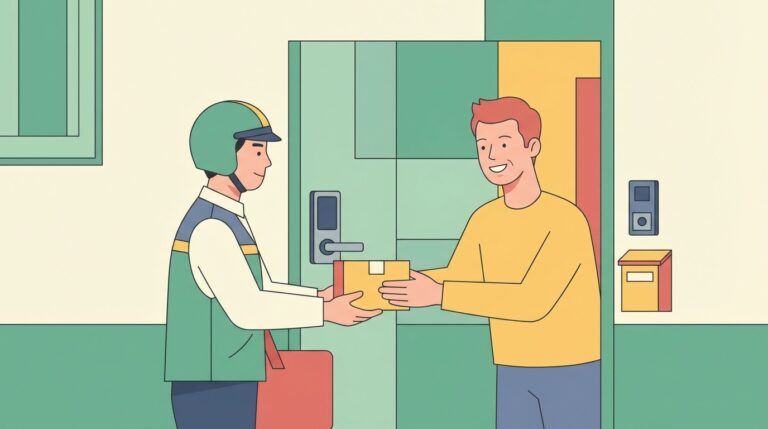
Picture this: You just scored an exclusive, limited-edition K-Pop photocard on X (Twitter), or maybe you found the perfect vintage jacket on Danggeun Market (Korea’s most popular second-hand app). A few days later, your doorbell rings.
You open the door with a huge smile. The delivery driver hands you the box and says something that sounds like, “Chakbul-imnida!”
You politely say, “Thank you!” and try to close the door. But… he doesn’t leave. He just stands there, holding a little card reader or looking at you expectantly. Awkward silence ensues. Did you do something wrong?
Not at all! You just missed one tiny, crucial word: 착불 (Chakbul).
If you live in Korea, travel here for a while, or even just buy K-Pop merch from Korean fans, knowing this one word will save you from major doorstep panic. Don’t worry—this guide is based on real SOS messages I’ve received from my beginner students. Let’s dive in and make you a Korean delivery pro!
Phase 2: Deep Dive into Key Expressions
Here are the 3 essential expressions you need when dealing with Korean packages.
1. 착불입니다 (Pay on Delivery)
- Pronunciation: chak-bul-im-ni-da [Chak-bool-eem-nee-dah]
- Meaning: Literal = “Arrival Payment is.” / Real nuance = “You need to pay the shipping fee now.”
- K-Culture Moment: This is extremely common in Korea’s bustling second-hand market culture. When fans trade photocards or sell used goods, they often send it 착불 (chakbul) so the receiver pays the exact shipping cost.
- Editor’s Insight: Think of the ‘Chak’ sound like “Check”—you need to write a check (pay money) when it arrives!
- Situation Spectrum:
[🚫 Never] ———— [⚠️ Be Careful] ———— [✅ Freely]- To friends (Casual): 🚫 (We don’t say ‘imnida’ to friends. Just say “착불이야” – chak-bul-i-ya)
- Delivery Driver to You (Formal): ✅
- 🤔 Think About It: Why is cash-on-delivery so common in Korea for small, peer-to-peer trades? It reflects a high level of social trust. People trust that the buyer will actually pay the fee when the package arrives!
2. 선불 (Prepaid Shipping)
- Pronunciation: seon-bul [Sun-bool]
- Meaning: Literal = “Front Payment” / Real nuance = “The shipping is already paid for.”
- K-Culture Moment: If you order from large online malls like Coupang or Olive Young, it is almost always 선불 (seonbul). You don’t need to do anything but smile and take the box!
- Editor’s Insight: The word “Seon” means “First/Before.” So, the payment was done before it got to you.
- Situation Spectrum:
[🚫 Never] ———— [⚠️ Be Careful] ———— [✅ Freely]- You to the convenience store clerk when sending a package: ✅ (“선불로 할게요” – I will prepay).
3. 얼마예요? (How much is it?)
- Pronunciation: eol-ma-ye-yo? [Ull-mah-yeh-yo?]
- Meaning: How much is it?
- K-Culture Moment: You will use this everywhere in Korea—from street food stalls in Myeongdong to paying your delivery driver.
- Editor’s Insight: Just memorize this. It is the ultimate survival phrase for anyone stepping foot in Korea.
- Situation Spectrum:
[🚫 Never] ———— [⚠️ Be Careful] ———— [✅ Freely]- To a delivery driver/shop owner: ✅
Phase 3: Textbook vs Real Life
| Situation | 📖 Textbook Korean | 🗣️ Real Korean | 💡 Why the difference? |
|---|---|---|---|
| Driver asking for shipping fee | 택배 요금은 받으시는 분이 내셔야 합니다. (The receiver must pay the fee.) | 착불입니다. (Chak-bul-im-ni-da.) | Koreans love efficiency (빨리빨리 – Palli-palli). Shorter is better! |
| Asking if shipping is prepaid | 배송비는 이미 지불되었습니까? (Has the shipping fee already been paid?) | 이거 선불이에요? (i-geo seon-bul-i-e-yo?) | The textbook version sounds like a robot or a police officer investigating a crime. |
| Telling the driver you’ll pay | 제가 배송비를 지불하겠습니다. (I will pay the shipping fee.) | 계좌이체 할게요. (gye-jwa-i-che hal-ge-yo – I’ll do a bank transfer) | Most drivers prefer bank transfers over cash because they don’t carry change! |
Bottom Note for Beginners (A1): Don’t try to make long, perfectly grammatical sentences right now. In Korea, saying “착불이에요?” (Is it chakbul?) with a polite nod is 100% perfect and natural.
Phase 4: Cultural Deep Dive
4-1. Non-verbal Communication: The “Nunchi” of Delivery
In Korea, delivery workers are always in a rush due to the famous Palli-palli (hurry-hurry) culture. When they say “착불입니다,” they appreciate it if you act quickly. If you don’t have cash, don’t panic. Just pull out your phone, point to it, and say “계좌이체 (Bank transfer)?” They will quickly show you their phone screen with their bank account number. Nod, take a quick photo of the account number, and let them leave. You can transfer the money right after!
4-2. K-Culture Connection: The K-Pop Photocard Economy
If you are deep into K-Pop, you know that collecting photocards (포카 – Po-ka) is serious business. When fans buy, sell, or trade these cards on Twitter or Bunjang (a trading app), they usually use Convenience Store Delivery (반값택배 – Half-price delivery).
Often, the seller will ask you: “선불? 착불?” (Prepaid? Or Pay-on-delivery?)
If you say “착불,” you will have to pay the shipping fee to the convenience store clerk when you go to pick up your precious photocard. Knowing this difference is a basic survival skill in the K-Pop fandom!
Phase 5: Immersive Roleplay
Scenario A: The Doorstep Dilemma
- Setting: A rainy Tuesday afternoon at your Airbnb in Seoul. You bought a cute Kakao Friends plushie from a second-hand app.
- Characters:
- YOU: A beginner in Korean, slightly nervous but excited for your package.
- Gi-sa-nim (기사님): The busy, hard-working delivery driver.
(Knock, Knock)
기사님 (Driver): 택배 왔습니다! 📦
(Taek-bae wat-seum-ni-da!)
[Package is here!]
YOU: 네, 나갑니다!
(Ne, na-gam-ni-da!)
[Yes, coming out!]
(🎭 Stage Direction: You open the door. He hands you a small box.)
기사님: 이거 착불입니다.
(i-geo chak-bul-im-ni-da.)
[This is pay-on-delivery.]
YOU: 아… 얼마예요?
(Ah… eol-ma-ye-yo?)
[Ah… how much is it?]
기사님: 3,500원입니다. 현금이세요?
(Sam-cheon-o-baek-won-im-ni-da. Hyeon-geum-i-se-yo?)
[It’s 3,500 won. Do you have cash?]
(🎭 Stage Direction: You open your wallet, but you only have a 50,000 won bill!)
🔀 Your Turn! How should you respond?
– A) “I don’t have money. Bye!” (Run away)
– B) “오만원 있어요…” (O-man-won it-seo-yo… / I have 50,000 won…)
– C) “계좌이체 되나요?” (Gye-jwa-i-che doe-na-yo? / Can I do a bank transfer?)✅ Best Choice: C — In Korea, delivery drivers almost never have enough change for a 50,000 won bill. Asking for a bank transfer is the most polite and modern way to handle this!
YOU: 계좌이체 되나요?
(Gye-jwa-i-che doe-na-yo?)
[Can I do a bank transfer?]
기사님: 네, 여기 계좌번호요.
(Ne, yeo-gi gye-jwa-beon-ho-yo.)
[Yes, here is the account number.]
YOU: 감사합니다! 수고하세요!
(Gam-sa-ham-ni-da! Su-go-ha-se-yo!)
[Thank you! Keep up the good work!]
Scenario B: Bonus K-Pop Merch Pickup
- Setting: A GS25 Convenience Store.
- Clerk: 손님, 이거 반값택배 착불이에요. 2,000원 결제 도와드릴게요.
(Son-nim, i-geo ban-kkap-taek-bae chak-bul-i-e-yo. I-cheon-won gyeol-je do-wa-deu-ril-ge-yo.)
[Customer, this half-price delivery is Chakbul. I’ll help you pay the 2,000 won.] - YOU: 아, 네! 카드 결제 할게요. 💳
(Ah, ne! Ka-deu gyeol-je hal-ge-yo.)
[Ah, yes! I’ll pay by card.]
Phase 6: 10-Second Shadowing Drill
Read out loud with the correct emotion and pauses!
🥺 기사님 / 이거 / 착불이에요?
(gi-sa-nim / i-geo / chak-bul-i-e-yo?)
[Driver, / is this / pay-on-delivery?]😊 네, / 계좌이체 / 할게요!
(ne, / gye-jwa-i-che / hal-ge-yo!)
[Yes, / I will do / a bank transfer!]
Phase 7: K-Culture Mini Glossary
| Korean | Romanization | English | Context & Culture |
|---|---|---|---|
| 기사님 | gi-sa-nim | Driver (Respectful) | Always use this to address delivery drivers, taxi drivers, and bus drivers. |
| 택배 | taek-bae | Package / Delivery | The lifeblood of modern Korea! Packages often arrive in exactly 1 day. |
| 중고거래 | jung-go-geo-rae | Second-hand trade | Apps like Danggeun (Karrot) are huge in Korea. Everyone uses them! |
| 수고하세요 | su-go-ha-se-yo | Keep up the good work | The absolute best way to say “goodbye and thank you for your hard work” to a worker in Korea. |
Phase 8: Traveler’s Survival Kit
Even if you are just staying at a hotel in Korea for a week, you might order something from Olive Young’s “O-neul Dream” (same-day delivery) or receive a package from a friend.
🆘 Survival Phrases for Packages
– 🇰🇷 “문 앞에 두고 가주세요.” (mun ap-e du-go ga-ju-se-yo)
– 🗣️ Pronunciation: [Moon ah-peh doo-go gah-joo-seh-yo]
– 📍 Meaning: Please leave it in front of the door.
– 💡 Pro Tip: Koreans rarely steal packages! It is 100% normal and safe to ask the driver to just leave it at your hotel door or Airbnb door.📌 Editor’s Travel Note
– Delivery Apps: If you order food on Yogiyo or Baemin, there is a “만나서 결제” (Meet and Pay) option. This is basically the food version of Chakbul.
– Tipping: NEVER tip your delivery driver in Korea. It will confuse them and they might even refuse it. Just giving a bright “수고하세요!” (Su-go-ha-se-yo) is the best reward!
Phase 9: Think Deeper
Global Era & Technology: The Magic of Korea’s Trust System
🧠 Think Deeper:
Have you ever wondered why Korean delivery drivers feel perfectly comfortable dropping a valuable package at your door without a signature? Or why strangers trust each other enough to use “Chakbul” (Pay on delivery) for second-hand items? Korea has an incredibly high level of “social trust” combined with a dense network of CCTV cameras. This unique environment created the Palli-palli (hurry up) delivery culture, where speed and convenience are valued above all else.💬 Your Turn: How do deliveries work in your home country? Are packages left at the door, or do you have to sign for them? Let us know in the comments!
Phase 10: FAQ & Troubleshooting
Q: Can I pay “Chakbul” with a credit card to the driver?
Yes and no. Post Office (우체국) delivery drivers usually have card machines. However, private companies (like CJ or Lotte) might prefer cash or bank transfers because carrying a card machine slows them down.
Q: What if I’m not home when a Chakbul package arrives?
The driver will usually call you or send a text message with their bank account number. You just transfer the money, and they will leave the box at your door!
❌ Common Mistake #1: Saying “안녕히 가세요” (Goodbye) to the driver.
✅ Do this instead: Say “수고하세요!” (Su-go-ha-se-yo – Keep up the good work). It is much more natural and acknowledges their hard work!
Phase 11: Wrap-up & Action Items
One-Liner Summary: When a package is 착불 (Chakbul), don’t panic—just ask “얼마예요?” (How much?) and pay the fee!
Action Mission:
– 🥉 Bronze (Solo): Look in the mirror and practice saying “아, 착불이에요?” 3 times with a natural, surprised face.
– 🥈 Silver (Online): Go to X (Twitter) and search the Korean keyword “착불” in the K-Pop merch tags. See how many fans are trading!
– 🥇 Gold (Real Life): If you are in Korea, try buying a 1,000 won item on Danggeun (Karrot Market) and experience Korean trading firsthand!
K-Culture Mission:
Watch a vlog of someone unboxing K-Pop albums or Korean online shopping on YouTube. Listen closely to see if they mention “택배” (taek-bae)!
Phase 12: Interactive Quiz
Let’s test your survival skills!
1. You bought a jacket online. The driver hands it to you and says “Seonbul-imnida! (선불입니다)” What do you do?
A) Give him money.
B) Say thank you and take the box. You already paid online.
C) Ask for his bank account number.
2. Fill in the blank: Delivery driver: “Chakbul 4,000 won!” You: “__________ do-e-na-yo? (Can I do a bank transfer?)”
A) 수고하세요 (Su-go-ha-se-yo)
B) 계좌이체 (Gye-jwa-i-che)
C) 얼마예요 (Eol-ma-ye-yo)
3. True or False: In Korea, it is polite to give a 10% tip to the delivery driver who brings your heavy package.
(Answers: 1. B – Seonbul means prepaid! / 2. B / 3. False – No tipping culture in Korea!)
Frequently Asked Questions (FAQ)
Q: What does "착불입니다 (Pay on Delivery)" mean in Korean and how do you pronounce it?
A: In Korean, "착불입니다 (Pay on Delivery)" is pronounced [chak-bul-im-ni-da [Chak-bool-eem-nee-dah] and means: Literal = "Arrival Payment is." / Real nuance = "You need to pay the shipping fee now."
Q: What does "선불 (Prepaid Shipping)" mean in Korean and how do you pronounce it?
A: In Korean, "선불 (Prepaid Shipping)" is pronounced [seon-bul [Sun-bool] and means: Literal = "Front Payment" / Real nuance = "The shipping is already paid for."
Q: What does "얼마예요? (How much is it?)" mean in Korean and how do you pronounce it?
A: In Korean, "얼마예요? (How much is it?)" is pronounced [eol-ma-ye-yo? [Ull-mah-yeh-yo?] and means: How much is it?






