

Hello! I am your Daily Hangul Editor.
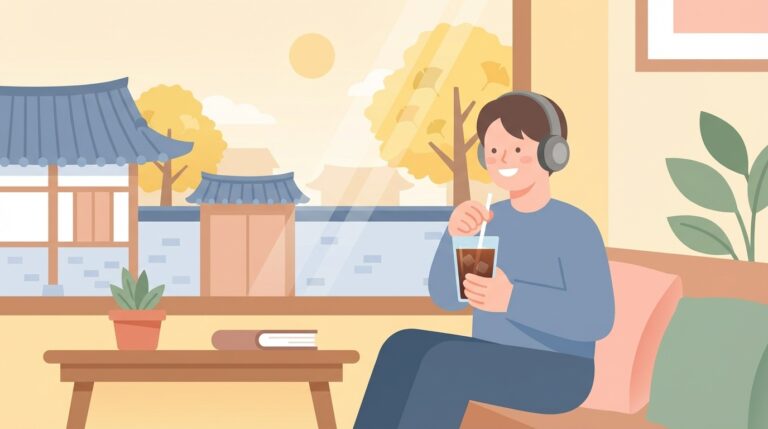
Picture this: It is a Friday evening. You are sitting in a trendy, industrial-style cafe in Seongsu-dong, Seoul. An amazing K-R&B track is playing in the background. Your new Korean friend turns to you and asks, ‘What do you do for fun?’
You want to say you love listening to music. Your brain scrambles, and out comes: ‘Music… good!’
Your friend smiles politely, but you feel a little disappointed. You wanted to sound natural, maybe even discuss your favorite K-Pop groups or indie bands! Don’t worry. As a tutor who has seen hundreds of students freeze in this exact moment, I am here to help. Today, we are going to learn how to talk about your music taste like a true local. By the end of this guide, you won’t just know the words—you will understand the culture behind them.
Let’s dive in!
Phase 2: Core Expressions Deep Dive
Let’s look at the 3 most important phrases you need.
1. 음악 듣는 거 좋아해요.
- Pronunciation: eumak deunneun geo joahaeyo
- Sound-alike guide: ‘eu’ sounds like the disgusted sound you make when stepping in gum. ‘deun-neun’ flows together smoothly.
- Meaning: I like listening to music. (Literal: Music listening thing, I like.)
- K-Culture Moment: This is the ultimate, universally safe answer when anyone—from a blind date to a new coworker—asks about your hobbies. It is polite, soft, and opens the door for them to ask, ‘Oh, what kind?’
- Editor’s Insight: In Korean, ‘듣다’ (to listen) is a verb. To say you like doing it, you must turn it into a noun by adding ‘~는 거’ (the act of). It feels much more conversational than using stiff textbook nouns.
- Situation Spectrum:
[🚫 Forbidden] ———— [⚠️ Caution] ———— [✅ Freely]
- Close Friends (Casual): ✅ (Just drop ‘요’ -> 음악 듣는 거 좋아해)
- Coworkers (Semi-formal): ✅
- Boss/Elders (Formal): ⚠️ (Better to use the formal version we cover below!)
- 🤔 Think About It: Why do Koreans add ‘거’ (thing) to verbs? It softens the sentence. Direct statements can feel too sharp in Korean culture, so wrapping actions into ‘things’ makes you sound gentler and more approachable.
2. 요즘 [가수] 노래에 빠져 있어요.
- Pronunciation: yojeum [gasu] noraee ppajyeo isseoyo
- Sound-alike guide: ‘ppa’ requires a tense P sound—like you are spitting out a tiny seed.
- Meaning: Lately, I’m obsessed with [Singer]’s songs. (Literal: I am fallen into [Singer]’s songs.)
- K-Culture Moment: You are sharing earbuds with a friend on the subway, or you are at a Noraebang (Karaoke) picking a song. Saying you are ‘fallen into’ (빠져 있다) a song shows true passion. K-Pop fans use this constantly!
- Editor’s Insight: This phrase instantly upgrades your Korean from A1 to ‘cool local.’ It shows you are actively engaged in the culture right now.
- Situation Spectrum:
[🚫 Forbidden] ———— [⚠️ Caution] ———— [✅ Freely]
- Close Friends (Casual): ✅
- Coworkers (Semi-formal): ✅
- Boss/Elders (Formal): ⚠️ (Might sound a bit too casual/emotional for a strict boss.)
- 🤔 Think About It: Does your native language use ‘falling’ to describe liking something? In English, we ‘fall in love.’ In Korean, you can ‘fall into’ hobbies, music, or even TV shows!
3. 쉴 때 보통 음악 들어요.
- Pronunciation: swil ttae botong eumak deureoyo
- Sound-alike guide: ‘swil’ sounds like ‘shweel’.
- Meaning: I usually listen to music when I rest.
- K-Culture Moment: Koreans work hard and study hard. So instead of ‘What is your hobby?’, people often ask ‘What do you do when you rest?’ (쉴 때 뭐 해요?). This is the perfect natural reply.
- Editor’s Insight: ‘보통’ (usually) is a magic word. It makes you sound relaxed and fluent, not like a robot reciting a script.
- Situation Spectrum:
[🚫 Forbidden] ———— [⚠️ Caution] ———— [✅ Freely]
- Close Friends (Casual): ✅
- Coworkers (Semi-formal): ✅
- Boss/Elders (Formal): ✅
Phase 3: Textbook vs Real Life
| Situation | 📖 Textbook Korean | 🗣️ Real Korean | 💡 Why is it different? |
|---|---|---|---|
| Formal intro | 제 취미는 음악 감상입니다. (My hobby is music appreciation.) | 저는 음악 듣는 거 좋아해요. (I like listening to music.) | ‘음악 감상’ sounds like you evaluate classical music for a living. It’s too stiff! |
| Asking a friend | 취미가 무엇입니까? (What is your hobby?) | 쉴 때 보통 뭐 해? (What do you usually do when resting?) | Koreans focus on ‘rest time’ rather than formal ‘hobbies’ due to busy lifestyles. |
| Liking a song | 이 노래를 아주 좋아합니다. (I like this song very much.) | 이 노래 완전 내 스타일이야! (This song is totally my style!) | ‘완전’ (totally) and ‘내 스타일’ (my style) are essential everyday slang. |
Bottom Note: Stick to ‘음악 듣는 거 좋아해요’ for safe, natural A2 level conversations!
Phase 4: Cultural Deep Dive
4-1. Non-verbal Communication: The ‘Nunchi’ of Music
When discussing music, Koreans often use ‘Nunchi’ (reading the room). If you are with older colleagues, they might prefer 90s ballads or Trot. It is polite to listen eagerly if they recommend an old song, even if you are a hardcore modern K-Pop fan. Nod along, say ‘Oh, the melody is so nice’ (멜로디 너무 좋네요), and you will win their hearts.
4-2. K-Culture Connection: Cafe & Noraebang
In Korea, music is everywhere. You cannot walk down a street without hearing the latest releases spilling out of cosmetics shops or cafes.
Often, talking about music naturally leads to the ultimate Korean group activity: Noraebang (Karaoke). If you say you like singing or listening to music, expect the follow-up question: ‘노래방 가는 거 좋아해요?’ (Do you like going to Noraebang?).
Critical Point: In K-Dramas, friends always sing perfectly at Noraebang. In reality? It’s about shaking tambourines, ordering drinks, and having fun even if you sound terrible!
Phase 5: Immersive Roleplay
Setting: 8:00 PM on a Friday. You are at a trendy BBQ restaurant in Gangnam for a team dinner (회식). The meat is sizzling, glasses are clinking, and a retro K-Pop song is blasting from the speakers.
Characters:
– YOU: An expat working in Korea for 3 months.
– Min-su (32): Your friendly Korean coworker who loves breaking the ice.
Dialogue:
Min-su: 이 식당 음악 진짜 신나지 않아요? 🎶
(i sikdang eumak jinjja sinnaji anayo?)
(Eng) The music in this restaurant is really exciting, isn’t it?
(🎭 Stage Direction: Min-su flips a piece of pork belly with his tongs and smiles at you.)
YOU: 네! 분위기 너무 좋아요.
(ne! bunwigi neomu joayo.)
(Eng) Yes! The atmosphere is so good.
Min-su: OO씨는 주말에 쉴 때 보통 뭐 해요?
(OO-ssineun jumare swil ttae botong mwo haeyo?)
(Eng) OO, what do you usually do when you rest on weekends?
YOU: 저는 음악 듣는 거 좋아해요.
(jeoneun eumak deunneun geo joahaeyo.)
(Eng) I like listening to music.
Min-su: 오, 진짜요? 어떤 음악 자주 들어요?
(o, jinjjayo? eotteon eumak jaju deureoyo?)
(Eng) Oh, really? What kind of music do you listen to often?
YOU: 요즘 K-Pop에 빠져 있어요.
(yojeum K-Pop-e ppajyeo isseoyo.)
(Eng) I’m obsessed with K-Pop lately.
Min-su: 대박! 제일 좋아하는 가수가 누구예요?
(daebak! jeil joahaneun gasuga nuguyeyo?)
(Eng) Awesome! Who is your favorite singer?
YOU: 아이유 노래 진짜 많이 들어요.
(aiyu norae jinjja mani deureoyo.)
(Eng) I listen to IU’s songs a lot.
Min-su: 아~ 아이유 최고죠! 우리 밥 먹고 다 같이 노래방 갈까요?
(a~ aiyu choegojyo! uri bap meokgo da gachi noraebang galkkayo?)
(Eng) Ah~ IU is the best! Should we all go to Noraebang after eating?
🔀 YOUR TURN! How do you answer?
– A) 노래방 싫어요. (I hate Noraebang.)
– B) 좋아요! 근데 저는 듣는 것만 할게요. (Sounds good! But I will only listen.)
– C) 콜! 제가 아이유 노래 부를게요. (Call! I will sing an IU song.)✅ Best Choice: B or C.
– If you are shy, B is perfect. It shows you want to join the fun without the pressure of singing.
– If you are outgoing, C (‘콜’ means ‘Deal/I’m in!’) will make you the star of the night!
⚠️ Why A is bad: It’s too direct and breaks the group harmony (눈치). If you really can’t go, say: ‘아쉽지만 오늘은 좀 피곤해서요.’ (It’s a shame, but I’m a bit tired today.)
Phase 6: 10-Second Shadowing Drill
Let’s practice reading with the right feeling! Follow the pauses (/) and the emotion.
😊 밝게 (Brightly):
저는 / 음악 듣는 거 / 정말 좋아해요!
(jeo-neun / eumak deunneun geo / jeong-mal joahaeyo!)
🥺 애교 섞어서 (With a bit of excitement/aegyo):
요즘 / 이 노래에 / 완~전 빠져 있어요.
(yojeum / i norae-e / wan~jeon ppajyeo isseoyo.)
Phase 7: K-Culture Glossary
| Korean | Romanization | English | Context |
|---|---|---|---|
| 눈치 | nunchi | Reading the room | The core Korean social skill. Sensing others’ moods. |
| 회식 | hoesik | Company dinner | A bonding event for coworkers, usually involving food, drinks, and karaoke. |
| 노래방 | noraebang | Karaoke room | A private room to sing with friends. Essential part of Korean nightlife. |
| 떼창 | ttechang | Crowd sing-along | When the entire audience sings along at a concert. A point of pride for K-Pop fans! |
| 신곡 | singok | New release | A newly released song. You will hear this a lot on Fridays when albums drop. |
Phase 8: Traveler’s Survival Kit
You are exploring Seoul, and you hear an amazing song in a cafe or clothing store. You MUST know what it is!
🆘 Survival Expression #1: Asking for a song
– 🇰🇷 ‘이 노래 제목이 뭐예요?’ (i norae jemogi mwoyeyo?)
– 🗣️ Meaning: What is the title of this song?
– 📍 Where to use: Cafes, taxis, small shops.
– 💡 Pro Tip: If the cafe worker is busy, just use the music search feature on the Naver App (Korean Google). It works just like Shazam and recognizes obscure indie Korean tracks much better!📌 Editor’s Travel Note
– Headphone Culture: Koreans respect public peace. On the subway or bus, always use earphones. Playing music out loud on public transit is a huge cultural faux pas!
– Concerts: If you buy tickets to a Korean concert, learn the ‘Fanchants’ (응원법). It takes the experience to a whole new level.
Phase 9: Think Deeper – ‘A Step Further’
Media vs Reality: Do Koreans only listen to Idol K-Pop?
If you watch global media, it seems like everyone in Korea listens exclusively to huge idol groups like BTS, BLACKPINK, or NewJeans. But if you walk down the streets of Seoul or look at the local music charts (like Melon), the reality is much richer! You will hear a massive amount of Indie acoustic music, emotional Ballads, K-Hip Hop, and even ‘Trot’ (traditional Korean pop loved by older generations). Mentioning that you like an indie artist like ’10cm’ or a ballad singer like ‘Sung Si-kyung’ will shock locals in the best way possible. It proves you appreciate the real Korea, not just the exported image.
💬 Your Turn: In your country, is the music exported globally different from what locals actually listen to every day? Let me know in the comments!
Phase 10: FAQ & Troubleshooting
Q: Can I just say ‘방탄소년단 좋아해요’ (I like BTS) instead of talking about music in general?
Yes! That is totally fine and very natural. But if they don’t know the group (rare, but possible with older folks), they might just nod. Saying ‘음악 듣는 거 좋아해요’ first gives broader context.
Q: Is it okay to sing English songs at Noraebang?
Absolutely! Most Korean karaoke machines have a huge database of pop songs. Singing a famous pop song can actually be a great ice-breaker.
❌ Common Mistake #1: Saying ‘음악을 들어요 좋아해요.’
✅ Do this instead: ‘음악 듣는 거 좋아해요.’
Why? You cannot put two conjugated verbs (‘listen’ and ‘like’) next to each other in Korean. You must change ‘listen’ to a noun form using ‘~는 거’!
Phase 11: Summary & Action Items
One-Liner Summary: To sound like a local, ditch ‘Music is my hobby’ and smoothly say ‘저는 음악 듣는 거 좋아해요’ (I like listening to music) using the ‘~는 거’ grammar tip!
Action Mission:
– 🥉 Bronze (Solo): Stand in front of a mirror and say ‘요즘 K-Pop에 빠져 있어요’ 3 times with a bright smile.
– 🥈 Silver (Online): Go to your favorite K-Pop idol’s YouTube video and comment: ‘요즘 이 노래에 완전 빠져 있어요!’ (I’m totally obsessed with this song lately!)
– 🥇 Gold (Real Life): Next time you are in a Korean cafe or restaurant with Korean friends, ask them: ‘쉴 때 보통 어떤 음악 들어요?’ (What kind of music do you usually listen to when you rest?)
Phase 12: Interactive Quiz
Test your new skills!
1. Fill in the blank: How do you naturally say ‘I like listening to music’?
저는 음악 ____ 거 좋아해요.
A) 듣다
B) 들어요
C) 듣는
2. T/F – K-Culture Edition:
If you want to find out the name of a song playing in a Korean cafe, it is rude to ask the staff ‘이 노래 제목이 뭐예요?’. You must only use Shazam.
3. Situational Judgment:
A strict company director (older generation) asks what you do on weekends. Which is the safest and most natural response?
A) 음악 듣는 거 좋아해요. (I like listening to music.)
B) 음악 완전 내 스타일이야! (Music is totally my style!)
C) 노래방 콜! (Noraebang, deal!)
(Answers: 1: C – we must use ‘는’ to make the verb a noun. 2: False – it is perfectly fine and polite to ask the staff! 3: A – it is polite, natural, and safe for all ages.)
Great job today! Let me know your favorite Korean song in the comments below. See you in the next Daily Hangul lesson!
Frequently Asked Questions (FAQ)
Q: What does "음악 듣는 거 좋아해요." mean in Korean and how do you pronounce it?
A: In Korean, "음악 듣는 거 좋아해요." is pronounced [eumak deunneun geo joahaeyo] and means: I like listening to music. (Literal: Music listening thing, I like.)
Q: What does "요즘 [가수] 노래에 빠져 있어요." mean in Korean and how do you pronounce it?
A: In Korean, "요즘 [가수] 노래에 빠져 있어요." is pronounced [yojeum [gasu] and means: Lately, I'm obsessed with [Singer]'s songs. (Literal: I am fallen into [Singer]'s songs.)
Q: What does "쉴 때 보통 음악 들어요." mean in Korean and how do you pronounce it?
A: In Korean, "쉴 때 보통 음악 들어요." is pronounced [swil ttae botong eumak deureoyo] and means: I usually listen to music when I rest.







