

Phase 1: 공감 — 몰입형 오프닝 (Immersive Hook)
Hello! I’m the lead editor of Daily Hangul.
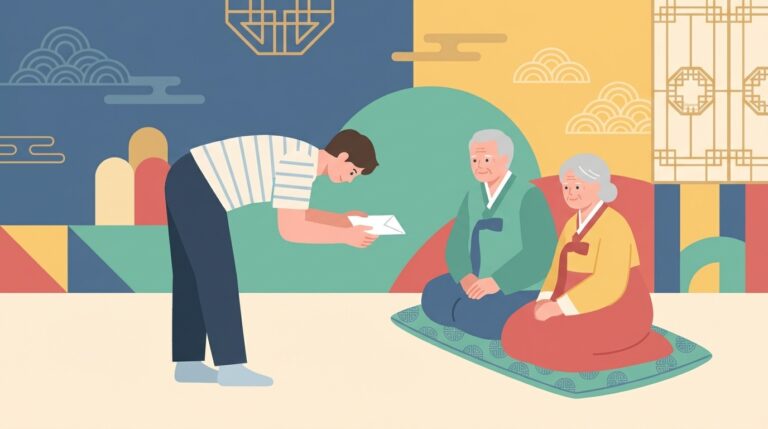
Picture this: You are watching a classic family K-Drama. It’s the morning of Seollal (Lunar New Year). The entire family is gathered in the living room, dressed in stunning Hanbok. The youngest kids step forward, drop to their knees, and perform a deep, respectful bow to their grandparents. In return, the grandparents smile, offer words of wisdom, and hand over crisp white envelopes. The kids’ eyes light up.
That envelope contains Sebaetdon (New Year’s money), and that deep bow is called Sebae.
Now, imagine you are invited to your Korean friend’s or partner’s house for Seollal. The living room is full of relatives you’ve just met. Suddenly, everyone lines up to bow. Panic sets in. How far do I bend? What do I say? Do I take the money right away?
Don’t worry! Whether you’re visiting a Korean family, watching your favorite K-Pop idol’s New Year greeting video, or just wanting to understand Korean holiday culture, I’ve got your back. Today, we are going to master the art of the Seollal bow. Let’s make sure you get that envelope like a true insider!
Phase 2: 핵심 표현 심층 분석 (Deep Dive)
Here are the absolute must-know phrases to survive and thrive during the Seollal family gathering.
1. 새해 복 많이 받으세요
- Pronunciation: Saehae bok mani badeuseyo [Sae-hae bok mah-nee bah-deu-se-yo] (Tip: ‘bok’ sounds like ‘book’ but cut short, and ‘mani’ sounds like ‘mah-nee’.)
- Meaning: Literal = Please receive a lot of New Year’s luck. / Real = Happy New Year!
- K-Culture Moment: This is the ultimate Seollal catchphrase. You will hear this everywhere—from TV commercials to K-Pop idols shouting it to their fans during a livestream. You say this while or right before you perform your Sebae bow.
- Editor’s Insight: Unlike the English “Happy New Year,” which is a wish for the year to be happy, the Korean phrase is an active offering of “Bok” (blessings/luck). It feels much warmer and more personal.
- Situation Spectrum:
[🚫 절대 금지] ———— [⚠️ 주의] ———— [✅ 자유롭게]- Casual (Friends): ✅ (Usually shortened to 새해 복 많이 받아!)
- Semi-formal (Colleagues): ✅
- Formal (Elders/Boss): ✅
- 🤔 Think About It: Why do Koreans focus on “receiving luck” rather than just “being happy”? How does your culture wish people a good new year?
2. 올해도 건강하세요
- Pronunciation: Olhaedo geonganghaseyo [Ol-hae-do geon-gang-ha-se-yo]
- Meaning: Literal = Please be healthy this year too. / Real = Wishing you continued health this year.
- K-Culture Moment: After the kids say “Saehae bok mani badeuseyo,” the older generation gives “Deokdam” (words of blessing). Then, it’s polite to add this phrase, especially when speaking to grandparents.
- Editor’s Insight: In Korea, wishing an elder good health is the highest form of respect. It shows you care deeply about their well-being, not just getting your Sebaetdon!
- Situation Spectrum:
[🚫 절대 금지] ———— [⚠️ 주의] ———— [✅ 자유롭게]- Casual (Friends): ⚠️ (A bit too formal, friends just say 건강해!)
- Formal (Elders/Boss): ✅
- 🤔 Think About It: Health and longevity have always been central to Korean traditional values. Do you notice how often Koreans ask “Have you eaten?” as a greeting? It all ties back to health!
3. 감사합니다, 잘 쓰겠습니다
- Pronunciation: Gamsahamnida, jal sseugesseumnida [Gam-sa-ham-ni-da, jal sseu-ge-sseum-ni-da]
- Meaning: Literal = Thank you, I will use it well. / Real = Thank you so much for the money.
- K-Culture Moment: The elder hands you the white envelope. You take it with two hands, bow your head slightly, and say this.
- Editor’s Insight: Never just say “Thanks” and shove it in your pocket. “I will use it well” implies you won’t waste the money on frivolous things (even if you secretly plan to buy K-Pop merch!).
- Situation Spectrum:
[🚫 절대 금지] ———— [⚠️ 주의] ———— [✅ 자유롭게]- Casual (Friends): 🚫 (Friends don’t usually give each other Sebaetdon)
- Formal (Elders/Boss): ✅
Phase 3: 교과서 vs 진짜 한국어 (Textbook vs Real Life)
| 상황 | 📖 교과서 한국어 | 🗣️ 진짜 한국어 | 💡 왜 다를까? |
|---|---|---|---|
| Bowing to Grandparents | 할아버지, 새해 복 많이 받으십시오. (Very stiff formal) | 할아버지! 새해 복 많이 받으세요~ 건강하시고요! | Modern families are more affectionate. “-십시오” sounds like you’re in the military. |
| Receiving the envelope | 감사합니다. 소중히 간직하겠습니다. (I will cherish it dearly) | 우와~ 감사합니다! 잘 쓰겠습니다! (With a big smile) | Expressing bright gratitude is preferred over overly dramatic textbook phrases. |
| Wishing a friend Happy New Year | 새해 복 많이 받으세요. | 새해 복 많이 받아! 올해 대박 나자! (Let’s hit the jackpot this year!) | Friends use Banmal (informal) and slang like ‘대박’ (Daebak) to show closeness. |
Phase 4: 문화적 맥락 — K-Culture 딥다이브 (Cultural Deep Dive)
4-1. 비언어적 요소 (Non-verbal Communication): The Art of Sebae
The words are only 50% of the battle. The physical Sebae (bow) is crucial.
– Hand Placement (공수 – Gongsu): Men put their LEFT hand over their right hand. Women put their RIGHT hand over their left hand. (Yes, there are specific rules!).
– The Descent: You smoothly drop to your knees, place your hands on the floor, and bend your upper body until your forehead almost touches your hands.
– Two Hands Rule: When the elder hands you the envelope, you MUST receive it with both hands. It’s the golden rule of Korean etiquette.
4-2. K-Culture Connection: K-Drama & The Generational Shift
Have you ever watched a K-Drama where an adult character (maybe in their late 20s or 30s) awkwardly lines up with their little nieces and nephews to bow? It’s a classic comedic trope!
Historically, Sebaetdon is for children. Once you graduate college, get a full-time job, or get married, you transition from receiver to giver. However, in modern Korea, the age of getting a job is getting higher. So, many “adults” still secretly hope for an envelope from their parents, creating hilarious, relatable K-Drama moments about the “Nunchi” (reading the room) of whether to bow or not.
Phase 5: 실전 롤플레이 시나리오 (Immersive Roleplay)
메인 롤플레이: The Morning of Seollal
Setting: Sunday morning, 10:00 AM. Your Korean friend Min-ji’s family home in Suwon. The house smells amazing—rich beef broth and sesame oil from the Tteokguk (rice cake soup). Everyone is in the living room. Min-ji’s grandmother is sitting on the sofa.
Characters:
– YOU: An expat spending your first traditional Seollal with a Korean family.
– Min-ji (28): Your helpful Korean friend.
– Halmoni (75): Min-ji’s grandmother, sweet but traditional.
Dialogue:
Min-ji: 자, 이제 세배하자! 떨지 말고 내가 하는 거 잘 따라 해.
(Ja, ije sebaehaja! Tteolji malgo naega haneun geo jal ttara hae.)
[Translation] Alright, let’s do the Sebae now! Don’t be nervous, just follow what I do.
YOU: 알았어. 심호흡 좀 하고… 😅
(Arasseo. Simhoheup jom hago…)
[Translation] Okay. Let me take a deep breath…
(🎭 Stage Direction: You and Min-ji stand in front of Halmoni. You place your hands correctly and drop to your knees, bowing deeply.)
YOU & Min-ji: 할머니, 새해 복 많이 받으세요! 건강하세요!
(Halmeoni, saehae bok mani badeuseyo! Geonganghaseyo!)
[Translation] Grandma, please receive a lot of New Year’s blessings! Please stay healthy!
Halmoni: 아이고~ 우리 민지도, 외국에서 온 친구도 새해 복 많이 받아. 타지에서 고생이 많지?
(Aigo~ uri minjido, oegugeseo on chingudo saehae bok mani bada. Tajieseo gosaengi manchi?)
[Translation] Aigo~ Our Min-ji, and our friend from overseas, receive lots of blessings too. It must be hard living far from home, right?
YOU: 아닙니다. 초대해 주셔서 감사합니다!
(Animnida. Chodaehae jusyeoseo gamsahamnida!)
[Translation] Not at all. Thank you for inviting me!
Halmoni: 맛있는 거 많이 사 먹어. (Hands you a crisp white envelope)
(Masinneun geo mani sa meogeo.)
[Translation] Buy yourself lots of delicious food.
🔀 당신의 차례! 어떻게 대답할까요? (Your Turn! How do you respond?)
– A) (Open the envelope immediately to check the amount) “우와! 5만 원이네요! 감사합니다!” (Wow! It’s 50,000 won! Thanks!)
– B) (Take it with one hand) “땡큐! 잘 쓸게요!” (Thank you! I’ll use it well!)
– C) (Take it with two hands, bowing your head) “정말 감사합니다! 잘 쓰겠습니다!” (Thank you so much! I will use it well!)
✅ Best Choice: C — This is the perfect textbook and real-life answer.
⚠️ Choice A 분석: Never, ever open the envelope in front of the person who gave it to you in Korea! It is considered very rude. Wait until you are in private.
⚠️ Choice B 분석: Taking something from an elder with one hand is a major etiquette violation.
Phase 6: 10초 섀도잉 드릴 (Shadowing Drill)
Let’s practice your timing and intonation so you sound like a local!
😊 할머니, / 새해 복 / 많~~~이 받으세요! / 항상 / 건강하세요!
(Halmeoni, / saehae bok / mah~~~ni badeuseyo! / hangsang / geonganghaseyo!)
Tip: Stretch out the “mah~~~ni” slightly with a bright smile to sound extra polite and affectionate!
Phase 7: K-Culture 미니 사전 (K-Culture Glossary)
| 한국어 | Romanization | 영어 | 맥락 설명 |
|---|---|---|---|
| 세배 | sebae | New Year’s Bow | The deep, traditional floor bow performed to elders on Lunar New Year. |
| 세뱃돈 | sebaetdon | New Year’s Money | The cash given by elders in a white or decorative envelope after receiving the Sebae. |
| 떡국 | tteokguk | Rice Cake Soup | The traditional Seollal dish. Koreans say you only “age one year” if you eat a bowl of Tteokguk! |
| 덕담 | deokdam | Words of Blessing | Well-wishes and advice given by elders. (Sometimes it includes nagging about marriage or jobs!) |
| 한복 | hanbok | Traditional Clothing | Korean traditional attire, often worn by children or traditional families during Seollal. |
| 귀성길 | gwiseonggil | Trip to Hometown | The massive traffic jam as millions of Koreans travel back to their hometowns. |
Phase 8: 여행자 서바이벌 키트 (Traveler’s Survival Kit)
If you are traveling in Korea during Seollal, it is completely different from a normal week. Many places are closed, and millions of people are moving across the country.
🆘 서바이벌 표현 TOP 3 (Holiday Travel Edition)
– 🇰🇷 “설날 연휴에 문 여나요?” (Seollal yeonhue mun yeonayo?)
– 🗣️ Meaning: Are you open during the Seollal holiday?
– 📍 Where to use: Cafes, local restaurants, shops.
- 🇰🇷 “KTX 표 매진됐나요?” (KTX pyo maejindwaennayo?)
- 🗣️ Meaning: Are the KTX (bullet train) tickets sold out?
- 📍 Where to use: Train stations.
🇰🇷 “새해 복 많이 받으세요!” (Saehae bok mani badeuseyo!)
- 🗣️ Meaning: Happy New Year!
- 📍 Where to use: To your taxi driver, hotel staff, or convenience store clerk. They will love it!
📌 Editor’s Travel Note
– The Ghost Town Effect: Seoul can actually feel very empty on the day of Seollal because everyone has gone to the provinces.
– Palaces are Free! Places like Gyeongbokgung Palace often offer free admission during the holiday, and there are many traditional games to play in the courtyards.
– Navigation Apps: Always check Naver Map or KakaoMap to see if a restaurant has updated its holiday hours. Don’t trust Google Maps in Korea!
Phase 9: 비판적 사고 코너 — “한 발 더 깊이” (Think Deeper)
🧠 Think Deeper: 언어와 권력 (Language & Power)
The tradition of Sebae and Sebaetdon is a fascinating look into Korean social hierarchy and the generational contract. It isn’t just about free cash. The deep bow (Sebae) requires the youth to physically lower themselves, showing ultimate respect and acknowledging the elder’s authority and life experience. In return, the elder gives money (Sebaetdon) and wisdom (Deokdam), taking on the responsibility of providing and caring for the younger generation. The formal language (Honorifics/Jondaetmal) used during this exchange reinforces this structured, mutual respect.💬 Your Turn: How does your culture handle the dynamic between youth and elders during major holidays? Is there an exchange of gifts, money, or specific greetings? Share your experiences in the comments!
Phase 10: FAQ & 오해 방지 (Troubleshooting)
- Q: “Am I too old to receive Sebaetdon?”
- A: It depends on the family, but generally, the cut-off is when you get a full-time job or get married. Once you are an independent adult, you are actually expected to give money (called 용돈 – Yongdon) to your parents and grandparents!
- Q: “Can I use ‘새해 복 많이 받으세요’ to my K-Pop idol on Weverse?”
- A: Yes! It’s the perfect greeting. Idols love seeing international fans use proper seasonal greetings.
❌ 흔한 실수 #1: Opening the envelope in front of the elders.
✅ 이렇게 하세요: In many Western cultures, it’s polite to open a gift immediately to show appreciation. In Korea, opening a cash envelope in front of the giver is considered greedy and rude. Slide it safely into your pocket or bag, and check it later!❌ 흔한 실수 #2: Using one hand during the exchange.
✅ 이렇게 하세요: Whether you are pouring a drink, shaking hands, or receiving Sebaetdon, always use two hands (or support your right elbow with your left hand) when interacting with elders.
Phase 11: 요약 및 액션 아이템 (Wrap-up)
- One-Liner Summary: Master the two-handed receive, say “Saehae bok mani badeuseyo,” and never open your Sebaetdon envelope in front of grandma!
-
Action Mission 3단계:
- 🥉 Bronze (Solo): Stand in front of a mirror, practice your best smile, and say “새해 복 많이 받으세요” three times.
- 🥈 Silver (Online): Leave a “새해 복 많이 받으세요 🙇♂️” comment on your favorite Korean celebrity’s Instagram or YouTube channel.
- 🥇 Gold (Real Life): If you are in Korea or have Korean friends, actually perform the Sebae and deliver the greeting perfectly!
- K-Culture Mission: Search for “아이돌 설날 인사” (Idol Seollal Greeting) on YouTube. Watch how they wear Hanbok, position their hands, and give the Sebae bow to the camera!
Phase 12: 퀴즈 — 인터랙티브 챌린지 (Interactive Quiz)
Q1. You just finished your Sebae bow, and your Korean partner’s father hands you a white envelope. What is the BEST thing to say?
1) 얼마예요? (How much is it?)
2) 감사합니다, 잘 쓰겠습니다! (Thank you, I will use it well!)
3) 아니에요, 괜찮아요! (No, it’s okay! – and then you refuse to take it)
Q2. True or False: In Korea, it is polite to open the envelope immediately to show how happy you are.
– T / F
Q3. Fill in the blank for the ultimate New Year greeting:
“새해 ___ 많이 받으세요!”
(Hint: It means ‘luck’ or ‘blessing’)
(Answers: Q1 = 2, Q2 = False, Q3 = 복(bok))
Frequently Asked Questions (FAQ)
Q: What does "새해 복 많이 받으세요" mean in Korean and how do you pronounce it?
A: In Korean, "새해 복 많이 받으세요" is pronounced [Saehae bok mani badeuseyo [Sae-hae bok mah-nee bah-deu-se-yo] and means: Literal = Please receive a lot of New Year's luck. / Real = Happy New Year!
Q: What does "올해도 건강하세요" mean in Korean and how do you pronounce it?
A: In Korean, "올해도 건강하세요" is pronounced [Olhaedo geonganghaseyo [Ol-hae-do geon-gang-ha-se-yo] and means: Literal = Please be healthy this year too. / Real = Wishing you continued health this year.
Q: What does "감사합니다, 잘 쓰겠습니다" mean in Korean and how do you pronounce it?
A: In Korean, "감사합니다, 잘 쓰겠습니다" is pronounced [Gamsahamnida, jal sseugesseumnida [Gam-sa-ham-ni-da, jal sseu-ge-sseum-ni-da] and means: Literal = Thank you, I will use it well. / Real = Thank you so much for the money.







