

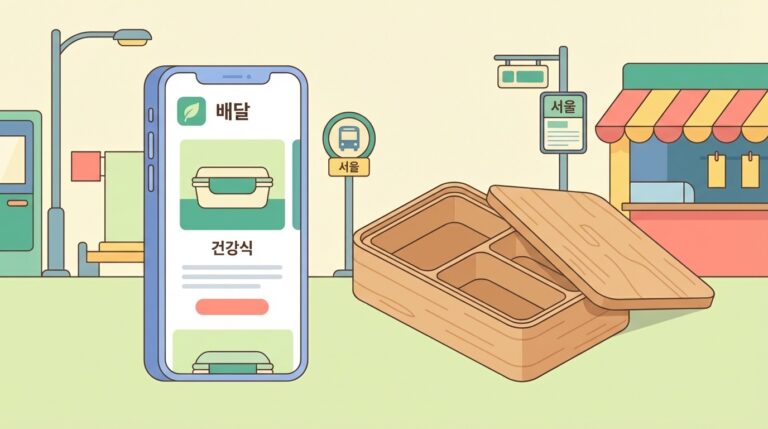
Phase 1: Empathy — Immersive Hook
Hello! I’m the Lead Editor at Daily Hangul.
Picture this: You’re sitting in your cozy Seoul Airbnb. You’ve just finished a marathon of Hospital Playlist, and seeing the characters devour late-night food has left you craving Jajangmyeon (black bean noodles). You eagerly open a Korean delivery app like Baedal Minjok (Baemin) or Yogiyo. But before you can hit ‘Order’, you see a little checkbox: ‘일회용 수저 안 주셔도 돼요’.
If you ignore it, your food will arrive with a mountain of plastic spoons, forks, and wooden chopsticks. While Korea is world-famous for its lightning-fast delivery culture (배달 문화), the amount of plastic waste it generates has become a massive social issue. That’s why the ‘Eco-friendly Delivery Movement’ (일회용품 줄이기 운동) is huge right now.
Knowing how to navigate this doesn’t just make you an eco-warrior; it makes you look like a true local who understands the unwritten rules of modern Korean life. Let’s dive into the B2-level nuances of ordering food sustainably in Korea!
Phase 2: Core Expressions Deep Dive
1. 일회용 수저 빼주세요
- Pronunciation: ilhoeyong sujeo ppaejuseyo [ill-hway-yong soo-juh ppay-joo-seh-yo]
- Meaning: (Literal) Please take out single-use cutlery. / (Real nuance) I don’t need plastic utensils.
- K-Culture Moment: You’re at a Hangang Park picnic with Korean friends. You order fried chicken. When writing the delivery request, your friend types this exact phrase because you brought your own forks.
- Editor’s Insight: The verb 빼다 (to remove/exclude) is your best friend in Korea. We use it for everything from “빼주세요” (remove the utensils) to “오이 빼주세요” (no cucumbers, please!). It feels much more natural and polite than saying “Don’t give me…”
- Situation Spectrum:
[🚫 절대 금지] ———— [⚠️ 주의] ———— [✅ 자유롭게]
- To friends (Casual): 🚫 (Use 반말: 빼줘)
- App request box (Semi-formal): ✅
- Speaking to a restaurant owner (Formal): ✅
- 🤔 Think About It: Why do Koreans use “빼주세요” (please remove) instead of “주지 마세요” (do not give)? In Korean culture, the default assumption of hospitality is to give everything (utensils, side dishes, sauces). Asking them to “remove” it acknowledges their initial intention to provide.
2. 일회용품 안 주셔도 돼요
- Pronunciation: ilhoeyongpum an jusyeodo dwaeyo [ill-hway-yong-poom ahn joo-shuh-do dway-yo]
- Meaning: (Literal) You don’t have to give me single-use items. / (Real nuance) No disposable items needed, thanks.
- K-Culture Moment: This is the exact phrasing used as the default checkbox on most Korean delivery apps today.
- Editor’s Insight: The grammar
-아/어/여도 되다(it is okay to…) is incredibly soft and considerate. Instead of a direct command, you are giving the restaurant owner permission not to do something. It’s the peak of Korean indirect politeness.- Situation Spectrum:
[🚫 절대 금지] ———— [⚠️ 주의] ———— [✅ 자유롭게]
- App request box / Delivery rider: ✅
- Formal business dinner: ⚠️ (A bit too casual for corporate higher-ups, but perfectly fine for service staff).
- 🤔 Think About It: This expression prioritizes the listener’s comfort. Does your native language have a way of saying “no” by giving the other person permission to do less work?
3. 다회용기로 주문할게요
- Pronunciation: dahoeyonggiro jumunhalgeyo [da-hway-yong-gi-ro joo-moon-hal-geh-yo]
- Meaning: (Literal) I will order with multiple-use containers. / (Real nuance) I want my food in reusable containers.
- K-Culture Moment: Many districts in Seoul (like Gangnam and Seocho) now offer a “reusable container” option on delivery apps. After eating, you just scan a QR code, leave the clean orange bowls outside your door, and a specialized company picks them up!
- Editor’s Insight: “다” (many) + “회” (times) + “용기” (container). It sounds a bit technical, but it’s the exact terminology used in Korean ESG (Environmental, Social, and Governance) campaigns.
- Situation Spectrum:
[🚫 절대 금지] ———— [⚠️ 주의] ———— [✅ 자유롭게]
- Clicking the option on the app: ✅
- Asking a traditional mom-and-pop shop: ⚠️ (They might not participate in this high-tech program yet!).
Phase 3: Textbook vs Real Life
| Situation | 📖 Textbook Korean | 🗣️ Real Korean | 💡 Why the difference? |
|---|---|---|---|
| App Delivery Note | 일회용 숟가락을 주지 마십시오. (Do not give disposable spoons.) | 일회용 수저 빼주세요~ (Please take out the disposable cutlery~) | The app interface prefers the softer “해요체” (polite/casual) to sound friendly, often adding a tilde (~) for warmth. |
| Refusing extra plastic bags at a cafe | 아니요, 비닐봉투는 필요 없습니다. (No, a plastic bag is not necessary.) | 아, 봉투 괜찮아요. (Ah, the bag is fine [I don’t need it].) | “괜찮아요” (It’s fine) is the ultimate Korean polite refusal. Saying “I don’t need it” is considered too blunt. |
| Asking to use a personal tumbler | 제 텀블러에 음료를 담아 주시겠습니까? (Would you put the beverage in my tumbler?) | 여기(텀블러)에 담아주세요. (Please put it in here.) | Efficiency! Koreans love “빨리빨리” (hurry hurry). Pointing to the tumbler and saying “in here” is much faster. |
Bottom Note: As a B2 learner, shifting from rigid textbook commands (-지 마십시오) to softer, relationship-building refusals (괜찮아요, 빼주세요) is the key to sounding like a true Seoulite.
Phase 4: Cultural Deep Dive — K-Culture Connection
4-1. Non-verbal Communication: The “Apologetic Hand”
When refusing a plastic bag or cup in person (like at a cafe or convenience store), Koreans rarely just say “No.” We often raise one hand slightly, palm facing sideways, and gently wave it while saying, “아, 괜찮아요” (Ah, I’m good). It visually softens the rejection. Try it next time—it works like magic!
4-2. K-Food & Everyday Life: The Burden of 분리수거 (Recycling)
Let’s connect this to Korea’s intense recycling culture (분리수거 – Bunlisugeo). In K-Dramas, you often see characters enjoying a massive feast of Tteokbokki and fried food from plastic containers. What the dramas don’t show you is the 20 minutes spent afterward washing the spicy red chili oil out of those plastic containers before throwing them in the recycling bin.
In Korea, if you don’t wash your plastic delivery containers, they are considered general waste, and you must pay for expensive standardized garbage bags (종량제 봉투). Therefore, choosing the “No disposable items” (일회용품 안 주셔도 돼요) or “Reusable container” (다회용기) option isn’t just about saving polar bears—it’s about saving yourself from doing the dishes and taking out the trash!
Phase 5: Immersive Roleplay
Scenario A: The Hangang Park Chicken Run
Setting: It’s a breezy Friday evening at Banpo Hangang Park. You and your Korean coworkers are sitting on a picnic mat. Your coworker, Minsu, opens a delivery app to order the ultimate Korean soul food: Chimaek (Chicken and Beer).
Characters:
– YOU: A foreign professional working in Seoul. You brought your own reusable chopsticks in your bag.
– Minsu (32): Your friendly, fast-talking Korean coworker.
Minsu: 배고프죠? 제가 앱으로 빨리 치킨 시킬게요. 🍗
(baegopeujyo? jaega aebeuro ppalli chikin sikilgeyo.)
(You’re hungry, right? I’ll quickly order chicken on the app.)
(🎭 Stage Direction: Minsu frantically taps his smartphone screen.)
Minsu: 아, 여기 ‘일회용 수저 받을까요?’ 옵션 있네. 밖이니까 당연히 받아야겠죠?
(a, yeogi ‘ilhoeyong sujeo badeulkkayo?’ opsyeon inne. bakkinikka dangyeonhi badayagetjyo?)
(Ah, there’s a ‘Should we get disposable cutlery?’ option here. Since we’re outside, we should definitely get it, right?)
🔀 Your Turn! How do you respond?
– A) “네, 젓가락 많이 달라고 하세요!” (Yes, ask them to give us lots of chopsticks!)
– B) “아니요, 일회용 수저 빼주세요. 저 개인 젓가락 가져왔어요!”
– C) “플라스틱은 지구를 파괴합니다. 절대 안 돼요.”✅ Best Choice: B — “No, please exclude the disposable cutlery. I brought my own personal chopsticks!” This shows you understand the app’s phrasing (“빼주세요”) and offers a practical reason.
⚠️ Choice C Analysis: While grammatically correct and morally sound, it sounds way too dramatic and documentary-like for a fun picnic.
Minsu: 우와, 개인 젓가락이요? 완전 준비성 대박인데요? 알겠어요, 일회용품 안 주셔도 된다고 체크할게요!
(uwa, gaein jeotgaragiyo? wanjeon junbiseong daebagindeyo? algesseoyo, ilhoeyongpum an jusyeodo doendago chekeuhalgeyo!)
(Wow, personal chopsticks? Your preparation is amazing! Got it, I’ll check the ‘No disposable items needed’ box!)
Bonus Scenario: The Cafe Tumbler Flex
Setting: A bustling mega-cafe in Hongdae. You are ordering an Iced Americano.
Barista: 드시고 가시나요? (Are you having it here?)
YOU: 아, 테이크아웃 할 건데, 제 텀블러에 담아주세요. (Ah, I’m doing take-out, but please put it in my tumbler.)
Barista: 네, 개인 컵 할인 300원 적용해 드릴게요! (Yes, I’ll apply the 300 won personal cup discount!)
(🎭 You just saved the Earth AND 300 won!)
Phase 6: 10-Second Shadowing Drill
Let’s practice getting that natural Korean rhythm. Read aloud, paying attention to the pauses (/) and the emotion!
😊 배달 기사님, / 문 앞에 두고 / 벨 눌러주세요. / 아, 그리고 / 일회용 수저는 / 빼주세요!
(baedal gisanim, / mun ape dugo / bel nulleojuseyo. / a, geurigo / ilhoeyong sujeoneun / ppaejuseyo!)
(Delivery driver, please leave it at the door and ring the bell. Ah, and please exclude the disposable cutlery!)
Phase 7: K-Culture Glossary
| Korean | Romanization | English | Context |
|---|---|---|---|
| 배달팁 | baedaltip | Delivery Fee | The fee added for delivery. Note: It’s a set fee, NOT a tip for the driver! There is no tipping culture in Korea. |
| 분리수거 | bunlisugeo | Recycling / Waste sorting | Korea’s strict waste separation system. Plastics, vinyl, paper, and food waste must all be separated. |
| 리뷰 이벤트 | ribyu ibenteu | Review Event | Restaurants give free side dishes if you promise to leave a 5-star review on the app. |
| 다회용기 | dahoeyonggi | Reusable container | Often orange or stainless steel bowls that are collected after you finish eating. |
| 환경호르몬 | hwangyeonghoreumon | Endocrine disruptors | A buzzword in Korea. Koreans avoid pouring hot soup into plastic bags due to fear of these chemicals. |
Phase 8: Traveler’s Survival Kit
Since food delivery is a massive part of a Korean trip, here’s how to survive if you’re a traveler wanting to order food but also minimize waste!
🆘 Survival Expression #1: When buying groceries/convenience store snacks
– 🇰🇷 “봉투 필요 없어요. 가방에 넣을게요.” (bongtu piryo eopseoyo. gabange noeulgeyo.)
– 🗣️ English Guide: [bong-too pee-ryo uhp-suh-yo. ga-bang-eh nuh-eul-geh-yo]
– 📍 Where to use: GS25, CU, E-mart, local markets.
– 💡 Pro Tip: By law, Korean stores charge for plastic bags (usually 50-100 KRW). Just tap your backpack and say this phrase to look like a pro.📌 Editor’s Travel Note
– App Issues for Travelers: Korean delivery apps (Baemin, Yogiyo) require a Korean phone number for identity verification. If you’re a tourist, use Shuttle Delivery (which operates in English and accepts foreign cards) or ask your hotel concierge to order for you. Just don’t forget to tell them: “No plastic utensils, please!”
– Trash in Airbnb: If you order delivery to an Airbnb, ask your host where the “분리수거장” (Recycling area) is. You are expected to clean and sort your takeout containers before checking out!
Phase 9: Think Deeper — “One Step Further”
Food & Identity: The Paradox of Delivery vs. Community
Korea is proudly known as “배달의 민족” (The Nation of Delivery). Historically, this comes from a deep-rooted culture of feeding others and sharing food (정 – Jeong). However, the modern explosion of single-person households and hyper-fast delivery apps has created a paradox: we share food virtually through apps, but eat alone, generating mountains of plastic.
The “No Disposable Items” campaign is Korea’s cultural compromise. It allows Koreans to maintain their beloved, fast-paced delivery lifestyle while alleviating the collective guilt toward the environment.
💬 Your Turn:
How does your country handle the environmental impact of food delivery? Are eco-friendly options a default, or do you have to go out of your way to request them? Share in the comments!
Phase 10: FAQ & Troubleshooting
Q: Do delivery riders or restaurants get annoyed if I ask for no utensils?
A: Absolutely not! In fact, restaurant owners love it when you check “일회용품 안 주셔도 돼요” because it saves them money on supplies.
Q: If I use the reusable container (다회용기) option, do I have to wash it perfectly before returning it?
A: You don’t need to scrub it with soap, but you MUST empty all leftover food and give it a quick rinse (물로 헹구기) so it doesn’t smell in the hallway.
❌ Common Mistake #1: Leaving leftover Tteokbokki sauce and food scraps in the delivery container when throwing it in the plastic recycling bin.
✅ Do this instead: Food scraps must go into a specific Food Waste Bag (음식물 쓰레기 봉투). The plastic container must be rinsed until it’s clean before going into the recycling bin!
Phase 11: Wrap-up & Action Items
One-Liner Summary: Use “일회용 수저 빼주세요” or “일회용품 안 주셔도 돼요” to order food like a considerate, eco-friendly local.
Action Mission:
– 🥉 Bronze (Solo): Stand in front of a mirror, wave your hand slightly, and practice saying: “아, 봉투 괜찮아요.” (Ah, the bag is fine/I don’t need it).
– 🥈 Silver (Online): Next time you watch a K-Drama eating scene, try to spot if they are using real metal utensils or disposable plastic ones.
– 🥇 Gold (Real Life): Go to a Korean cafe, bring your tumbler, and confidently say: “여기 담아주세요!” (Please put it in here!).
K-Culture Mission:
Download a Korean delivery app (even if you can’t order yet), navigate to the cart page, and see if you can find the exact Korean phrasing for the eco-friendly checkbox we learned today!
Phase 12: Interactive Quiz
1. Situational Judgment: You are ordering Bingsu (shaved ice) to your hotel room, which already has metal spoons. What should you write in the delivery request box?
– A) 일회용 수저 주세요.
– B) 숟가락 절대 주지 마십시오.
– C) 일회용 수저 빼주세요.
2. True or False — K-Culture Edition:
“In Korea, you must pay a small fee if you want a plastic bag at a convenience store.”
– [ True / False ]
3. Fill in the Blank:
You want to give the restaurant permission to skip the plastic forks.
“일회용품 안 _________ 돼요.”
(Scroll down for answers!)
Click to reveal answers
1. C (B is grammatically correct but too aggressive/stiff for an app request).
2. True (By law, stores must charge for plastic bags to reduce waste).
3. 주셔도 (안 주셔도 돼요 = You don’t have to give it).
Frequently Asked Questions (FAQ)
Q: What does "일회용 수저 빼주세요" mean in Korean and how do you pronounce it?
A: In Korean, "일회용 수저 빼주세요" is pronounced [ilhoeyong sujeo ppaejuseyo [ill-hway-yong soo-juh ppay-joo-seh-yo] and means: (Literal) Please take out single-use cutlery. / (Real nuance) I don't need plastic utensils.
Q: What does "일회용품 안 주셔도 돼요" mean in Korean and how do you pronounce it?
A: In Korean, "일회용품 안 주셔도 돼요" is pronounced [ilhoeyongpum an jusyeodo dwaeyo [ill-hway-yong-poom ahn joo-shuh-do dway-yo] and means: (Literal) You don't have to give me single-use items. / (Real nuance) No disposable items needed, thanks.
Q: What does "다회용기로 주문할게요" mean in Korean and how do you pronounce it?
A: In Korean, "다회용기로 주문할게요" is pronounced [dahoeyonggiro jumunhalgeyo [da-hway-yong-gi-ro joo-moon-hal-geh-yo] and means: (Literal) I will order with multiple-use containers. / (Real nuance) I want my food in reusable containers.







