

Phase 1: 공감 — 몰입형 오프닝 (Immersive Hook)
안녕하세요! I’m your Daily Hangul Editor, your local culture navigator and veteran tutor.
Imagine this: You’re in Seoul. During your morning commute on the subway, you’re surrounded by hundreds of people, yet everyone is dead silent, staring at their phones. No eye contact, no greetings. It’s the unwritten rule of the big city.
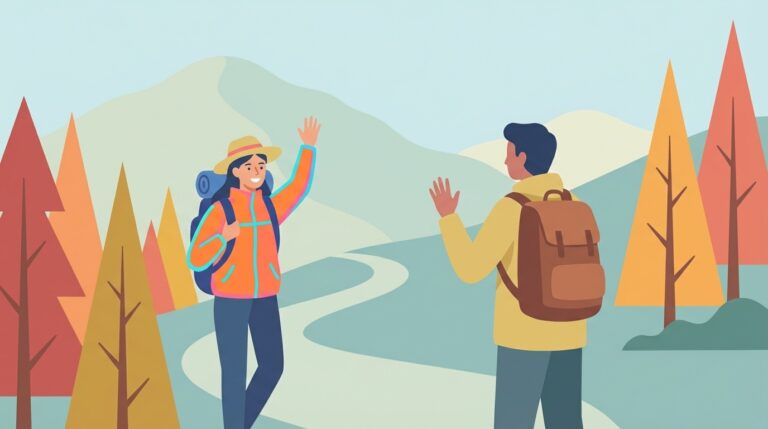
But on Saturday morning, you decide to hike Bukhansan. As you drag your exhausted legs up the steep, rocky trail, a middle-aged Korean man—fully decked out in neon-colored, professional Gore-Tex gear from head to toe—effortlessly glides down the mountain toward you. As he passes, he makes eye contact, gives a short nod, and warmly says:
“안녕하세요!” (Hello!)
Wait… do I know him? Did we meet somewhere? Why is a stranger greeting me in Korea?
If you’ve ever watched a K-Drama where a strict CEO forces his entire office team to go hiking on a weekend (a classic Korean corporate trope!), you might have noticed the unique atmosphere of Korean mountains. The mountain in Korea is a magical place where the rigid social walls of the city completely disappear. Knowing how to navigate this “Trail Etiquette” won’t just keep you polite—it will unlock an entirely new level of Korean community spirit (and maybe even earn you a free cup of Makgeolli at the summit!).
This guide is built from the exact moments my students asked, “Teacher, why does everyone keep saying hello to me on the mountain?”
Phase 2: 핵심 표현 심층 분석 (Deep Dive)
Let’s break down the most essential expressions you’ll need (and hear) on the hiking trail.
1. 안녕하세요 (Annyeonghaseyo)
- Pronunciation: [an-nyeong-ha-se-yo] (‘yo’ sounds like the ‘yo’ in yo-yo)
- Meaning: (Literal) Are you in peace? / (Real Nuance) Hello / Have a safe hike!
- K-Culture Moment: You’ll hear this exactly when you cross paths with someone going the opposite direction, or when you overtake someone. It’s an acknowledgment of shared suffering and shared joy on the mountain.
- Editor’s Insight: On the street, saying this to a stranger would be weird. On the mountain, not saying it when making eye contact can sometimes feel cold. It’s spoken briefly, usually with a slight breathless pant!
- Situation Spectrum:
[🚫 절대 금지] ———— [⚠️ 주의] ———— [✅ 자유롭게]- Casual (To fellow hikers of similar age): ✅
- Semi-formal (To older hikers / Ajusshis): ✅
- Formal (To hiking grandpas/grandmas): ✅
- 🤔 Think About It: Why do Koreans suddenly become so friendly to strangers only when they reach an altitude of 300 meters? What does this say about the concept of ‘community’ in Korea?
2. 수고하십니다! (Sugohasimnida)
- Pronunciation: [su-go-ha-sim-ni-da] (‘su’ sounds like Sue, ‘go’ like go)
- Meaning: (Literal) You are making an effort. / (Real Nuance) Keep up the good work! You’re doing great!
- K-Culture Moment: In K-Dramas, you usually hear this when leaving the office. But on a hike, it’s used when you pass someone who looks exhausted, or when someone is taking a break. It’s the ultimate “I feel your pain, fighting!” phrase.
- Editor’s Insight: This phrase is magical. It’s a verbal pat on the back. If someone says this to you while you’re panting on a rock, they are acknowledging your hard work.
- Situation Spectrum:
[🚫 절대 금지] ———— [⚠️ 주의] ———— [✅ 자유롭게]- Casual: ✅ (Though friends might say ‘수고해~’)
- To older strangers on the mountain: ⚠️ (Usually acceptable on the mountain, but in normal daily life, younger people shouldn’t say this to elders!)
- 🤔 Think About It: Does your native language have a phrase that acknowledges someone’s physical effort in a positive, encouraging way?
3. 다 왔어요! (Da wasseoyo)
- Pronunciation: [da wa-sseo-yo] (‘sseo’ sounds like the ‘su’ in sun)
- Meaning: (Literal) We have all arrived. / (Real Nuance) We are almost there!
- K-Culture Moment: You stop an older hiker and ask, “How much further to the top?” They smile brightly and say, “다 왔어요! Just 5 minutes!” Spoiler alert: It is NEVER just 5 minutes. It’s usually 30 more minutes of grueling stairs.
- Editor’s Insight: This is the “Universal White Lie of Korean Hikers.” They say it to encourage you so you don’t give up.
- Situation Spectrum:
[🚫 절대 금지] ———— [⚠️ 주의] ———— [✅ 자유롭게]- To everyone: ✅ (Use it to encourage others, even if it’s a lie!)
Phase 3: 교과서 vs 진짜 한국어 (Textbook vs Real Life)
| 상황 (Situation) | 📖 교과서 한국어 (Textbook) | 🗣️ 진짜 한국어 (Real Life) | 💡 왜 다를까? (Why the difference?) |
|---|---|---|---|
| Passing by someone | 안녕히 가세요. (Goodbye) | 수고하세요! / 수고하십니다! | On the mountain, acknowledging ‘effort’ is more natural than a simple ‘goodbye.’ |
| Encouraging a friend | 힘내세요! (Cheer up!) | 파이팅! / 다 왔어! (Fighting! / Almost there!) | Koreans love the Konglish ‘Fighting!’ and using the ‘Almost there’ white lie. |
| Offering food | 이것 좀 드시겠어요? (Would you like some?) | 오이 좀 먹어요. (Have some cucumber.) | Trail talk is direct and practical. No need for overly formal dining phrases for a cucumber! |
Bottom Note: As a B2 learner, shifting from “안녕히 가세요” to “수고하세요” when passing strangers will instantly make you sound like a local who truly understands the vibe.
Phase 4: 문화적 맥락 — K-Culture 딥다이브 (Cultural Deep Dive)
4-1. 비언어적 요소 (Non-verbal Communication)
Don’t just shout “안녕하세요!” like a cheerleader. The Korean mountain greeting requires the right body language:
* 목례 (Mongnye – Short Nod): A slight bow of the head (about 15 degrees). No need for a full 90-degree waist bow while climbing rocks!
* 눈치 (Nunchi): Use your Nunchi (social sense). If the trail is narrow, step to the side to let descending hikers pass, make quick eye contact, nod, and say the greeting softly.
4-2. K-Culture 연결 고리 (K-Food & Hiking Fashion)
Let’s talk about why Koreans really hike: The After-Party (뒷풀이).
If you watch K-Dramas or reality shows (like I Live Alone), you’ll notice that the hike isn’t complete without the food at the bottom of the mountain. The holy trinity of Korean hiking food is: 막걸리 (Makgeolli – Rice wine), 파전 (Pajeon – Green onion pancake), and 도토리묵 (Dotorimuk – Acorn jelly).
When you greet an older hiker well on the mountain, sometimes they will literally hand you a cherry tomato, a piece of cucumber, or even offer you a paper cup of Makgeolli at the peak. Sharing food is the ultimate expression of Korean 정 (Jeong – deep emotional connection/affection).
Critical View: Have you noticed the incredibly bright, neon-colored hiking gear (등산복) middle-aged Koreans wear? It’s a massive fashion industry in Korea. While younger generations (Gen Z) recently started hiking in leggings and oversized tees, the “Ahjusshi/Ajumma” neon armor remains a powerful cultural symbol of vitality and community.
Phase 5: 실전 롤플레이 시나리오 (Immersive Roleplay)
시나리오 A: The Bukhansan Encounter
- Setting: Saturday morning, 10:30 AM. Halfway up Bukhansan. Your legs are burning. You are leaning against a rock, drinking water.
- Characters:
- YOU: An expat living in Seoul, trying to survive your first Korean hike.
- Ahjusshi (50s): Wearing a bright neon green jacket, trekking poles in hand. He is bouncing down the mountain like a mountain goat.
Ahjusshi: (Walking down quickly, sees you resting)
아이고, 수고하십니다! 쉬엄쉬엄 올라가요~
(Aigo, sugohasimnida! Swieomswieom ollagayo~)
[Oh, keep up the good work! Take your time going up~]
(🎭 Stage Direction: He gives you a friendly smile and a slight nod)
🔀 당신의 차례! 어떻게 대답할까요? (Your Turn! How will you reply?)
* A) (Staring blankly) “네… (Ne…)”
* B) “안녕하세요! 조심히 내려가세요! (Annyeonghaseyo! Josimhi naeryeogaseyo!)”
* C) “다 왔나요? (Da wannayo?)”✅ Best Choice: B — You acknowledge his greeting and wish him a safe descent (“조심히 내려가세요” – Be careful going down). It’s the perfect, polite, and culturally accurate response!
⚠️ Choice C Analysis: Asking “Are we almost there?” is a great follow-up question! But be prepared for him to say “5 minutes!” (He means 40 minutes).
시나리오 B: The Makgeolli After-Party (Bonus)
- Setting: A lively restaurant at the base of the mountain. You sit with your Korean friends.
- Friend: 파전에 막걸리 어때요? (Pajeone makgeolli eottaeyo?) / How about Pajeon and Makgeolli?
- YOU: 무조건이죠! 이모님~ 여기 막걸리 하나 주세요! (Mujogeonijyo! Imonim~ yeogi makgeolli hana juseyo!) / Absolutely! Auntie~ one Makgeolli here please!
Phase 6: 10초 섀도잉 드릴 (Shadowing Drill)
Ready to sound like a local? Practice this 10-second drill. Follow the pauses (/) and emotions!
- (To someone passing by)
😊 안녕하세요! / 수고하십니다!
(an-nyeong-ha-se-yo! / su-go-ha-sim-ni-da!) - (When you’re dying and want to ask how far)
🥺 저기요… / 정상까지 / 얼마나 남았어요?
(jeo-gi-yo… / jeong-sang-kka-ji / eol-ma-na na-ma-sseo-yo?) - (The inevitable reply you will hear)
😎 다 왔어요! / 5분만 가면 돼요!
(da wa-sseo-yo! / o-bun-man ga-myeon dwae-yo!)
Phase 7: K-Culture 미니 사전 (K-Culture Glossary)
| 한국어 | Romanization | English | 맥락 설명 (Context) |
|---|---|---|---|
| 눈치 | nunchi | Social sense | The ability to read the room. E.g., stepping aside on a narrow trail. |
| 아저씨 | ajeossi | Middle-aged man | Often the friendliest people on the mountain, usually in bright gear. |
| 막걸리 | makgeolli | Rice wine | The traditional, slightly milky, fizzy alcohol consumed after hiking. |
| 파전 | pajeon | Green onion pancake | The soulmate of Makgeolli. Crispy, savory, and perfect after burning calories. |
| 하산 | hasan | Descending the mountain | The journey down. Often when greetings like “조심히 가세요” are used. |
Phase 8: 여행자 서바이벌 키트 (Traveler’s Survival Kit)
🆘 서바이벌 표현 (Survival Expressions for the Trail)
* 🇰🇷 “정상으로 가는 길 맞나요?” (jeongsang-euro ganeun gil mannayo?)
* 🗣️ Meaning: Is this the right way to the peak?
* 📍 When to use: When the trail splits and you are confused.
* 🇰🇷 “화장실이 어디에 있어요?” (hwajangsiri eodie isseoyo?)
* 🗣️ Meaning: Where is the restroom?
* 📍 When to use: At the mountain entrance or shelter (대피소).
* 🇰🇷 “조심히 내려가세요~” (josimhi naeryeogaseyo~)
* 🗣️ Meaning: Have a safe descent.
* 📍 When to use: To hikers passing you on their way down.📌 Editor’s Travel Note
* Useful Apps: Do NOT use Google Maps for hiking in Korea. Use KakaoMap or Naver Map. They show incredibly detailed mountain trails, elevation, and estimated times!
* Water & Snacks: Buy plenty of water and some chocolate bars at the convenience store before you start. Prices at mountain shelters are much higher.
Phase 9: 비판적 사고 코너 — “한 발 더 깊이” (Think Deeper)
🧠 Think Deeper: 언어와 권력, 그리고 산 (Language, Power, and the Mountain)
In Korean society, language is deeply tied to age, status, and hierarchy. In the workplace or city streets, people are careful to maintain boundaries, often avoiding interactions with strangers entirely. However, the mountain acts as a great social equalizer. Once you put on your hiking boots, the strict corporate hierarchy softens. The shared physical struggle against gravity creates an instant ‘in-group’ (우리 – ‘we’ culture). By saying “안녕하세요” to a stranger on the trail, you are stepping out of the rigid urban structure and embracing a primal, community-driven identity. It’s one of the rare places in Korea where a 20-something and a 60-something can share a casual, cheerful greeting without the heavy weight of social rank.
💬 Your Turn: Does nature or physical activity break down social barriers in your home country too? How do strangers interact on hiking trails where you live? Share in the comments!
Phase 10: FAQ & 오해 방지 (Troubleshooting)
Q: “Can I use 반말 (casual language, like ‘안녕’) to older hikers because the vibe is so friendly?”
A: NO. Even though the mountain is an equalizer, basic age-related respect still applies. Always use the ‘-요’ or ‘-습니다’ forms (존댓말) with strangers, no matter how friendly they seem!
Q: “Someone offered me food from their lunchbox on the mountain. Do I have to accept it?”
A: It’s considered a warm gesture of Jeong (정). If you have allergies or really don’t want it, politely say, “아이고, 감사합니다. 그런데 제가 배가 불러서요” (Oh, thank you, but I’m quite full). Otherwise, take a small piece, say “잘 먹겠습니다!” and enjoy the connection!
❌ 흔한 실수 (Common Mistake): Stopping right in the middle of a narrow trail to take a selfie while people are waiting behind you.
✅ 이렇게 하세요 (Do this instead): Step to the side, say “먼저 가세요” (Please go ahead), and take your photo peacefully!
Phase 11: 요약 및 액션 아이템 (Wrap-up)
- One-Liner Summary: On Korean mountains, a breathless “안녕하세요” or “수고하십니다” is the ultimate key to unlocking the hidden, warm community spirit of Korea.
🎯 Action Mission 3단계
* 🥉 Bronze (혼자서): Look in the mirror, pretend you are out of breath, give a slight nod, and say “안녕하세요! 수고하십니다!”
* 🥈 Silver (온라인): Drop a comment below using the word “다 왔어요!” in a creative sentence.
* 🥇 Gold (실전): Next time you are in Korea, hike Bukhansan or Namsan. Wait for an Ajusshi in neon gear to pass by, and confidently greet him first!
🌸 K-Culture Mission: Open Google Street View (or KakaoMap Road View) for ‘Bukhansan National Park Entrance’. Look at the restaurants at the bottom and find one that sells 막걸리 (Makgeolli) and 파전 (Pajeon). Imagine sitting there after a successful hike!
Phase 12: 퀴즈 — 인터랙티브 챌린지 (Interactive Quiz)
1. You are walking UP the mountain, and a hiker is walking DOWN toward you. What is the most natural thing to say as they pass?
A) 안녕히 계세요! (Stay in peace!)
B) 조심히 내려가세요! (Go down safely!)
C) 저기요! (Excuse me!)
- Answer: B. (A is used when you are leaving a place and someone else is staying. C is used to call for attention, like to a waiter.)
2. True or False: If a Korean hiker tells you “다 왔어요 (We’re almost there),” it means the peak is definitely only 5 minutes away.
* Answer: False! It is a motivational white lie. Prepare mentally for at least 20-30 more minutes!
3. Fill in the blank: The traditional alcohol that Koreans love to drink AFTER a hike is called ___________.
* Answer: 막걸리 (Makgeolli)
4. Situational Judgment: An older hiker stops and hands you a piece of cucumber. What is the best response?
A) No thank you, I don’t take food from strangers.
B) 두 손으로 (with both hands) accept it, bow slightly, and say “감사합니다! 잘 먹겠습니다!”
C) Give him 1,000 won for it.
- Answer: B. Accepting it with both hands and expressing gratitude perfectly embraces the culture of ‘Jeong’. Offering money (C) would be insulting!
How did you do? Are you ready to conquer the Korean mountains? See you on the trail! 파이팅! ⛰️
Frequently Asked Questions (FAQ)
Q: What does "안녕하세요 (Annyeonghaseyo)" mean in Korean and how do you pronounce it?
A: In Korean, "안녕하세요 (Annyeonghaseyo)" is pronounced [an-nyeong-ha-se-yo] and means: (Literal) Are you in peace? / (Real Nuance) Hello / Have a safe hike!
Q: What does "수고하십니다! (Sugohasimnida)" mean in Korean and how do you pronounce it?
A: In Korean, "수고하십니다! (Sugohasimnida)" is pronounced [su-go-ha-sim-ni-da] and means: (Literal) You are making an effort. / (Real Nuance) Keep up the good work! You're doing great!
Q: What does "다 왔어요! (Da wasseoyo)" mean in Korean and how do you pronounce it?
A: In Korean, "다 왔어요! (Da wasseoyo)" is pronounced [da wa-sseo-yo] and means: (Literal) We have all arrived. / (Real Nuance) We are almost there!







