

Phase 1: 공감 — 몰입형 오프닝 (Immersive Hook)
Hello there! It’s your Daily Hangul Editor.
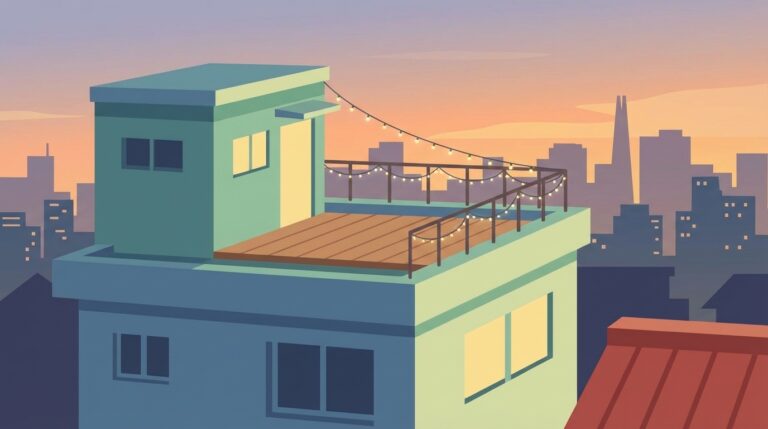
Picture this: You are watching a hit K-Drama. The hardworking protagonist comes home after a long day, climbs up to their rooftop, and cracks open a cold beer. Fairy lights are twinkling, pork belly is sizzling on a portable grill, and the sparkling night view of the N Seoul Tower is right behind them.
At that exact moment, you probably thought: “Wow, I want to live in a Korean rooftop apartment!”
Well, my friend, welcome to the world of the 옥탑방 (Oktapbang). It’s the ultimate K-Drama fantasy. But if you tell a Korean friend in Seoul that you want to move into one, instead of saying “That’s so cool!” they might look at you with deep concern and sigh. Why? Because the gap between the romance on screen and the reality of surviving a Korean summer on a concrete roof is massive.
Today, we are going to learn the essential vocabulary to talk about Korean housing, specifically decoding the fantasy of the K-Drama rooftop. Let’s dive into the real Korean lifestyle!
Phase 2: 핵심 표현 심층 분석 (Deep Dive)
Let’s look at the top 3 expressions you need to discuss the rooftop fantasy like a true local.
1. 옥탑방 (Rooftop Apartment)
- Pronunciation: [ok-tap-bang] 🗣️ Sounds like: ‘oak-top-bang’ (‘bang’ sounds like the ‘bahng’ in ‘Bangkok’).
- Meaning: Literal: Rooftop room / Real nuance: A small, cheap studio apartment built on the flat roof of a multi-story residential building.
- K-Culture Moment: Think of Park Seo-joon’s iconic rooftop hangout in Itaewon Class or the cozy rooftop in Fight For My Way. In dramas, it symbolizes youth, dreams, and romance.
- Editor’s Insight: The word ‘방(bang)’ means room. You’ll see it everywhere in Korea: 노래방 (Karaoke room), PC방 (Internet cafe), 찜질방 (Sauna). 옥탑방 specifically carries a vibe of “I’m young, broke, but full of dreams.”
- Situation Spectrum:
[🚫 절대 금지] ———— [⚠️ 주의] ———— [✅ 자유롭게]
- Casual / Semi-formal / Formal: ✅ (It’s just a noun, completely safe to use anywhere!)
- 🤔 Think About It: Why does Seoul have so many rooftop apartments? Due to rapid urbanization and a lack of space, landlords started building extra rooms on flat roofs to rent out to students and young workers. Does your city have a specific housing type for young people?
2. 로망이에요 (It’s my fantasy/dream)
- Pronunciation: [ro-mang-i-e-yo] 🗣️ Sounds like: ‘ro-mahng-ee-eh-yo’
- Meaning: Literal: It’s romance / Real nuance: It’s a fantasy, a bucket-list dream I hold in my heart.
- K-Culture Moment: When a K-Pop idol is asked about their ideal date, they might say, “한강에서 치맥 하는 게 제 로망이에요” (Having chicken and beer at the Han River is my fantasy).
- Editor’s Insight: Koreans use the French-derived word ‘로망 (romance)’ not just for love, but to describe a deep, somewhat idealized wish. Living in an Oktapbang is a classic “외국인들의 로망” (foreigners’ fantasy).
- Situation Spectrum:
[🚫 절대 금지] ———— [⚠️ 주의] ———— [✅ 자유롭게]
- Casual with friends: ✅
- Talking to coworkers: ✅
- Formal business meeting: ⚠️ (A bit too emotional/personal)
- 🤔 Think About It: Korean culture often romantizes specific lifestyles (like living in an Oktapbang or opening a small cafe). What is a common ‘로망’ in your culture?
3. 여름엔 덥고 겨울엔 추워요 (Hot in summer, cold in winter)
- Pronunciation: [yeo-reu-men deop-go gyeo-u-ren chu-wo-yo] 🗣️ ‘eo’ sounds like ‘uh’ in ‘uh-oh’.
- Meaning: Literal & Real nuance: It is hot in the summer and cold in the winter.
- K-Culture Moment: This is the exact phrase any Korean will say when you mention moving into an Oktapbang.
- Editor’s Insight: Because Oktapbangs are exposed to the sun directly in summer and lack proper insulation in winter, they are infamous for extreme temperatures. This phrase is the ultimate reality check!
- Situation Spectrum:
[🚫 절대 금지] ———— [⚠️ 주의] ———— [✅ 자유롭게]
- Usable anywhere: ✅
Phase 3: 교과서 vs 진짜 한국어 (Textbook vs Real Life)
| 상황 | 📖 교과서 한국어 | 🗣️ 진짜 한국어 | 💡 왜 다를까? |
|---|---|---|---|
| Telling someone where you live | 저는 옥상에 있는 방에 삽니다. (I live in a room on the roof.) | 저 옥탑방 살아요. (I live in an Oktapbang.) | Koreans prefer specific compound nouns over long descriptive sentences. |
| Talking about cheap rent | 임대료가 저렴합니다. (The rent is cheap.) | 가성비 좋아요. (It’s cost-effective.) | ‘가성비’ (Cost-performance ratio) is a massive trend in modern Korean culture. |
| Complaining about stairs | 계단이 너무 많습니다. (There are too many stairs.) | 매일 등산하는 기분이에요. (Feels like I’m hiking everyday.) | Koreans love dramatic, humorous exaggerations (and hiking is a national pastime!). |
Phase 4: 문화적 맥락 — K-Culture 딥다이브 (Cultural Deep Dive)
4-1. Non-verbal Communication: The “Sympathetic Nod”
When someone tells you they live in an Oktapbang or a Gosiwon (a tiny study room), the socially correct Korean reaction isn’t “Wow, that’s cool!” It’s a slight, sympathetic nod with an “아… (Ah…)” of understanding. Koreans have high Nunchi (눈치), meaning they read the room. They know that Oktapbang living means the person is likely trying to save money and working hard for their future. A warm, encouraging smile works best.
4-2. K-Drama Connection: The Rooftop Trope
Why do K-Dramas love the Oktapbang so much? Visually, it provides a stunning contrast: a poor, struggling protagonist positioned high above the city, with the dazzling, wealthy skyline of Seoul directly behind them. It symbolizes that while they are at the bottom of the financial ladder, their dreams are soaring high.
Reality Check: The drama rarely shows the protagonist hauling a 20kg suitcase up five flights of extremely steep, narrow stairs because Oktapbang buildings almost never have elevators!
Phase 5: 실전 롤플레이 시나리오 (Immersive Roleplay)
메인 롤플레이: The Reality Check at a Yeonnam-dong Cafe
- Setting: A trendy indie cafe in Yeonnam-dong, Seoul. You are sipping an iced Americano with your Korean coworker.
- Characters:
- YOU: A foreigner who just got a job in Seoul and is looking for housing, deeply inspired by K-Dramas.
- Min-su (32): Your Korean coworker. Practical, friendly, and very honest.
YOU: 민수 씨, 저 이사 갈 집 찾았어요! 🏠
(Min-su ssi, jeo isa gal jip chajasseoyo!)
[Min-su, I found a house to move into!]
Min-su: 오, 진짜요? 어디로 가요?
(O, jinjja-yo? Eodi-ro gayo?)
[Oh, really? Where are you moving?]
YOU: 홍대 근처 옥탑방이에요! 제 로망이었거든요 ✨
(Hongdae geuncheo oktapbang-i-e-yo! Je romang-i-eot-geo-deun-yo.)
[It’s a rooftop apartment near Hongdae! It was my fantasy.]
(🎭 Stage Direction: Min-su almost chokes on his coffee, his eyes widening in concern.)
Min-su: 옥탑방요? 에이, 농담하지 마세요.
(Oktapbang-yo? Ei, nongdam-haji maseyo.)
[An Oktapbang? Hey, don’t joke around.]
YOU: 농담 아니에요. 뷰가 진짜 예뻐요!
(Nongdam ani-e-yo. Byu-ga jinjja yeppeo-yo!)
[I’m not joking. The view is really pretty!]
Min-su: 뷰는 예쁘죠… 근데 옥탑방은 여름엔 엄청 덥고, 겨울엔 엄청 추워요. 눈 오면 계단 진짜 위험해요.
(Byu-neun yeppeujo… geunde oktapbang-eun yeoreumen eomcheong deopgo, gyeouren eomcheong chuwoyo. Nun omyeon gyedan jinjja wiheomhaeyo.)
[The view is pretty, sure… But Oktapbangs are incredibly hot in the summer and incredibly cold in the winter. If it snows, the stairs are really dangerous.]
🔀 당신의 차례! 어떻게 대답할까요? (Decision Point)
- A) “아… 그래요? 다시 생각해 봐야겠네요.” (Oh… really? I should think about it again.)
- B) “괜찮아요! 드라마 주인공처럼 살 거예요!” (It’s fine! I’m going to live like a drama main character!)
- C) “에어컨 틀면 되잖아요!” (I can just turn on the AC!)
✅ Best Choice: A — Reason: In Korea, when a local gives you practical advice out of concern (정 – Jeong), acknowledging their worry shows good manners and high Nunchi.
⚠️ Choice B & C 분석: If you choose B or C, Min-su will likely sigh and say, “전기세(Electric bill) 폭탄 맞을걸요…” (You’ll get hit with a bomb of an electric bill…).
Min-su: 네, 엘리베이터 있는 원룸으로 다시 알아봐요. 제가 도와줄게요.
(Ne, ellibeiteo inneun wonnumeuro dasi arabwayo. Jaega dowajulgeyo.)
[Yeah, look for a studio with an elevator again. I’ll help you.]
Phase 6: 10초 섀도잉 드릴 (Shadowing Drill)
Let’s practice the ultimate reality-check sentence. Pay attention to the pauses!
😤 옥탑방은 / 여름엔 너무 덥고, / 겨울엔 너무 추워요!
(ok-tap-bang-eun / yeo-reu-men neo-mu deop-go, / gyeo-u-ren neo-mu chu-wo-yo!)
(Oktapbangs are too hot in the summer, and too cold in the winter!)
Phase 7: K-Culture 미니 사전 (K-Culture Glossary)
| 한국어 | Romanization | 영어 | 맥락 설명 |
|---|---|---|---|
| 옥탑방 | oktapbang | Rooftop apartment | Affordable, exposed housing on roofs. A K-Drama staple. |
| 자취 | jachwi | Living alone | The act of living independently away from one’s family. A big milestone for young Koreans. |
| 원룸 | wonnum | Studio apartment | “One room.” The most common housing type for single people in Korea. |
| 보증금 | bojeunggeum | Security deposit | Korean deposits are huge! Often starting from $5,000 to $10,000 USD just for a studio. |
| 월세 | wolse | Monthly rent | Paid every month, similar to Western renting systems. |
| 로망 | romang | Fantasy/Dream | A romanticized ideal or bucket-list wish. |
Phase 8: 여행자 서바이벌 키트 (Traveler’s Survival Kit)
Even if you aren’t moving to Korea, you might book an Airbnb that happens to be an Oktapbang. Here are survival phrases for navigating Korean accommodations!
🆘 서바이벌 표현 TOP 3
- 🇰🇷 “엘리베이터 있어요?” (ellibeiteo isseoyo?)
- 🗣️ Meaning: Is there an elevator?
- 📍 Use when: Booking an Airbnb or guest house. Crucial if you have heavy luggage!
- 🇰🇷 “보일러 어떻게 켜요?” (boilleo eotteoke kyeoyo?)
- 🗣️ Meaning: How do I turn on the boiler (floor heating)?
- 📍 Use when: You enter your Korean room in winter. Korean houses use Ondol (underfloor heating), not radiators.
- 🇰🇷 “에어컨이 안 시원해요.” (eeokeoni an siwonhaeyo.)
- 🗣️ Meaning: The AC isn’t cold.
- 📍 Use when: Surviving the brutal humidity of a Korean summer in your rooftop room.
📌 Editor’s Travel Note
Be careful with Airbnb listings in Seoul labeled “Romantic Rooftop.” Always check the reviews for mentions of “stairs” (계단) or “water pressure” (수압). Oktapbangs often have weak water pressure because the water has to be pumped all the way to the roof!
Phase 9: 비판적 사고 코너 — “한 발 더 깊이” (Think Deeper)
미디어 vs 현실 (Media vs Reality): The Glamorization of Poverty
🧠 Think Deeper:
K-Dramas often romanticize spaces like the Oktapbang or the tiny Gosiwon (exam prep rooms). They use fairy lights and handsome actors to make these cramped, poorly insulated spaces look cozy and bohemian. However, for many young Koreans facing a fiercely competitive job market and skyrocketing real estate prices in Seoul, living in an Oktapbang isn’t a romantic choice—it’s an economic necessity. The media softens the harsh reality of Seoul’s housing crisis, packaging the struggles of the youth into an aesthetic, consumable fantasy.💬 Your Turn: Have you ever visited a place that looked completely different in reality compared to how it was shown in movies or dramas? How does your culture’s media portray affordable housing for young people? Share in the comments!
Phase 10: FAQ & 오해 방지 (Troubleshooting)
Q: Is it rude to ask a Korean friend how much their “월세(monthly rent)” is?
Editor says: ⚠️ Maybe. Among very close friends who are both struggling students or young workers, it’s a common topic to share tips. However, asking an acquaintance or coworker about their rent or deposit (보증금) is considered quite invasive, as it directly reveals their financial status.
❌ 흔한 실수 #1: Confusing 월세 (Monthly Rent) with 전세 (Jeonse).
✅ 이렇게 하세요: Korea has a unique system called Jeonse, where instead of paying monthly rent, you give the landlord a massive lump-sum deposit (often 50-80% of the house’s value) which is returned to you when you move out. If you tell someone you live in a Jeonse Oktapbang, they might get very confused!
Phase 11: 요약 및 액션 아이템 (Wrap-up)
One-Liner Summary: The K-Drama Oktapbang (옥탑방) is a beautiful ‘로망(fantasy)’, but in reality, it’s ‘여름엔 덥고 겨울엔 추워요’ (hot in summer, cold in winter)!
🎯 Action Mission 3단계:
– 🥉 Bronze (혼자서): Say “옥탑방은 여름엔 너무 덥고 겨울엔 너무 추워요” out loud 3 times with dramatic K-Drama acting.
– 🥈 Silver (온라인): Leave a comment in English or Korean about your personal “로망” (fantasy) for living in Korea.
– 🥇 Gold (실전): Next time you watch a K-Drama and see a rooftop scene, point at the screen and confidently tell your friend: “That’s an Oktapbang! No elevator!”
🍿 K-Culture Mission:
Go to YouTube and search for “옥탑방 브이로그” (Oktapbang Vlog). Watch a real Korean living in one. Notice how different the vibe is from the polished K-Drama sets!
Phase 12: 퀴즈 — 인터랙티브 챌린지 (Interactive Quiz)
1. Fill in the Blank:
Your friend says they want to live on a Korean rooftop because it looks romantic. You want to warn them about the summer heat.
“옥탑방은 ( _____ ) 너무 더워요!”
– A) 겨울엔
– B) 여름엔
– C) 봄엔
2. True or False — K-Culture Edition:
In Korea, it is polite to bring a roll of toilet paper (휴지) or laundry detergent (세제) as a gift when you are invited to someone’s new Oktapbang for a housewarming party (집들이).
– T / F
3. Situational Judgment:
You are looking for a studio on a Korean real estate app. You see the word “보증금.” What does this mean?
– A) The monthly utility bill
– B) The real estate agent’s fee
– C) The large security deposit
👀 정답 확인하기 (Click to reveal answers)
1. B) 여름엔 (In the summer. A means winter, C means spring.)
2. True! Toilet paper symbolizes everything “unrolling smoothly” (good luck/wealth), and detergent bubbles symbolize wealth “bubbling up.”
3. C) The large security deposit. It’s usually thousands of dollars, so be prepared!
Frequently Asked Questions (FAQ)
Q: What does "옥탑방 (Rooftop Apartment)" mean in Korean and how do you pronounce it?
A: In Korean, "옥탑방 (Rooftop Apartment)" is pronounced [ok-tap-bang] and means: Literal: Rooftop room / Real nuance: A small, cheap studio apartment built on the flat roof of a multi-story residential building.
Q: What does "로망이에요 (It's my fantasy/dream)" mean in Korean and how do you pronounce it?
A: In Korean, "로망이에요 (It's my fantasy/dream)" is pronounced [ro-mang-i-e-yo] and means: Literal: It's romance / Real nuance: It's a fantasy, a bucket-list dream I hold in my heart.
Q: What does "여름엔 덥고 겨울엔 추워요 (Hot in summer, cold in winter)" mean in Korean and how do you pronounce it?
A: In Korean, "여름엔 덥고 겨울엔 추워요 (Hot in summer, cold in winter)" is pronounced [yeo-reu-men deop-go gyeo-u-ren chu-wo-yo] and means: Literal & Real nuance: It is hot in the summer and cold in the winter.







