

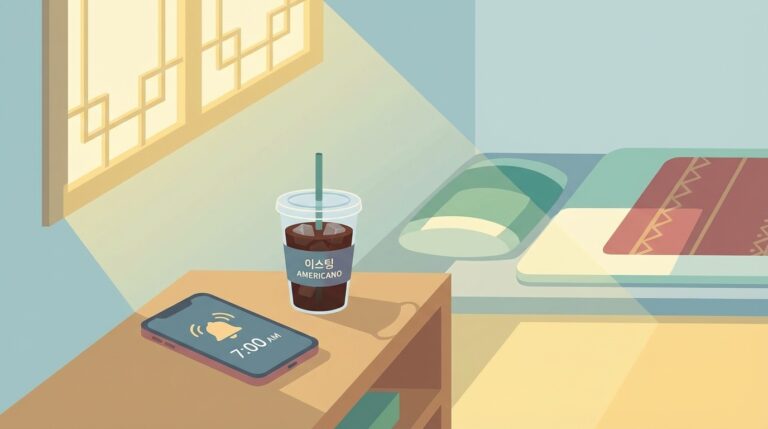
Hello! I am the Lead Editor at Daily Hangul, your premium Korean tutoring brand. As a veteran tutor and a local culture navigator who has lived in Seoul for over a decade, I am thrilled to guide you through today’s lesson!
Have you ever watched a K-Drama where the female lead smacks her alarm clock, looks at the time with wide eyes, and screams, “Oh no, I’m late!” while rushing out the door with a piece of toast in her mouth? Or maybe you’ve tuned into a K-Pop idol’s early morning live stream, and they softly ask the fans, “Did you sleep well? What time did you wake up today?”
Talking about your morning routine—specifically, what time you wake up—isn’t just about telling time. In Korea, asking about someone’s daily routine is the ultimate icebreaker. It shows you care about their lifestyle! Today, we are going to learn how to talk about your wake-up time naturally, without sounding like a robotic textbook. Let’s dive right in!
Phase 2: Core Expressions Deep Dive 🕵️♀️
Let’s look at the top 3 expressions you need to survive mornings in Korea.
1. 보통 몇 시에 일어나요? (What time do you usually wake up?)
- Pronunciation: [botong myeot si-e ireonayo?]
(Tip: ‘myeot’ sounds a bit like the ‘mut’ in ‘mutt’, and ‘si’ is a soft ‘shee’ sound)- Meaning: Literal = Usually, what time at wake up? / Real nuance = What’s your morning routine like?
- K-Culture Moment: This is a classic question on a first blind date (소개팅) or when making small talk with a new language exchange partner at a cafe.
- Editor’s Insight: It feels friendly and curious. The word 보통 (botong – usually) makes the question feel less intrusive and more casual.
- Situation Spectrum:
[🚫 절대 금지] ———— [⚠️ 주의] ———— [✅ 자유롭게]
- Close Friends (Casual): ✅ (Drop the ‘요’ -> 보통 몇 시에 일어나?)
- Co-workers (Semi-formal): ✅
- Boss/Elders (Formal): ⚠️ (You shouldn’t ask your boss about their personal routine unless they bring it up first!)
- 🤔 Think About It: Why do Koreans love asking about daily routines? In Korean culture, showing interest in someone’s daily life is a common way to build affection (정 – Jeong). Does your culture use routines as small talk?
2. 아침 일찍 일어났어요. (I woke up early in the morning.)
- Pronunciation: [achim iljjik ireonasseoyo.]
(Tip: ‘iljjik’ has a sharp, tense ‘jj’ sound. Say it quickly and sharply!)- Meaning: Literal = Morning early woke up. / Real nuance = I had a productive start today.
- K-Culture Moment: There is a huge “Miracle Morning” (미라클 모닝) trend in Korea where young professionals wake up at 5 AM to study, work out, or read. Saying this makes you sound like a go-getter!
- Editor’s Insight: Use this when you want to subtly brag about being productive.
- Situation Spectrum:
[🚫 절대 금지] ———— [⚠️ 주의] ———— [✅ 자유롭게]
- Close Friends (Casual): ✅
- Co-workers (Semi-formal): ✅
- Boss/Elders (Formal): ✅ (They will think you are very diligent!)
- 🤔 Think About It: Korea has a “Pali-Pali” (Hurry up) culture. How does the concept of waking up early tie into the image of a “successful person” in modern society?
3. 늦잠 잤어요! (I overslept! / I slept in!)
- Pronunciation: [neutjam jasseoyo!]
(Tip: ‘neut’ sounds like ‘nut’ but with a flat mouth. ‘jam’ sounds like ‘jahm’)- Meaning: Literal = Late sleep slept. / Real nuance = I missed my alarm / I slept in on purpose.
- K-Culture Moment: The frantic text you send your friend when you were supposed to meet at Hongdae Station Exit 9 at 1 PM, and you just woke up at 12:45 PM.
- Editor’s Insight: This word is versatile! It can mean an accidental oversleeping (Oh no, I’m late!) or a relaxing weekend sleep-in (I happily slept in!). The context and your tone will decide the meaning.
- Situation Spectrum:
[🚫 절대 금지] ———— [⚠️ 주의] ———— [✅ 자유롭게]
- Close Friends (Casual): ✅
- Co-workers (Semi-formal): ⚠️ (Only if it’s the weekend. Don’t say this on a workday!)
- Boss/Elders (Formal): 🚫 (Never tell your boss you overslept!)
- 🤔 Think About It: Notice how Korean combines “Late” (늦) and “Sleep” (잠) to make a new noun. Korean is like building blocks!
Phase 3: Textbook vs Real Life 📖🗣️
Let’s see how the textbooks teach it, versus how we actually speak on the streets of Seoul.
| Situation | 📖 Textbook Korean | 🗣️ Real Korean | 💡 Why is it different? |
|---|---|---|---|
| Telling your wake-up time | 저는 오전 7시에 기상합니다. (I arise at 7 AM.) | 저 7시에 일어나요. (I wake up at 7.) | “기상하다” is a military or formal broadcast term. It sounds like you are at a boot camp! |
| Asking someone’s routine | 당신은 언제 잠자리에서 일어납니까? (When do you rise from your bed?) | 보통 몇 시에 일어나요? (What time do you usually wake up?) | Koreans rarely use “당신” (You) and prefer simpler, direct verbs over poetic phrases. |
| Weekend plans | 주말에는 늦게까지 수면을 취합니다. (I take sleep until late on weekends.) | 주말엔 늦잠 자요. (I sleep in on weekends.) | Efficiency! A short compound word like “늦잠” is always preferred over long descriptive phrases. |
Phase 4: Cultural Deep Dive — The K-Culture Connection 🇰🇷
4-1. Non-verbal Communication: The “Tired but Proud” Nod
When a Korean coworker tells you, “오늘 아침 일찍 일어났어요” (I woke up early today), they might let out a slight sigh or stretch their neck. They aren’t complaining! It’s a humble way of showing they are working hard. The correct reaction? Give them an empathetic nod and offer them an Iced Americano.
4-2. K-Pop Connection: The “Sanok” (사녹) Culture
If you are a K-Pop fan, talking about wake-up times takes on a whole new meaning. Have you heard of 사녹 (Sanok – Pre-recording)? When idols perform on music shows like Music Bank, the actual recording happens very early in the morning.
Fans who want to cheer for them often have to gather outside the broadcasting station at 3:00 AM or 4:00 AM!
– Idol on an app: “우리 팬들, 오늘 몇 시에 일어났어요?” (Our fans, what time did you wake up today?)
– Fan: “새벽 2시에 일어났어요! 피곤해요 ㅠㅠ” (I woke up at 2 AM! I’m tired T_T)
Critical View: The dedication of K-Pop fans is amazing, but this extreme schedule is a unique (and exhausting!) part of the Korean entertainment industry.
Phase 5: Immersive Roleplay 🎭
Scenario A: The Weekend Catch-up
Setting: A trendy cafe in Seongsu-dong. It’s Sunday afternoon. The smell of roasted coffee beans fills the air. You are meeting your Korean language exchange partner, Minji (25, energetic, loves taking Instagram photos).
Minji: 와, 오늘 날씨 진짜 좋죠! 주말 잘 보냈어요?
(Wa, oneul nalssi jinjja jotjyo! jumal jal bonaesseoyo?)
[Wow, the weather is so good today, right? Did you have a good weekend?]
(🎭 Stage Direction: Minji takes a sip of her iced coffee and smiles brightly)
YOU: 네! 너무 좋았어요. 그런데 민지 씨는 좀 피곤해 보여요.
(Ne! neomu joasseoyo. Geureonde Minji ssineun jom pigonhae boyeoyo.)
[Yes! It was great. But Minji, you look a bit tired.]
Minji: 아… 티 나요? 저 오늘 아침에 알바(part-time job)가 있어서 일찍 일어났거든요.
(Ah… ti nayo? jeo oneul achime albaga isseoseo iljjik ireonatgeodeunyo.)
[Ah… does it show? I had a part-time job this morning, so I woke up early.]
YOU: 헉, 보통 몇 시에 일어나요?
(Heok, botong myeot si-e ireonayo?)
[Gasp, what time do you usually wake up?]
Minji: 평일엔 7시에 일어나는데, 주말 알바 갈 때는 5시에 일어나요. 〇〇씨는 오늘 몇 시에 일어났어요?
(Pyeong-iren ilgop si-e ireonaneunde, jumal alba gal ttaeneun daseot si-e ireonayo. 〇〇-ssineun oneul myeot si-e ireonasseoyo?)
[On weekdays I wake up at 7, but when I go to my weekend job, I wake up at 5. What time did you wake up today?]
🔀 Your Turn! How will you answer Minji?
– A) 저는 오전 7시에 기상합니다. (I arise at 7 AM in the morning.)
– B) 저요? 저는 오늘 완전 늦잠 잤어요! 11시에 일어났어요. (Me? I completely slept in today! I woke up at 11.)
– C) 비밀이에요. (It’s a secret.)✅ Best Choice: B — It’s natural, casual, and uses the “늦잠 잤어요” expression perfectly for a weekend context!
⚠️ Choice A Analysis: You sound like an AI robot! Save “기상합니다” for formal written documents.
Scenario B: Bonus Roleplay – The Hotel Front Desk
Setting: A hotel lobby in Myeongdong. You have an early tour tomorrow.
You: 저기요, 내일 아침에 모닝콜 부탁할 수 있을까요? (Excuse me, can I request a wake-up call tomorrow morning?)
Staff: 네, 손님. 내일 몇 시에 깨워드릴까요? (Yes, guest. What time shall I wake you up tomorrow?)
You: 아침 6시에 부탁드립니다! (At 6 AM, please!)
Phase 6: 10-Second Shadowing Drill 🗣️⏱️
Practice makes perfect! Speak out loud with the correct emotion and pausing.
- 😊 Brightly (Introducing yourself):
저는 / 보통 / 아침 일곱 시에 / 일어~나요!
(jeoneun / botong / achim ilgop si-e / ireonayo!) - 😢 Sadly/Apologetically (When you are late):
미안해요… / 저 오늘 / 늦잠 / 잤어요 ㅠㅠ
(mianhaeyo… / jeo oneul / neutjam / jasseoyo TT) - 😤 Proudly (Showing off your diligence):
저 오늘 / 완전 일찍 / 일어났어요!
(jeo oneul / wanjeon iljjik / ireonasseoyo!)
Phase 7: K-Culture Glossary 📚
| Korean | Romanization | English | Context & Meaning |
|---|---|---|---|
| 모닝콜 | moning-kol | Wake-up call | Konglish for “morning call.” Used in hotels or when a boyfriend/girlfriend wakes you up over the phone! |
| 오픈런 | opeun-reon | Open run | Waking up super early to line up at a store/cafe before it opens (Open + Run). |
| 늦잠 | neut-jam | Sleeping in / Oversleeping | Used for both accidentally oversleeping and happily sleeping in on weekends. |
| 얼죽아 | eol-juk-a | Iced Americano even if I freeze | An abbreviation. Many Koreans wake up and immediately drink this, even in winter! |
| 미라클 모닝 | mirakeul moning | Miracle Morning | The self-improvement trend of waking up extremely early (e.g., 5 AM) to be productive. |
Phase 8: Traveler’s Survival Kit 🧳
Are you planning to travel to Korea? If you have an early itinerary, these expressions will save your life!
🆘 Survival Expressions for the Morning
– 🇰🇷 “조식은 몇 시부터예요?” (josigeun myeot sibuteoyeyo?)
– 🗣️ English: From what time is breakfast?
– 📍 Where to use: Hotel check-in desk.
– 💡 Pro Tip: Korean hotel breakfasts usually start around 7:00 AM. But if you want to beat the crowd, wake up early! Koreans eat breakfast fast.📌 Editor’s Travel Note
– Time Formatting: In Korea, we use the 12-hour clock in daily conversation (아침 7시 – morning 7 o’clock). But on train tickets (KTX) and digital clocks, the 24-hour format is widely used. Don’t miss your train thinking 18:00 is 8 AM!
– Alarms: If you stay in a traditional Hanok guesthouse, the walls might be thin. Be careful with loud morning alarms!
Phase 9: Think Deeper — Media vs Reality 🧠
The K-Drama Morning vs The Seoulite Reality
In K-Dramas, the wealthy CEO always wakes up at 6 AM, goes for a peaceful jog along the Han River, and drinks a perfectly brewed espresso in a spotless apartment.
But for the average Seoulite? The reality is a bit more chaotic. We wake up to the sound of our smartphone alarms, rush to grab an “Eoljuka” (Iced Americano) from a budget cafe like Mega Coffee, and sprint to catch the crowded Line 2 subway. The concept of “근면성실” (diligence and hard work) is deeply rooted in Korean society. Waking up early is traditionally seen as a sign of good character. So, when someone says they woke up early, they aren’t just telling time—they are projecting a reliable image!
💬 Your Turn: Does media in your country romanticize morning routines? What is a typical, realistic morning like in your culture? Share it in the comments!
Phase 10: Troubleshooting & FAQ 🛠️
Q: Can I use “몇 시에 일어나요?” to my boss?
A: No! In Korean culture, asking a superior about their private daily routine is considered slightly rude and crosses a boundary. If you must ask, use the honorific form: “몇 시에 일어나십니까?” (But seriously, let them talk about it first!)
Q: Is it okay to tell my Korean teacher “늦잠 잤어요” if I am late to class?
A: Yes, but with an apology. “죄송합니다. 제가 오늘 늦잠을 잤어요” (I’m sorry. I overslept today). It’s an honest excuse and sounds very natural.
❌ Common Mistake Alert!
Many English speakers confuse 시 (o’clock) with 시간 (hours/duration).
– ❌ 7 시간에 일어나요. (I wake up in 7 hours.) – Wrong meaning!
– ✅ 7 시에 일어나요. (I wake up at 7 o’clock.) – Correct!
Phase 11: Wrap-up & Action Items 🎯
One-Liner Summary: To master Korean mornings, drop the robotic textbook phrases and use “일어나요” (wake up) and “늦잠 잤어요” (slept in) to sound like a true local!
Your Mission for Today:
– 🥉 Bronze (Solo): Look at the clock right now and say what time you woke up today in Korean out loud!
– 🥈 Silver (Online): Drop a comment below: “저는 보통 [number]시에 일어나요!”
– 🥇 Gold (Action): Set your phone alarm label in Korean! (e.g., 일찍 일어나요! / Wake up early!)
🎬 K-Culture Mission:
The next time you watch a K-Drama or a K-Pop vlog, listen closely for the word “늦잠” (Neut-jam). I guarantee you will hear it at least once when they are talking about their weekends or days off!
Phase 12: Interactive Quiz 🧩
Let’s test what you’ve learned!
1. You are meeting your Korean friend for lunch at 1 PM, but you accidentally slept until 12:30 PM! What is the most natural text to send?
A) 저는 오전 12시 반에 기상했습니다.
B) 미안해! 나 오늘 완전 늦잠 잤어!
C) 오늘 미라클 모닝 했어!
(Answer: B. “늦잠 잤어” is the perfect casual way to say you overslept! A is too robotic, and C means you woke up super early!)
2. True or False: Asking “보통 몇 시에 일어나요?” is a great question to ask your company’s CEO on your first day of work.
(Answer: False! While it’s a great icebreaker for friends and dates, asking a superior about their personal routine is a cultural no-no.)
3. Fill in the blank: 저는 아침 7 ___ 에 일어나요. (I wake up at 7 AM.)
A) 시간 (si-gan)
B) 시 (si)
(Answer: B. Remember, ‘시’ is for a specific time on the clock, while ‘시간’ is for duration!)
Good luck with your morning routine tomorrow! 내일도 일찍 일어나요! (Let’s wake up early tomorrow too!)
Frequently Asked Questions (FAQ)
Q: What does "보통 몇 시에 일어나요? (What time do you usually wake up?)" mean in Korean and how do you pronounce it?
A: In Korean, "보통 몇 시에 일어나요? (What time do you usually wake up?)" is pronounced [botong myeot si-e ireonayo?] and means: Literal = Usually, what time at wake up? / Real nuance = What's your morning routine like?
Q: What does "아침 일찍 일어났어요. (I woke up early in the morning.)" mean in Korean and how do you pronounce it?
A: In Korean, "아침 일찍 일어났어요. (I woke up early in the morning.)" is pronounced [achim iljjik ireonasseoyo.] and means: Literal = Morning early woke up. / Real nuance = I had a productive start today.
Q: What does "늦잠 잤어요! (I overslept! / I slept in!)" mean in Korean and how do you pronounce it?
A: In Korean, "늦잠 잤어요! (I overslept! / I slept in!)" is pronounced [neutjam jasseoyo!] and means: Literal = Late sleep slept. / Real nuance = I missed my alarm / I slept in on purpose.







