

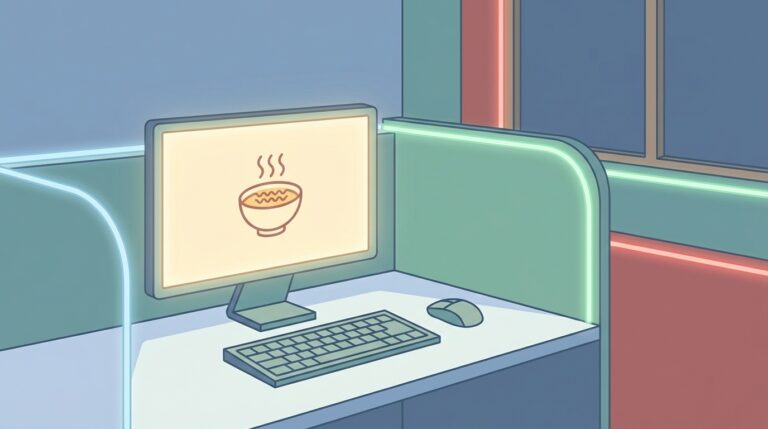
Phase 1: Empathy — Immersive Hook
Hello! This is your Daily Hangul Editor.
Imagine this: You are sitting in a dimly lit, neon-glowing room in Seoul. The sound of rapid mouse clicking and enthusiastic shouts of “Go, go, go!” fill the air. You’re in a Korean PC Bang (PC방, Internet Cafe). Suddenly, a scent hits you. It’s savory, spicy, and absolutely mouth-watering. You look over, and the person next to you is intensely gaming while slurping a steaming bowl of Ramyeon topped with a perfect egg and hot dog sausages.
You want it. You need it. But… how do you get it?
If you’ve watched K-Dramas, you know the PC Bang is a sacred place for gamers, couples on casual dates, and students hiding from their homework. But here’s the secret: PC Bangs are actually some of the best affordable restaurants in Korea.
As a tutor who has lived in Seoul for over 10 years, I’ve seen so many of my beginner students sit in a PC Bang with a growling stomach, too intimidated to order. Today, we are going to fix that. I will teach you the exact, simple phrases you need to conquer the PC Bang food menu. Don’t worry, you won’t need complex grammar—just a bit of courage and an empty stomach!
Phase 2: Core Expressions Deep Dive
Let’s learn the top 3 survival phrases for ordering food as an A1 (Super Beginner) learner.
1. 라면 하나 주세요
- Pronunciation: ra-myeon ha-na ju-se-yo
- ra-myeon: Like “ramen” but round your lips more on the “myeon”.
- ha-na: Means “one”.
- ju-se-yo: Sounds like “Juice-eh-yo”. It means “Please give me…”
- Meaning: Please give me one ramyeon.
- K-Culture Moment: In a PC Bang, you actually order by clicking the menu on your computer screen! But you will use this phrase if you order at the front counter, or when adding something to your order when the staff brings your food.
- Editor’s Insight: The magic word here is 주세요 (ju-se-yo). You can point at anything in Korea and say “주세요”, and you will survive!
- Situation Spectrum:
[🚫 Never] ———— [⚠️ Be Careful] ———— [✅ Freely]
- Friends (Casual): ⚠️ (Friends use 반말(informal): “라면 하나 줘”)
- PC Bang Staff (Service): ✅
- Boss/Elders (Formal): ✅ (Perfectly polite!)
- 🤔 Think About It: In English, we say “I would like a ramyeon.” In Korean, we literally say “Ramyeon one, please give.” Why do you think Koreans put the object (Ramyeon) first before the number?
2. 이거 매워요?
- Pronunciation: i-geo mae-wo-yo?
- i-geo: Sounds like “e-go” (Means: This)
- mae-wo-yo: Sounds like “meh-woah-yo” (Means: Is it spicy?)
- Meaning: Is this spicy?
- K-Culture Moment: Korean Ramyeon is famously red and fiery (think of the viral Fire Noodle Challenge!). If your spice tolerance is low, this question will save your life.
- Editor’s Insight: Point to the picture on the kiosk screen or computer and ask this. If the staff crosses their arms in an “X” shape or waves their hand, it means “No.” If they nod and smile with pity, brace yourself.
- Situation Spectrum:
[🚫 Never] ———— [⚠️ Be Careful] ———— [✅ Freely]
- Friends (Casual): ⚠️ (To a friend: “이거 매워?”)
- PC Bang Staff / Restaurant Staff: ✅
- 🤔 Think About It: Spicy food (매운 음식) is known in Korea as a way to relieve stress (스트레스 풀기). Does your culture have a specific food people eat when they are stressed?
3. 저기요!
- Pronunciation: jeo-gi-yo!
- jeo-gi-yo: Sounds like “Juggy-yo!”
- Meaning: Excuse me! (To get someone’s attention)
- K-Culture Moment: You will hear this echoing in restaurants, cafes, and PC Bangs all over Korea. It literally means “Over there!” but is used to call staff.
- Editor’s Insight: Don’t be shy! In Korea, waiting quietly for a waiter to make eye contact might mean you wait forever. Raise your hand slightly and say “저기요!” confidently.
- Situation Spectrum:
[🚫 Never] ———— [⚠️ Be Careful] ———— [✅ Freely]
- Calling staff in a busy place: ✅
- To a stranger who dropped their wallet: ✅
- To your boss or teacher: 🚫 (Never! Call them by their title instead)
Phase 3: Textbook vs Real Life
| Situation | 📖 Textbook Korean | 🗣️ Real Korean (In PC Bang) | 💡 Why the difference? |
|---|---|---|---|
| Ordering food | 라면을 주문하고 싶습니다. (I would like to order ramyeon.) | (Just clicks the button on the computer screen 🖱️) | Efficiency! Modern Korea is super digitalized. PC Bang ordering is 99% done via the PC interface. |
| Calling the staff | 실례합니다. (Excuse me – for apologizing) | 저기요! / 사장님! (Excuse me! / Boss!) | ‘실례합니다’ is for asking directions or passing by someone, not for calling staff! |
| When food arrives | 감사합니다. 맛있게 먹겠습니다. (Thank you. I will eat well.) | 아, 감사합니다~ (Ah, thank you~) + Slight nod | A quick, polite acknowledgment is enough. You’re busy gaming! |
Phase 4: Cultural Deep Dive
4-1. Non-verbal Communication: The “PC Bang Nod”
When the staff brings your steaming bowl of Ramyeon, they will usually place it carefully on the tiny space next to your keyboard. You don’t need to pause your game or stand up. Just keep your hands on the mouse, make quick eye contact, give a slight head nod, and say a soft “감사합니다” (Thank you). In Korean culture, eye contact combined with a slight bow of the head shows respect without breaking the flow of the moment.
4-2. K-Culture Connection: K-Drama & K-Food 🍜🖥️
Have you ever noticed in K-Dramas that when characters need to hide, do secret hacking, or just vent their frustration, they go to a PC Bang?
In the past, PC Bangs were just for gaming. Today, they are essentially gourmet restaurants with gaming computers. You can order hotdogs, smoothies, dumplings, and of course, the iconic PC Bang Ramyeon (PC방 라면).
Why does it taste better there? PC Bangs use special Ramyeon cookers that boil the water at the exact perfect temperature, and they top it with green onions, a perfectly soft-boiled egg, and sometimes cheese. It’s a K-Food experience you cannot miss!
Phase 5: Immersive Roleplay
Scenario A: The Missing Drink 🥤
- Setting: Friday night, 9 PM. A bustling PC Bang in Hongdae. You are in the middle of a gaming match.
- Characters:
- YOU: An exchange student who just ordered a spicy Ramyeon via the computer.
- Min-su (Staff): A busy 20-something part-timer wearing a black apron.
- Dialogue:
(🎭 Stage Direction: Min-su approaches your desk with a tray. He places a very red bowl of Ramyeon next to your keyboard.)
Min-su: 주문하신 라면 나왔습니다.
(ju-mun-ha-sin ra-myeon na-wat-seum-ni-da.)
[Translation: Here is the ramyeon you ordered.]
YOU: 아, 감사합니다.
(a, gam-sa-ham-ni-da.)
[Translation: Ah, thank you.]
(🎭 Stage Direction: You look at the Ramyeon. It looks incredibly spicy. You realize you forgot to order a drink on the computer! Min-su is about to walk away.)
🔀 Your Turn! How do you stop him to ask for water?
– A) “물 주세요!” (mul ju-se-yo! – Water please!)
– B) “저기요! 물 좀 주세요.” (jeo-gi-yo! mul jom ju-se-yo. – Excuse me! A little water please.)
– C) “실례합니다…” (sil-lye-ham-ni-da… – Excuse me…)✅ Best Choice: B — Saying “저기요!” gets his attention naturally. Adding “좀” (a little/please) makes the request softer and much more natural sounding than just barking “물 주세요”.
⚠️ Why A is risky: It’s a bit too direct and abrupt.
❌ Why C is wrong: “실례합니다” is used when you are physically in someone’s way or interrupting a serious conversation, not for ordering food.
Scenario B: Bonus K-Culture Interaction (The Kiosk)
You walk into the PC Bang. Before you can even sit down, you need to add time to your PC card using the glowing machine near the door (키오스크 – Kiosk). You are confused.
YOU: 저기요… 이거 어떻게 해요?
(jeo-gi-yo… i-geo eo-tteo-ke hae-yo?)
[Translation: Excuse me… how do I do this?]
Staff: 아, 카드 먼저 올려주세요.
(a, ka-deu meon-jeo ol-lyeo-ju-se-yo.)
[Translation: Ah, please place your card here first.]
Pro-tip: “어떻게 해요?” (How do I do this?) is the ultimate A1 survival phrase for literally any confusing machine or situation in Korea!
Phase 6: 10-Second Shadowing Drill
Let’s practice the flow of the sentence. Follow the pauses ( / ) and the emotion tags!
- Calling the staff:
🗣️ (Confidently) 저기요! / 여기요! (jeo-gi-yo! / yeo-gi-yo!) -
Asking a question:
🥺 (Slightly scared of spice) 이거 / 많이 매워요? (i-geo / ma-ni mae-wo-yo?)
(많이 = a lot) -
Ordering:
😊 (Politely) 단무지 좀 / 더 주세요~ (dan-mu-ji jom / deo ju-se-yo~)
(Please give me more pickled radish~)
Phase 7: K-Culture Glossary
| Korean | Romanization | English | Context |
|---|---|---|---|
| PC방 | pi-si-bang | PC Room / Internet Cafe | The ultimate gaming and snacking hub in Korea. |
| 단무지 | dan-mu-ji | Pickled yellow radish | Always served with Ramyeon. It helps cool down the spice! |
| 키오스크 | ki-o-seu-keu | Kiosk | Machines where you pay for PC time or order food. |
| 후불 | hu-bul | Post-paid | Paying when you leave (becoming rare nowadays). |
| 선불 | seon-bul | Pre-paid | Paying before you play (The standard everywhere now). |
Phase 8: Traveler’s Survival Kit
If you are visiting a PC Bang (or any casual restaurant) in Korea, keep these in your back pocket!
🆘 Survival Phrases TOP 3
1. 🇰🇷 “화장실 어디예요?” (hwa-jang-sil eo-di-ye-yo?)
– 🗣️ Meaning: Where is the restroom?
2. 🇰🇷 “카드 돼요?” (ka-deu dwae-yo?)
– 🗣️ Meaning: Do you accept credit cards?
3. 🇰🇷 “영어 메뉴판 있어요?” (yeong-eo me-nyu-pan i-sseo-yo?)
– 🗣️ Meaning: Do you have an English menu?📌 Editor’s Travel Note
– Cash vs Card: Korea is a cashless society! 99% of PC Bangs require a credit card or local payment app at the kiosk.
– Tipping Culture: Do NOT tip the staff who brings your Ramyeon! Tipping does not exist in Korea, and handing them money will just confuse them.
Phase 9: Think Deeper — “A Step Further”
Food & Identity: Why eat a full meal at a computer?
In many Western cultures, eating at your computer means a cold sandwich or a quick snack because you are “too busy” to eat. But in Korea, food is central to the culture and identity. Even when escaping into a virtual world of gaming, Koreans refuse to compromise on a hot, satisfying meal. The evolution of PC Bangs into gourmet kitchens shows that for Koreans, “밥 먹었어?” (Did you eat rice/a meal?) is not just a greeting; it’s a core value. A warm meal is a right, even if your hands are busy clicking a mouse.
💬 Your Turn: Do you usually eat at your desk in your home country? What is your go-to “computer food”? Share in the comments!
Phase 10: FAQ & Troubleshooting
Q: Can I just shout “라면 주세요!” across the PC Bang?
No! It’s better to use the PC ordering system. If the system is down, walk to the counter. If you must call them, start with “저기요!” first.
Q: Can I use “주세요 (ju-se-yo)” with my Korean friends?
Technically yes, but it sounds a bit too formal and distant for close friends. With close friends of the same age, you can drop the ‘yo’ and just say “줘 (jwo)”. But for A1 beginners, stick to “주세요” to be safe!
❌ Common Mistake #1: Handing cash directly to the part-timer at your desk.
✅ Do this instead: Order and pay through the pop-up menu on your monitor (it usually accepts Korean digital payments), or buy a food ticket at the Kiosk machine near the entrance.
Phase 11: Wrap-up & Action Items
💡 One-Liner Summary: When in a PC Bang, use the computer to order, but always keep “저기요” (Excuse me) and “~주세요” (Please give me~) ready in your mind!
🎯 Action Mission:
– 🥉 Bronze (Solo): Say “라면 하나 주세요” 3 times out loud while pretending to click a mouse.
– 🥈 Silver (Online): Comment below with your favorite type of Korean Ramyeon! (e.g., Shin Ramyeon, Buldak, Neoguri)
– 🥇 Gold (Real Life): Next time you visit a Korean restaurant or PC Bang, get the staff’s attention by confidently saying “저기요!”
🎮 K-Culture Mission:
Go to YouTube and search for “Korean PC Bang Mukbang” or “PC방 먹방”. Watch how the food is delivered directly to the desk. Notice if the gamer says thank you or just nods!
Phase 12: Interactive Quiz
1. Situational Judgment:
You are at a PC Bang and the staff just brought your food. You want some water. What is the most natural thing to say?
– A) 야! 물! (Hey! Water!)
– B) 실례합니다. 물을 원합니다. (Excuse me. I desire water.)
– C) 저기요, 물 좀 주세요. (Excuse me, water please.)
2. True or False – K-Culture Edition:
– If the PC Bang staff gives you excellent service and brings your food quickly, you should leave a 10% tip on the desk.
3. Fill in the Blank:
You want to ask if the Fire Noodle is spicy.
“이거 _________?” (i-geo _________?)
(Answers hidden below!)
Click to reveal answers
1. C (A is extremely rude and informal. B sounds like a robot from an old textbook. C is natural and polite.)
2. False (There is NO tipping culture in Korea! A polite “감사합니다” is the best tip.)
3. 매워요 (mae-wo-yo / Is it spicy?)
Frequently Asked Questions (FAQ)
Q: What does "라면 하나 주세요" mean in Korean and how do you pronounce it?
A: In Korean, "라면 하나 주세요" is pronounced [ra-myeon ha-na ju-se-yo] and means: a key conversational Korean expression covered in this lesson.
Q: What does "이거 매워요?" mean in Korean and how do you pronounce it?
A: In Korean, "이거 매워요?" is pronounced [i-geo mae-wo-yo?] and means: a key conversational Korean expression covered in this lesson.
Q: What does "저기요!" mean in Korean and how do you pronounce it?
A: In Korean, "저기요!" is pronounced [jeo-gi-yo!] and means: a key conversational Korean expression covered in this lesson.







