

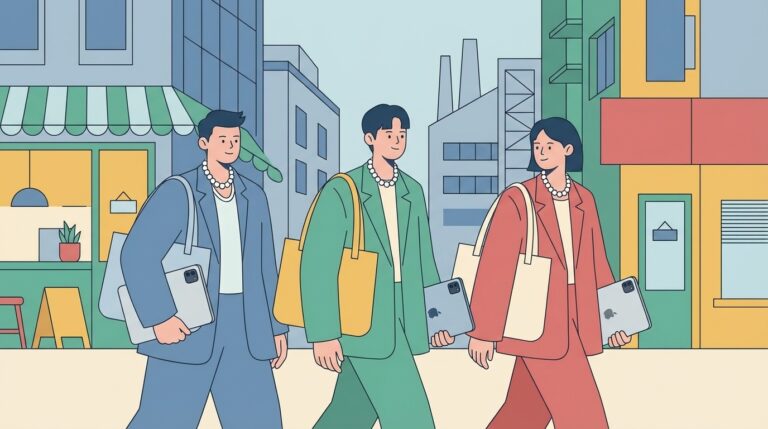
Hello, everyone! I’m the Lead Editor at Daily Hangul. Have you ever walked down the vibrant streets of Seongsu-dong or Hongdae and had to do a double-take? You might see a guy rocking a cropped tweed jacket with a pearl necklace, or a woman commanding the room in a massively oversized, broad-shouldered men’s suit.
If your image of Korea is still stuck in the conservative, rigidly gender-divided society of the past, you’re missing out on a massive cultural earthquake. K-Pop idols like G-Dragon, Taemin, and members of TXT or Stray Kids have been wearing skirts, corsets, and lace on stage for years. And guess what? That trend has heavily trickled down to the streets of Seoul.
Today, we aren’t just learning how to buy clothes. Because you are an advanced (C2) learner, we are going to dive deep into the language of societal shifts, breaking stereotypes, and the ‘Genderless’ (젠더리스) movement in Korea. If you can discuss these topics fluently, your Korean friends won’t just think you speak well—they’ll view you as a true cultural insider.
Let’s break the mold together.
Phase 2: Core Expressions Deep Dive
To talk about fashion and societal changes at a native level, you need more than just textbook vocabulary. Let’s look at the sophisticated expressions Seoulites actually use.
1. 고정관념을 깨다 (Breaking the Stereotype)
- Pronunciation: [gojeong-gwannyeomeul kkaeda] ‘Kkae’ sounds like the sharp crack of an eggshell breaking.
- Meaning: Literal: To break fixed ideas. / Real Nuance: To shatter societal norms or stereotypes.
- K-Culture Moment: You’ll hear this in K-Drama dialogue when a rebellious protagonist defends their unconventional choices to their conservative parents. “엄마, 요즘 누가 그런 고정관념을 가져요?” (Mom, who holds onto such stereotypes these days?)
- Editor’s Insight: This isn’t just about fashion. You can use it for career choices, dating, or lifestyle. It carries a progressive, empowered energy.
- Situation Spectrum:
[🚫 절대 금지] ———— [⚠️ 주의] ———— [✅ 자유롭게]
- Casual with friends: ✅
- Semi-formal (colleagues): ✅
- Formal (boss/elders): ⚠️ (May sound like you are lecturing them if used incorrectly!)
- 🤔 Think About It: Korean society values harmony and fitting in (눈치). Why do you think expressions about “breaking the mold” are becoming so popular among Gen Z and Millennials?
2. 성별의 경계를 허물다 (Tearing Down Gender Boundaries)
- Pronunciation: [seongbyeorui gyeong-gyereul heomulda] ‘Heo’ has a breathy ‘H’ sound, like a sigh of relief.
- Meaning: Literal: To demolish the border of gender. / Real Nuance: To embrace gender-fluid or genderless concepts.
- K-Culture Moment: This is the exact phrasing Korean fashion magazines (like Vogue Korea or GQ Korea) use when describing a new genderless collection or reviewing an idol’s avant-garde airport fashion.
- Editor’s Insight: The verb ‘허물다’ (to demolish/tear down a wall) is highly advanced C2 vocabulary. Using this instead of the basic ‘없애다’ (to get rid of) instantly elevates your Korean to an intellectual, native-like level.
- Situation Spectrum:
[🚫 절대 금지] ———— [⚠️ 주의] ———— [✅ 자유롭게]
- Casual with friends: ⚠️ (A bit too formal/academic for a drinking session)
- Semi-formal (colleagues): ✅
- Formal/Presentations: ✅ (Perfect for professional discussions)
- 🤔 Think About It: Look at the word ‘경계’ (boundary). In what other aspects of life are boundaries being torn down globally?
3. 남의 시선을 덜 의식하다 (To care less about others’ gazes)
- Pronunciation: [namui siseoneul deol uisikada] ‘Ui’ sounds like ‘ooh’ blending quickly into ‘ee’.
- Meaning: Literal: To be less conscious of others’ lines of sight. / Real Nuance: To stop caring about what other people think.
- K-Culture Moment: Picture a quiet indie cafe in Hapjeong. Two friends are talking. One says, “I want to wear a crop top, but I’m worried what people will say.” The other replies, “야, 남의 시선 좀 덜 의식해. 네 인생이잖아!” (Hey, stop caring so much about others’ gazes. It’s your life!)
- Editor’s Insight: ‘시선’ (gaze/eyes of others) is a massive concept in Korea. The shift from heavily caring about the ‘gaze’ to prioritizing one’s own comfort is the exact psychological shift driving the genderless fashion trend.
- Situation Spectrum:
[🚫 절대 금지] ———— [⚠️ 주의] ———— [✅ 자유롭게]
- Casual with friends: ✅
- Semi-formal (colleagues): ✅
- Formal (boss/elders): 🚫 (Do not tell your boss to stop caring about others’ opinions!)
Phase 3: Textbook vs Real Life
When discussing tastes and fashion, textbooks are too stiff. Here is how real young Koreans talk.
| Situation | 📖 Textbook Korean | 🗣️ Real Korean | 💡 Why the difference? |
|---|---|---|---|
| Expressing individuality | 저는 개성이 강한 사람입니다. (I am a person with strong individuality.) | 전 취존(취향 존중)을 중요하게 생각해요. (I value respecting personal tastes.) | ‘취존’ is a widely accepted abbreviation reflecting the modern value of non-judgmental individualism. |
| Describing gender-neutral clothing | 이것은 남녀공용 옷입니다. (This is unisex clothing.) | 요즘은 젠더리스 핏이 대세죠. (Genderless fit is the trend these days.) | ‘남녀공용’ feels like a cheap, practical t-shirt, whereas ‘젠더리스’ is a high-fashion, intentional aesthetic choice. |
| Reacting to an unconventional outfit | 옷이 참 독특하네요. (Your clothes are quite unique.) | 와, 오늘 스타일 완전 파격적인데? 완전 힙하다! (Wow, today’s style is super unconventional! So hip!) | ‘독특하다’ can sometimes sound like a polite insult. ‘힙하다’ (hip) or ‘파격적이다’ implies admiration for their bold choice. |
Bottom Note: As a C2 learner, try dropping ‘취존’ casually in a conversation. It shows you understand not just the language, but the cultural mindset of modern Korea.
Phase 4: Cultural Deep Dive
4-1. Non-verbal Communication: The Art of ‘Nunchi’ in Fashion
In Korea, Nunchi (눈치) isn’t just about reading the room during a conversation; it applies to fashion too. Traditionally, dressing appropriately for the ‘TPO’ (Time, Place, Occasion) was a strict rule dictated by age and gender. However, the modern genderless trend is a rebellion against this visual Nunchi. When Koreans wear genderless fashion, their non-verbal body language changes too—they walk with more confidence, chin up, deliberately owning their disruption of the norm.
4-2. K-Culture Connection: K-Pop Idols as Fashion Pioneers
Why did genderless fashion explode in Korea? Look no further than K-Pop. Male idols routinely wear makeup, crop tops, pearl necklaces, and skirts (think BTS’s Jimin, EXO’s Kai, or TXT’s Yeonjun). Female idols wear oversized suits and combat boots, radiating ‘Girl Crush’ energy.
Critical Perspective: There is a gap between Media and Reality. While fans scream with joy when an idol breaks gender norms on stage, if an ordinary office worker wore a pearl necklace to a corporate firm in Yeouido, they would face severe backlash. The genderless trend is highly localized to specific creative hubs (Seongsu, Hongdae, Itaewon) and younger demographics, exposing a fascinating generational and spatial divide in Seoul.
Phase 5: Immersive Roleplay Scenario
Scenario A: The Seongsu-dong Boutique
Setting: Saturday afternoon in Seongsu-dong. You are browsing a highly curated, industrial-chic boutique. The racks are not divided by ‘Men’s’ and ‘Women’s’—everything is mixed. You pick up a gorgeous, slightly sheer, oversized silk shirt.
Characters:
– YOU (Reader): A fashion-forward expat who loves exploring Seoul’s trends.
– Sujin (28): The trendy boutique staff member, dressed in a genderless oversized blazer and wide slacks.
Dialogue:
Sujin: 손님, 그 셔츠 정말 예쁘죠? 이번 시즌 신상이에요.
(sonnim, geu syeocheu jeongmal yeppeujyo? ibeon sijeun sinsang-ieyo.)
(Customer, that shirt is really pretty, right? It’s a new arrival for this season.)
(🎭 Stage Direction: Sujin approaches you with a welcoming smile, noticing your interest in the garment)
YOU: 네, 색감이 참 좋네요. 그런데 이거 남성용인가요, 여성용인가요?
(ne, saekgami cham jonneyo. geureonde igeo namseong-yong-ingayo, yeoseong-yong-ingayo?)
(Yes, the color is great. By the way, is this for men or women?)
Sujin: 아, 저희 브랜드는 기본적으로 다 젠더리스로 나와요. 성별 경계를 허문 디자인이라 남녀 구분 없이 입으실 수 있어요.
(a, jeohui beuraendeuneun gibonjeogeuro da jenderiseuro nawayo. seongbyeol gyeong-gyereul heomun dijainira namnyeo gubun eopsi ibeusil su isseoyo.)
(Ah, our brand basically releases everything as genderless. It’s a design that tears down gender boundaries, so you can wear it regardless of gender.)
YOU: 아, 그렇군요! 어쩐지 핏이 되게 독특하더라고요.
(a, geureokunyo! eojjeonji pisi doege dokteukadeoragoyo.)
(Ah, I see! No wonder the fit is so unique.)
Sujin: 네! 특히 남성분들이 진주 목걸이랑 같이 매치하시면 엄청 힙해 보이더라고요. 한번 입어보시겠어요?
(ne! teuki namseongbundeuri jinju mokgeorirang gachi maechihasimyeon eomcheong hiphae boideoragoyo. hanbeon ibeobosigesseoyo?)
(Yes! Especially when men match it with a pearl necklace, it looks incredibly hip. Would you like to try it on?)
🔀 Your Turn! How do you respond?
– A) “아뇨, 저는 남자라서/여자라서 이런 건 좀 부담스럽네요.” (No, because I’m a man/woman, this is a bit burdensome for me.)
– B) “오, 진짜요? 남의 시선 신경 쓸 필요 있나요! 피팅룸 어디예요?” (Oh, really? Is there a need to care about others’ gazes! Where is the fitting room?)
– C) “비쌀 것 같아서 안 입을게요.” (I won’t try it because it seems expensive.)✅ Best Choice: B — Reason: You are embracing the cultural moment! Using the C2 phrase ‘남의 시선 신경 쓸 필요 있나요’ (No need to care about others’ gazes) proves your high-level fluency and cultural understanding.
⚠️ Choice A Analysis: While grammatically flawless, it rejects the cultural context of the store. You might get a polite but awkward nod from the staff.
Scenario B: The Subway Generational Clash (Bonus)
Setting: You are on the Subway Line 2. A young man walks in wearing a chic skirt over pants.
Dialogue:
Older Man (whispering loudly): 쯧쯧, 남자가 왜 치마를 입고 다녀? 세상이 말세야.
(jjeutjjeut, namjaga wae chimareul ipgo danyeo? sesang-i malseya.)
(Tsk tsk, why is a man wearing a skirt? It’s the end of the world.)
Young Man (smiling politely): 할아버지, 요즘은 이게 패션이에요. 제 개취니까 존중해주세요!
(harabeoji, yojeumeun ige paesyeon-ieyo. je gaechwinikka jonjunghaejuseyo!)
(Grandpa, this is fashion these days. It’s my personal taste, so please respect it!)
Phase 6: 10-Second Shadowing Drill
Practice this empowered, modern Korean phrase. Remember the intonation!
😤 단호하고 당당하게 (Firmly and confidently):
옷에 / 남자 옷, 여자 옷이 / 어디 있어요? / 내 맘에 들면 / 그만이지!
(ose / namja ot, yeoja osi / eodi isseoyo? / nae mame deulmyeon / geumaniji!)
Translation: Where is the rule that clothes are men’s or women’s? If I like it, that’s all that matters!Pro Tip: Stress the ‘어’ in 어디 있어요, raising your pitch slightly to show rhetorical disbelief.
Phase 7: K-Culture Glossary (Fashion & Society)
| Korean | Romanization | English | Context |
|---|---|---|---|
| 젠더리스 | jenderiseu | Genderless | Used primarily in high-fashion and trend analysis. |
| 핏 | pit | Fit | Konglish. Extremely common. (e.g., “오버핏” – oversized fit). |
| 개취 | gaechwi | Personal Taste | Short for 개인 취향. A vital concept for modern Korean youth defending their individuality. |
| 파격적이다 | pagyeokjeogida | Unconventional/Radical | Used when someone wears something totally unexpected or boundary-breaking. |
| 눈치 보지 마 | nunchi boji ma | Don’t mind others | The ultimate modern encouragement to dress however you want. |
Phase 8: Traveler’s Survival Kit (Shopping in Korea)
Even if you’re discussing high-level sociology, you still need to know how to buy the clothes!
🆘 Survival Phrases for Seoul Shopping
– 🇰🇷 “이거 프리사이즈인가요?” (igeo peurisaijeu-ingayo?)
– 🗣️ English Meaning: Is this ‘free size’ (one-size-fits-all)?
– 📍 Where to use: Small boutiques, underground shopping malls (like Express Bus Terminal).
– 💡 Pro Tip: In Korea, “Free Size” is very common but often equates to a standard Women’s S/M. Always ask to try it on if possible!
- 🇰🇷 “피팅룸 어디예요? 입어봐도 되나요?” (pitingnum eodiyeyo? ibeobwado doenayo?)
- 🗣️ English Meaning: Where is the fitting room? Can I try it on?
- 💡 Pro Tip: If you try on tops, store clerks will often hand you a “페이스 커버” (face cover) to prevent makeup from staining the collar. Wear it like a veil over your head before pulling the shirt on!
Phase 9: Think Deeper — K-Culture Critical Thinking
🧠 Language & Power: How Korean Reflects Societal Hierarchies
When exploring the genderless trend, it’s fascinating to observe how Koreans argue about it. The Korean language is heavily coded with hierarchical markers (honorifics and politeness levels) based on age and status. When a conservative elder criticizes a young person’s unconventional outfit, they will use banmal (casual/impolite speech) because of their age superiority. The young person, however, must defend their individuality using jondaemal (polite speech). This creates a unique linguistic friction: trying to assert radical, boundary-breaking, modern individualism while being bound by a deeply traditional, hierarchical language framework.
💬 Your Turn: Does your native language have built-in hierarchies that make it difficult to argue against traditional norms? How do you express rebellion or individuality in your culture? Let me know in the comments!
Phase 10: FAQ & Troubleshooting
Q: If I see a Korean friend wearing something totally gender-bending and cool, can I say “너 옷차림이 이상해”?
A: NO! 🚫 “이상해” means weird in a negative, strange way. If you want to praise their bold choice, say “와, 오늘 스타일 완전 힙한데?” (Wow, your style is so hip today!) or “개성 넘친다!” (You’re overflowing with individuality!).
Q: Are there any clothes that are still strictly gendered in Korea?
A: Yes. Traditional Hanbok is still largely gendered, though modern designers are starting to create genderless Hanboks. Also, formal corporate attire (especially in banking or conglomerates) remains strictly conservative.
❌ Common Mistake: Complimenting a male friend’s delicate fashion by saying “여자 같아요” (You look like a woman).
✅ Do This Instead: Say “스타일이 되게 세련됐어요” (Your style is very sophisticated) or “젠더리스 룩이 잘 어울려요” (The genderless look suits you well). Labeling it as ‘women’s’ defeats the purpose of the genderless concept!
Phase 11: Wrap-up & Action Items
📌 One-Liner Summary: Korea’s fashion scene is actively tearing down gender boundaries (성별의 경계를 허물다), urging the youth to stop caring about societal gazes (남의 시선을 덜 의식하다) and embrace their personal taste (취존).
🚀 Your Action Missions:
– 🥉 Bronze (Solo): Look in the mirror and confidently say the shadowing drill: “옷에 남자 옷 여자 옷이 어디 있어요!”
– 🥈 Silver (Online): Go to a K-Pop idol’s Instagram who is known for genderless fashion (like TXT’s Yeonjun or Seventeen’s The8) and leave a comment: “오늘 젠더리스 스타일 너무 파격적이고 멋있어요!”
– 🥇 Gold (Real Life): Next time you shop in Korea, walk into a trendy boutique and ask the clerk: “혹시 젠더리스 핏으로 나온 옷 추천해주실 수 있나요?” (Could you recommend clothes that come in a genderless fit?)
🎬 K-Culture Mission: Watch a recent Korean fashion vlog on YouTube. Count how many times they use the words ‘핏’ (Fit), ‘힙하다’ (Hip), and ‘개취’ (Personal taste).
Phase 12: Interactive Challenge (Quiz)
1. Situational Judgment: Your Korean friend is hesitating to buy a pearl necklace because he is worried people will stare. What is the most C2-level, culturally appropriate advice to give him?
– A) 남자도 진주 목걸이 할 수 있어. (Men can wear pearl necklaces too.)
– B) 남의 시선 의식하지 마. 네 개취잖아! (Don’t be conscious of others’ gazes. It’s your personal taste!)
– C) 너무 파격적이니까 사지 마. (It’s too unconventional, so don’t buy it.)
2. True or False – K-Culture Edition:
“In Korea, if a store clerk hands you a white tissue-like bag when you are about to try on a t-shirt, it is a complimentary gift bag for your purchase.”
(Answers: 1. B is the best C2 answer. A is grammatically correct but basic. C is discouraging. / 2. FALSE. That is a ‘face cover’ to prevent your makeup from staining the clothes while you put them over your head!)
Frequently Asked Questions (FAQ)
Q: What does "고정관념을 깨다 (Breaking the Stereotype)" mean in Korean and how do you pronounce it?
A: In Korean, "고정관념을 깨다 (Breaking the Stereotype)" is pronounced [gojeong-gwannyeomeul kkaeda] and means: Literal: To break fixed ideas. / Real Nuance: To shatter societal norms or stereotypes.
Q: What does "성별의 경계를 허물다 (Tearing Down Gender Boundaries)" mean in Korean and how do you pronounce it?
A: In Korean, "성별의 경계를 허물다 (Tearing Down Gender Boundaries)" is pronounced [seongbyeorui gyeong-gyereul heomulda] and means: Literal: To demolish the border of gender. / Real Nuance: To embrace gender-fluid or genderless concepts.
Q: What does "남의 시선을 덜 의식하다 (To care less about others' gazes)" mean in Korean and how do you pronounce it?
A: In Korean, "남의 시선을 덜 의식하다 (To care less about others' gazes)" is pronounced [namui siseoneul deol uisikada] and means: Literal: To be less conscious of others' lines of sight. / Real Nuance: To stop caring about what other people think.






