

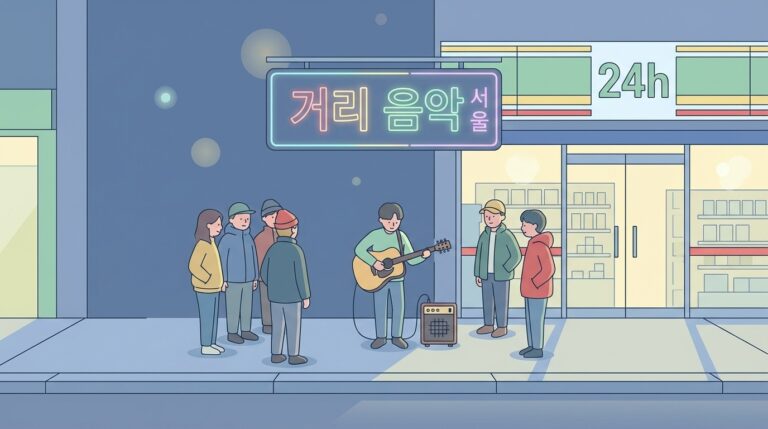
Decoding Hongdae: The Unspoken Rules & C1 Korean for Street Performance Planners
Phase 1: Immersive Hook — Welcome to the Acoustic Jungle
Hello! I am the Lead Editor at Daily Hangul.
Imagine it is 8 PM on a Friday. You step out of Hongdae Station Exit 9. The sensory overload hits you instantly. In K-Dramas, street performances (busking) are always romantic—a lone guitarist playing an acoustic ballad while the protagonist locks eyes with their crush.
But in reality? It is a chaotic, vibrant battlefield. Ten different amplifiers are fighting for dominance. Indie bands are begging for Instagram followers, and as a performing arts planner or a passionate fan, you realize your textbook Korean is utterly useless here. You might have passed TOPIK Level 5, but when the band leader yells ‘막곡 갈게요!’ (Going for the mak-gok!), you are left blinking in confusion.
Whether you are scouting indie talent for an international festival, or just trying to survive a night out in Seoul’s artistic hubs (like Hongdae, Sinchon, or Marronnier Park), knowing the advanced, real-life vocabulary of the street is your VIP pass. Let us dive into the insider language of Korean busking culture!
Phase 2: Deep Dive into Key Expressions
As a C1 learner, you need more than just ‘sing’ or ‘dance.’ You need to understand the social dynamics and crowd psychology embedded in the language.
1. 분위기를 띄우다
- Pronunciation: [bun-wi-gi-reul tti-u-da] — ‘tti’ sounds like the sharp ‘t’ in ‘steep’, but tighter.
- Meaning: Literal: To float the atmosphere. / Real nuance: To hype up the crowd, to break the ice.
- K-Culture Moment: The band has just finished a slow, emotional ballad. The crowd is quiet. The vocalist grabs the mic and says, ‘자, 이제 분위기 한 번 제대로 띄워볼까요?’ (Alright, shall we properly hype up the mood now?). Suddenly, the bass drops.
- Editor’s Insight: This phrase is essential for MCs, planners, and performers. It is not just about making noise; it is about actively shifting the collective energy of the room or street.
- Situation Spectrum:
[🚫 Formal/Solemn] ———— [⚠️ Semi-formal] ———— [✅ Casual/Performances]
- Close friends at Karaoke (Noraebang): ✅
- Busking / Concerts: ✅
- Boardroom meeting: 🚫
- 🤔 Think About It: Why does Korean use the verb ‘띄우다’ (to make something float)? It implies that a heavy, quiet atmosphere sinks, and it takes active effort from a leader to make it ‘float’ and become light and energetic. How do you express ‘hyping up’ in your language?
2. 호응 좀 부탁드릴게요
- Pronunciation: [ho-eung jom bu-tak-ddeu-ril-gge-yo]
- Meaning: Literal: Please grant me your response. / Real nuance: Make some noise / Please interact with us!
- K-Culture Moment: Korean performers thrive on ‘호응’ (ho-eung). Without it, a performance feels dead. You will constantly hear idols, indie singers, and street dancers practically begging the crowd, ‘여러분의 호응이 필요합니다!’ (We need your reaction!).
- Editor’s Insight: At a C1 level, you know ‘대답’ (answer) and ‘반응’ (reaction). But ‘호응’ specifically refers to a positive, supportive response from an audience (clapping, cheering, singing along).
- Situation Spectrum:
[🚫 Close friends] ———— [⚠️ Formal] ———— [✅ Public Speaking/Performances]
- Solo to a crowd: ✅
- Asking a friend for advice: 🚫 (Use ‘반응’ or ‘대답’ instead)
- 🤔 Think About It: Korean performance culture is heavily two-way. The audience is considered part of the show. Does your culture expect audiences to be loud and interactive, or quiet and respectful?
3. 텃세와 눈치싸움
- Pronunciation: [teot-sse-wa nun-chi-ssa-um]
- Meaning: Territoriality and the battle of wits (reading the room).
- K-Culture Moment: You are an arts planner trying to secure a prime spot (명당) for your artists in Hongdae. But wait! The regular street dancers are glaring at you. Your Korean colleague whispers, ‘여기는 텃세가 심해서 눈치싸움 해야 돼요.’ (The territorial vibe is fierce here, we have to play the nunchi game.)
- Editor’s Insight: ‘텃세’ is when established locals act hostile to newcomers. ‘눈치싸움’ is the silent, psychological battle to claim a spot without causing a loud argument. This is the dark side of busking that textbooks never teach!
- Situation Spectrum:
[🚫 To someone's face] ———— [⚠️ Professional context] ———— [✅ Gossiping/Strategy]
- Behind-the-scenes planning: ✅
- Direct confrontation: 🚫 (Too aggressive)
Phase 3: Textbook vs. Real Life
| Situation | 📖 Textbook Korean | 🗣️ Real Korean (Busking) | 💡 Why the difference? |
|---|---|---|---|
| Announcing the final song | 마지막 노래입니다. | 막곡 갈게요! / 아쉽지만 막곡입니다. | Efficiency! ‘마지막 곡’ is shortened to ‘막곡’ (mak-gok), a staple K-Indie/K-Pop slang. |
| Asking the crowd to sing | 같이 불러주세요. | 떼창 부탁드려요! / 소리 질러! | ‘떼창’ (group singing) is the ultimate goal of any K-performance. It implies massive, united energy. |
| Asking for money/tips | 돈을 주세요. (Never said) | 관람료는 계좌이체나 인스타 팔로우로 받겠습니다~ | Korea has NO tipping culture. Tips here are framed as ‘sponsorship’ via Bank Transfer (계좌이체) or social media clout. |
Pro Tip for C1: Using ‘막곡’ and ‘떼창’ instantly signals to native speakers that you are a cultural insider, not just a language student.
Phase 4: Cultural Deep Dive — The K-Busking Ecosystem
4-1. Non-verbal Communication: The Nunchi of the Street
In Korea, you cannot just grab a guitar and start singing anywhere. Public space is highly regulated. Buskers must use local government apps to book a ‘Busking Zone.’ If an artist overstays their time slot by even 5 minutes, the next act will not yell at them—they will stand at the edge of the zone with their arms crossed, heavily projecting ‘눈치’ (Nunchi). As a planner, reading these silent cues is crucial to avoid a turf war.
4-2. K-Culture Connection: The QR Code Tip Box
Remember K-Dramas from the 2000s where buskers had an open guitar case full of cash? Forget it. Korea is a cashless society. Today, buskers tape an A4 paper to their amp with a massive QR code and their Bank Account Number (계좌번호). Also, the true currency of the street is the Instagram Follow. You will often hear: ‘공연이 좋으셨다면 팔로우! 그게 저희에겐 가장 큰 자릿세입니다.’ (If you liked the show, follow us! That is the biggest rent fee for us.)
Phase 5: Immersive Roleplay Scenarios
Scenario A: The Main Hustle (Scouting in Hongdae)
Setting: Friday, 9:30 PM. Hongdae ‘Walkable Street’. You are managing a global indie festival and just watched an incredible acoustic duo. The crowd disperses, and you approach the sweaty, exhausted band leader (Min-su).
YOU (Festival Planner): 저기요, 공연 너무 잘 봤습니다!
(jeo-gi-yo, gong-yeon neo-mu jal bwat-sseum-ni-da!)
[Excuse me, I really enjoyed the performance!]
Min-su: 아, 감사합니다! 끝까지 남아서 호응해 주셔서 진짜 큰 힘이 됐어요.
(a, gam-sa-ham-ni-da! kkeut-kka-ji na-ma-seo ho-eung-hae ju-syeo-seo jin-jja keun hi-mi dwaet-sseo-yo.)
[Ah, thank you! Staying until the end and hyping us up was a huge help.]
(🎭 Stage Direction: Min-su starts packing his cables and looking around anxiously at the next band.)
YOU: 혹시 저희 기획사 명함인데, 나중에 미팅 한번 가능할까요?
(hok-si jeo-hui gi-hoek-ssa myeong-ha-min-de, na-jung-e mi-ting han-beon ga-neung-hal-kka-yo?)
[This is my agency’s business card. Could we possibly have a meeting later?]
Min-su: 우와, 진짜요? 영광입니다! 근데 저희가 지금 빨리 자리를 비워줘야 해서요. 다음 팀 눈치 보이네요.
(u-wa, jin-jja-yo? yeong-gwang-im-ni-da! geun-de jeo-hui-ga ji-geum ppal-li ja-ri-reul bi-wo-jwo-ya hae-seo-yo. da-eum tim nun-chi bo-i-ne-yo.)
[Wow, really? It is an honor! But we have to clear this spot quickly. We are getting looks (nunchi) from the next team.]
🔀 Your Turn! How should you respond?
– A) 네, 그럼 안녕히 가세요. (Yes, then goodbye.)
– B) 아, 텃세가 있군요? 제가 싸워드릴게요! (Ah, there is territoriality? I will fight them for you!)
– C) 아, 넵! 뒷정리하시는 거 도와드릴까요? 편하실 때 연락 주세요!✅ Best Choice: C — ‘Ah, yes! Shall I help you pack up? Contact me when you are free!’ It shows you understand the urgency and ‘nunchi’ of the situation while being incredibly polite.
⚠️ Choice B Analysis: Way too aggressive and misreads the situation. It is not always a fight; it is just standard street etiquette to leave promptly.
Scenario B: Bonus Roleplay — The 2+1 Convenience Store Run
You are buying drinks for the busking crew. You grab three bottles of Pocari Sweat because the tag says ‘2+1’ (Two plus one – buy two, get one free), but you only brought two to the counter.
Cashier: 손님, 이거 투플러스원 행사 상품인데 하나 더 안 가져가세요?
(son-nim, i-geo tu-peul-leo-seu-won haeng-sa sang-pu-min-de ha-na deo an ga-jyeo-ga-se-yo?)
[Customer, this is a 2+1 promo item, aren’t you going to take one more?]
YOU: 아, 진짜요? 그럼 얼른 하나 더 가져올게요!
(a, jin-jja-yo? geu-reom eol-leun ha-na deo ga-jyeo-ol-gge-yo!)
[Oh, really? I’ll quickly go grab another one!]
(🎭 Stage Direction: You sprint to the fridge like an Olympic runner to not hold up the line.)
Phase 6: 10-Second Shadowing Drill
Practice this until it flows naturally. Pay attention to the pauses (/)!
😊 여러분! / 오늘 호응이 너
무 좋아서 / 막곡 가기 전에 / 분위기 한 번 제대로 / 띄워볼게요! 소리 질러!
(yeo-reo-bun! / o-neul ho-eung-i neomu jo-a-seo / mak-gok ga-gi jeo-ne / bun-wi-gi han-beon je-dae-ro / tti-wo-bol-gge-yo! so-ri jil-leo!)
[Everyone! / The response is soooo good today / before we go to the last song / let’s properly hype up the mood! Make some noise!]
Phase 7: K-Culture Glossary (Arts & Street Edition)
| Korean | Romanization | English | Contextual Meaning |
|---|---|---|---|
| 떼창 | tte-chang | Sing-along | A massive crowd singing in unison. The ultimate badge of honor for a K-performer. |
| 막곡 | mak-gok | Last song | Slang for ‘마지막 곡’. If a busker says this, the crowd usually begs for an ‘앵콜’ (Encore). |
| 계좌이체 | gye-jwa-i-che | Bank transfer | How you tip in Korea. Toss or KakaoPay are standard. |
| 명당 | myeong-dang | Prime spot | Historically meaning a lucky ‘feng shui’ spot, now used for the best viewing or performing location. |
| 앰프 | aem-peu | Amp(lifier) | The weapon of choice in the Hongdae street volume wars. |
Phase 8: Traveler’s Survival Kit
Navigating Hongdae or securing a spot? You need these.
🆘 Survival Phrases for the Street
– 🇰🇷 ‘혹시 다음 공연 언제 시작해요?’ (hok-si da-eum gong-yeon eon-je si-ja-kae-yo?)
– 🗣️ English: By any chance, when does the next performance start?
– 📍 Where to use: Asking fans sitting on the ground waiting with their cameras.
- 🇰🇷 ‘지나가겠습니다. 잠시만요!’ (ji-na-ga-get-sseum-ni-da. jam-si-man-yo!)
- 🗣️ English: Passing through. Just a moment!
- 📍 Where to use: When the busking crowd blocks the entire street and you need to squeeze through.
📌 Editor’s Travel Note:
– Apps to Survive: Download KakaoMap. Google Maps does not provide walking directions reliably in Korea.
– Tipping: Again, do not hand them cash unless there is a physical tip box. Use a Korean bank app, or simply follow their Instagram and tag them in your stories. Clout is currency.
Phase 9: Think Deeper — “한 발 더 깊이”
1. Language & Power: The Hierarchy of Public Space
🧠 Think Deeper:
Street performance seems like the ultimate expression of freedom, but Korean busking culture reveals a strict invisible hierarchy. The concepts of ‘텃세’ (territoriality) and ‘눈치’ (reading the room) dictate who gets the best spots, who plays the loudest, and who has to step aside. Even in the seemingly rebellious indie scene, age, seniority, and established crews hold immense power. The public street isn’t just ‘open space’; it is a complex web of social contracts negotiated through highly polite, yet deeply strategic, language.💬 Your Turn: Does your culture have unspoken rules about public spaces? How do street performers navigate territoriality in your country? Let me know in the comments!
Phase 10: FAQ & Troubleshooting
Q: ‘분위기를 띄우다’ — Can I use this in a corporate meeting?
A: ⚠️ Maybe, but be careful. If you are the team leader trying to cheer up a depressed team after a bad quarter, you can say ‘우리 분위기 좀 띄워봅시다’. But as a junior employee, telling your strict boss to ‘hype up’ is a terrible idea.
Q: How do I tip if I do not have a Korean bank account?
A: Do not panic! Often, buying their physical CD (if they have one) or simply following their social media is highly appreciated. Some now accept foreign platforms like PayPal, but it is rare on the street.
❌ Common Mistake #1: Shouting ‘Encore!’ repeatedly in English.
✅ Do This Instead: In Korea, it is pronounced ‘앵콜’ (Aeng-kol). Chant ‘앵콜! 앵콜!’ rhythmically with the crowd.
Phase 11: Wrap-up & Action Items
One-Liner Summary: To survive and thrive in the Korean arts scene, you must master the art of ‘호응’ (interaction), hype up the ‘분위기’ (mood), and skillfully navigate the ‘눈치’ (nunchi) of the streets.
Action Mission:
– 🥉 Bronze: Say ‘분위기 한 번 띄워볼까요?’ out loud 3 times with maximum MC energy.
– 🥈 Silver: Leave a comment on a Korean busker’s YouTube video using the word ‘떼창’ or ‘호응’.
– 🥇 Gold (For Planners & Travelers): Go to Hongdae, watch a performance until the ‘막곡’ (last song), and actively participate in the ‘호응’!
🎬 K-Culture Mission:
Search for ‘홍대 버스킹 레전드’ (Hongdae Busking Legend) on YouTube. Watch how the singer talks to the crowd between songs. Can you catch them asking for ‘호응’?
Phase 12: Interactive Quiz 챌린지!
Q1. Situational Judgment:
You are managing a K-Indie band. They are setting up their amp, but a local dance crew is glaring at them, clearly unhappy they took this spot. What is the cultural term for this vibe?
A) 떼창 (Tte-chang)
B) 호응 (Ho-eung)
C) 텃세 (Teot-sse)
Q2. True or False – K-Culture Edition:
‘If you enjoy a street performance in Korea, you should immediately walk up and hand the singer a 10,000 won bill while they are singing.’ (T/F)
(Scroll down for answers)
.
.
.
Answers:
1. C) 텃세 (Teot-sse). The local territorial vibe. You’ll need some excellent ‘nunchi’ to handle this!
2. False. Handing cash directly mid-song is awkward. Wait until the end, or better yet, use ‘계좌이체’ (Bank Transfer) using the account number written on their amp.
Frequently Asked Questions (FAQ)
Q: What does "분위기를 띄우다" mean in Korean and how do you pronounce it?
A: In Korean, "분위기를 띄우다" is pronounced [bun-wi-gi-reul tti-u-da] and means: Literal: To float the atmosphere. / Real nuance: To hype up the crowd, to break the ice.
Q: What does "호응 좀 부탁드릴게요" mean in Korean and how do you pronounce it?
A: In Korean, "호응 좀 부탁드릴게요" is pronounced [ho-eung jom bu-tak-ddeu-ril-gge-yo] and means: Literal: Please grant me your response. / Real nuance: Make some noise / Please interact with us!
Q: What does "텃세와 눈치싸움" mean in Korean and how do you pronounce it?
A: In Korean, "텃세와 눈치싸움" is pronounced [teot-sse-wa nun-chi-ssa-um] and means: Territoriality and the battle of wits (reading the room).







