

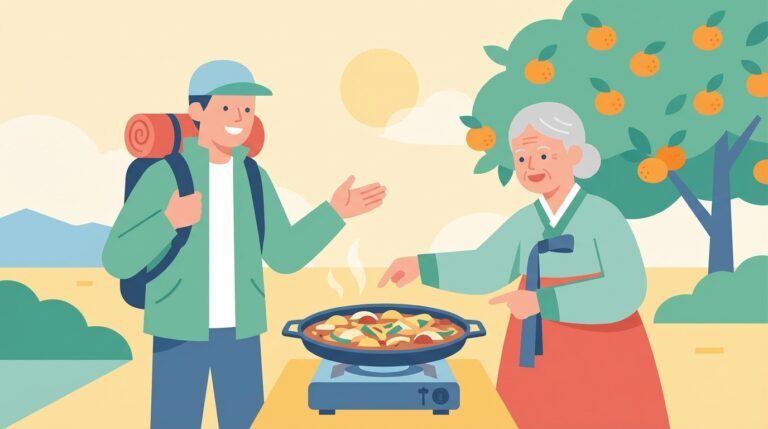
Phase 1: 공감 — 몰입형 오프닝 (Immersive Hook)
Hello, everyone! I’m your Lead Editor at Daily Hangul.
Picture this: You are watching a hit K-Drama like Our Blues or Welcome to Samdal-ri, set on the breathtaking Jeju Island. You’ve been studying Korean hard, feeling confident. The screen shows a local grandmother talking to the main character. But wait… you don’t understand a single word. Even the mainland Korean character on screen looks completely lost, and suddenly, Korean subtitles pop up for the Korean audience!
Did your textbook lie to you? Not at all! You’ve just encountered 제주어 (Jeju-eo), the Jeju Island dialect.
Because of its geographical isolation from the mainland, Jeju dialect preserved many Middle Korean words and developed a completely unique grammar structure. If standard Korean is like British English, Jeju dialect is like a thick Scottish brogue—charming, deeply historic, and notoriously difficult for outsiders to understand.
In this guide, we won’t ask you to become fluent in Jeju dialect (even mainlanders can’t do that!). But knowing a few key phrases will not only stop you from panicking in a Jeju Black Pork restaurant but will also earn you the biggest, warmest smiles from the locals. Let’s dive in! This guide is entirely based on real questions from students who traveled to Jeju and thought they forgot all their Korean.
Phase 2: 핵심 표현 심층 분석 (Deep Dive)
Let’s break down the most iconic Jeju expressions you will hear during your travels or in your favorite K-Dramas.
1. 혼저옵서예 (Honjeo-opseoye)
- Pronunciation: [hon-jeo-op-seo-ye] (Sounds a bit like ‘hone-juh-op-suh-yeh’. The ‘eo’ sounds like the ‘u’ in ‘uh-oh’.)
- Meaning:
- Literal interpretation by mainlanders: “Come alone!” (혼자 오세요)
- Real Jeju meaning: “Welcome!” (어서 오세요)
- K-Culture Moment: You land at Jeju International Airport. The very first thing you see is a giant sign reading “혼저옵서예!” You might panic and think, “Wait, I brought my family! Am I supposed to enter alone?” Don’t worry, it’s just their warm way of saying “Welcome!”
- Editor’s Insight: This is the undisputed king of Jeju phrases. It sounds misleadingly similar to the standard Korean words for “alone” (혼자) and “come” (오세요). It’s spoken with a welcoming, bright tone, often by restaurant owners and tour guides.
- Situation Spectrum:
[🚫 절대 금지] ———— [⚠️ 주의] ———— [✅ 자유롭게]
- Friends (Casual): ⚠️ (It’s usually used by hosts to guests, not casually among friends)
- Stores/Restaurants (Semi-formal): ✅ (Perfect to recognize when a shop owner says it to you!)
- Boss/Elders (Formal): 🚫 (As a foreigner, you don’t need to say this to an elder, just smile and say 안녕하세요)
- 🤔 Think About It: Why do tourist destinations often greet visitors in their local dialect rather than the standard language? What feeling does “Honjeo-opseoye” give you compared to the standard “Eoseo-oseyo”?
2. 고맙수다 / 반갑수다 (Gomapsuda / Bangapsuda)
- Pronunciation: [go-map-su-da] / [ban-gap-su-da]
- Meaning:
- Literal: Thank you / Nice to meet you.
- Real nuance: A hearty, folksy way of expressing gratitude or greeting.
- K-Culture Moment: In K-Dramas featuring Haenyeo (Jeju’s famous female divers), after a long day of diving for abalone, they share their catch and say “고생했수다~” (Good job/You worked hard).
- Editor’s Insight: Notice the “~수다/우다 (~suda/uda)” ending? That’s the signature sound of Jeju formal speech! Where standard Korean uses “~습니다 (~seumnida)”, Jeju uses “~수다”. It sounds earthy, robust, and full of affection.
- Situation Spectrum:
[🚫 절대 금지] ———— [⚠️ 주의] ———— [✅ 자유롭게]
- Friends (Casual): 🚫 (Too formal/old-fashioned for young friends)
- Elderly Locals/Market vendors: ✅ (They will absolutely love it if you say 고맙수다 instead of 감사합니다!)
- 🤔 Think About It: Standard Korean “~습니다” sounds very polite and slightly rigid, like a crisp suit. “~수다” feels like a warm, hand-knit sweater. Does your native language have regional accents that sound “warmer” than the standard version?
3. 무사? (Musa?)
- Pronunciation: [mu-sa] (Sounds exactly like ‘moo-sah’.)
- Meaning:
- Mainland meaning: Warrior (무사 ⚔️)
- Real Jeju meaning: Why? (왜?)
- K-Culture Moment: In tense K-Drama scenes set in Jeju, characters might start arguing: “무사 겅 햄수과!?” (Why are you doing that?!). Mainlanders watching might wonder why they are suddenly talking about warriors!
- Editor’s Insight: This is a perfect example of a word completely disconnected from modern standard Korean. If a local friend looks at you and asks “무사?”, they just want to know “Why?”, not asking if you brought a sword.
- Situation Spectrum:
[🚫 절대 금지] ———— [⚠️ 주의] ———— [✅ 자유롭게]
- Close Jeju Friends: ✅
- Business meetings in Seoul: 🚫 (They will be extremely confused)
- 🤔 Think About It: Island cultures often preserve ancient vocabulary because they are separated from the mainland’s rapid linguistic changes. Is there an isolated region in your country with ancient words still in use?
Phase 3: 교과서 vs 진짜 한국어 (Textbook vs Real Life)
Let’s compare what you studied in your B2 textbook with what you’ll actually hear in a Jeju traditional market.
| 상황 (Situation) | 📖 교과서 한국어 (Textbook) | 🗣️ 제주 진짜 한국어 (Jeju Local) | 💡 왜 다를까? (Why the difference?) |
|---|---|---|---|
| Welcoming a guest | 어서 오세요 (Eoseo oseyo) | 혼저옵서예 (Honjeo-opseoye) | ‘혼저’ meant ‘quickly/early’ in Middle Korean, preserved only in Jeju. |
| Saying “Thank you” | 감사합니다 (Gamsahamnida) | 고맙수다 (Gomapsuda) | Jeju uses the ~수다/우다 ending for polite declarations instead of ~습니다. |
| Asking “Why?” | 왜 그래요? (Wae geuraeyo?) | 무사 경 햄수과? (Musa gyeong haemsugwa?) | Completely different vocabulary root preserved from isolation. |
| Eating deliciously | 맛있게 드세요 (Masitge deuseyo) | 많이 먹읍서 (Hayeong meogeupseo) | ‘하영(Hayeong)’ means ‘a lot’ in Jeju dialect. Island hospitality focuses on abundance! |
Bottom Note for B2 Learners: You don’t need to speak these perfectly. Recognizing them is enough to boost your listening comprehension and cultural appreciation!
Phase 4: 문화적 맥락 — K-Culture 딥다이브 (Cultural Deep Dive)
4-1. 비언어적 요소 (Non-verbal Communication: The Jeju Vibe)
Jeju dialect isn’t just about vocabulary; it’s about the delivery. Standard Seoul Korean tends to be rising, polite, and sometimes a bit fast-paced. Jeju dialect often sounds flatter, more robust, and deeply grounded.
When an elderly Jeju restaurant owner speaks to you in dialect, they might not make intense eye contact, but they will likely pile side dishes (반찬) onto your table. That gesture of giving food is their version of Nunchi (눈치)—reading that you must be hungry after traveling and showing affection through action, not just words.
4-2. K-Culture 연결 고리: The Drama & Travel Connection
K-Drama: Have you noticed that in K-Dramas set in Jeju (like Warm and Cozy or Our Blues), there is a distinct difference between the “mainland characters” who speak standard Seoul Korean and the “local characters”? Dramas use dialect to instantly establish a character’s authenticity, stubbornness, or deep connection to nature. Interestingly, actors often spend months with local coaches because the intonation is incredibly hard to master!
K-Travel & K-Food: When you visit a 흑돼지 (Black Pork) BBQ restaurant in Jeju, the dialect is part of the ambiance. The sizzling of the thick meat on a charcoal grill, the smell of the ocean, and the cheerful “고맙수다!” from the staff create a fully immersive cultural experience.
Phase 5: 실전 롤플레이 시나리오 (Immersive Roleplay)
시나리오 A: 메인 롤플레이 (The Black Pork Feast)
- Setting: Friday night, 7:30 PM. A bustling Black Pork (흑돼지) BBQ restaurant in Seogwipo, Jeju. Smoke fills the air, and K-Pop plays faintly in the background.
- Characters:
- YOU: An intermediate Korean learner traveling to Jeju for the first time.
- Min-su (30): Your Korean friend from Seoul who invited you. He knows standard Korean but struggles with Jeju dialect.
- Grandma Owner (70s): The warm, energetic owner of the restaurant.
Min-su: 여기요! 흑돼지 2인분 주세요~ 🥩
(Yeogiyo! Heukdwaeji i-inbun juseyo~)
[Excuse me! Two servings of black pork, please~]
Grandma Owner: (Bringing the meat) 아이고, 혼저옵서예! 삼춘, 하영 먹읍서!
(Aigo, honjeo-opseoye! Samchun, hayeong meogeupseo!)
[Oh my, welcome! Folks, eat a lot!]
(🎭 Stage Direction: Min-su looks slightly confused at the dialect, while the grandma starts grilling the thick pork belly for you)
Min-su: (Whispering to you) Did she just call me ‘Samchun’ (uncle)? I’m 30!
YOU: Wait, I think I read about this on Daily Hangul… In Jeju, ‘Samchun’ is used for any adult neighbor or friendly stranger, regardless of gender or exact relation!
Grandma Owner: (Piling grilled meat onto your plate) 맛 좋수다! 경 허지 말고 하영 먹으라~
(Mat jotsuda! Gyeong heoji malgo hayeong meogeura~)
[It’s delicious! Don’t be shy and eat a lot~]
🔀 당신의 차례! 어떻게 대답할까요? (Your Turn! How will you respond?)
– A) “네, 감사합니다!” (Ne, gamsahamnida!) – Standard and safe.
– B) “무사?” (Musa?) – Confused and mildly aggressive.
– C) “아이고, 고맙수다! 잘 먹겠습니다~” (Aigo, gomapsuda! Jal meokgetseumnida~)✅ Best Choice: C — Blending a standard “I will eat well” with the Jeju “Gomapsuda” is the ultimate charm offensive. The grandma will likely give you extra drinks on the house (서비스)!
⚠️ Choice B Analysis: Saying “Why?” when someone tells you to eat a lot sounds very strange and a bit rude in this context!
시나리오 B: K-Culture 보너스 롤플레이 (The Taxi Ride)
- Setting: Inside a Jeju taxi heading to a beautiful beach cafe.
- Taxi Driver: 학생, 제주도는 처음이우과? 경치 참 좋수다.
(Haksaeng, Jejudoneun cheoeumiugwa? Gyeongchi cham jotsuda.)
[Student, is it your first time in Jeju? The scenery is really nice.] - YOU: 네! 제주도 너무 예뻐요.
(Ne! Jejudo neomu yeppeoyo.)
[Yes! Jeju is so pretty.] - Taxi Driver: 하영 봅서예~
(Hayeong bopseo-ye~)
[Look around a lot / Enjoy the sights~] - YOU: (Smiling and looking out the window) 네, 감사합니다!
Phase 6: 10초 섀도잉 드릴 (Shadowing Drill)
Practice making it sound natural! Pay attention to the pauses (/) and the mood.
😊 아이고~ / 혼저옵서예! / 하영 / 먹읍서!
(Aigo~ / honjeo-opseoye! / ha-yeong / meogeupseo!)
[Oh my~ Welcome! Eat a lot!]
Tip: Deliver “아이고” with a deep breath, and make “하영” sound warm and generous.
Phase 7: K-Culture 미니 사전 (K-Culture Glossary)
| 한국어 (Korean) | Romanization | Meaning | 맥락 설명 (Context) |
|---|---|---|---|
| 사투리 / 방언 | saturi / bangeon | Dialect | The regional variations of the Korean language. |
| 흑돼지 | heukdwaeji | Black Pork | Jeju’s most famous culinary export. A must-eat! |
| 해녀 | haenyeo | Sea Women | Jeju’s legendary female divers who catch seafood without oxygen tanks. |
| 삼춘 | samchun | Uncle (Standard) / Neighbor (Jeju) | In Jeju, a gender-neutral term of endearment for any adult you feel friendly toward. |
| 귤 / 감귤 | gyul / gamgyul | Tangerine / Mandarin | Jeju is covered in tangerine farms. Locals often give them away for free in winter. |
Phase 8: 여행자 서바이벌 키트 (Traveler’s Survival Kit)
Are you heading to Jeju soon? You don’t need to speak the dialect perfectly, but you do need to know how to navigate the island!
🆘 서바이벌 표현 (Survival Phrases for Jeju)
– 🇰🇷 “(표준어로) 말씀해 주실 수 있나요?” (Pyojuneoro malsseumhae jusil su innayo?)
– 🗣️ Meaning: Could you please speak in standard Korean?
– 📍 Where to use: When a local speaks pure Jeju dialect and you are completely lost.
– 💡 Pro Tip: Don’t panic! 100% of Jeju residents understand and can speak standard Seoul Korean. If you look confused, they will naturally switch for you.📌 Editor’s Travel Note: Jeju Edition
– Transportation: Unlike Seoul, the subway does not exist in Jeju. You will rely on buses (which can be slow) or Kakao T (Taxis). Renting a car is the best option if you have an international license.
– Cafes & Tipping: Jeju has some of the most aesthetic ocean-view cafes in the world. Remember, even if the service is amazing, there is no tipping culture in Korea. Simply saying “고맙수다” or “감사합니다” with a smile is the best tip you can give!
– Weather: It’s very windy! Be prepared for sudden rain or strong coastal winds.
Phase 9: 비판적 사고 코너 — “한 발 더 깊이” (Think Deeper)
🧠 Think Deeper: 언어와 지리 (Geography and Language)
Have you ever wondered why Jeju dialect is so incredibly different from standard Korean? It comes down to geography and isolation. During the Joseon Dynasty, traveling from the mainland to Jeju across the rough seas was dangerous and rare. While the mainland’s language rapidly evolved through contact with neighboring countries and modern changes, Jeju became a linguistic time capsule. They preserved words from the 15th-century Middle Korean! Today, UNESCO classifies the Jeju language as “Critically Endangered.” The young generation mostly uses standard Korean mixed with Jeju intonation.💬 Your Turn: Does your country have an island or isolated region where the language is completely different from the mainland? How are people trying to preserve it? Share in the comments!
Phase 10: FAQ & 오해 방지 (Troubleshooting)
Q: Do I have to speak Jeju dialect when I visit Jeju Island?
No, absolutely not! Locals actually find it very cute and surprising when foreigners try it, but standard Korean is perfectly fine. Think of using dialect as a “bonus” to show your cultural appreciation.
Q: If I use Jeju dialect in Seoul, will people think I’m cool?
They will mostly just be very confused! Unless you are quoting a K-Drama or specifically talking about Jeju, it’s better to stick to standard Korean in Seoul.
❌ 흔한 실수 #1 (Common Mistake): Taking “혼저옵서예” literally.
We said it before, but we’ll say it again. Do not tell your friends to wait outside because the sign says “Come alone” (혼자). It just means “Welcome!”❌ 흔한 실수 #2 (Common Mistake): Assuming “Samchun (삼춘)” means the speaker is actually their uncle.
In standard Korean, ‘삼촌’ refers strictly to a relative. In Jeju, ‘삼춘’ is a friendly term for an older neighbor, regardless of whether they are a man or a woman.
Phase 11: 요약 및 액션 아이템 (Wrap-up)
One-Liner Summary: Jeju dialect is a warm, historically rich linguistic treasure; mastering just a few phrases like “혼저옵서예” and “고맙수다” will unlock the true hospitality of the island.
Action Mission:
– 🥉 Bronze (Solo): Say “아이고, 고맙수다!” out loud three times, channeling your inner Jeju grandma.
– 🥈 Silver (Online): Find a YouTube video of the K-Drama Our Blues and listen to the difference in how the actors speak compared to standard K-Dramas.
– 🥇 Gold (Real Life): If you visit a Korean restaurant, playfully ask a Korean friend if they know what “Musa? (무사?)” means in Jeju dialect!
🌴 K-Culture Mission:
Next time you eat Korean BBQ (especially if you find a Black Pork place!), imagine you are sitting by the windy coast of Jeju Island. Mentally practice saying “하영 먹읍서!” to your friends before you start eating!
Phase 12: 퀴즈 — 인터랙티브 챌린지 (Interactive Quiz)
1. 상황 판단 문제 (Situational Judgment):
You enter a lovely cafe in Jeju Island, and the owner smiles and says “혼저옵서예!” What should you do?
– A) Leave your friend outside and enter alone.
– B) Smile back and say “안녕하세요!”
– C) Ask them why they are rushing you.
(Answer: B! It means Welcome, so a standard greeting in return is perfect.)
2. True or False — K-Culture Edition:
– Jeju’s dialect uses “~수다” (~suda) to make sentences formal, replacing the standard “~습니다” (~seumnida). (T / F)
(Answer: True! 고맙수다, 반갑수다 are prime examples.)
3. 빈칸 채우기 (Fill in the Blank):
If you want to thank the restaurant owner in Jeju dialect, you can say: “정말 ________!”
(Answer: 고맙수다)
How did you do? Are you ready to book your ticket to Jeju Island? Let us know in the comments below which Jeju word was your favorite! ✈️🍊
Frequently Asked Questions (FAQ)
Q: What does "혼저옵서예 (Honjeo-opseoye)" mean in Korean and how do you pronounce it?
A: In Korean, "혼저옵서예 (Honjeo-opseoye)" is pronounced [hon-jeo-op-seo-ye] and means: Literal interpretation by mainlanders: "Come alone!" (혼자 오세요)
Q: What does "고맙수다 / 반갑수다 (Gomapsuda / Bangapsuda)" mean in Korean and how do you pronounce it?
A: In Korean, "고맙수다 / 반갑수다 (Gomapsuda / Bangapsuda)" is pronounced [go-map-su-da] and means: Literal: Thank you / Nice to meet you.
Q: What does "무사? (Musa?)" mean in Korean and how do you pronounce it?
A: In Korean, "무사? (Musa?)" is pronounced [mu-sa] and means: Mainland meaning: Warrior (무사 ⚔️)







