

Phase 1: 공감 — 몰입형 오프닝 (Immersive Hook)
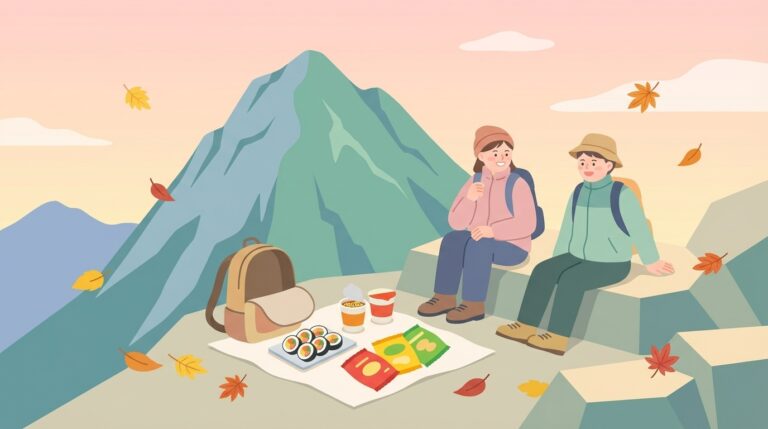
Hello! I’m your Daily Hangul Editor. Picture this: You’re watching a classic office K-Drama. It’s Saturday morning. Instead of sleeping in, the strict CEO has dragged his entirely unenthusiastic team up a steep mountain. They reach the peak, exhausted and out of breath. But then, a magical transformation happens. Out of their heavily packed bags comes a full-blown feast—kimbap, cherry tomatoes, sliced cucumbers, and the holy grail: steaming cup noodles prepared with water carried in a heavy thermos.
Wait, why are they eating a three-course meal at 800 meters above sea level instead of just grabbing a protein bar?
In Korea, hiking (등산) isn’t just a cardiovascular workout; it’s a profound cultural and culinary expedition. If you ever hike Bukhansan or Seoraksan, you’ll inevitably encounter older hikers in dazzling, neon-colored outdoor gear who might suddenly offer you a handful of cherry tomatoes. If you only know textbook Korean, you might just nod awkwardly. But if you master the C1-level vocabulary surrounding 산행 도시락 (mountain packed lunches) and 행동식 (trail snacks), you won’t just survive the hike—you’ll become a true insider who understands the soul of the Korean mountain feast. This guide is built from the real experiences of expats who survived weekend hikes with their Korean in-laws or coworkers. Let’s dive in!
Phase 2: 핵심 표현 심층 분석 (Deep Dive)
Here are the top three advanced expressions you need to master Korean mountain snacking culture.
1. 당 떨어지네요. 행동식 좀 먹을까요?
- Pronunciation: dang tteoreojineyo. haengdongsik jom meogeulkkayo? (dang sounds like the English word ‘dang!’)
- Meaning:
- Literal: My blood sugar is dropping. Shall we eat some rations?
- Real nuance: I’m totally exhausted and need an energy boost right now. Let’s have some trail snacks.
- K-Culture Moment: You’re halfway up the mountain, panting. A Korean friend wipes their sweat, sighs, and says “당 떨어지네요.” It’s the ultimate green light to bust out the chocolate. ‘당 떨어지다’ is a ubiquitous slang used anytime someone is mentally or physically drained (even at the office!). ‘행동식’ (literally “action food”) is the specific, slightly professional term hikers use for trail snacks.
- Editor’s Insight: Using ‘행동식’ instead of just ‘간식’ (snack) instantly elevates your Korean to an advanced, outdoorsy level. It shows you know your hiking culture.
- Situation Spectrum:
[🚫 절대 금지] ———— [⚠️ 주의] ———— [✅ 자유롭게]- Casual (Friends): ✅
- Semi-formal (Coworkers): ✅
- Formal (Boss/Elders): ✅ (It shows you are looking out for their health!)
- 🤔 Think About It: Why is “blood sugar dropping” such a common phrase in modern Korean society, extending far beyond hiking? Does your culture have a medical term that became casual slang for exhaustion?
2. 요기 좀 할까요?
- Pronunciation: yogi jom halkkayo? (yo-gee sounds just like Yogi Bear)
- Meaning:
- Literal & Real nuance: Shall we have a quick bite to stave off hunger?
- K-Culture Moment: The group stops at a scenic rock. It’s not quite lunchtime, but stomachs are rumbling. Someone suggests, “요기 좀 할까요?”
- Editor’s Insight: ‘요기(하다)’ is a beautifully nuanced, advanced vocabulary word. It means eating just enough to kill the hunger, not a full meal. It sounds much more sophisticated than just saying “밥 먹읍시다” (Let’s eat food).
- Situation Spectrum:
[🚫 절대 금지] ———— [⚠️ 주의] ———— [✅ 자유롭게]- Casual (Friends): ✅
- Semi-formal (Coworkers): ✅
- Formal (Boss/Elders): ✅ (Very polite and considerate to ask elders if they need to ‘요기하다’).
- 🤔 Think About It: Korean has dozens of words for the act of eating depending on the volume, time, and social context (식사, 간식, 요기, 참, 야식). What does this tell us about the importance of food in Korean daily life?
3. 산에서 먹는 컵라면이 국룰이죠.
- Pronunciation: saneseo meongneun keomnamyeoni gungnurijyo.
- Meaning:
- Literal: Cup noodles eaten on the mountain are the national rule.
- Real nuance: Eating cup noodles on the mountain is the absolute best/unwritten rule that everyone agrees on.
- K-Culture Moment: You reach the summit. While foreigners might sip water, Koreans are opening thermoses to pour boiling water into Shin Ramyun cups. If you declare this phrase while holding your noodles, the locals will practically adopt you.
- Editor’s Insight: ‘국룰’ (국민 Rule -> National Rule) is a trendy slang term used to describe a universally accepted truth or unspoken social norm in Korea.
- Situation Spectrum:
[🚫 절대 금지] ———— [⚠️ 주의] ———— [✅ 자유롭게]- Casual (Friends): ✅
- Semi-formal (Coworkers): ✅
- Formal (Boss/Elders): ⚠️ (Older generations might not fully grasp the slang ‘국룰’, though they’ll understand the sentiment).
Phase 3: 교과서 vs 진짜 한국어 (Textbook vs Real Life)
| 상황 | 📖 교과서 한국어 | 🗣️ 진짜 한국어 | 💡 왜 다를까? |
|---|---|---|---|
| Tired & hungry on the trail | 너무 피곤해요. 간식 먹읍시다. | 아, 당 떨어지네요. 초코바 하나 할까요? | Koreans love describing fatigue through physical symptoms (‘blood sugar dropping’). |
| Reaching the peak | 이제 정상에서 점심을 먹겠습니다. | 정상 찍었으니까 컵라면 물 올릴게요. | “Boiling water for noodles” (물 올리다) implies the meal is about to start. ‘찍다’ (to stamp) is slang for reaching a destination. |
| Handing out food | 이것 좀 드세요. | 오이 좀 싸왔는데, 하나 드실래요? | Specifying the food (cucumbers/오이 are hiking staples for hydration) and downplaying the effort (‘싸왔는데’). |
Bottom Note: At the C1 level, your goal is to move away from robotic textbook phrases. Using words like ‘물 올리다’ (putting water on the boil) or ‘당 떨어지다’ instantly bridges the gap between a language learner and a cultural participant.
Phase 4: 문화적 맥락 — K-Culture 딥다이브 (Cultural Deep Dive)
4-1. 비언어적 요소 (Non-verbal Communication)
In Korea, hiking isn’t a solitary sport—it’s highly communal. If an older hiker offers you a cherry tomato or a piece of kimbap, receive it with two hands or with your right hand supported by your left. This is standard Korean etiquette, but on the mountain, it’s mixed with the concept of ‘Jeong’ (정 – unspoken affection).
Nunchi (눈치) on the mountain: If you’re hiking with your boss, your ‘nunchi’ should be on high alert. When they sit down, that’s your cue to unpack the trail snacks (행동식) and offer them first.
4-2. K-Culture 연결 고리 (K-Culture Connection)
K-Drama Tropes & Office Politics:
Have you ever noticed in dramas like My Mister or Misaeng how the characters end up at a local mountain (usually wearing thousands of dollars worth of pristine outdoor gear)? The “Company Weekend Hike” (주말 등산) is a infamous aspect of Korean corporate culture. It’s meant to build teamwork, but younger employees often dread it. If you ever find yourself in this situation, carrying the heavy thermos of hot water for your senior’s cup noodles is considered the ultimate display of dedication.
K-Food – The Mountain Menu:
Why cucumbers (오이)? They are 95% water and come in their own biodegradable wrapper! Along with kimbap and cherry tomatoes, they are the holy trinity of Korean hiking snacks. It’s all about high-efficiency hydration and sharing.
Phase 5: 실전 롤플레이 시나리오 (Immersive Roleplay)
시나리오 A: 메인 롤플레이 (The Summit Feast)
Setting: Saturday morning, 11:30 AM. You are near the Baegundae peak of Bukhansan. The autumn leaves are stunning. You are hiking with your Korean coworker, Minsu.
Characters:
– YOU: An expat working in Seoul, trying to survive your first Korean mountain hike.
– Minsu (32): Your friendly, slightly overly energetic Korean coworker who brought a huge backpack.
Minsu: 아, 진짜 힘들다! 정상까지 거의 다 왔어요.
(A, jinjja himdeulda! Jeongsangkkaji geoui da wasseoyo.)
[Ah, this is really hard! We’re almost at the peak.]
YOU: 다리가 후들거리네요. 경치는 진짜 좋은데…
(Dariga hudeulgeorineyo. Gyeongchineun jinjja joeunde…)
[My legs are shaking. The view is really nice though…]
Minsu: (Sits on a large flat rock and swings his heavy bag off) 안 되겠다. 나 당 떨어져서 쓰러질 것 같아요. 우리 여기서 요기 좀 하고 갈까요?
(An doegetda. Na dang tteoreojyeoseo sseureojil geot gatayo. Uri yeogiseo yogi jom hago galkkayo?)
[I can’t take it. I feel like I’m going to collapse because my blood sugar is dropping. Shall we have a quick bite here before we keep going?]
YOU: 좋아요! 저도 행동식 좀 챙겨왔어요. 에너지바 드실래요?
(Joayo! Jeodo haengdongsik jom chaenggyeowasseoyo. Eneojiba deusillaeyo?)
[Sounds good! I brought some trail snacks too. Would you like an energy bar?]
Minsu: 오, 센스 대박! 감사합니다. (Pulls out a massive Tupperware container) 저는 엄마가 싸준 김밥이랑 오이 가져왔어요. 좀 드실래요?
(O, senseu daebak! Gamsahamnida. Jeoneun eommaga ssajun gimbabirang oi gajyeowasseoyo. Jom deusillaeyo?)
[Oh, great sense! Thanks. I brought kimbap and cucumbers my mom packed. Do you want some?]
🔀 당신의 차례! 어떻게 대답할까요? (Your Turn! How will you respond?)
– A) “아니요, 괜찮습니다. 제 에너지바 먹을게요.” (No, it’s okay. I’ll eat my energy bar.)
– B) “우와, 어머님표 김밥! 진짜 맛있겠네요. 잘 먹겠습니다!” (Wow, your mom’s kimbap! That looks so good. I will eat well!)
– C) “저도 하나 사올걸 그랬네요. 너무 미안해서 못 먹겠어요.” (I should have bought one too. I feel too sorry to eat it.)✅ Best Choice: B — Reason: In Korea, sharing food is the ultimate sign of bonding. Enthusiastically accepting homemade food with “잘 먹겠습니다” (I will eat well) is the best way to show appreciation.
⚠️ Choice A & C 분석: Refusing food outright (A) can be seen as rejecting their ‘Jeong’ (affection). Being overly apologetic (C) makes the situation slightly uncomfortable.
시나리오 B: K-Culture 보너스 롤플레이 (The Ahjumma Encounter)
Setting: You are resting by the trail. A group of older Korean women (Ahjummas) in matching bright pink windbreakers sits next to you.
Ahjumma: 학생~ 외국인이야? 한국말 할 줄 알아? 이거 방울토마토 좀 먹고 해.
(Haksaeng~ oeguginiya? Hangungmal hal jul ara? Igeo bangultomato jom meokgo hae.)
[Student~ Are you a foreigner? Can you speak Korean? Eat some of these cherry tomatoes while you rest.]
YOU: (Receiving with two hands) 아, 감사합니다! 너무 예쁘게 싸오셨네요. 잘 먹겠습니다.
(A, gamsahamnida! Neomu yeppeuge ssaosyenneyo. Jal meokgetseumnida.)
[Ah, thank you! You packed them so beautifully. I will eat well.]
Ahjumma: 어머, 한국말 진짜 잘하네! 당 떨어질 땐 과일이 최고야~
(Eomeo, hangungmal jinjja jalhane! Dang tteoreojil ttaen gwairi choegoya~)
[Oh my, you speak Korean so well! Fruit is the best when your blood sugar is dropping~]
Phase 6: 10초 섀도잉 드릴 (Shadowing Drill)
Let’s practice advanced intonation. Emphasize the slashes (/) for natural pausing.
😫 아, / 다리 아파요. / 나 당 떨어지는데, / 행동식 좀 / 먹고 갈까요?
(a, / dari apayo. / na dang tteoreojineunde, / haengdongsik jom / meokgo galkkayo?)
[Emotion: Exhausted but hopeful 🥺]
Editor’s Tip: Drag out the ‘아~’ (Ah~) at the beginning to sound truly tired. Put the stress on ‘당’ (dang) to emphasize your need for sugar!
Phase 7: K-Culture 미니 사전 (K-Culture Glossary)
| 한국어 | Romanization | 영어 | 맥락 설명 |
|---|---|---|---|
| 행동식 | haengdongsik | Trail snacks / Rations | Professional/outdoorsy term for snacks eaten while moving or resting briefly. |
| 산악회 | sanakhoe | Hiking club | Social clubs usually for middle-aged/older Koreans. Famous for their colorful gear, group meals, and loud bonding. |
| 정상석 | jeongsangseok | Summit stone | The large stone monument at the top of a mountain. Taking a photo hugging it is mandatory (‘국룰’). |
| 국룰 | gungnul | Unwritten rule | Slang combining 국민 (Nation) + Rule. The universally agreed-upon standard (e.g., Cup noodles at the peak). |
| 뒷풀이 | dwitpuri | After-party | The heavy meal and drinking session (usually Makgeolli and Jeon) AFTER the hike at the base of the mountain. |
Phase 8: 여행자 서바이벌 키트 (Traveler’s Survival Kit)
Before hitting the trail, you’ll likely stop at a convenience store (편의점) at the base of the mountain to buy your 행동식 (trail snacks).
🆘 서바이벌 표현 TOP 3 (At the Convenience Store)
– 🇰🇷 “이거 2+1 (투플러스원) 교차 지원 되나요?” (igeo tu-peulleoseu-won gyocha jiwon doenayo?)
– 🗣️ Meaning: “Can I mix and match flavors for this 2-for-1 deal?”
– 📍 Where to use: Buying energy bars or sports drinks.
– 🇰🇷 “뜨거운 물은 어디서 받나요?” (tteugeoun mureun eodiseo bannayo?)
– 🗣️ Meaning: “Where can I get hot water?”
– 📍 Where to use: If you plan to carry hot water in a thermos for your peak cup noodles.
– 🇰🇷 “종량제 봉투 제일 작은 거 하나 주세요.” (jongnyangje bongtu jeil jageun geo hana juseyo.)
– 🗣️ Meaning: “Please give me one of the smallest official garbage bags.”
– 💡 Pro Tip: There are NO trash cans on Korean mountains. You must pack out what you pack in. Buying a small garbage bag in advance is an absolute pro move!📌 Editor’s Travel Note
– Navigating the Trails: Google Maps is notoriously bad for hiking trails in Korea. Use KakaoMap or Naver Map, and look for the trails marked with dotted lines.
– Mountain Base Cuisine: Don’t eat too much on the peak! Save room for the 뒷풀이 (after-party) at the restaurants clustered at the mountain base. Seafood green onion pancakes (해물파전) and Makgeolli (막걸리) are the true reward.
Phase 9: 비판적 사고 코너 — “한 발 더 깊이” (Think Deeper)
음식과 정체성 (Food & Identity): The Korean Mountain Feast
🧠 Think Deeper:
Have you ever wondered why Koreans carry heavy thermoses, complex side dishes, and whole cucumbers up a steep mountain, instead of just lightweight, high-calorie energy bars? In Korean culture, dining is fundamentally a communal activity—a way to build and reinforce Jeong (정, emotional connection). A meal isn’t just fuel for the body; it’s social glue. Sharing food at the summit is a ritual of mutual care. The effort of carrying heavy food to share with others proves your dedication to the group.💬 Your Turn: Does your culture view outdoor/sports food strictly as functional “fuel,” or is there a communal ritual attached to it? Share your thoughts in the comments!
Phase 10: FAQ & 오해 방지 (Troubleshooting)
- Q: I’ve seen older men drinking Makgeolli (rice wine) on the mountain. Can I bring alcohol?
- Editor’s Answer: No! While it used to be a huge part of the hiking culture, drinking alcohol is now strictly prohibited in national and provincial parks (like Bukhansan or Seoraksan) for safety reasons. You can get a hefty fine. Save the Makgeolli for the 뒷풀이 at the restaurants down below!
- Q: Is it okay to refuse food from an older hiker if I’m not hungry?
- Editor’s Answer: Yes, but do it politely. Instead of a flat “No,” say: “아, 방금 요기를 해서 배가 부르네요. 마음만 감사히 받겠습니다.” (Ah, I just had a bite so I’m full. I gratefully accept the thought.)
❌ 흔한 실수 (Common Mistake): Leaving your trash at the resting spot or burying food waste (like fruit peels) in the dirt.
✅ 이렇게 하세요: Korea has a strict “Leave No Trace” culture on mountains. Even biodegradable items like banana peels disrupt the local ecosystem. Put all your trash in a bag and take it back to the city.
Phase 11: 요약 및 액션 아이템 (Wrap-up)
- One-Liner Summary: Surviving a Korean mountain isn’t just about stamina; it’s about sharing your haengdongsik (행동식) and enjoying the communal summit feast!
Action Mission 3단계:
– 🥉 Bronze: Stand up, stretch, sigh heavily, and say “아~ 당 떨어지네요. 요기 좀 할까요?” three times to yourself.
– 🥈 Silver: Go to a Korean language forum/community and write a short post: “주말에 등산 갈 건데, 행동식으로 뭐가 좋을까요?” (I’m going hiking this weekend, what would be good for trail snacks?)
– 🥇 Gold: Next time you are doing a physical activity with Korean friends or coworkers, actually pack some extra snacks and offer them using today’s phrases!
🎒 K-Culture Mission:
Open YouTube and search “한국 등산 브이로그” (Korean hiking vlog). Watch how many times they stop to eat, and try to spot the moment they say “당 떨어진다” or pull out a cucumber/cup noodles!
Phase 12: 퀴즈 — 인터랙티브 챌린지 (Interactive Quiz)
1. [상황 판단] You are hiking with your Korean boss. He stops, breathing heavily, and looks tired. What is the most culturally appropriate thing to say?
– A) 부장님, 빨리 가요! (Boss, let’s go fast!)
– B) 부장님, 당 떨어지시죠? 행동식 좀 챙겨 드세요. (Boss, your blood sugar is dropping, right? Have some trail snacks.)
– C) 부장님, 산에서는 컵라면이 국룰이죠. (Boss, cup noodles on the mountain are the national rule.)
2. [True or False] It is a highly respected and legal tradition to drink Makgeolli right at the summit of a National Park mountain.
3. [빈칸 채우기] A: 배고픈데 우리 밥 먹을까요?
B: 아직 식당 가려면 멀었으니까, 여기서 간단하게 ( ______ ) 좀 할까요?
Toggle below for answers!
정답 확인하기 (Click to reveal)
1. 정답: B. Offering a trail snack out of concern for his energy (‘당 떨어지다’) is polite and shows great nunchi. (A is rude, and C uses slang ‘국룰’ which might be too casual for a boss).
2. 정답: False. It is illegal and dangerous to drink alcohol on National Park mountains. Save it for the restaurants at the bottom!
3. 정답: 요기. ‘요기(하다)’ is the perfect advanced word for having a light bite to stave off hunger.
Frequently Asked Questions (FAQ)
Q: What does "당 떨어지네요. 행동식 좀 먹을까요?" mean in Korean and how do you pronounce it?
A: In Korean, "당 떨어지네요. 행동식 좀 먹을까요?" is pronounced [dang tteoreojineyo. haengdongsik jom meogeulkkayo? (dang sounds like the English word 'dang!'] and means: Literal: My blood sugar is dropping. Shall we eat some rations?
Q: What does "요기 좀 할까요?" mean in Korean and how do you pronounce it?
A: In Korean, "요기 좀 할까요?" is pronounced [yogi jom halkkayo? (yo-gee sounds just like Yogi Bear] and means: Literal & Real nuance: Shall we have a quick bite to stave off hunger?
Q: What does "산에서 먹는 컵라면이 국룰이죠." mean in Korean and how do you pronounce it?
A: In Korean, "산에서 먹는 컵라면이 국룰이죠." is pronounced [saneseo meongneun keomnamyeoni gungnurijyo.] and means: Literal: Cup noodles eaten on the mountain are the national rule.







